Gehong Su,
Tao Zhou*,
Xifei Liu,
Jihai Zhang,
Jianjun Bao* and
Aiming Zhang
State Key Laboratory of Polymer Materials Engineering of China, Polymer Research Institute, Sichuan University, Chengdu 610065, China. E-mail: zhoutaopoly@scu.edu.cn; jjbao2000@sina.com; Fax: +86-28-85402465; Tel: +86-28-85402601
First published on 22nd September 2015
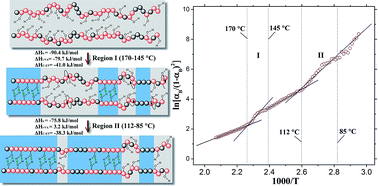
In this paper, quantitative spectroscopic evidence for the important role of hydrogen bonds during the cooling crystallization of poly(ethylene-co-vinyl alcohol) (EVOH) was successfully obtained. Furthermore, the detailed molecular movements during the crystallization of EVOH were revealed via two-dimensional correlation infrared spectroscopy. Two cooling crystallization processes were detected at 159 °C and around 101–105 °C via the combination of DSC and the newly proposed scaling-MW2D correlation FTIR spectroscopy. These two crystallization processes were defined as the primary crystallization (region I) and the secondary perfection process (region II) of EVOH. The methods for calculating the enthalpies of the pair-bonded hydrogen bonding (ΔHh), vinyl alcohol (VA) repeating unit crystallization (ΔHC-VA), VA repeating unit diffusion into the crystal lattice (ΔHl-VA), and ethylene (ET) repeating unit crystallization (ΔHC-ET) were established via van ’t Hoff plots. For regions I and II, the contributions of the pair-bonded hydrogen bonding of the VA repeating units to the entire EVOH crystallization were 42.8% (ΔHh = −90.4 ± 5.2 kJ mol−1) and 64.6% (ΔHh = −75.8 ± 3.1 kJ mol−1), respectively. However, the contributions of the ET crystallization to the EVOH crystallization were 19.4% (ΔHC-ET = −41.0 ± 2.0 kJ mol−1) and 32.7% (ΔHC-ET = −38.3 ± 0.8 kJ mol−1), which were only half of the contributions of the pair-bonded hydrogen bonding. 2D correlation analysis was used to investigate the sequential order of the groups’ movement in the crystallization. It was found that region I had 3 steps. The first step is the formation of the hydrogen bonds in the VA repeating unit, and the second step is the diffusion of the VA repeating unit into the crystal lattice, resulting in the primary crystallization. The third step is the ET repeating unit crystallization accompanied by the movement of the VA repeating unit without hydrogen bonding in the amorphous region. Region II had 4 steps. The first step is also the generation of the hydrogen bonds in the VA repeating unit. The second step is a local rearrangement of the lattice in the imperfect crystalline of the VA repeating unit, called the secondary perfection process. The third step is the movement of the VA repeating unit without hydrogen bonding in the amorphous region. The fourth step is the weak crystallization of the ET repeating unit at a low temperature.
In the past few decades, the crystallization behavior of EVOH copolymers has been extensively studied. It was proved that EVOH could form two types of crystals upon cooling from melts. These crystal types are orthorhombic and monoclinic when the content of VA comonomer is 0–40 mol% and 40–60 mol%, respectively.13,14 Cerrada reported that the orthorhombic crystal was generated for slowly crystallized samples.15 Lopez-Rubio investigated the influence of the cooling rate on the crystalline morphology of EVOH, and the formation of the orthorhombic crystal was also discovered at a high cooling speed.16 The orthorhombic crystal had a tendency to transform into the monoclinic crystal after an annealing treatment.16 It was reported that both ET and VA segments were incorporated into the crystal lattice during the crystallization process of EVOH, forming a mixed crystal. However, the capacity of the ET and VA segments diffusing into the lattice was different.13–16 The hydrogen bonds generated by the hydroxyl groups of the VA segments play an important role in the various properties of EVOH. Certainly, the crystallization behavior of EVOH is strongly influenced by the hydrogen bonds. However, the role of the hydrogen bonding in the crystallization process of EVOH has been unclear so far. Furthermore, quantitative evidence for the role of hydrogen bonding during EVOH crystallization is still lacking. So, an in depth understanding of the hydrogen bonding during EVOH crystallization will have great scientific and practical value.
Generalized two-dimensional (2D) correlation infrared spectroscopy was originally proposed by Noda in 1993,22 and has become a very important spectroscopy method. Due to the spreading of the spectral peaks over the second dimension, the spectral resolution of this method is significantly enhanced compared with 1D FTIR spectra.23 Thus, 2D correlation spectra can capture the information which is not obvious or is overlapping in the 1D spectra. In addition, the sequential order of the spectral variables can be easily obtained from the 2D correlation infrared spectra according to Noda’s rules. So, 2D correlation infrared spectroscopy can be conveniently used to investigate the detailed mechanism of a material’s transitions. In 2000, Thomas and Richardson proposed moving-window two-dimensional correlation spectroscopy (MW2D),24 which can be used to determine the transition temperature of a thermotropic liquid-crystal sample. MW2D can be directly applied to see the spectral correlation variation along both perturbation variable (e.g., temperature) and spectral variable (e.g., wavenumber) axes. After that, a similar method based on MW2D was proposed by Morita in 2006, which is called perturbation-correlation moving-window two-dimensional correlation spectroscopy (PCMW2D).25 Recently, we have proposed scaling moving-window two-dimensional correlation spectroscopy (scaling-MW2D), which was designed to identify weak transitions of materials.26 The reason we established scaling-MW2D is that conventional MW2D (by Thomas and Richardson)24 is unable to clearly distinguish weak transitions because of its low resolving capacity along the perturbation variable axis (e.g. temperature) in the MW2D spectra.26 For scaling-MW2D, the concept of a scaling factor α is provided.26 People can highlight interesting weak transitions by altering this scaling factor.
2D correlation infrared spectroscopy has an inherent advantage in the study of polymer transitions, especially the transitions in which hydrogen bonds are involved.27–36 In the past five years, scientists found that the best implementation is the combination of 2D correlation infrared spectroscopy with moving-window and generalized 2D correlation analysis.32,37–42 Generally speaking, MW2D or PCMW2D was first employed to determine the transition point and the transition region of polymers; then, generalized 2D analysis was performed to study the sequential order of the functional groups at a given transition.32,37–42 Many successful applications were reported in the study of the mechanism of physical or chemical polymer transitions.
In the present study, two regions of EVOH crystallization are determined via the combination of differential scanning calorimetry (DSC) and scaling-MW2D correlation FTIR spectroscopy. In addition, the methods for calculating the enthalpies of the pair-bonded hydrogen bonding (ΔHh), VA repeating unit crystallization (ΔHC-VA), and ET repeating unit crystallization (ΔHC-ET) are established via van ’t Hoff plots. Also, the relationship between the enthalpies of the EVOH crystallization (ΔHC-EVOH), ΔHC-ET, ΔHh, and the diffusion of the VA repeating unit into the crystal lattice (ΔHl-VA) is proposed. So, the contribution of the pair-bonded hydrogen bonding to the EVOH crystallization can be estimated quantitatively. Powerful 2D correlation analysis is used to investigate the sequential order of the movement of the groups involved in the crystallization process of EVOH. All the results from this paper confirm that the two regions of the EVOH crystallization are both dominated by the pair-bonded hydrogen bonding.
A(v, I) is a M × N spectral intensity data matrix. I and v are the perturbation variable (e.g. temperature) and spectral variable (e.g. wavenumber), respectively.
![]() | (1) |
The reference spectrum and dynamic spectrum in the jth submatrix of A(v, I) are calculated according to eqn (2) and (3).
![]() | (2) |
| ỹ(v, IJ) = y(v, IJ) − ȳ(v) | (3) |
![]() | (4) |
ãj(v, I) has 2m + 1 rows and this number is called the window size. The index range of the perturbation variable I of ãj(v, I) is from j − m to j + m. Then, the generalized synchronous 2D correlation spectra is calculated from ãj(v, I) according to eqn (5).
![]() | (5) |
For each window, the standard deviations of the spectral intensities at v1 and v2 are defined in eqn (6) and (7).
![]() | (6) |
![]() | (7) |
The correlation coefficient ρ(v1, v2) is defined as follows:
| ρ(v1, v2) = Φj(v1, v2)/[σ(v1)σ(v2)] | (8) |
The scaled forms of the synchronous correlation spectrum in each window are defined as:
| Φj(v1, v2)(scaled) = Φj(v1, v2)[σ(v1)σ(v2)]−α|ρ(v1, v2)|β | (9) |
The constant α is called the scaling factor, and β is the correlation enhancement factor. The value of α is limited to 0–1.0. For scaling-MW2D based on auto-correlation, each row (ΩA,j (v, Ij)) of the correlation matrix of scaling-MW2D is directly extracted from a diagonal line (v1 = v2) of the Φj(scaled) matrix. The auto-correlation scaling-MW2D correlation spectrum is obtained through sliding the window position from j = 1 + m to M − m and repeating calculations of eqn (2)–(9) at each window.
Here, we also provide an easier way to obtain an auto-correlation scaling-MW2D spectrum. According to eqn (9), the auto-correlation scaling-MW2D can be described as follows.
| Φj(v1, v1)(scaled) = Φj(v1, v1)[σ(v1)σ(v1)]−α|ρ(v1, v1)|β | (10) |
| ρ(v1, v1) = Φj(v1, v1)/[σ(v1)σ(v1)] = 1 | (11) |
| Φj(v1, v1)(scaled) = [Φj(v1, v1)]1−α | (12) |
A conventional auto-correlation MW2D spectrum is obtained when the value of the scaling factor α = 0. In the present study, the value of α = 0.618 was chosen according to our previous study. The detailed theory and algorithm for scaling-MW2D can be found in ref. 26.
![]() | ||
| Fig. 2 The temperature-dependent FTIR spectra of EVOH upon cooling from 225 °C to 50 °C. (a) 3660–2700 cm−1; (b) 1160–700 cm−1. | ||
| Wavenumber (cm−1) | Assignments | |
|---|---|---|
| Vinyl alcohol repeating unit (VA) | Ethylene repeating unit (ET) | |
| 3490 | v(O–H, free), O–H stretching of “free” O–H groups | — |
| 3310 | v(O–H, bonded), O–H stretching of hydrogen-bonded O–H groups | — |
| 2932 | vas(–CH2–), C–H asymmetrical stretching of –CH2– groups | vas(–CH2–) |
| 2903 | vs(–CH–), C–H stretching of –CH– groups | — |
| 2854 | vs(–CH2–), C–H symmetrical stretching of –CH2– groups | vs(–CH2–) |
| 1139 | vs(–C–O–, crystals), –C–O– stretching of the VA repeating unit in the crystals | — |
| 1100 | vs(–C–O–, amorphous), –C–O– stretching of the VA repeating unit in the amorphous region | — |
| 725 | — | γ(–CH2–, crystals), C–H rocking of –CH2– groups of the ET repeating unit in the crystals |
In Fig. 2(b), the bands at 1139 cm−1 and 1100 cm−1 are both assigned to the –C–O– stretching of the VA repeating unit.32,45,47–51 The 1139 cm−1 band is assigned to the –C–O– stretching in the crystals, and the band at 1100 cm−1 is attributed to the –C–O– stretching in the amorphous state.32,45,47–51 The bands at 725 cm−1 are assigned to the C–H rocking of the –CH2– groups of the ET repeating unit.45 Here, 1139 cm−1 and 725 cm−1 are the wavenumbers of the characteristic bands of the crystal in the VA and ET repeating units, respectively. The appearance and the intensity increase of the 1139 cm−1 band reveals the crystallization of the VA repeating unit of EVOH when the temperature decreases from 225 °C to 50 °C. At the same time, the intensity at 1100 cm−1 decreases, which represents the process of the amorphous state of the VA repeating unit transforming into the crystalline state. The enhancement of the intensity at 725 cm−1 also indicates the formation of the crystals of the ET repeating unit upon cooling. The temperature-dependent FTIR spectra of EVOH reveal not only the crystalline formation of both the VA and ET repeating unit, but also the generation of hydrogen bonds in the VA repeating unit upon cooling.
![]() | ||
| Fig. 3 Conventional MW2D FTIR spectra of EVOH upon cooling in the regions 3660–2700 cm−1, 1170–950 cm−1, and 780–700 cm−1. | ||
Auto-correlation scaling-MW2D was then employed in our work, and the scaling-MW2D FTIR spectra of EVOH in the regions 3660–2700 cm−1, 1170–950 cm−1, and 780–700 cm−1 are shown in Fig. 4. As expected, the scaling-MW2D FTIR spectra detect two transitions at 159 °C and 101–105 °C. The former is the maximum crystallization temperature of EVOH, and the latter corresponds to the weak exothermic peak found in DSC (Fig. 1). In Fig. 4, correlation peaks appear at 1139 cm−1 and 725 cm−1 at a temperature of 101–105 °C. Because the bands at 1139 cm−1 and 725 cm−1 are the crystalline bands of EVOH, the transition at 101–105 °C is attributed to the secondary perfection process of EVOH. In the DSC measurement (Fig. 1), the weak peaks at around 97–106 °C are exothermic, which is also in line with one of the characteristics of crystallization. During the secondary perfection process, the temperature point of the band at 1139 cm−1 is 105 °C, which is 4 °C higher than that of the 725 cm−1 band (101 °C). This reveals that the secondary perfection process of the VA repeating unit is before that of the ET repeating unit. In the scaling-MW2D FTIR spectra, a large drift of the bands around 3310 cm−1 from 3350 cm−1 to 3260 cm−1 can also be observed when the temperature decreases from 216 °C to 60 °C. The crystallization process of EVOH determined by scaling-MW2D is consistent with that detected by DSC, and two regions are observed. The first region is at the maximum crystallization temperature at 159 °C, and the second region is the secondary perfection process at around 101–105 °C. As shown in Fig. 4, the temperature regions of these two crystallization processes can be determined to be within 170–145 °C (named as region I) and 112–85 °C (named as region II), respectively. It should be pointed out that these two processes are both continuous processes, and do not occur only at the transition temperature. That is to say, the crystallization processes are continuous within region I and region II. The transition points of 159 °C and 101–105 °C are the temperatures which have a maximum crystallization rate, and also correspond to the crystallization peaks observed in the DSC curves.
![]() | ||
| Fig. 4 Scaling-MW2D FTIR spectra of EVOH upon cooling in the regions 3660–2700 cm−1, 1170–950 cm−1, and 780–700 cm−1. The scaling factor is chosen as α = 0.618. | ||
The absorbance change extracted from the temperature-dependent FTIR spectra of EVOH at 3310 cm−1 and 1139 cm−1 from 225 °C to 50 °C upon cooling is illustrated in Fig. S2 in the ESI.† For 3310 cm−1, two sudden changes of absorbance around 159 °C and 103 °C can be clearly observed. These two temperatures are very close to the results determined by scaling-MW2D. The sudden change of absorbance around 159 °C is more obvious than that around 103 °C. The absorbance at 3310 cm−1 of both sudden changes is increased upon cooling, which shows the generation of hydrogen bonds in the VA repeating unit. For 1139 cm−1, a sudden change of absorbance around 159 °C is also observed. The increase of absorbance around 159 °C reveals the crystalline formation of the VA repeating unit. However, unlike at 3310 cm−1, no sudden change can be discerned around 103 °C. This is to say, the secondary perfection process cannot be distinguished from the absorbance change at 1139 cm−1. The absorbance change at 725 cm−1 upon cooling is also plotted in Fig. S3 in the ESI.†
![]() | (13) |
The relationship between absorbance A and the molar concentration C can be expressed by the Beer–Lambert law:52
| A = εLC | (14) |
At a lower temperature Tlow, the total concentration of the pair-bonded hydroxyl groups is C0. The concentration of the pair-bonded hydroxyl groups and free hydroxyl groups are CB and CF, respectively, at a higher temperature Thigh. The free hydroxyl groups can be gradually converted to the pair-bonded hydroxyl groups when the temperature decreases. So, the following relationship exists:
| CB + CF = C0 | (15) |
According to the Beer–Lambert law:52
| A0 = εBLC0 | (16) |
| AB = εBLCB | (17) |
| AF = εFLCF | (18) |
At a given temperature between Tlow and Thigh, the molar fraction of the pair-bonded hydroxyl groups is:
![]() | (19) |
The mole fraction of the free hydroxyl groups can be expressed as:
![]() | (20) |
The equilibrium constant of eqn (13) can be calculated from:
![]() | (21) |
Eqn (21) can be transformed into the van ’t Hoff form:
![]() | (22) |
![]() | (23) |
So a straight line can be fitted from the plot between ln[αB/(1 − αB)2] and 1/T using least squares fitting. The enthalpy of the pair-bonded hydrogen bonding of the hydroxyl groups can be easily obtained from the slope of the fitted line.
Similarly, the crystallization enthalpy of the VA (represented by a band at 1139 cm−1) and ET repeating units (represented by a band at 725 cm−1) can also be calculated using a similar procedure, which is described in detail in the ESI.†
van ’t Hoff plots which are calculated from the temperature-dependent FTIR of EVOH are illustrated in Fig. 5. Three interesting bands were used to perform the van ’t Hoff analysis, including the absorbance changes at 3310 cm−1, 1139 cm−1, and 725 cm−1. The reason for choosing these bands is that the band at 3310 cm−1 is assigned to the hydrogen-bonded O–H groups in the VA repeating unit, and that at 1139 cm−1 is attributed to the –C–O– groups in the VA repeating unit in the crystal. Moreover, the band at 725 cm−1 is the crystalline characteristic band of the ET repeating unit. That is to say, the band at 3310 cm−1 represents the hydrogen bonding of the hydroxyl groups in the VA repeating unit, and those at 1139 cm−1 and 725 cm−1 represent the crystallization of the VA repeating unit and the ET repeating unit, respectively. Thus, the enthalpy of the hydrogen bond generation and that of the crystallization of EVOH upon cooling can be estimated via van ’t Hoff analysis. To obtain an accurate result, the absorbance change at 3310 cm−1 used in Fig. 5 was actually the change from 3350 cm−1 to 3260 cm−1. This is because of the observations of a large drift of the bands from 3350 cm−1 to 3260 cm−1 in the scaling-MW2D FTIR spectra (Fig. 4). Combining Fig. 4 and 5, as shown, two regions of 170–145 °C (region I) and 112–85 °C (region II) can be conveniently determined. According to the discussions of DSC and scaling-MW2D, region I and II can be confirmed as the primary crystallization process and the secondary perfection process, respectively.
In Fig. 5(a–c), it can be observed that four straight lines can be successfully fitted for each van ’t Hoff plot. This actually indicates that the enthalpy splits into 4 regions upon cooling. The estimated enthalpies of these 4 regions are listed in Table 2. The minus sign before the number reveals it is an exothermic process. So, a larger absolute value of the enthalpy represents a bigger trend to generate hydrogen bonds or the crystal. The enthalpy of the pair-bonded hydrogen bonding (ΔHh) is −32.8 ± 0.3 kJ mol−1 when the temperature is within 215–172 °C. This temperature is above the primary crystallization (region I), and EVOH is still in the melt state. At the same time, the crystallization enthalpy of the VA repeating unit (ΔHC-VA) is −5.3 ± 0.2 kJ mol−1. This reveals that a small number of hydrogen bonds in EVOH probably still exist at a high temperature. However, the crystallization is impossible due to there being no impetus at this high temperature. For region I, ΔHh = −90.4 ± 5.2 kJ mol−1 and ΔHC-VA = −170.1 ± 11.8 kJ mol−1, a great number of free hydroxyl groups form pair-bonded hydrogen bonds, and a strong crystallization occurs.
| 215–172 °C | Region I | 146–114 °C | Region II | |
|---|---|---|---|---|
| Enthalpy of the pair-bonded hydrogen bonding of the VA repeating unit, ΔHh (kJ mol−1) | −32.8 ± 0.3 | −90.4 ± 5.2 | −48.0 ± 0.6 | −75.8 ± 3.1 |
| Crystallization enthalpy of the VA repeating unit, ΔHC-VA (kJ mol−1) | −5.3 ± 0.2 | −170.1 ± 11.8 | −42.8 ± 1.2 | −72.6 ± 2.1 |
| Enthalpy of the VA repeating unit diffusing into the crystal lattice, ΔHl-VA (kJ mol−1) | — | −79.7 ± 6.6 | 5.2 ± 0.6 | 3.2 ± 1.0 |
| Crystallization enthalpy of the ET repeating unit, ΔHC-ET (kJ mol−1) | −9.4 ± 0.2 | −41.0 ± 2.0 | −20.6 ± 0.2 | −38.3 ± 0.8 |
| Crystallization enthalpy of the entire EVOH (kJ mol−1) | −14.7 ± 0.2 | −211.1 ± 6.9 | −63.4 ± 0.7 | −110.9 ± 1.5 |
| Contribution of the hydrogen bonding to VA crystallization (%) | — | 53.1 | — | 95.9 |
| Contribution of the hydrogen bonding to the whole EVOH crystallization (%) | — | 42.8 | — | 64.6 |
| Contribution of the VA repeating unit diffusing into the crystal lattice to the whole EVOH crystallization (%) | 37.8 | 2.7 | ||
| Contribution of the ET crystallization to the whole EVOH crystallization (%) | — | 19.4 | — | 32.7 |
| Contribution of the VA crystallization to the whole EVOH crystallization (%) | — | 80.6 (42.8 + 37.8) | — | 67.3 (64.6 + 2.7) |
| Total (%) | — | 100.0 (42.8 + 37.8 + 19.4) | — | 100.0 (64.6 + 2.7 + 32.7) |
It is noted that the absolute value of the calculated enthalpies is different from the usual reported data (10–40 kJ mol−1). As mentioned above, the formation of hydrogen bonds involved in the EVOH crystallization is pair-bonded, considering the regularity of the molecular chains in the crystal lattice. That is to say, a pair of hydroxyls produces two hydrogen bonds. Thus, the estimated enthalpies in our study actually include the enthalpies of formation of two hydrogen bonds in a pair of hydroxyls, and the enthalpy of formation of a single hydrogen bond is half of the calculated value, which is very close to that of the usual reported data.
The enthalpies estimated using the van ’t Hoff method in our work are close to those in other literature reports.53–56 In these reports, the van ’t Hoff method was also employed to estimate the enthalpy changes from the polymer repeating units, especially the enthalpy of the hydrogen bonds.
In the chemical structure of the VA repeating unit, the hydroxyl group and the ether bond are directly connected, namely as –C–O–H. In general, scientists believe that hydrogen bonding is the direct driving force leading to the crystallization of PVA or EVOH.13–15,32 That is to say, from the molecular structure, the crystal of the VA repeating unit (reflected by 1139 cm−1) certainly contains the stable pair-bonded hydrogen bonds of the hydroxyl groups. The generation of pair-bonded hydrogen bonds is an important part of the VA repeating unit crystallization. From the point of view of polymer physics, the polymer crystallization needs the molecular repeating unit to be able to smoothly diffuse into the crystal lattice. Thus, there exists the following relationship:
| ΔHC-VA ≈ ΔHh + ΔHl-VA | (24) |
Eqn (24) shows that both ΔHh and ΔHl-VA are essential parts of the crystallization enthalpy of the VA repeating unit (ΔHC-VA). It is noted that eqn (24) is only correct and reasonable when the temperature is below or equal to the initial crystallization temperature (onset point). In this study, this initial temperature is 170 °C.
For region I, ΔHl-VA = −79.7 ± 6.6 kJ mol−1 which shows that the VA repeating units of EVOH have a strong tendency to spontaneously form the crystal lattice under the induction of pair-bonded hydrogen bonding, accompanied by a large release of heat. After region I, ΔHh = −48.0 ± 0.6 kJ mol−1 and ΔHC-VA = −42.8 ± 1.2 kJ mol−1, and the capacity for forming pair-bonded hydrogen bonds is obviously reduced when the temperature is within 146–114 °C. The calculated ΔHl-VA is 5.2 ± 0.6 kJ mol−1, and this indicates that the VA repeating units never have a capacity to diffuse into the crystal lattice, also reflecting the loss of the molecular chains’ movement at a low temperature. In region II, ΔHh = −75.8 ± 3.1 kJ mol−1 and ΔHC-VA = −72.6 ± 2.1 kJ mol−1, and a number of pair-bonded hydrogen bonds are generated again from the free hydroxyl groups. This is probably because a low temperature is more conducive for the formation of pair-bonded hydrogen bonds from free hydroxyl groups. ΔHl-VA is calculated as 3.2 ± 1.0 kJ mol−1. For region II, a part of the molecular repeating unit gains the ability to move locally due to the bonding of pair-bonded hydrogen bonds, resulting in a local rearrangement of the lattice in the imperfect crystal. The VA repeating units absorb energy of 3.2 ± 1.0 kJ mol−1 from the enthalpy of the pair-bonded hydrogen bonding to obtain this local motion to recrystallize. From the view point of the released and absorbed enthalpy, the contribution of the pair-bonded hydrogen bonding to the VA crystallization in region I and II can be estimated as:
![]() | (25) |
As listed in Table 2, the contribution of the pair-bonded hydrogen bonding to the VA crystallization is 53.1% and 95.9% during the primary crystallization (region I) and the secondary perfection process (region II), respectively.
For the whole EVOH crystallization, it is important to note that there are contributions from both the crystallization of the ET and VA repeating units. Thus, the ET crystallization also needs to be focused on.
In Table 2, it can be seen that the crystallization enthalpy of the ET repeating unit (ΔHC-ET) is −9.4 ± 0.2 kJ mol−1 when the temperature is above region I (within 215–172 °C). This indicates that the crystallization of the ET repeating unit is impossible, which is similar to the VA repeating unit (ΔHC-VA = −5.3 ± 0.2 kJ mol−1). As is known, EVOH is in a molten state at such a high temperature, and therefore, the crystallization cannot occur. In region I, ΔHC-ET is −41.0 ± 2.0 kJ mol−1, and the ET repeating unit crystallization take places. However, the absolute value of ΔHC-ET is significantly less than that for the VA repeating unit (ΔHC-VA = −170.1 ± 11.8 kJ mol−1), and even obviously less than the enthalpy of pair-bonded hydrogen bonding of the VA repeating unit (ΔHh = −90.4 ± 5.2 kJ mol−1). This clearly shows that the crystallization trend of the ET repeating unit is much weaker than that of the VA repeating unit. Compared with the VA repeating unit, the ET repeating unit crystallization can only be called a weak crystallization. In region II, ΔHC-ET = −38.3 ± 0.8 kJ mol−1, and its absolute value is also obviously less than those of ΔHC-VA (−72.6 ± 2.1 kJ mol−1) and ΔHh (−75.8 ± 3.1 kJ mol−1). From the viewpoint of thermodynamics, this result also reveals that the crystallization trend of the VA repeating unit is much larger than that of the ET repeating unit. It is noted that ΔHC-ET is −20.6 ± 0.2 kJ mol−1 when the temperature is within 146–114 °C (below region I and above region II). The absolute value of this is even lower than that in region II (−38.3 ± 0.8 kJ mol−1), which reveals the enhancement in the crystallization ability of the ET repeating unit for some reason in region II. Overall, as with the VA repeating unit, the ET crystallization is an indispensable part of the whole EVOH crystallization.
The contribution of the pair-bonded hydrogen bonding, as well as the VA repeating unit diffusion into the crystal lattice, to the whole EVOH crystallization can be calculated according to the following equations:
![]() | (26) |
![]() | (27) |
Here, ΔHC-ET is the crystallization enthalpy of the ET repeating unit, and ΔHl-VA is the enthalpy of the VA repeating unit diffusion into the crystal lattice, and ΔHh represents the enthalpy of the pair-bonded hydrogen bonding of the VA repeating unit. The detailed deduction of the above two equations can be found in the ESI.†
Similarly, the contributions of the ET and VA repeating unit crystallization to the whole EVOH crystallization can also be calculated from eqn (28) and (29):
![]() | (28) |
| ContributionVA-to-EVOH = 100 − contributionET-to-EVOH | (29) |
For region I and region II, the contributions of the VA crystallization, the ET crystallization, and the pair-bonded hydrogen bonding to the whole EVOH crystallization are calculated. As listed in Table 2, in region I, the contribution of the VA crystallization to the whole EVOH crystallization is 80.6%; however, that of the ET repeating unit only reaches 19.4%. In region II, the contributions of the VA and ET crystallization are 67.3% and 32.7%, respectively. These results fully demonstrate that, in both regions I and II, the VA crystallization provides a larger contribution, and the ET crystallization provides a smaller contribution. Thus, EVOH crystallization is dominated by the VA repeating unit. In addition, the contributions of the hydrogen bonding to the VA crystallization in region I and region II are 53.1% and 95.9%, respectively. That is to say, the pair-bonded hydrogen bonding dominates the crystallization of the VA repeating unit. So, the important role of the pair-bonded hydrogen bonding in the whole EVOH crystallization is apparent. In Table 2, the contributions of the pair-bonded hydrogen bonding to the whole EVOH crystallization in regions I and II are 42.8% and 64.6%, which are obviously higher than those of the ET repeating unit (19.4% and 32.7%). The contribution of the pair-bonded hydrogen bonding to the whole EVOH crystallization is approximately twice that of the ET repeating unit.
(1) If Φ(v1, v2) > 0, Ψ(v1, v2) > 0 or Φ(v1, v2) < 0, Ψ(v1, v2) < 0, then the movement of v1 is before that of v2;
(2) If Φ(v1, v2) > 0, Ψ(v1, v2) < 0 or Φ(v1, v2) < 0, Ψ(v1, v2) > 0, then the movement of v1 is after that of v2;
(3) If Φ(v1, v2) > 0, Ψ(v1, v2) = 0 or Φ(v1, v2) < 0, Ψ(v1, v2) = 0, then the movements of v1 and v2 are simultaneous.
| Cross correlation peak (cm−1) | Sign in synchronous spectra | Sign in asynchronous spectra | Sequential order |
|---|---|---|---|
| (3490, 3310) | − | + | 3490 ← 3310 |
| (3490, 1100) | + | 0 | 3490 = 1100 |
| (3490, 1139) | − | + | 3490 ← 1139 |
| (3310, 1100) | − | − | 3310 → 1100 |
| (3310, 1139) | + | + | 3310 → 1139 |
| (1139, 1100) | − | − | 1139 → 1100 |
| 3310 cm−1 → 1139 cm−1 → 1100 cm−1 = 3490 cm−1 | |||
| (3490, 725) | − | 0 | 3490 = 725 |
| (3310, 725) | + | + | 3310 → 725 |
| (1139, 725) | + | + | 1139 → 725 |
| (1100, 725) | − | 0 | 1100 = 725 |
| 3310 cm−1 → 1139 cm−1 → 1100 cm−1 = 3490 cm−1 = 725 cm−1 | |||
| v(O–H, bonded) → vs(–C–O–, crystals) → vs(–C–O–, amorphous) = v(O–H, free) = γ(–CH2–, crystals) | |||
| Cross correlation peak (cm−1) | Sign in synchronous spectra | Sign in asynchronous spectra | Sequential order |
|---|---|---|---|
| (3490, 3310) | − | + | 3490 ← 3310 |
| (3490, 1100) | + | 0 | 3490 = 1100 |
| (3490, 1139) | − | + | 3490 ← 1139 |
| (3310, 1100) | − | − | 3310 → 1100 |
| (3310, 1139) | + | + | 3310 → 1139 |
| (1139, 1100) | − | − | 1139 → 1100 |
| 3310 cm−1 → 1139 cm−1 → 3490 cm−1 = 1100 cm−1 | |||
| (3490, 725) | − | − | 3490 → 725 |
| (3310, 725) | + | + | 3310 → 725 |
| (1139, 725) | + | + | 1139 → 725 |
| (1100, 725) | − | − | 1100 → 725 |
| 3310 cm−1 → 1139 cm−1 → 3490 cm−1 = 1100 cm−1 → 725 cm−1 | |||
| v(O–H, bonded) → vs(–C–O–, crystals) → vs(–C–O–, amorphous) = v(O–H, free) → γ(–CH2–, crystals) | |||
The detailed steps in region I and region II inferred from the 2D correlation analysis are illustrated in Scheme 1. Region I is the primary crystallization of EVOH, which undergoes 3 steps. Region II is the secondary perfection process, which has 4 steps. In Scheme 1, the red balls represent the VA repeating unit of EVOH, and the black balls represent the ET repeating unit. The crystalline EVOH is represented by light blue areas, and gray areas are the amorphous region. For region I (170–145 °C), the first step is the formation of pair-bonded hydrogen bonds (ΔHh = −90.4 ± 5.2 kJ mol−1) in the VA repeating unit. The second step is the spontaneous diffusion of the VA repeating unit into the lattice to crystallize (ΔHl-VA = −79.7 ± 6.6 kJ mol−1). This step is induced by the first step (pair-bonded hydrogen bonding). The third step is the ET repeating unit crystallization (ΔHC-ET = −41.0 ± 2.0 kJ mol−1) accompanied by the movement of the VA repeating unit without hydrogen bonding in the amorphous region. After the temperature decreases to region II (112–85 °C), the secondary perfection process of EVOH occurs. The first step of region II is the generation of pair-bonded hydrogen bonds (ΔHh = −75.8 ± 3.1 kJ mol−1) of the VA repeating unit from residual free hydroxyl groups after region I, and the second step is the local rearrangement of the lattice in the imperfect crystal of the VA repeating unit. It is noted that the value of ΔHl-VA in this step is 3.2 ± 1.0 kJ mol−1, which shows that the rearrangement needs to absorb heat. The pair-bonded hydrogen bonding releases enthalpy which can be absorbed. Thus, the second step of region II in also induced by the first step. The third step of region II is the movement of the VA repeating unit with no hydrogen bonds (possibly a local rotation). The fourth step is a weak crystallization of the ET repeating unit (ΔHC-ET = −38.3 ± 0.8 kJ mol−1), which is probably caused by the movement of the VA repeating unit directly connecting with the ET repeating unit in the third step. From the view point of the enthalpy, for region I and II, the contributions of the pair-bonded hydrogen bonding to the EVOH crystallization are calculated as 42.8% and 64.6%, respectively. At the same time, the contributions of the ET repeating unit crystallization to the EVOH crystallization are 19.4% and 32.7%, respectively.
In the present study, the leading role of the hydrogen bonding on the primary crystallization and secondary perfection process of EVOH was elucidated in a quantitative way and confirmed from the molecular movements.
Footnote |
| † Electronic supplementary information (ESI) available. See DOI: 10.1039/c5ra13486b |
| This journal is © The Royal Society of Chemistry 2015 |