Structure and asymmetric epoxidation reactivity of chiral Mn(III) salen catalysts modified by different axial anions

Xiuxing Xi, Jing Shao, Xingbang Hu* and Youting Wu*
School of Chemistry and Chemical Engineering, Nanjing University, Nanjing 210093, P. R. China. E-mail: huxb@nju.edu.cn; ytwu@nju.edu.cn; Tel: +86 2583 596665

Received 6th July 2015 , Accepted 15th September 2015

First published on 15th September 2015


Abstract

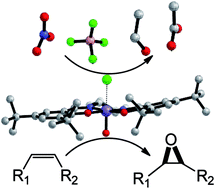
A series of chiral Mn(III) catalysts [salen–Mn(III)][X] (X = Cl, OAc, NO3, BF4, CF3SO3, OCH2CH3) were synthesized by ion exchange. The influence of the axial anion on both the electronic structure and steric configuration of [salen–Mn(III)][X] were carefully investigated. Besides, the reactivity and enantioselectivity of these catalysts were explored in the asymmetric epoxidation of olefins. The obtained results indicate that the axial anions have influences on both electronic structure and steric configuration of the chiral Mn(III) salen complexes. Controlling the reactivity and enantioselectivity of these chiral Mn(III) salen complexes can be achieved by changing the axial anions.

Introduction

The asymmetric epoxidation of olefins is an extremely important and powerful reaction for the synthesis of chiral intermediates in the pharmaceutical and agrochemical fields.1–7 Jacobsen et al. had reported that chiral Mn(III) salen complexes with chloride ions connecting to the mental center could efficiently catalyze the asymmetric epoxidation of olefins.8–14 As a kind of homogeneous catalysts, chiral Mn(III) salen complexes show quite good catalytic activity and enantioselectivity.

In order to further improve their activity and enantioselectivity, intense efforts have been made to modify the chiral metal (Cr, Mn, Co, or Cu) salen complexes. Among the various methods that have been reported, modifying the salicylidene rings of the metal–salen catalysts with functional group is considered as an effective method to produce compounds with high enantioselectivity.15–20 The most established one is introducing different substituents at the 3,3′- and 5,5′-positions of the salen unit, such as bulked triethylaminomethyl, methylimidazolium,15 triphenyl phosphine.18 Moreover, an increasing number of studies have been focusing on the substituent of the cyclohexyl on the structure of the metal salen complexes.21–25 Besides, macrocyclic chiral metal salen complexes possessing achiral and chiral linkers were introduced for enantioselective reactions to obtain higher catalytic activity and enantioselectivity relative to the monomeric counterparts.4,26–28

An exciting new progress is that asymmetric counterion-directed catalysis (ACDC) is used as a general strategy for asymmetric synthesis and it has been revealed that a chiral counterion could induce a preference for enantiomorphic conformations.29–37 These findings suggest the strong ability of counterion with big bulk to influence the asymmetric catalysis. Most of the chiral metal (Cr, Mn, Co, or Cu) salen complexes, including the well-known Jacobsen catalyst, have quite small counterion (such as Cl, OAc, NO3, BF4, CF3SO3, and CH3CH2O).8–14,18,38–41 The influence of these small counterions on the electronic structure has received much research attention.8–14,18,38–42 What is the influence of these axial anions on the reactivity and enantioselectivity of chiral salen catalysts? Recently, Kurahashi et al. found that the small axial anions could obviously change the steric configuration of chiral salen–Mn(IV) compound.43,44 However, it still remained unclear about the influence of these small counterions on the structure of MnV[double bond, length as m-dash]O active intermediate and the enantioselectivity of the chiral salen catalysts.19–21,44–46

Herein, the influence of the axial anions on the electronic structure and steric configuration of [salen–Mn(III)][X] and its MnV[double bond, length as m-dash]O active intermediate were investigated. Besides, the reactivity and enantioselectivity of these catalysts were explored in the asymmetric epoxidation of olefins.

Results and discussion

Influence of axial anions on the structure of chiral Mn(III) salen catalysts

The chiral Mn(III) salen compounds were synthesized according to the well-known procedures8–14 and catalysts with different anions were obtained by ion exchange (Scheme 1). These compounds were characterized by FT-IR, MS, elemental analysis and UV-vis spectroscopy.
image file: c5ra13178b-s1.tif
Scheme 1 Synthetic of [salen–Mn(III)][X](X = OAc, NO3, BF4, CF3SO3 and CH3CH2O).

As we know, the IR frequency and UV-vis absorption band can be used as an indicator for the slight change of electronic structure. The C[double bond, length as m-dash]N groups in different [salen–Mn(III)][X], which participate in coordination with manganese, have different IR vibration frequencies (ranging from 1607.9 to 1619.8 cm−1) (Table 1). Similarly, the C–O vibration frequencies also differ from each other. Moreover, the UV-vis absorption band for the d–d transition of Mn salen complex,4 ranges from 486.6 to 496.8 nm for different catalysts. Comparing with compound without axial anion, the coordinated anion obviously increase the λmax values. These FT-IR and UV-vis differences suggest that the axial anions directly influence the electronic distribution of the active site Mn.

Table 1 Some of the typical spectroscopy parameters
Axial anions VC[double bond, length as m-dash]Na (cm−1) VC–Oa (cm−1) λmaxb (nm) [α]20Dc
a The typical vibration frequency measured as KBr pellets.b The main absorbed peak of UV-vis in CH2Cl2.c The specific rotation of 0.0005 g ml−1 [salen–Mn][X] (X = Cl, OAc, NO3, BF4, CF3SO3 and CH3CH2O) in CH2Cl2.d Compound without axial anion was synthesized according to the method reported in ref. 46.
Cl 1608 1251 435.6 496.8 −1038
OAc 1609 1251 431.8 492.6 −1268
NO3 1612 1252 437.6 491.2 −954
BF4 1613 1252 431.5 489.8 −536
CF3SO3 1620 1252 438.6 486.6 −456
CH3CH2O 1608 1251 434.4 491.6 −890
Noned 1611 1251 421.6 481.4 −640


Besides the influence on the electronic structure of the active center, axial anion also brings remarkable steric configuration variation of [salen–Mn(III)][X]. It is well-known that specific rotatory power is an inherent property to rotate the plane of incident polarized light, which is related to the steric configuration of the chiral compound. The specific rotator power of different [salen–Mn(III)][X] was measured on the same conditions. It was found that these values ranged from −456 to −1268. Comparing with compound without axial anion, week coordinated anion BF4 and CF3SO3 decrease the values of specific rotation whereas the other stronger coordinated anion increase this value. It indicated the axial anion had an obvious influence on the steric configuration of the chiral Mn(III) salen, which agrees with the crystal results of double axial anion [salen–Mn(IV)][X]2.43

Influence of axial anions on the MnV[double bond, length as m-dash]O active intermediate

It has been widely accepted that MnV[double bond, length as m-dash]O(salen) complex is the active intermediate in the asymmetric epoxidation using Mn(III) salen as catalyst.45–49 Though steric configuration of [salen–Mn(IV)][X]2 (X = Cl, NO3, N3 and CF3CH2O) have been well established basing on crystal research,43 it is still quite difficult to explore the steric structure of these active MnV[double bond, length as m-dash]O(salen) intermediates by experimental methods. Herein, theoretical calculations based on density functional theory were used to investigate the influence of axial anions on MnV[double bond, length as m-dash]O active intermediate. It is worth noting that this theoretical method is accurate enough to reproduce the crystal structures43 or predict experimental results.50–52

It has been found that the spin density (SD) and charge (Q) carried by the active metal and oxygen are good indicators for the reactivity of catalysts and there exists a linear relationship between SD/Q values and reaction barrier.51,53 For the [MnV[double bond, length as m-dash]O(salen)][X] system, it is not surprising that the axial anion has an obvious influence on the SD/Q values of Mn and O atoms (Table 2). Hence, these catalysts should have quite different catalytic abilities.

Table 2 Structural parameters for complexes [MnV[double bond, length as m-dash]O(salen)][X] (X = Cl, OAc, NO3, BF4, CF3SO3 and CH3CH2O)a
  X = Cl X = AcO X = NO3 X = BF4 X = CH3CH2O
a Structural parameters of triplet (quintuplet).b The absolute value of spin density carried by Mn and O.c The charge carried by Mn and O.d The Mn[double bond, length as m-dash]O and Mn–X bond lengths in Å.e Dihedral angle.f The energy difference between triplet and quintuplet (EtripletEquintuplet).
SDMnb 3.099 (2.757) 2.622 (2.772) 2.647 (2.643) 2.597 (2.621) 3.125 (2.982)
SDOb −0.870 (0.870) 0.632 (0.892) 0.596 (0.824) 0.587 (0.751) −0.852 (1.024)
QOc −0.099 (−0.216) −0.589 (−0.313) −0.584 (−0.331) −0.506 (−0.370) −0.150 (−0.038)
RMn[double bond, length as m-dash]Od 1.751 (1.723) 1.649 (1.715) 1.645 (1.685) 1.637 (1.664) 1.776 (1.828)
RMn–Xd 2.361 (2.405) 2.106 (2.023) 2.225 (2.114) 2.227 (2.167) 1.869 (1.872)
∠MnN1O1C1e 32.9 (17.6) 35.3 (11.5) 44.4 (14.7) 37.5 (18.7) 38.1 (36.8)
∠MnN1O1C4e 13.6 (9.7) 17.7 (11.8) 14.9 (13.3) 23.1 (17.2) 14.6 (10.7)
∠MnO2N2C2e −33.0 (−28.5) −27.2 (−35.1) −11.3 (−31.6) −23.0 (−28.5) −36.1 (−39.1)
∠MnO2N2C3e −11.9 (−3.6) −6.7 (−1.9) −6.2 (0.1) −1.3 (4.8) −16.5 (−17.3)
ΔEf 1.4 17.8 9.2 5.7 −11.4


The steric configuration of Mn salen complex plays a significant role in determining the enantioselectivity of the catalytic process.1–7,45 It is interesting to find that, though the volumes of these anions (Cl, AcO, NO3, BF4, and CH3CH2O) are quite small compared with those used in ACDC,29–37 they have an undeniable effect on the steric configuration of Mn salen complex. Being similar to [salen Mn(IV)][X]2,43,44 these active MnV[double bond, length as m-dash]O(salen) intermediates also adopt a stepped conformation with one of two salicylidene rings pointing upward and the other downward (Fig. 1). The values of dihedral angle ∠MnN1O1C1, ∠MnN1O1C4, ∠MnO2N2C2, and ∠MnO2N2C3 were used to describe steric configuration distortion of these catalysts (Table 2). For the quintuplet structure, the values of ∠MnO2N2C3 and ∠MnO2N2C2 range from 4.8 to −17.3 and −28.5 to −39.1 respectively.


image file: c5ra13178b-f1.tif
Fig. 1 The optimized structures of [MnV[double bond, length as m-dash]O(salen)][X], (a) X = Cl, (b) X = OAc, (c) X = NO3, (d) X = BF4, (e) X = CH3CH2O.

Though it is found that the catalysts with different structure characteristics can be obtained by introducing different counterion, we still can not find out the relationship between the specific rotation and the degree of configuration distortion of these complexes. Based on the results presented in Table 1 and Fig. 1, what we can safely state is that the degree of configuration distortion diversifies with different axial anion obviously. Controlling the enantioselectivity by changing the axial anions should be possible.

Reactivity of chiral Mn(III) salen with different axial anions

Though above spectral and theoretic results have demonstrated that the axial anions have an undeniable effect on the electronic and steric configuration of Mn salen complex, a careful experimental research on the catalytic process shows that the influence of axial anion is dependent on the reaction substrate and solvent.

The asymmetric epoxidation of olefins with different steric hindrance (styrene, indene, and acenaphthylene) were investigated (Table 3). No matter what axial anion is used, the epoxidation of styrene can be finished within 0.5 hour. But, the enantioselectivities are all poor and the corresponding ee values only vary in a narrow range (28.6–45.8). Though axial anions have brought an obvious difference in the steric configuration distortion of these catalysts, the steric hindrance of styrene is too small to clearly distinguish the variation induced by the axial anions.

Table 3 Asymmetric epoxidation of different olefins catalyzed by [salen–Mn][X] (X = Cl, OAc, NO3, BF4, CF3SO3 and CH3CH2O)a
Entry Axial anionb Substrate Con.c (%) eed (%) TOFe (h−1)
a Reaction conditions: substrate (1 mmol), m-CPBA (2 mmol), NMO (5 mmol) in CH2Cl2, T = 0 °C.b Catalyst was 1 mol% of substrate.c Conversion% of substrate determined by GC.d ee is the enantiomeric excess, which determined by GC with RESTEK RT-BetaDEXse chiral column.e Turnover frequency (TOF) is calculated by expression of [product]/[catalyst] × time (h−1).
1 Cl Styrene 99.1 34.7 198.2
2 AcO 99.5 40.7 199.0
3 NO3 98.6 37.1 197.2
4 BF4 93.0 45.8 186.0
5 CF3SO3 93.8 28.6 184.0
6 CH3CH2O 90.2 33.5 199.6
7 Cl Indene 96.1 78.7 192.2
8 AcO 93.2 90.6 186.4
9 NO3 89.7 93.1 179.4
10 BF4 96.4 57.7 192.8
11 CF3SO3 93.0 64.9 186.0
12 CH3CH2O 99.8 48.9 199.6
13 Cl Acenaphthylene 29.7 94.2 59.4
14 AcO 34.2 97.7 68.4
15 NO3 36.5 91.1 73.0
16 BF4 49.2 94.4 98.4
17 CF3SO3 30.7 97.2 61.4
18 CH3CH2O 28.5 95.1 57.0


Increasing the steric hindrance of the reactant makes the diversity induced by axial anions more clear. In the asymmetric epoxidation of indene, the ee values range from 48.9 to 93.1 (entries 7–12, Table 3). The catalyst with NO3 as axial anion gives the highest ee value whereas the one with CH3CH2O gives the lowest ee value. At the same time, high conversion can be achieved in 0.5 h for all catalysts. Compared with the methods which introduce functional groups on salicylidene rings of the metal–salen catalysts,15–20 changing the axial anion provides a much easier, but also effective, method to control the reactivity of the traditional Jacobsen catalysts [salen–Mn(III)][Cl].

Further increasing the steric hindrance of the substrate results in lower discrimination in the influence of the axial anion. In the asymmetric epoxidation of acenaphthylene (entries 13–18, Table 3), though good enantioselectivities are obtained for all catalysts, the corresponding ee values vary in an extremely narrow range (91.1–97.7).

It should be noticed that even though the steric configuration of Mn salen complex plays a significant role in determining the enantioselectivity of the asymmetric epoxidation of olefins, many other factors also have noticeable influences on the enantioselectivity values. Jacobsen et al. discovered and studied the influence of electronic effects of substituents on the asymmetric epoxidation in detail. They found that the enantioselectivity could be improved when the electron-donating group at the 5,5′-positions of the salen unit.9 Jacobsen also found that the structure of substrates had great influences on the enantioselectivity of the reaction,1,1–4,9 and cis-di-substituted olefins had high enantioselectivity values.1 Besides that, oxidant,4,5 additives,6,9 and reaction temperature9 also affect the enantioselectivity values.

Herein we found that the solvent can cooperate with the axial anion to influence the reaction. The asymmetric epoxidation of indene catalyzed by [salen–Mn(III)][X] (X = Cl, NO3, and BF4) were further investigated in solvents with different polarity (DCM, CH3CN and DMF). For all catalysts, reactions performed in DMF gave poor conversion and enantioselectivity (Table 4). As we known, even though there is no olefin in the reaction system, the MnV[double bond, length as m-dash]O active intermediate can also decompose in solution (Fig. 2a).54 For [salen–Mn(III)][Cl], full decomposition takes 8 hours in DCM. However, this decomposition becomes quite fast in DMF for all catalysts investigated here. It is probably because that there exists a competition between the active oxygen of Mn[double bond, length as m-dash]O and the oxygen of DMF. This competition will accelerate the release of active oxygen and enhance the possibility of olefin oxidation by the released oxygen rather than by the active oxygen of Mn[double bond, length as m-dash]O. Thus, the steric configuration of Mn salen complex has a poor influence on the reaction and a poor enantioselectivity was obtained in DMF. When the axial anions were Cl or NO3, reactions performed in DCM gave better enantioselectivity, whereas the enantioselectivity was better in CH3CN when the axial anion was BF4. Correspondingly, we can find that the decomposition of the MnV[double bond, length as m-dash]O active intermediate is slower in DCM than that in CH3CN for [salen–Mn(III)][X] (X = Cl and NO3). However, this decomposition is slower in CH3CN than that in DCM for [salen–Mn(III)][BF4].

Table 4 The effect of solvent on the epoxidation of indene catalyzed by different catalystsa
Entry Catalystb Solventc Time (h) Con.d (%) eee (%) TOFf (h−1)
a Reaction conditions: indene (1 mmol), m-CPBA (2 mmol), NMO (5 mmol) in different solvent, T = 0 °C.b Catalyst was 1 mol% of indene.c DCM: dichloromethane; CH3CN: acetonitrile; DMF: N,N-dimethylformamide.d Conversion% of indene determined by GC.e ee is the enantiomeric excess, which determined by GC with RESTEK RT-BetaDEXse chiral column.f Turnover frequency (TOF) is calculated by expression of [product]/[catalyst] × time (h−1).
1 X = Cl DCM 0.5 96.1 78.7 192.2
2 CH3CN 0.5 98.6 71.1 197.2
3 DMF 0.5 23.6 55.7 47.2
4 X = NO3 DCM 0.5 89.7 93.1 179.4
5 CH3CN 0.5 93.8 80.7 187.6
6 DMF 0.5 8.6 59.5 17.2
7 X = BF4 DCM 0.5 96.4 57.7 192.8
8 CH3CN 0.5 97.3 86.8 194.6
9 DMF 0.5 6.8 41.0 13.6


image file: c5ra13178b-f2.tif
Fig. 2 (a) UV-vis spectra of [salen–Mn(III)][Cl], [salen–Mn(III)][Cl] + m-CPBA in CH2Cl2 (0.1 mM) in dependence of time (every 20 min from the top down n1–n6, n7, 6 h, n8, 8 h). (b–d) The changing curves of MnV[double bond, length as m-dash]O absorbance of [salen–Mn(III)][Cl], [salen–Mn(III)][NO3] and [salen–Mn(III)][BF4] with time in A: DCM, B: CH3CN, C: DMF.

Conclusions

The structure and reactivity of a series of chiral Mn(III) catalysts [salen–Mn(III)][X] (X = Cl, OAc, NO3, BF4, CF3SO3, and CH3CH2O) were investigated. The obtained results indicate that a simply changing on the axial anions can result in obvious variation in not only the electronic structure, but also the steric configuration of [salen–Mn(III)][X] and its MnV[double bond, length as m-dash]O active intermediate. It can further lead to different reactivity and enantioselectivity in the asymmetric epoxidation of olefins. Besides, the axial anions can also change the decomposition rate of the MnV[double bond, length as m-dash]O active intermediate. However, the influence of axial anion is dependent on the substrate and the solvent.

Previous research has revealed that, based on the two-state-reactivity model, the singlet, triplet, and quintet spin states of Mn–salen complexes are all accessible during the reaction processes.55 Hence, to fully understand the effect of these counterions on the enantioselectivity, a theoretic investigation on the whole reaction process is necessary. Our theoretic on this topic is on progress, including reaction catalyzed by singlet, triplet, and quintet spin states of Mn–salen complexes with different counterions.

Experimental

Synthesis of catalysts and characterizations

The NMR spectra were detected by Bruker ARX 500 MHz instrument, using CDCl3 as solvents and TMS as the internal standard. Elemental analysis was taken on an Elementar vario EL II. Optical rotations of chiral complexes were recorded on a WZZ-2A automatic polarimeter instrument. FT-IR spectra were obtained from KBr pellets on a Bruker APEX-III spectrometer in 400–4000 cm−1 region and UV-vis spectra on a UV-vis SPECORD 200 spectrophotometer. No any data treatment were adopted on the spectra measurements. Mass spectra were performed on an LCMS-2020 mass spectrometer. The products of epoxidation reaction were monitored by GC5890C gas chromatograph equipped with a flame ionization detector using high-purity nitrogen as the carrier gas. Conversions and ee values were determined by GC with a chiral capillary column (RESTEK RT-BetaDEXse, 30 m × 0.25 mm × 0.25 μm). The reagents and solvents were pure analytical grade materials purchased from commercial sources and used without further purification unless otherwise indicated.
Synthesis of salen-1. (1R,2R)-(−)-1,2-Diaminocyclohexane (3.42 g, 30 mol) was mixed with potassium carbonate (3.78 g, 27 mol) in 20 ml distilled water at 80 °C for 0.5 h. When the solid was completely dissolved, 50 ml ethanol was added to the solution at reflux for 1 h. Then 3,5-di-tert-butyl salicylaldehyde (5.86 g, 25 mol) was added dropwise to the mixture within 1 h which was dissolved in ethanol (100 ml). The reaction mixture was heated at 80 °C for an additional 3 h and then cooled at the ice-water bath. The yellow solid which was precipitated out was separated by filtration. The preliminary product was dissolved in dichloromethane (80 ml) and then washed sequentially with distilled water (2 × 40 ml) and saturated brine (2 × 30 ml). The organic layer was dried over anhydrous MgSO4 overnight and the solvent was evaporated under reduced pressure to get bright yellow product. Yield: 74.8%; [α]20D = −347.75 (c = 0.02, CH2Cl2); mp 207.6–208.6 °C; 1H NMR (CDCl3, 500 MHz) δ, ppm: 13.67 (s, 2H; Ar-OH), 8.33 (s, 2H; CH[double bond, length as m-dash]N), 7.31 (d, 2H; Ar-H), 6.98 (d, 2H; Ar-H), 3.36 (s, 2H; N–CH), 2.0–1.4 (m, 8H; CH2), 1.43 (s, 18H; CH3), 1.26 (s, 18H; CH3). 13C NMR (CDCl3, 500 MHz) δ, ppm: 165.87, 158.04, 139.91, 136.39, 126.76, 126.07, 117.91, 72.46, 34.99, 34.06, 33.30, 32.22, 31.46, 29.49, 24.40; FT-IR (KBr, ν/cm−1): 3418.6, 2961.9, 2871.8, 1630.6, 1594.4, 1467.3, 1361.3, 1269.7, 1173.6, 1134.9, 1084.9, 1037.2, 878.8, 827.8, 772.4, 711.0, 644.0; UV-vis (CH2Cl2, λmax nm−1): 232, 262, 331; MS (m/z): calcd for C36H55N2O2: 547.43 [M + H]+; found: 547.25; elemental analysis calcd (%) for C36H54N2O2: C, 79.07; H, 9.95; N, 5.12; found: C, 78.77; H, 9.93; N, 5.03.
Synthesis of [salen–Mn][Cl]. The ligand salen-1 (4.92 g, 9 mmol) dissolved in toluene (60 ml) was added dropwise to 3 equivalent of Mn(OAc)2·4H2O (6.62 g, 27 mmol) in ethanol (75 ml). The reaction mixture was stirred at reflux for 3 h. Then the LiCl (27 mol, 1.63 g) was added and the resulted mixture was further heated to reflux at 80 °C for 2 h. After 1.5 h, the cold solution was washed with distilled water (2 × 40 ml), and the organic layer was dried over anhydrous MgSO4. The solvent was removed by rotary evaporation under reduced pressure. The residue was purified by recrystallizing from CH2Cl2 (20 ml) and pentane (80 ml). After filtered and dried in vacuum, brown powdery [salen–Mn][Cl] was obtained. Yield: 79.7%; [α]20D = −1038.0 (c = 0.0005, CH2Cl2); mp > 300 °C; FT-IR (KBr, ν/cm−1): 2948.7, 2865.8, 1607.9, 1535.7, 1461.1, 1432.5, 1388.5, 1312.2, 1251.2, 1175.5, 1031.4, 837.0, 780.8, 749.2, 566.8, 543.4, 483.7; LC-MS (m/z): calcd for [C36H52ClMnN2O2]+˙: 634.31; found: 634.25; MS (ESI, m/z): calcd for [salen–Mn]+: 599.34; found: 599.83; elemental analysis calcd (%) for C36H52ClMnN2O2: C, 68.07; H, 8.25; N, 4.41; found: C, 68.25; H, 8.40; N, 4.08.
Synthesis of [salen–Mn][X]. (X = OAc, NO3, BF4, CF3SO3): 5 equivalent of AgX (X = OAc, NO3, BF4, CF3SO3) (1 mmol) was respectively added to the [salen–Mn][Cl] (0.127 g, 0.2 mmol) in CH2Cl2 (5 ml) at 40 °C below. The mixture was stirred for 5 h. Then the cold solution was filtered to remove silver salts. Anhydrous pentane (50 ml) was added to the filtration to give a light brown precipitate. Collected by filtration and washed with pentane, the residue was dried in vacuum. Then recrystallization from CH2Cl2 (2 ml) and pentane (20 ml) at 20 °C below, the pure solid [salen–Mn][X] was obtained.
[Salen–Mn][OAc]. Yield: 52.3%; [α]20D = −1268.0 (c = 0.0005, CH2Cl2); FT-IR (KBr, ν/cm−1): 3405.5, 2946.5, 2865.6, 1609.3, 1536.9, 1434.4, 1388.0, 1308.1, 1250.7, 1175.9, 1031.6, 836.0, 780.9, 748.8, 567.5, 543.2, 483.7; LC-MS (m/z): calcd for [C38H55MnN2O4]+˙: 658.35; found: 658.30; MS (ESI, m/z): calcd for [salen–Mn]+: 599.34; found: 599.83; elemental analysis calcd (%) for C38H55MnN2O4·0.5H2O: C, 68.34; H, 8.45; N, 4.19; found: C, 68.22; H, 8.46; N, 4.06.
[Salen–Mn][NO3]. Yield: 46.8%; [α]20D = −954.0 (c = 0.0005, CH2Cl2); FT-IR (KBr, ν/cm−1): 3419.3, 2952.1, 2866.6, 1612.4, 1535.6, 1463.0, 1432.6, 1390.1, 1310.9, 1251.8, 1175.2, 1115.5, 1028.4, 836.9, 780.2, 748.8, 567.6, 543.3, 484.0; LC-MS (m/z): calcd for [C36H52MnN3O5]+˙: 661.33; found: 661.25; MS (ESI, m/z): calcd for [salen–Mn]+: 599.34; found: 599.92; elemental analysis calcd (%) for C36H52MnN3O5·0.5H2O: C, 64.46; H, 7.96; N, 6.26. Found: C, 64.35; H, 8.05; N, 6.07.
[Salen–Mn][BF4]. Yield: 47.5%; [α]20D = −536.0 (c = 0.0005, CH2Cl2); FT-IR (KBr, ν/cm−1): 2954.0, 2867.3, 1613.1, 1536.6, 1463.5, 1433.7, 1392.0, 1311.6, 1251.9, 1175.8, 1059.5, 1029.4, 837.2, 780.7, 749.4, 572.4, 544.0, 485.9; LC-MS (m/z): calcd for [C36H52BF4MnN2O2]+˙: 686.34; found: 686.30; MS (ESI, m/z): calcd for [salen–Mn]+: 599.34; found: 599.83; elemental analysis calcd (%) for C36H52BF4MnN2O2: C, 62.98; H, 7.63; N, 4.08; found: C, 62.87; H, 7.63; N, 4.13.
[Salen–Mn][CF3SO3]. Yield: 66.2%; [α]20D = −456.0 (c = 0.0005, CH2Cl2); FT-IR (KBr, ν/cm−1): 3471.0, 2955.6, 2868.4, 1619.8, 1536.2, 1434.1, 1389.9, 1313.1, 1252.4, 1174.4, 1031.9, 837.7, 780.9, 750.2, 635.1, 574.9, 544.8, 487.9; LC-MS (m/z): calcd for [C37H52F3MnN2O5S]+˙: 748.29; found: 748.25; MS (ESI, m/z): calcd for [salen–Mn]+: 599.34; found: 599.83; elemental analysis calcd (%) for C37H52F3MnN2O5S·H2O: C, 57.95; H, 7.10; N, 3.65; found: C, 58.19; H, 7.00; N, 3.68.
Synthesis of [salen–Mn][OCH2CH3]. 2 equivalents of CH3CH2O–Na (0.4 mmol, 0.0272 g) was added to the [salen–Mn][Cl] (0.127 g, 0.2 mmol) in CH2Cl2 (10 ml) at 40 °C below. After the mixture was stirred for 2 h, the solvent was removed by rotary evaporation. The resulting solid was dissolved in CH2Cl2 (5 ml) and the solution was filtered in vacua. The rest of process was similar as above. Finally, the pure yellowish-brown powder [salen–Mn][OCH2CH3] was obtained.
[Salen–Mn][OCH2CH3]. Yield: 37.8%; [α]20D = −890.0 (c = 0.0005, CH2Cl2); FT-IR (KBr, ν/cm−1): 3448.1, 2949.8, 2866.1, 1607.9, 1534.8, 1432.2, 1388.6, 1312.7, 1251.4, 1175.1, 1031.7, 837.1, 780.7, 749.2, 566.6, 543.5, 483.6; LC-MS (m/z): calcd for [C38H57MnN2O3]+˙: 644.37; found: 644.35; MS (ESI, m/z): calcd for [salen–Mn]+: 599.34; found: 599.83; elemental analysis calcd (%) for C38H57MnN2O3·H2O: C, 68.86; H, 8.97; N, 4.23; found: C, 68.56; H, 8.40; N, 4.37.

General epoxidation reaction procedure

A typical asymmetric epoxidation reaction was performed as follows. The catalysts [salen–Mn][X] (0.01 mmol, 1 mol% based on Mn element) and N-methylmorpholine-N-oxide (NMMO) (5 mmol as an axial additive) were dissolved in CH2Cl2 containing olefins (styrene, indene, diphenylethene, acenaphthylene as substrates, 1 mmol) at 0 °C. The mixed solution was stirred for 10 minutes. Then 3-chloroperoxybenzoic acid (m-CPBA) (2 mmol) as an oxidant was added in 4 equal portions in 2 minutes. Gas chromatograph was employed to determine the conversions and ee values of the reaction. Each ee value was measured three times. Hence, these data should be statistically reliable. Except dichloromethane, acetonitrile and N,N-dimethylformamide (DMF) were used as reactive solvent in the epoxidation of indene catalyzed by [salen–Mn][Cl], [salen–Mn][NO3] and [salen–Mn][BF4].

Computational methods

The B3LYP method has been widely used in the calculation of metallorganic complexes. For this reason, we optimized all the structures by the B3LYP method. 6-31+G* basis set was generally used for these atoms except for transition metal. LANL2DZ was used for Mn. Geometric configuration optimization, energy calculation, frequency calculation, and zero-point energy correction were performed by using the same basis set. All calculations were performed with the Gaussian 03 suite of programs.

Acknowledgements

This work was supported by the National Natural Science Foundation of China (No. 21176110 and 21376115) and Jiangsu Province Natural Science Foundation (BK20141311).

Notes and references

  1. P. Besse and H. Veschambre, Tetrahedron, 1994, 50, 8885–8927 CrossRef CAS.
  2. Q. Xia, H. Ge, C. Ye, Z. Liu and K. Su, Chem. Rev., 2005, 105, 1603–1662 CrossRef CAS PubMed.
  3. L. L. Lou, K. Yu, F. Ding, X. J. Peng, M. M. Dong, C. Zhang and S. X. Liu, J. Catal., 2007, 249, 102–110 CrossRef CAS PubMed.
  4. N. C. Maity, G. V. S. Rao, K. J. Prathap, S. H. R. Abdi, R. I. Kureshy, N. H. Khan and H. C. Bajaj, J. Mol. Catal. A: Chem., 2013, 366, 380–389 CrossRef CAS PubMed.
  5. T. Sugiishi, M. Matsugi, H. Hamamoto and H. Amii, RSC Adv., 2015, 5, 17269–17282 RSC.
  6. Q. P. Shi, Z. H. Shi, N. G. Li, Y. P. Tang and W. Li, Curr. Org. Chem., 2013, 17, 2936–2970 CrossRef CAS.
  7. J. Rich, E. Manrique, F. Molton, C. Duboc, M. N. Collomb, M. Rodríguez and I. Romero, Eur. J. Inorg. Chem., 2014, 16, 2663–2670 CrossRef PubMed.
  8. W. Zhang, J. L. Loebach, S. R. Wilson and E. N. Jacobsen, J. Am. Chem. Soc., 1990, 112, 2801–2803 CrossRef CAS.
  9. M. Palucki, P. J. Pospisil, W. Zhang and E. N. Jacobsen, J. Am. Chem. Soc., 1994, 116, 9333–9334 CrossRef CAS.
  10. D. A. Annis and E. N. Jacobsen, J. Am. Chem. Soc., 1999, 121, 4147–4154 CrossRef CAS.
  11. E. N. Jacobsen, Acc. Chem. Res., 2000, 33, 421–431 CrossRef CAS PubMed.
  12. T. Katsuki, J. Mol. Catal. A: Chem., 1996, 113, 87–107 CrossRef CAS.
  13. T. Katsuki, Adv. Synth. Catal., 2002, 344, 131–147 CrossRef CAS.
  14. M. Peng, Y. J. Chen, R. Tan, W. G. Zheng and D. H. Yin, RSC Adv., 2013, 3, 20684–20692 RSC.
  15. R. I. Kureshy, K. J. Prathap, T. Roy, N. C. Maity, N. H. Khan, S. H. R. Abdi and H. C. Bajaj, Adv. Synth. Catal., 2010, 352, 3053–3060 CrossRef CAS PubMed.
  16. M. A. Nasseri, A. Allahresani and H. Raissi, RSC Adv., 2014, 4, 26087–26093 RSC.
  17. X. Yun, X. Hu, Z. Y. Jin, J. H. Hu, C. Yan, J. Yao and H. Li, J. Mol. Catal. A: Chem., 2010, 327, 25–31 CrossRef CAS PubMed.
  18. T. Chang, L. L. Jin and H. W. Jing, ChemCatChem, 2009, 1, 379–383 CrossRef CAS PubMed.
  19. W. Adam, K. J. Roschmann, C. R. Saha-Möller and D. Seebach, J. Am. Chem. Soc., 2002, 124, 5068–5073 CrossRef CAS PubMed.
  20. J. Teixeira, A. R. Silva, L. C. Branco, C. A. M. Afonso and C. Freire, Inorg. Chim. Acta, 2010, 363, 3321–3329 CrossRef CAS PubMed.
  21. W. Sun, H. W. Wang, C. G. Xia, J. W. Li and P. Q. Zhao, Angew. Chem., Int. Ed., 2003, 42, 1042–1044 CrossRef CAS PubMed.
  22. M. Sankaralingama and M. Palaniandavar, Dalton Trans., 2014, 43, 538–550 RSC.
  23. D. P. Wang, M. Wang, R. Zhang, X. N. Wang, A. Gao, J. Ma and L. C. Sun, Appl. Catal., A, 2006, 315, 120–127 CrossRef CAS PubMed.
  24. J. Dimroth and M. Weck, RSC Adv., 2015, 5, 29108–29113 RSC.
  25. Z. Li, Z. H. Tang, X. X. Hu and C. G. Xia, Chem.–Eur. J., 2005, 11, 1210–1216 CrossRef CAS PubMed.
  26. N. C. Maity, S. H. R. Abdi, R. I. Kureshy, N. H. Khan, E. Suresh, G. P. Dangi and H. C. Bajaj, J. Catal., 2011, 277, 123–127 CrossRef CAS PubMed.
  27. R. Tan, D. H. Yin, N. Y. Yu, H. H. Zhao and D. L. Yin, J. Catal., 2009, 263, 284–291 CrossRef CAS PubMed.
  28. X. J. Zhu, K. Venkatasubbaiah, M. Weck and C. W. Jones, ChemCatChem, 2010, 2, 1252–1259 CrossRef CAS PubMed.
  29. N. J. A. Martin and B. List, J. Am. Chem. Soc., 2006, 128, 13368–13369 CrossRef CAS PubMed.
  30. G. L. Hamilton, E. J. Kang, M. Mba and F. D. Toste, Science., 2007, 317, 496–499 CrossRef CAS PubMed.
  31. B. Zhao, H. Du and Y. Shi, J. Org. Chem., 2009, 74, 8392–8395 CrossRef CAS PubMed.
  32. S. H. Liao and B. List, Angew. Chem., Int. Ed., 2010, 49, 628–631 CrossRef CAS PubMed.
  33. M. Mahlau and B. List, Angew. Chem., Int. Ed., 2013, 52, 518–533 CrossRef CAS PubMed.
  34. J. L. Cai, J. Huang, C. M. Li, H. Feng and Z. G. Liu, RSC Adv., 2013, 3, 18661–18670 RSC.
  35. R. J. Phipps, G. L. Hamilton and F. D. Toste, Nat. Chem., 2012, 4, 603–614 CrossRef CAS PubMed.
  36. V. Rauniyar, A. D. Lackner, G. L. Hamilton and F. D. Toste, Science, 2011, 334, 1681–1684 CrossRef CAS PubMed.
  37. S. Kemper, P. Hrobarik, M. Kaupp and N. E. Schlorer, J. Am. Chem. Soc., 2009, 131, 4172–4173 CrossRef CAS PubMed.
  38. A. Westphal, A. Klinkebiel, H. M. Berends, H. Broda, P. Kurz and F. Tuczek, Inorg. Chem., 2013, 52, 2372–2387 CrossRef CAS PubMed.
  39. W. Adam, K. J. Roschmann and C. R. Saha-Möller, Eur. J. Org. Chem., 2000, 3519–3521 CrossRef CAS.
  40. Y. L. Wei, W. S. Huang, Y. M. Cui, K. F. Yang, Z. Xu and L. W. Xu, RSC Adv., 2015, 5, 3098–3103 RSC.
  41. L. H. Yuan, Y. Xu, X. B. Hu, G. Yang and Y. Wu, J. Mol. Catal. A: Chem., 2015, 396, 55–60 CrossRef CAS PubMed.
  42. X. Hu, D. Martin, M. Melaimi and G. Bertrand, J. Am. Chem. Soc., 2014, 136, 13594–13597 CrossRef CAS PubMed.
  43. T. Kurahashi, M. Hada and H. Fujii, J. Am. Chem. Soc., 2009, 131, 12394–12405 CrossRef CAS PubMed.
  44. C. L. Wang, T. Kurahashi, K. Inomata, M. Hada and H. Fujii, Inorg. Chem., 2013, 52, 9557–9566 CrossRef CAS PubMed.
  45. L. Kürti, M. M. Blewett and E. J. Corey, Org. Lett., 2009, 11, 4592–4595 CrossRef PubMed.
  46. M. K. Brown, M. M. Blewett, J. R. Colombe and E. J. Corey, J. Am. Chem. Soc., 2010, 132, 11165–11170 CrossRef CAS PubMed.
  47. W. Adam, C. Mock-Knoblauch, C. R. Saha-Möller and M. Herderich, J. Am. Chem. Soc., 2000, 122, 9685–9691 CrossRef CAS.
  48. P. Fristrup, B. B. Dideriksen, D. Tanner and P.-O. Norrby, J. Am. Chem. Soc., 2005, 127, 13672–13679 CrossRef CAS PubMed.
  49. M. Rocha, S. L. H. Rebelo and C. Freire, Appl. Catal., A, 2013, 460–461, 116–123 CrossRef CAS PubMed.
  50. K. B. Petersen, P.-O. Norrby, A. M. Daly and D. G. Gilheany, Chem.–Eur. J., 2002, 8, 4299–4307 CrossRef.
  51. X. Hu, Y. Sun, J. Mao and H. Li, J. Catal., 2010, 272, 320–332 CrossRef CAS PubMed.
  52. X. Hu, J. Mao, Y. Sun, H. Chen and H. Li, Catal. Commun., 2009, 10, 1908–1912 CrossRef CAS PubMed.
  53. X. Hu, C. Liu, Y. Wu and Z. Zhang, J. Phys. Chem. C, 2011, 115, 23913–23921 CAS.
  54. M. P. Feth, C. Bolm, J. P. Hildebrand, M. Kohler, O. Beckmann, M. Bauer, R. Ramamonjisoa and H. Bertagnolli, Chem.–Eur. J., 2003, 9, 1348–1359 CrossRef CAS PubMed.
  55. W. Adam, K. J. Roschmann, C. R. Saha-moller and D. Seebach, J. Am. Chem. Soc., 2002, 124, 5068–5073 CrossRef CAS PubMed.

This journal is © The Royal Society of Chemistry 2015
Click here to see how this site uses Cookies. View our privacy policy here.