R. Ghosha,
M. Yedukondalub,
M. Ravikanthb and
D. K. Palit*a
aRadiation and Photochemistry Division, Bhabha Atomic Research Centre, Mumbai-400085, India. E-mail: dkpalit@barc.gov.in
bDepartment of Chemistry, Indian Institute of Technology, Mumbai-400076, India
First published on 21st September 2015
Intramolecular energy transfer dynamics in two molecular dyads, in which zinc porphyrin (ZnN4) and dithiaporphyrin (N2S2) units were linked covalently by different bridges, namely phenylene (ph) and diphenylethyne (dpe), were studied employing ultrafast time-resolved transient absorption and fluorescence spectroscopic techniques. The rates of energy transfer in both these dyads are slower than in the corresponding ZnN4–N4 dyads, in spite of the better gradient for energy flow in the case of the ZnN4–N2S2 dyads. Quantum chemical calculations reveal that the frontier orbital characteristics of the porphyrins are not significantly altered by sulphur substitution at the acceptor porphyrin core, and thus this does not modify the electronic factor in the energy transfer mechanism. However, a significant decrease in overlap between the absorption spectrum of the donor and the emission spectrum of the acceptor results in lower efficiency of the intramolecular energy transfer. The energy transfer process in dpe-linked dyads follows a through-bond super-exchange mechanism, whereas, in ph-linked dyads, the through-space multipole resonance interaction plays an important role.
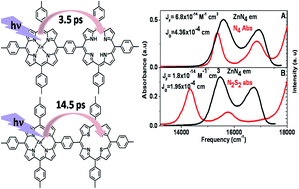
Recently, the synthesis of hetero-porphyrin derivatives has been of great interest because of significant variation of the chemical and photophysical properties upon core modification.20–24 Hetero-porphyrins are prepared by modification of the porphyrin core by replacing one or two nitrogen atoms with another hetero-atom, like oxygen, sulphur etc. These core-modified porphyrins possess a significantly lower singlet state energy than that of the free base porphyrin. This creates a suitable energy gradient in the excited singlet state for efficient energy flow from the metalloporphyrin to the freebase porphyrin. This property can make them suitable for construction of artificial light harvesting systems. A large number of dyads containing hetero-porphyrins have been synthesized to study energy transfer properties.25–30 Although steady state studies have revealed an efficient energy transfer process, the detailed mechanism of the energy transfer dynamics has not been explored because the energy transfer rates in these dyads have not been reported from time resolved studies having high temporal resolution. In this paper, we describe the energy transfer dynamics in a pair of porphyrin dyads, in which zinc tetraphenylporphyrin (ZnN4) and dithiaporphyrin (N2S2) are linked by two different linker groups, namely, diphenylethynyl and phenyl linkers (Scheme 1). We employed sub-picosecond transient absorption and picosecond fluorescence spectroscopic techniques to determine the energy transfer rates in these two dyads and to compare them with those of the free base porphyrin analogues reported earlier. Differences in the rates of energy transfer between these two classes of porphyrin dyads have been rationalized and mechanistic aspects have been enumerated from comparison of the frontier molecular orbital characteristics of porphyrin and dithiaporphyrin.
![]() | ||
| Scheme 1 Structures of the two hetero-porphyrindyads and corresponding sub-units used in the present study. | ||
The dynamics of the excited states were monitored following photoexcitation using 400 nm laser pulses with a femtosecond pump-probe transient absorption spectrometer, which has been described in detail elsewhere.31 The pulses of 50 fs duration and 200 μJ per pulse energy at 800 nm at 1 kHz repetition rate were obtained from an amplified laser system (Thales, France). Pump pulses at 400 nm (energy ∼ 5 μJ per pulse) were generated by frequency-doubling of one part of the 800 nm output of the amplifier in a 0.5 mm thick BBO crystal and a small amount from the other part (energy ∼ 1 μJ per pulse) to generate a white light continuum (480–1000 nm) probe in a 2 mm thick sapphire plate. The polarization of the pump beam was fixed at the magic angle with respect to that of the probe beam. The sample solutions were flowed through a quartz cell with a 1 mm path length during measurement. Decay dynamics in a particular wavelength region (10 nm width) was selected using a pair of interference filters placed in front of the photodiodes. The overall time resolution of the absorption spectrometer was about 120 fs. The temporal profiles recorded in the 480–750 nm wavelength region were fitted with up to three exponentially rising or decaying components by an iterative deconvolution method using a sech2 type instrument response function with full width at half-maximum of 120 fs, and were also used for constructing the time-resolved differential absorption spectra. All the experiments were performed at 296 K.
Picosecond time resolved fluorescence studies were performed using a streak camera detector (Optoscope-SC10, Optronis, Germany). Samples were excited using 400 nm laser pulses of 50 fs duration obtained from the laser system described above. Fluorescence from the sample was collected (perpendicular to excitation) and focused into the input slit of a spectrograph (Spectral Product, DK240), which spectrally dispersed the fluorescence signal and produced a vertical image at the spectrograph output. The spectrally dispersed fluorescence signal from the spectrograph output was focused into the input slit of the streak camera. Hence a spectrally and temporally resolved fluorescence signal was obtained in a single shot, which was averaged over multiple excitation shots for a better S/N ratio. The temporal resolution of the instrument was measured to be ∼15 ps at a 25 ps mm−1 sweep speed.
Quantum chemical calculations were performed using the GAMESS software package employing the density functional theory (DFT) method using the B3LYP functional and the 6-311 G (d,p) basis set.32–34
Fig. 1B also shows that the absorption spectrum calculated by addition of those of III and IV agrees well with those of the two dyads. This clearly suggests that the absorption characteristics of both of the sub-units III and IV are not significantly altered by integrating them into the dyads and hence indicates a very weak electronic interaction between the two subunits as well as with the linker in the ground state of each of the two dyads.
The emission spectra of the dyads I and II are shown in Fig. 2A and B, respectively. For each of these two dyads, the emission spectrum recorded using 415 nm photoexcitation consists of dual emission bands. The relatively weaker one, appearing in the 470–670 nm region, consists of two vibronic bands, which are characteristic of fluorescence emission originating from the S1 state of the sub-unit ZnN4 (III) (not shown in Fig. 2, vide infra). The more intense emission band appearing in the 670–850 nm region with a maximum at ca. 720 nm is characteristic of the sub-unit N2S2 (IV). However, upon photoexcitation at 440 nm, which selectively excites the sub-unit N2S2, the intensity of the emission from the sub-unit ZnN4 reduces significantly. The fact that, in spite of 415 nm photoexcitation which selectively excites the ZnN4 unit, more intense emission has been observed from the N2S2 unit suggests that efficient transfer of energy from the S1 state localized on the ZnN4 unit to that of the N2S2 unit in the dyad takes places. The fluorescence spectra are measured to be independent of concentration (in the range of 10 to 50 μM) and suggest that the observed energy transfer process is intramolecular in nature. In the case of Dyad II, in which two sub-units are linked by a phenyl group, the contribution of the emission from the ZnN4 unit is negligibly small and hence suggests a very fast and near quantitative transfer of energy from the sub-unit ZnN4 to the sub-unit N2S2. In the case of Dyad I, in which the diphenylethyne group is the linker, the emission spectrum recorded following 415 nm photoexcitation has a small contribution from the ZnN4 unit and the energy transfer efficiency in this case has been determined to be close to 90%. Thus, steady state studies clearly indicate efficient energy transfer from the ZnN4 unit to the N2S2 unit in the cases of both the dyads. However, it is noted that exclusive excitation to one unit is not possible and thus the energy transfer efficiency calculation from steady state measurement is an approximate one. We would like to mention that the energy transfer rate has been directly measured from time resolved studies and energy transfer efficiencies were determined using experimental energy transfer rates using eqn (1).
The temporal emission profile recorded at 620 nm shows a single exponential decay with a lifetime of 17 ps, followed by another long-lived component, the lifetime of which could not be determined with significant accuracy because of very low intensity as well as the limitation of the streak camera detection recording up to only 1.5 ns. This long-lived emission may be assigned to the ZnN4 monomer that remains as an impurity,19 or to the ZnN4 moiety of those Dyad I molecules which do not have geometrical configurations favourable for energy transfer (vide infra).31 The transient profile recorded at 720 nm shows the rise of emission intensity with a lifetime of 16 ps followed by a slow decay of the emission intensity with a lifetime of about 1.2 ns, which agrees well with the S1 state lifetime of the N2S2 molecule reported earlier.25 Thus we determine the energy transfer rate in the case of Dyad I as kET (I) = 16.5 ps−1 = 6.06 × 10¹⁰ s−1 and using eqn (1) and the value of kf (I) = 2.4 ns−1 = 0.04 × 10¹⁰ s−1 the efficiency of the energy transfer process calculated in the case of Dyad I, ξET (I), is 0.98.
![]() | (1) |
We also recorded the TRES and the temporal profiles at 620 and 720 nm using the streak camera in the case of Dyad II in toluene. We observed that the features of the time evolution of the TRES are very similar to those observed in the case of Dyad I, but the time domain, in which the evolution of the TRES takes place, is much longer. The temporal profile recorded at 620 nm reveals the instrument response time-limited rise followed by two exponential decay components. The faster decay component has a lifetime of 60 ps, but the lifetime of the longer lived component could not be determined accurately because of its very small amplitude. The appearance of this component with a smaller amplitude suggests near complete energy transfer from the ZnN4 moiety to the N2S2 moiety. The rise of emission intensity at 720 nm with a lifetime of 60 ps also ensures the occurrence of the energy transfer process, and the rate of this process has been calculated to be kET (II) = 1.67 × 10¹⁰ s−1. The efficiency of the energy transfer process ξET (II) calculated using eqn (1) is about 0.96.
![]() | ||
| Fig. 4 Time evolution of the transient absorption spectra and temporal profiles recorded at a few selected wavelengths following photoexcitation of Dyad I in toluene using 400 nm laser pulses. | ||
The appearance of two near isosbestic points at ca. 530 and 570 nm suggests that the process of transformation of one excited species into another must be associated with the evolution of the transient spectra. In conjunction with our time resolved fluorescence data, we infer that decreases in absorbance in the 470–530 and 570–770 nm regions are associated with the decay of the S1 state, in which the energy is localized on the ZnN4 moiety, whereas the rise of absorption in the 530–570 nm region represents the energy transfer process from the ZnN4 moiety to the N2S2 moiety. Therefore, the negative absorbance band appearing at 530 nm is assigned to bleaching and that at 710 nm to stimulated emission (SE) from the excited state of the dyad, in which the excitation energy is localized on the N2S2 moiety.
Temporal profiles of the transient absorption signals recorded at three selected wavelengths along with the multi-exponential fit functions have also been presented in Fig. 4. Each of them could be fitted well with a three component exponential function, where the components had very similar lifetimes. This suggests that each of the transient absorption spectra recorded in the entire 470–770 nm region have contributions from both the excited states, in which the singlet state energy is localized either on ZnN4 or N2S2. The temporal profile recorded at 520 nm is associated with an instrument response time-limited rise of the ESA followed by an ultrafast decay of the ESA with a lifetime of 0.9 ps leading to the bleaching signal, which subsequently rises slowly to a lifetime of 15 ps. The bleaching signal is long-lived (its lifetime is longer than 500 ps). The temporal profile recorded at 710 nm shows the instrument response time-limited rise of the ESA, followed by its double exponential decay with lifetimes of 0.6 and 14 ps leading to a long-lived negative absorbance signal, which may be assigned to stimulated emission from the N2S2 moiety. The transient signal monitored at 570 nm also shows the instrument response time-limited rise of the ESA, which initially decays with about a 1.0 ps lifetime but subsequently rises with a lifetime of about 14 ps.
Ultrafast decay of the ESA with an average lifetime of about 0.9 ± 0.2 ps, which is associated with each of the three transient absorption signals, may be assigned to the S2 state, corresponding to the Soret band. This state is initially populated by absorption of 400 nm light and decays to populate the S1 state, in which the excitation energy remains stored on the ZnN4 moiety, via an internal conversion process. The rise of the stimulated emission intensity monitored at 710 nm or the rise of ESA at 520 nm with a lifetime of 14 ps is ascribed to the population of the S1 state of the dyad, in which the excitation energy is localized on the N2S2 moiety, via an energy transfer process. These results and the rate of energy transfer thus calculated (kET = 14.5 ps−1 = 6.9 × 10¹⁰ s−1) are in perfect agreement with those obtained in the time-resolved fluorescence experiment.
In the case of Dyad II, time evolution of the transient spectra and the temporal profiles recorded at a few selected wavelengths have been presented in Fig. 5 and are seen to be similar to that of Dyad I. Following the arguments presented above, the ultrafast decay lifetime of ESA (1.2 ± 0.4 ps) is correlated with the internal conversion of the S2 state to the S1 state of the dyad, in which the excitation energy remains localized on the ZnN4 moiety. In addition, the rate of energy transfer from the ZnN4 moiety to the N2S2 moiety (kET = 60 ps−1 = 1.7 × 10¹⁰ s−1) in the case of Dyad II could be determined from the rise time of the ground state bleach monitored at 520 nm, the SE at 710 nm or the ESA at 570 nm.
![]() | ||
| Fig. 5 Time evolution of the transient absorption spectra and temporal profiles recorded at a few selected wavelengths following photoexcitation of Dyad II in toluene using 400 nm laser pulses. | ||
We compare the energy transfer rates determined for the dyads in this work (N2S2 substituted dyads) with those already reported for two N4 substituted dyads, in which the donor (ZnN4) and the spacers are same.15,16 We find that the energy transfer rates in the N2S2 substituted dyads are nearly four times (for ph linked) and 2.5 times (for dpe linked) slower as compared to the corresponding N4 substituted dyads. Therefore, although the N2S2 substituted dyads provide a better energy gradient for energy flow due to the lower energy of the S1 electronic state of N2S2, the energy transfer process in the hetero-porphyrin system is less efficient compared to that in the N4 analogue. A series of papers published by Lindsey and coworkers has established the fact that the frontier orbital compositions of the energy donor and acceptor porphyrin units greatly influence the through-bond energy transfer dynamics.12–15 In the case of ZnN4, the a2u orbital acts as the HOMO, possessing a high electron density at the meso position and a low electron density at the β position.13 Thus, in the meso-substituted ZnN4–N4 dyad, the energy transfer rate is found to be remarkably faster than the β-linked dyad due to the stronger through-bond electronic interaction in the meso-linked derivative.
In contrast, following pentafluoro substitution of the four phenyl rings of the ZnN4 unit, a reversal of orbital ordering occurs leading to a reversal in the energy transfer rate in the meso- and β-linked dyads.14 In the present study, the donor unit and the linker position for both the dyads are the same as Lindsey’s dyads, whereas the acceptor unit is different, and thus any difference in electronic interaction may originate from the acceptor site. Hence, it is necessary to know the effect of core modification by sulphur substitution on the frontier orbital characteristics, which participate in the electronic interaction and may significantly alter the energy transfer rate. Fig. 6 shows the DFT calculated frontier molecular orbitals of porphyrin (N4) and dithiaporphyrin (N2S2). It is apparent from the frontier orbital pictures that both of the N4 and N2S2 porphyrins have nearly similar orbital characteristics, which suggests that core modification upon sulphur substitution does not influence the HOMO–LUMO composition. This clearly indicates that the through-bond electronic interaction is essentially similar in the N4 and N2S2 systems. Thus, in comparison to the N4-porphyrin, the N2S2-porphyrin is not expected to influence the energy transfer dynamics via electronic interaction.
![]() | ||
| Fig. 6 Frontier molecular orbitals of the N4 and N2S2 porphyrins, which influence energy transfer dynamics. Hydrogen atoms are omitted in the figures. | ||
Numerous studies on intramolecularly connected energy donor and acceptor systems reveal that the electronic coupling for the energy transfer process follows one or more of three possible mechanisms: (a) the Förster mechanism of dipole–dipole resonant (coulombic) or through-space interaction, which is active at longer distances up to 100 Å;35 (b) the Dexter mechanism of the electron exchange interaction, which requires an orbital overlap and is active at distances less than 10 Å;36 and (c) super-exchange electronic coupling between the donor, bridge and the acceptor.37 In the first two cases, the bridge is considered as an inert spacer. The super-exchange coupling is believed to decay exponentially with distance (vide infra).
For the energy transfer process of the Förster mechanism, along with other factors, the rate of energy transfer is dependent upon the degree of overlap between the donor emission and the acceptor absorption spectra. The spectral overlap integral for the resonance interaction, JF (in M−1 cm3), is determined by eqn (2).
![]() | (2) |
The rate of energy transfer (in s−1) by the Förster mechanism can be calculated using eqn (3)
![]() | (3) |
![]() | (4) |
![]() | (5) |
Thus, the overlap between the donor emission and acceptor absorption spectra is an important parameter in both the Förster and Dexter mechanisms because the values of both the resonance integral and the exchange integral depend on the magnitude of the overlap integral. The donor emission and acceptor absorption spectra are shown in Fig. 7 and the calculated values of the resonance integral and exchange integral are shown in the insets of the figure.
Considering the Förster energy transfer mechanism, employing eqn (2) and (3), the energy transfer rates in the cases of Dyad I and Dyad II have been calculated to be 8.6 × 10⁹ s−1 and 6.5 × 10⁸ s−1, respectively. The following values were used for calculation of the Förster energy transfer rates: Φf (ZnN4) = 0.03, τ (ZnN4) = 2.4 ns, n (toluene) = 1.49, r = 13 Å (Dyad I) and 20 Å (Dyad II), and k2 = 0.84 (a dynamic average of different conformations is assumed due to the fact that the donor and acceptor units can freely rotate around the single bonds).38 These calculated rates are significantly smaller than the experimentally determined rates of energy transfer, which clearly suggests that the dipole–dipole resonance mechanism does not control the energy transfer rate in these dyad systems. Indeed, the dipole–dipole mediated through space contribution (χTS) to the experimentally measured energy transfer rate is around 4% and 13% for Dyad I and Dyad II, respectively, whereas, the through-bond contribution (χTB) to energy transfer process dominates in both dyads (Table 1). This is in accordance with the energy transfer mechanism observed in numerous meso–meso linked porphyrin dyad assemblies.12–17 It may be noted that the ratios of the experimentally determined rates to those calculated assuming the Förster mechanism in the dpe linked dyad are significantly larger (about 10–14 times) as compared to those in the case of ph linked dyads (about 4–6 times).
| Dyad | ξET | kET, 1010 s−1 | JF, 10−14 cm3 M−1 | Förster rate 109 s−1 | Ratio, JFa/JFb | JD 10−4 cm | Ratio, JDa/JDb | χTS | χTB | Ratio, kETa/kETb |
|---|---|---|---|---|---|---|---|---|---|---|
| a Ref. 13 and 15.b This work. | ||||||||||
| ZnN4–ph–N4a | 0.99 | 28 | 6.8 | 29 | 3.8 | 4.35 | 2.2 | 0.10 | 0.90 | 4.5 |
| ZnN4–ph–N2S2b | 0.99 | 6.2 | 1.8 | 8.6 | 1.95 | 0.13 | 0.87 | |||
| ZnN4–dpe–N4a | 0.98 | 4.2 | 6.8 | 2.4 | 4.35 | 0.05 | 0.95 | 2.5 | ||
| ZnN4–dpe–N2S2b | 0.96 | 1.7 | 1.8 | 0.7 | 1.95 | 0.04 | 0.96 | |||
On the other hand, the Dexter mechanism via the exchange interaction generally dominates when the donor and acceptor orbitals are in close proximity (within a few Å). In dpe and ph linked porphyrin dyads, the centre-to-centre distance is ∼20 Å and ∼13 Å, respectively. Thus direct orbital overlap between the donor and acceptor units is expected to be too weak to impart Dexter exchange-mediated energy transfer. An alternative mechanism is the bridge mediated through-bond super-exchange interaction, which can provide the necessary electronic coupling for Dexter energy transfer to become feasible. Indeed, through-bond electronic interaction has been established to be the dominant energy transfer pathway in porphyrin dyads with various linker groups.12–14
In the case of either the Dexter exchange mechanism or the through-bond super-exchange mechanism, the rate of energy transfer should be proportional to the value of the exchange integral (JD in eqn (5)), provided that the electronic interaction is comparable and that the latter governs the electronic coupling matrix element. The DFT calculated molecular orbital composition (Fig. 6) clearly suggests that the orbital contribution at the meso position of the N4 and N2S2 acceptors is similar. Hence it is reasonable to assume that the electronic coupling matrix element, V, is similar in magnitude for both the N4 and N2S2 acceptor containing dyads. In this situation, the rate of energy transfer is expected to be proportional to JD. Indeed, the ratio of the values of JD to the ZnN4–N4 pair and to that of the ZnN4–N2S2 pair closely corresponds to the ratio of the energy transfer rates observed in the case of the dpe linked dyads (Table 1). This essentially confirms that the energy transfer rate in Dyad II is controlled by the through-bond super-exchange mechanism.
We calculated the magnitude of the electronic coupling (V) from the experimentally determined values of the energy transfer rates and the exchange integrals using eqn (4). For Dyad II, the value of V is calculated to be 8.58 cm−1. The magnitude of this parameter indicates a moderate coupling between the donor and acceptor components, i.e. that they retain their electronic identity in the dyad form. This is in agreement with the steady state spectroscopic results discussed in Section 3.1. For Dyad I, the value of V is calculated to be 17.5 cm−1. The enhanced value of V in Dyad I is due to the shorter distance between the donor and the acceptor groups as compared to that in Dyad II. The value of the attenuation factor (β) has been calculated to be 0.178 Å−1 using eqn (6).
![]() | (6) |
The value of β ∼ 0.2 is typical for the phenylethyene bridge mediated energy transfer process.38 Hence, the calculation presented above is valid for the super-exchange mediated energy transfer mechanism operative in both the dyads.
However, unlike in the case of the dpe-linked dyads, in the case of the ph-linked dyads, the energy transfer mechanism appears to be more complicated when we compare the energy transfer rate determined in this work with that previously reported for a N4 substituted dyad. The ratio of the rate of the energy transfer process determined for the N4-substituted phenyl-linked dyad to that of the N2S2-substituted one (i.e. kETa/kETb = 4.5) is higher than the ratio of the calculated values of the exchange integrals (i.e. JDa/JDb = 2.2). This suggests that the contribution of the energy transfer process occurring via the through-bond mechanism is not the major one in these dyads, unlike in the case of the dpe-linked dyads. In exchange mediated energy transfer, the difference between the energies of the excited state of the donor and the bridge (ΔEDB) plays an important role. An inverse square dependence of the energy transfer rate on ΔEDB has been theoretically predicted and experimentally verified.38 Exchange mediated energy transfer in the case of Dyad I is expected to be of lesser importance as ΔEDB in the case of the ph-bridge is much larger than that in the dpe-bridge case. On the other hand, the purely dipole–dipole mediated Förster resonance energy transfer mechanism cannot account for the measured energy transfer rate, which is about seven times faster than the calculated one (vide supra). Surprisingly, we find that the ratio of the rates of the energy transfer processes in the ph-linked dyads is close to the ratio of the resonance integral (JF) (Table 1). This possibly suggests that resonance interaction via multipole states may contribute to the energy transfer mechanism. Previous studies have shown that at short distances corrections due to the multipole contribution to the dipole–dipole approximation may increase the energy transfer rate by a factor of five or more.39 In the ph-linked porphyrin dyads, the center-to-center distance between the energy donor and acceptor units is ∼13 Å, which is sufficiently short to impart such an effect. It is also reported by Lindsey et al. that the effect of orbital ordering reversal on the energy transfer rate in the ph-linked dyad is less prominent compared to that of the dpe-linked dyads.15 This led them to infer that the through-bond mechanism becomes less important in the case of the ph-linked dyad as compared to that of the dpe-linked dyads. The observed rate dependence with linker length or donor/acceptor character could not be fully accounted for by either the pure through-space or the through-bond mechanism. A change from the through-bond to the through-space mechanism is hinted at in previous studies by Lindsey and coworkers.15 Our present observation is also suggestive of a similarly intriguing mechanistic involvement and warrants further study to understand the through-space versus through-bond energy transfer mechanisms in covalently linked porphyrin dyads.40
| This journal is © The Royal Society of Chemistry 2015 |