
Junjie Wu,
Shuanglong Lu,
Danhua Ge and
Hongwei Gu*
Key Laboratory of Organic Synthesis of Jiangsu Province, College of Chemistry, Chemical Engineering and Materials Science & Collaborative Innovation Center of Suzhou Nano Science and Technology, Soochow University, Suzhou 215123, China. E-mail: hongwei@suda.edu.cn; Fax: +86-512-65880905; Tel: +86-512-65880905
First published on 21st September 2015
Plentiful tertiary amine derivates are synthesized by direct formation of tertiary amines by the interaction of aldehydes with secondary amines over Pt nanowires under mild conditions. This method offers a green and rapid approach to transform secondary amines into various tertiary amines.
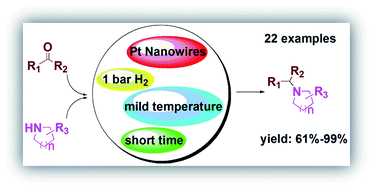
In our previous work, we demonstrated that Pt NWs showed a high catalytic activity and selectivity towards the hydrogenation of aromatic compounds, carbonyls, nitro-compounds and reversible hydrogenation-oxidative dehydrogenation of quinolines.19–23 Moreover, our group obtained tertiary amines from hydrogenation and deamination of nitriles with excellent yields.24 Besides, Nishimura has ever reported related contents about the formation of tertiary amine.25 Several heterogeneous catalyst were successfully applied in the formation of tertiary by reductive alkylation of secondary amines with carbonyl compounds. Inspired by these works, we assumed that the nitriles could be substituted with aldehydes to form tertiary amines, because the aldehydes can be easily obtained and much more cheap. Therefore, this reaction system could meet the demand of industrial production.
Hence, we report a heterogeneous catalytic system which is extremely effective in the direct formation of tertiary amine by interaction of aldehydes with secondary amines over ultra-thin Pt NWs catalyst. And it proves to be much faster and more eco-friendly than that in previous researches. Due to the prominent stability which can be easily recovered and recycled with no loss of catalytic activity and the exceptionally high catalytic activity, Pt NWs catalyst with no supports could meet all the requirements for green chemistry under mild reaction conditions. Pt NWs as heterogeneous catalyst have important advantages in separating products and recycling without any loss of activity, in stark contrast to most supported nanocatalysts and homogeneous metal catalysts.
To confirm the feasibility of our concept, ultra-thin Pt NWs catalyst was synthesized through acidic etching of FePt NWs, followed by repeated centrifugation and washing for several times with methanol,23 the ultimate prepared material was dispersed in methanol for further use. No Fe element was detected by inductively coupled plasma (ICP) analysis (the content of Fe element is 0) indicating that Fe was completely removed from the FePt NWs. TEM and HR-TEM images indicate that the diameter of NWs is approximately 1.5 nm and several micrometers in length (see the ESI†). At the beginning of this study, benzaldehyde and piperidine were selected as the model reaction substrates to assess the possibility of hydrogenating aldehydes with secondary amines to obtain tertiary amines (Scheme 1). As shown in Scheme 1, 1-benzylpiperidine was the major product and phenylmethanol was the main side product. Many control experiments were carried out to optimize the reaction conditions.
![]() | ||
| Scheme 1 The formation of tertiary amine by interaction of benzaldehyde with piperidine catalysed by Pt NWs. | ||
Table 1 shows the hydrogenation results of benzaldehyde with piperidine under different reaction conditions. Water was firstly used as the solvent at 40 °C and 80 °C under an initial hydrogen pressure of 1 bar. The yields of 1-benzylpiperidine were 29% (Table 1, entry 1) and 64% (Table 1, entry 2), respectively. Also, alcohols were used as solvents in this reaction including methanol and ethanol (Table 1, entries 3–4). The yield of 1-benzylpiperidine could reach up to 99% in ethanol at 80 °C under a hydrogen pressure of 1 bar for 3 hours (Table 1, entry 5). In addition, we selected p-xylene, dioxane, DMF, toluene and n-heptane as solvents for this reaction (Table 1, entries 6–10). However, no better yields of target product were obtained. Among all solvents we used, ethanol is the most appropriate solvent for this reaction because it is environmentally friendly and effectively free as well as high yield. Furthermore, worse results were observed when this reaction was performed with platinum nanorods (Pt NRs)23 and platinum nanoparticles (Pt NPs)23 as catalysts (Table 1, entries 11–12). As expected, no hydrogenated products were observed without catalyst or hydrogen. Commercial Pt/C catalyst was also used to draw a comparison to Pt NWs catalyst (see the ESI†). As a result, it was demonstrated that Pt NWs and H2 were essential for interaction of aldehydes with secondary amines (Table 1, entries 13–14).
| Entry | Solvent | Catalyst | T (°C) | Conv.b (%) | Select.b (%) |
|---|---|---|---|---|---|
| a Reaction conditions: benzaldehyde (1.0 mmol), piperidine (1.1 mmol) and solvent (2 mL) at 1 bar H2 with 0.005 mmol Pt NWs for 3 h.b GC yield.c The reaction was performed without H2. | |||||
| 1 | Water | Pt NWs | 40 | 76 | 38 |
| 2 | Water | Pt NWs | 80 | 92 | 70 |
| 3 | Methanol | Pt NWs | 40 | 100 | 60 |
| 4 | Ethanol | Pt NWs | 40 | 100 | 62 |
| 5 | Ethanol | Pt NWs | 80 | 100 | 99 |
| 6 | p-Xylene | Pt NWs | 80 | 100 | 91 |
| 7 | Dioxane | Pt NWs | 80 | 100 | 96 |
| 8 | DMF | Pt NWs | 80 | 100 | 95 |
| 9 | Toluene | Pt NWs | 80 | 100 | 94 |
| 10 | n-Heptane | Pt NWs | 80 | 100 | 89 |
| 11 | Ethanol | Pt NRs | 80 | 45 | 2 |
| 12 | Ethanol | Pt NPs | 80 | 96 | 56 |
| 13 | Ethanol | — | 80 | 0 | 0 |
| 14c | Ethanol | Pt NWs | 80 | 0 | 0 |
Under the optimal reaction conditions (Table 1, entry 5), we proceeded to explore the scope of this catalytic reaction using a series of para, meta, ortho-substituted aldehydes as substrates with piperidine. The results of these scoping experiments are summarized in Table 2. As shown in Table 2, different substituted aldehydes reacted with piperidine to form corresponding tertiary amines under 1 bar H2 in ethanol for 3 hours. The hydrogenation of o-, m-, p-substituent benzaldehydes with piperidine (Table 2, entries 1–10) could afford the desired tertiary amines with high yields superior to 90%. And we can find that the functional groups showed little influence on the formation of tertiary amines. However, the steric hindrance of the substituents was closely related to the yield of the target product. Substituents with smaller steric hindrance could afford higher yield of tertiary amines (entries 1–3), o-, m-, p-methyl benzaldehyde corresponds to yields of 83%, 90%, 99%, respectively. Aliphatic aldehydes could also give a perfect yield higher than 98% (Table 2, entries 11 and 12). Several other heterocyclic aldehydes were also employed as substrates and gave decent results (Table 2, entries 13 and 14). Interestingly, para-tertiary amines could be received when terephthalaldehyde was used as substrate (Table 2, entry 15). Furthermore, relatively inactive cyclohexanone could also react with piperidine and gave corresponding product with a good yield of 80% (Table 2, entry 16).
| Entry | Substrate | Product | Conv.b (%) | Yieldb (%) |
|---|---|---|---|---|
| a Substrate (1 mmol), piperidine (1.1 mmol), ethanol (2 mL), Pt NWs (0.005 mmol) and 1 bar of H2, 80 °C, 3 h.b Determined by GC and GC-MS.c 2.2 mmol piperidine.d 6 h. The numbers in parenthesis refer to the yields of isolated products. | ||||
| 1 | ![]() |
![]() |
91 | 82(79) |
| 2 | ![]() |
![]() |
99 | 90(88) |
| 3 | ![]() |
![]() |
100 | 99(96) |
| 4 | ![]() |
![]() |
100 | 94(91) |
| 5 | ![]() |
![]() |
100 | 94(92) |
| 6 | ![]() |
![]() |
100 | 95(92) |
| 7 | ![]() |
![]() |
100 | 94(90) |
| 8 | ![]() |
![]() |
100 | 98(95) |
| 9 | ![]() |
![]() |
100 | 91(87) |
| 10 | ![]() |
![]() |
100 | 94 |
| 11 | ![]() |
![]() |
100 | 99 |
| 12 | ![]() |
![]() |
100 | 98(94) |
| 13 | ![]() |
![]() |
94 | 91(88) |
| 14 | ![]() |
![]() |
90 | 90(88) |
| 15c | ![]() |
![]() |
100 | 95(93) |
| 16d | ![]() |
![]() |
80 | 80 |
In view of these results, several kinds of secondary amines as substrates were subjected to the reaction for the formation of tertiary amines (Table 3). Annular secondary amines can all provide high yields (Table 3, entries 1–4). The exceedingly inactive diethylamine could even afford desired product with a moderate yield of 61% (Table 3, entry 5).
| Entry | Substrate | Product | Conv.b (%) | Select.b (%) |
|---|---|---|---|---|
| a Substrate (1.1 mmol), benzaldehyde (1 mmol), ethanol (2 mL), Pt NWs (0.005 mmol) and 1 bar H2, 80 °C, 3 h.b Determined by GC and GC-MS.c 2.2 mmol benzaldehyde.d 6 h. The numbers in parenthesis refer to the yields of isolated products. | ||||
| 1 | ![]() |
![]() |
100 | 95(91) |
| 2 | ![]() |
![]() |
100 | 97(94) |
| 3c | ![]() |
![]() |
100 | 81 |
| 4 | ![]() |
![]() |
100 | 97(93) |
| 5d | ![]() |
![]() |
100 | 61 |
In order to get the possible mechanism of this reaction, kinetic experiment (tenfold amount of substrates was added) was carried out. The time-dependent conversion of the hydrogenation of benzaldehyde with piperidine was on account of the GC analysis. From the Fig. 1 we can see, under the optimized reaction conditions, benzaldehyde reacted swiftly with piperidine to form the tertiary amine with a perfect yield of only within 30 minutes.
According to the kinetic picture and literature,26–31 we have proposed a plausible mechanism for the reaction shown in Scheme 2. In the progress, Pt NWs played a predominant role in activating H2 and eliminating a molecular of water, making sure this reaction could successfully conduct and offer high-yield target products. With the purpose of certifying the catalytic stability of Pt NWs, cycle experiments were carried out over ten times. As seen in Fig. 2, the Pt NWs catalyst can be expediently recycled and reused for many times without any attenuation in catalytic activity and selectivity. After the reaction, the Pt NWs can be separated and reused by centrifugation and washing with methanol and hydrochloric acid (0.1 M) and the TEM image of Pt nanowires after ten cycles was observed (see the ESI†). Moreover, platinum ion could not be detected by atomic absorption spectrum (AAS) and inductively coupled plasma mass spectrometry (ICP-MS).
Footnote |
| † Electronic supplementary information (ESI) available: Experimental details, additional figures, 1H NMR and 13C analysis of products. See DOI: 10.1039/c5ra12299f |
| This journal is © The Royal Society of Chemistry 2015 |