DOI:
10.1039/C5RA11059A
(Paper)
RSC Adv., 2015,
5, 66334-66338
Highly stretchable cell-cultured hydrogel sheet†
Received
10th June 2015
, Accepted 27th July 2015
First published on 27th July 2015
Abstract
A free-standing cell-cultured hydrogel sheet with stretchability was prepared for an in vitro cellular assay with mechanical stimulation. The anti-fouling surface of the stretchable double network (DN) hydrogel composed of poly(2-acrylamido-2-methyl-1-propanesulfonic acid sodium salt) (PNaAMPS) and poly(N,N-dimethylacrylamide) (PDMAAm) was modified as the cell adhesive by additional polymerization of PNaAMPS at the surface region of the DN hydrogel in the depth of around 170 μm, while preserving the original stretchability and molecular permeability. The mechanically stable and flexible hydrogel sheet holding the culture medium has the advantage that it can be handled with tweezers in air, and cells adhered on the sheet maintain physiological activity during transportation of the film for in vitro assays. The stretchability of the free-standing culture sheet allows for the observation of the Ca2+ response of epidermal keratinocytes upon mechanical stimulation.
Introduction
The cellular response to mechanical stimulation is one of the most important physiological functions that have been difficult to quantify in vivo. Especially, the effects of mechanical stretching on the cellular morphology, proliferation, lineage commitment, and differentiation have been reported for the tissue engineering of bone, muscle, cartilage, blood vessel, neuron, skin, etc.1 A typical method to apply stretching to the cells in vitro utilizes physical deformation of a culture substrate composed of silicone rubber such as polydimethylsiloxane (PDMS).2,3 For stable cell cultivation even on stretching, the surface of PDMS is chemically modified with cell adhesive molecules and polymers.2,3 The PDMS film containing an array of micropores serves as the quasi-permeable culture substrate which is useful for air/liquid interface cultivation4 and the diaphragm-type co-cultivation.5 However, the preparation of the porous PDMS is troublesome because densely arrayed micropores decrease mechanical stability of the thin PDMS film, as well as the nutrient supply through the micropores is restricted.
Totally permeable hydrogels are promising substrate materials for in vitro cell cultivation.6–11 Furthermore, recent progress in hydrogel synthesis enabled the preparation of stretchable hydrogels such as a double network (DN) hydrogel, which consists of two interpenetrated polymer networks: one is made of highly cross-linked rigid and brittle polymers (the first network) and the other is made of loosely cross-linked flexible polymers (the second network).12 These stretchable hydrogels would be alternative to conventional PDMS-based culture substrate. However, the surface property of typical DN hydrogel composed of polymers of 2-acrylamido-2-methyl-1-propanesulfonic acid sodium salt (NaAMPS) and N,N-dimethylacrylamide (DMAAm) is not suitable for cell adhesion and proliferation. Although the first network of PNaAMPS is known as bioadhesive, overall property tends to be dominated by that of the second network, PDMAAm, which is inert for protein and cell adhesion. Although a triple network (TN) hydrogel composed of a PNaAMPS/PDMAAm DN hydrogel additionally entangled with a bioadhesive PNaAMPS third polymer can be used for cell cultivation,13 the densely cross-linked PNaAMPS third polymer network induces brittleness in the DN hydrogel.14
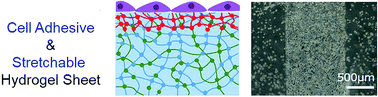
Here, we study the technique to modify the anti-fouling surface of the DN hydrogel as cell-adhesive while keeping original stretchability and molecular permeability. The cell-adhesive PNaAMPS was additionally entangled at only the surface region of DN hydrogel sheet as schematically illustrated in Fig. 1. The resulting stretchable, cell-adhesive hydrogel sheet was used for cultivation of epidermal keratinocytes.
 |
| | Fig. 1 Illustration of the surface region-modified DN hydrogel for free-standing cell culture hydrogel sheet with preserving original stretchability and molecular permeability of the DN hydrogel. The blue and green colored lines denote two kinds of polymers that compose an original DN hydrogel, and the red line is a polymer additionally entangled at the surface region of the DN hydrogel. | |
Experimental
Surface modification of double network hydrogel
The double network hydrogel was prepared according to previously reported protocols.13 The first prepolymer solution containing 1 M 2-acrylamido-2-methyl-1-propanesulfonic acid sodium salt (NaAMPS, Sigma Aldrich) as a monomer, 40 mM N,N′-methylenebis(acrylamide) (MBAA, Wako Pure Chemicals) as a crosslinker, and 1 mM 2-oxoglutaric acid (Wako Pure Chemicals) as a photoinitiator was prepared. The solution was poured into the reaction chamber composed of two glass plates binding with a silicone spacer of 0.2 mm thickness. The reaction chamber was irradiated with UV light (365 nm, 8 W, Funakoshi) for 6 h in a nitrogen-filled glovebox. The obtained PNaAMPS hydrogel sheet was immersed in the second aqueous solution containing 3 M N,N-dimethylacrylamide (DMAAm, Sigma Aldrich), 3 mM MBAA, and 1 mM 2-oxoglutaric acid for 2 days at room temperature in the dark. The hydrogel sheet was again irradiated with UV light for 6 h in the nitrogen-filled glovebox to polymerize the second hydrogel, followed by washing with distilled water overnight to remove residual cytotoxic monomers. The resulting DN hydrogel has a thickness of about 0.5 mm after swelling in distilled water.
Fig. 2 shows the process of the additional network formation at the surface region of the DN hydrogel. The DN hydrogel sheet was put on the pool of the third prepolymer solution (1 mL cm−3 in a silicone chamber) containing 2 M NaAMPS, 80 mM MBAA, and 40 mM 2-oxoglutaric acid (Fig. 2a–c), and immediately irradiated with UV light (power: 350 mW cm−2, exposure time: 10 s, Hamamatsu Photonics LIGHTNINGCURE LC8 L9588) (Fig. 2d). The resulting surface region-modified DN (smDN) hydrogel and the third polymer formed in the chamber can be easily divided by tweezers (Fig. 2e) because of the large difference in their swelling ratios. For the patterning of surface modification, the UV was irradiated through a photomask. For fluorescent imaging of the third polymer in the smDN hydrogel, 1 mg mL−1 of fluorescein o-acrylate (Sigma Aldrich) was mixed with the third prepolymer solution. The wholly modified triple network (TN) hydrogel was prepared by immersing a DN hydrogel film in the third prepolymer solution with the same composition described above for 2 days, followed by UV irradiation (power: 350 mW cm−2, exposure time: 10 s). The hydrogel was washed with distilled water overnight to remove residual cytotoxic monomers. A fluorescent intensity profile of the cross-section of the smDN hydrogel was obtained from the three-dimensional confocal fluorescent image captured by a confocal microscopy with the ZEN software (Zeis). The vertical slice of the three-dimensional image was analysed by ImageJ software to plot the fluorescent intensity versus the Z coordinate.
 |
| | Fig. 2 Illustration of the process of additional network formation at the surface region of the DN hydrogel. (a–c) The DN hydrogel sheet was mounted on the pool of the third prepolymer solution. (d) The DN hydrogel was immediately irradiated with UV light (power: 350 mW cm−2, exposure time: 10 s). (e) The resulting surface region-modified DN hydrogel and the third polymer formed in the chamber was divided by tweezers. | |
Measurement of water uptake and porosity of the hydrogel
The equilibrium water uptake of the hydrogel was calculated as (Weq − Wdry)/Wdry × 100 (%), where Weq and Wdry denote the equilibrium wet weight and dry weight of the hydrogel, respectively.15 The porosity was calculated as (Weq − Wdry)/Vρ × 100 (%), where V is the volume of equilibrium wet hydrogel and ρ is the density of water.16 Three samples were taken for each measurement. The calculated values were shown as the mean ± standard error.
Evaluation of mechanical characteristics of the hydrogels
Tensile mechanical properties of the hydrogels were measured using a commercial axial-loading system (IMADA) under air. The hydrogel stripes (length: 30 mm, width: 10 mm, thickness: 0.5 mm) were mounted on the system, where the sample length between two clamps was 10 mm. The stress–strain curves were recorded while the sample was stretched parallel to the long axis of the stripe at a constant rate of 0.36 mm s−1.
Evaluation of permeability of the hydrogel
The acrylic chamber filled with PBS solution containing 50 μg mL−1 of Alexa Fluor 488 IgG solution (Molecular Probes) was covered with the smDN hydrogel. The IgG molecules penetrating through the smDN hydrogel were captured by another agarose hydrogel placed on the smDN hydrogel (ESI Fig. S4†). After the penetration for 1 h, the fluorescent image of the cross section of the agarose was captured by an inverted fluorescence microscope with excitation at 488 nm and detection at 530 nm.
Cell culture and intracellular Ca2+ imaging
The circular form of smDN hydrogel (20 mm diameter) was sterilized by an autoclave at 120 °C for 20 min at 2 atm. Then, the hydrogel was soaked into 0.15 mg mL−1 collagen type I-A solution (Nitta Gelatin) diluted by 1 mM HCl solution for 1 h at room temperature to coat the collagen fibril on the hydrogel surface for facilitating cell adhesion. The collagen-coated smDN hydrogel was immersed in the culture medium (Epilife, Life Technologies) for 1 h at room temperature for solvent exchange. Human epidermal keratinocytes (Life Technologies) were seeded on the collagen-coated smDN hydrogel at a density of 1.1 × 10⁵ cells per cm2 and were cultured at 37 °C under 5% CO2 atmosphere.
After 4 days of culture, the cell-cultured smDN hydrogel sheet was immersed in serum free medium containing fluorescent calcium indicator, fluo-4 AM (Dojindo), for 30 min at 37 °C. Serum was removed because it significantly increases background fluorescence and decreases the S/N ratio. Cells were imaged with excitation at 488 nm and emission at 530 nm with a time lapse with 3 s intervals. The fluorescent images shown in Fig. 6b represents the change of fluorescent intensities that was calculated by subtracting fluorescent intensity of the image obtained at time 0 s from that of original fluorescent images.
Results and discussion
In order to clarify the effect of surface modification of the DN hydrogel, the UV irradiation for polymerization of the third polymer was conducted through a photomask (Fig. 3a). The contact angle of water on the surface region-modified area (19°) was lower than that of the original DN hydrogel area (40°), clearly suggesting entanglement of the hydrophilic third PNaAMPS polymer to the surface region of the DN hydrogel (ESI Fig. S1†).17 Fig. 3b shows the image of fluorescently labeled collagen type I (Chondrex) adsorbed on the hydrogel film prepared using a photomask (1 mm line and space). Consistent with the result of contact angle measurement, a clear band form of fluorescent image was obtained corresponding to the original design of the photomask. Fig. 3c shows keratinocytes cultured on the collagen-adsorbed hydrogel film, in which the cells adhered and spread (ESI Fig. S2a†) to form a band pattern because collagen type I is one of the most important components as an extracellular matrix facilitating epidermal keratinocyte adhesion in vivo.18 No cells were visible on the microscope when the inside of the smDN hydrogel film was focused, which indicated that cells were not internalized in the hydrogel film. This is probably because of a densely cross-linked non-biodegradable polymer network in the smDN hydrogel.19 The same result was suggested in the previous in vitro study using a TN hydrogel cell culture.13 On the other hand, the cells adsorbed on the surrounding were in a round form even after a week of culture. A previous study suggested that a DN hydrogel composed of PNaAMPS and PDMAAm does not facilitate cell spreading and proliferation.13 Although the first network of PNaAMPS is cell adhesive,13,20 overall property is dominated by that of the second network of PDMAAm, which is inert for protein and cell adhesion. The results shown in Fig. 3 prove that the additionally entangled PNaAMPS at the surface region of the DN hydrogel sheet turned the surface bioadhesive. The appearance of bioadhesive property was 100% reproducible for our experiments using the third prepolymer solution of 2 M NaAMPS and 80 mM MBAA. It is worthwhile to note that, in order to ensure the reproducibility, 10 s irradiation of 350 mW cm−2 UV light was required; the shorter irradiation often caused irregular modification, resulting in fewer cells adhering on the gel (ESI Fig. S2b and c†).
 |
| | Fig. 3 (a) Illustration of the localized surface modification of DN hydrogels by photopolymerization of the third NaAMPS polymer through a photomask. (b) A fluorescence microscopy image of fluorescently labeled collagen type I adsorbed on the smDN hydrogel. (c) A bright-field microscopy image of keratinocytes cultured on the collagen-adsorbed smDN hydrogel. | |
Fig. 4 shows the typical tensile mechanical properties of the original DN (black), TN (blue), and smDN (red) hydrogels. Rectangular pieces of hydrogel (10 mm width, 30 mm length, 0.5 mm thickness) were stretched parallel to the 30 mm axis by the tensile speed of 0.36 mm s−1. The original DN hydrogels showed typical S-shaped profile until reaching 0.8 strain. Gong et al. suggested the strain mechanism of the DN hydrogel as follows: elastic deformation occurs first before reaching about 0.1 strain, and then, the brittle first PNaAMPS network is gradually broken into small clusters chemically connected by stretchable second PDMAAm chains to efficiently disperse the applied stress, followed by mainly stretching PDMAAm chains.21–23 The smDN hydrogel was also stretchable as shown in ESI Fig. S3† and could be stretched to 0.8 strain without any apparent cracks on its surface under microscopy observation. The obtained stress–strain profile for the smDN hydrogel was similar to that of the original DN hydrogel, indicating the preserved stretchability through the surface-limited modification of the DN hydrogel with the third polymer. On the other hand, the wholly modified TN hydrogel was broken at only 0.2 strain, probably because the rigid and brittle third polymer network uniformly cross-linked with the DN hydrogel diminished original stretchability of the second polymer chain. It is difficult to use such a brittle hydrogel for in vitro assay mimicking human skin stretching at a knee joint that is accompanied by strain up to 0.5
24 and traumatic brain injury using brain-derived neurons that is accompanied by strain up to 0.7.25,26 Young's moduli of the three hydrogels, DN hydrogel (824.6 ± 45.3 kPa, n = 3), TN hydrogel (1825.9 ± 92.8 kPa, n = 3), and smDN hydrogel (1164.6 ± 61.3 kPa, n = 3), were derived from the initial angle of stress–strain curves at less than 0.1 strain where the hydrogel shows elastic deformation.22,23 Small variation in each value indicates that the tensile test was reproducible. To speculate the depth of third polymer network complexly entangled with the surface region of DN hydrogel, the structure of smDN hydrogel was assumed as a simple laminate of elastic films composed of TN hydrogel and DN hydrogel. The theoretical Young's modulus of the laminate (E) is expressed by the following equation:27
where
E1,
E2,
t1, and
t2 are Young's moduli and thickness of the film 1 (TN hydrogel) and film 2 (DN hydrogel), respectively.
t is the total thickness of the laminate, 0.5 mm. By substituting the measured values for
E,
E1, and
E2 in the
eqn (1), the depth of the additionally entangled layer was calculated to be in the range of 174.2 ± 32.0 μm. The result was reproducible when UV irradiation (10 s) was applied immediately after mounting the DN hydrogel on the pool of the third prepolymer.
 |
| | Fig. 4 Stress–strain curves of the original DN (black), TN (blue), and smDN (red) hydrogels. The stress–strain curves were measured for three specimens for each of the DN, smDN, and TN hydrogel, and the representative curves of each hydrogel were shown in this figure. Young's moduli of the three hydrogels shown as the mean ± standard error was 824.6 ± 45.3 kPa (DN hydrogel), 1825.9 ± 92.8 kPa (TN hydrogel), and 1164.6 ± 61.3 kPa (smDN hydrogel), respectively. | |
The depth of modification was also studied by fluorescent staining of the third polymer network in the smDN hydrogel (Fig. 5). A fluorescein-labeled acrylate monomer was mixed with the third prepolymer solution and diffused into a DN hydrogel to be copolymerized into the third polymer network in the DN hydrogel. The observed fluorescence image of the cross section of smDN hydrogel showed that the fluorescently stained third polymer was polymerized at the surface region of the smDN hydrogel (Fig. 5a). Fluorescent intensity profile calculated from Fig. 5a showed that the depth of modification during 10 s of UV irradiation was around 170 μm (Fig. 5b), which is similar to that of calculated above. Assuming one dimensional diffusion of the monomer 170 μm into the DN hydrogel during 10 s of UV irradiation, the diffusion constant was 1.4 × 10⁻⁵ cm2 s−1 calculated using the equation for the root-mean-square displacement at time t,
, which is similar to the typical diffusion constant in hydrogels.28
 |
| | Fig. 5 (a) Fluorescent image of the cross-section of the smDN hydrogel with fluorescently labeled third polymer network. (b) Fluorescent intensity profile depending on the distance from the smDN hydrogel surface. | |
The molecular permeability was tested for the smDN hydrogel by using fluorescently labeled IgG as a marker molecule (ESI Fig. S4†). The IgG molecules freely penetrated across the smDN hydrogel film. Since the molecular weight of IgG (ca. 160 kDa) is larger than that of almost all components in the culture medium,29 it is expected that the supplement of the nutrient compounds through the smDN hydrogel to the cells cultured on the film is sufficient.
Mechanical stretching assay of the free-standing keratinocyte monolayer cultured on the smDN hydrogel was demonstrated using the setup illustrated in Fig. 6a. The mechanically stable and flexible hydrogel sheet with a keratinocyte monolayer enables easy manipulation with tweezers while holding the culture medium in the gel (water uptake: 654.1 ± 2.5%, porosity: 88.7 ± 1.9%) during transportation of the film (0.5 mm thickness). The keratinocyte monolayer was cultured on the circular form of collagen-coated smDN hydrogel sheet (20 mm diameter), and stained with fluo-4 for imaging of cytosolic Ca2+. The back of the hydrogel was transiently pushed down (indent depth: ca. 2 mm) for 1 s with a glass rod (1 mm diameter) with time-lapse observation of fluorescent intensity at 3 s intervals. Fig. 6b shows the typical fluorescence images obtained before and after the mechanical stimulation, exhibiting the propagation of Ca2+ waves from the center of the hydrogel sheet (3 s) to the whole (21 s). The fluorescence intensity of the cells (cytosolic Ca2+ concentration) gradually decreased by the following 108 s. This temporal increase of intracellular Ca2+ and propagation of Ca2+ waves is the typical response of mechanically stimulated keratinocytes.30 Almost all the cells reproducibly exhibited the Ca2+ response to the mechanical stimulation even after 4 days of culture on the smDN hydrogel, suggesting that the smDN hydrogel sheet does not have cytotoxicity to the cultured cells.
 |
| | Fig. 6 (a) Illustration of the setup for mechanical stretch stimulation of the keratinocyte monolayer on the smDN hydrogel. (b) Snapshots of the fluorescence images of fluo-4-loaded keratinocytes before and after the mechanical stimulation. The assays were conducted at three different local areas on the same cell-cultured smDN hydrogel and the representative response was shown in this figure. | |
Conclusions
In summary, we developed in this study a technique to prepare a stretchable, cell-adhesive hydrogel sheet that can be used for in vitro cellular assay. Furthermore, the hydrogel sheet is applicable for mechanical stimulation to the cells. The cells supported by the free-standing hydrogel sheet containing culture medium can be handled while keeping their physiological activity. It is also possible to make cellular micropatterns on the present stretchable hydrogel by printing bioadhesive materials such as Matrigel.11 In addition, molecular permeability is the further advantage of the present hydrogel sheet that provides the quasi air/liquid interface cultivation necessary for epidermal skin tissue engineering.31–33 Further research is in progress along this way.
Acknowledgements
This work was partly supported by Center of Innovation Program (COI), Creation of Innovation Centers for Advanced Interdisciplinary Research Area Program from Japan Science and Technology Agency, JST, Regional Innovation Strategy Support Program “Knowledge-based Medical Device Cluster/Miyagi Area”, and by Grand-in-Aid for Scientific Research A (25246016) and Challenging Exploratory Research (K15K13315) from the Ministry of Education, Culture, Sports, Science and Technology, Japan.
Notes and references
- B. D. Biehl, J. H. Park, I. K. Kwon and J. Y. Lim, Tissue Eng., Part B, 2012, 18, 288 CrossRef PubMed
. - E. Kang, J. Ryoo, G. S. Jeong, Y. Y. Choi, S. M. Jeong, J. Ju, S. Chung, S. Takayama and S. H. Lee, Adv. Mater., 2013, 25, 2167 CrossRef CAS PubMed
. - Y. Kamotani, T. Bersano-Begey, N. Kato, Y. C. Tung, D. Huh, J. W. Song and S. Takayama, Biomaterials, 2008, 29, 2646 CrossRef CAS PubMed
. - D. Huh, B. D. Matthews, A. Mammoto, M. Montoya-Zavala, H. Y. Hsin and D. E. Ingber, Science, 2010, 328, 1662 CrossRef CAS PubMed
. - Q. Chen, J. Wu, Q. Zhuang, X. Lin, J. Zhang and J. M. Lin, Sci. Rep., 2013, 3, 2433 Search PubMed
. - D. Seliktar, Science, 2012, 336, 1124 CrossRef CAS PubMed
. - J. Thiele, Y. Ma, S. M. Bruekers, S. Ma and W. T. Huck, Adv. Mater., 2014, 26, 125 CrossRef CAS PubMed
. - N. N. Kachouie, Y. Du, H. Bae, M. Khabiry, A. F. Ahari, B. Zamanian, J. Fukuda and A. Khademhosseini, Organogenesis, 2010, 6, 234 CrossRef PubMed
. - K. Nagamine, T. Kawashima, T. Ishibashi, H. Kaji, M. Kanzaki and M. Nishizawa, Biotechnol. Bioeng., 2010, 105, 1161 CAS
. - K. Nagamine, T. Kawashima, S. Sekine, Y. Ido, M. Kanzaki and M. Nishizawa, Lab Chip, 2011, 11, 513 RSC
. - K. Nagamine, T. Hirata, K. Okamoto, Y. Abe, H. Kaji and M. Nishizawa, ACS Biomater. Sci. Eng., 2015, 1, 329 CrossRef CAS
. - J. P. Gong, Y. Katsuyama, T. Kurokawa and Y. Osada, Adv. Mater., 2003, 15, 1155 CrossRef CAS PubMed
. - Y. M. Chen, J. P. Gong, M. Tanaka, K. Yasuda, S. Yamamoto, M. Shimomura and Y. Osada, J. Biomed. Mater. Res., Part A, 2009, 88, 74 CrossRef PubMed
. - D. Kaneko, T. Tada, T. Kurokawa, J. P. Gong and Y. Osada, Adv. Mater., 2005, 17, 535 CrossRef CAS PubMed
. - T. P. Nquyen and B. T. Lee, J. Biomater. Appl., 2012, 27, 311 CrossRef PubMed
. - B. Mattiasson, A. Kumar, and I. Galaev, in Macroporous polymers: Production properties and biotechnological/biomedical applications, CRC Press, 1st edn, 2009, ch. 9, p. 216 Search PubMed
. - K. Yoshikawa, N. Kitamura, T. Kurokawa, J. P. Gong, Y. Nohara and K. Yasuda, BMC Musculoskeletal Disord., 2013, 14, 56 CrossRef CAS PubMed
. - S. Papini, D. Cecchetti, D. Campani, W. Fitzgerald, J. C. Grivel, S. Chen, L. Margolis and R. P. Revoltella, Stem Cells, 2003, 21, 481 CrossRef PubMed
. - H. Zhang, A. Qadeer and W. Chen, Biomacromolecules, 2011, 12, 1428 CrossRef CAS PubMed
. - Y. M. Chen, N. Shiraishi, H. Satokawa, A. Kakugo, T. Narita, J. P. Gong, Y. Osada, K. Yamamoto and J. Ando, Biomaterials, 2005, 26, 4588 CrossRef CAS PubMed
. - M. A. Haque, T. Kurokawa and J. P. Gong, Polymer, 2012, 53, 1805 CrossRef CAS PubMed
. - T. Nakajima, T. Kurokawa, S. Ahmed, W. L. Wu and J. P. Gong, Soft Matter, 2013, 9, 1955 RSC
. - H. Itagaki, T. Kurokawa, H. Furukawa, T. Nakajima, Y. Katsumoto and J. P. Gong, Macromolecules, 2010, 43, 9495 CrossRef CAS
. - T. Yamada, Y. Hayamizu, Y. Yamamoto, Y. Yomogida, A. Izadi-Najafabadi, D. N. Futaba and K. Hata, Nat. Nanotechnol., 2011, 6, 296 CrossRef CAS PubMed
. - E. F. Ellis, J. S. Mckinney, K. A. Willoughby, S. Liang and J. T. Povlishock, J. Neurotrauma., 1995, 12, 325 CrossRef CAS
. - M. Skotak, F. Wang and N. Chandra, J. Neurosci. Methods, 2012, 205, 159 CrossRef PubMed
. - D. Hull and T. W. Clyne, in An introduction to composite materials, Cambridge solid state science series, Cambridge University Press, Cambridge, 2nd edn, 1996, ch. 5, p. 78 Search PubMed
. - K. Vergote, Y. De Deene, E. Vanden Bussche and C. De Wagter, J. Phys.: Conf. Ser., 2004, 3, 205 CrossRef CAS
. - R. Mahesparan, B. B. Tysnes, K. Edvardsen, H. K. Hauqeland, I. G. Cabrera, M. Lund-Johansen, O. Engebraaten and R. Bjerkvig, Neuropathol. Appl. Neurobiol., 1997, 23, 102 CrossRef CAS PubMed
. - M. Tsutumi, K. Inoue, S. Denda, K. Ikeyama, M. Goto and M. Denda, Cell Tissue Res., 2009, 338, 99 CrossRef PubMed
. - M. Prunieras, M. Regnier and D. Moodley, J. Invest. Dermatol., 1983, 81, S28 Search PubMed
. - Y. Poumay, F. Dupont, S. Marcoux, M. Leclercq-Smekens, M. Herin and A. Coquette, Arch. Dermatol. Res., 2004, 296, 203 CrossRef CAS PubMed
. - A. Frankart, J. Malaisse, E. De Vuyst, F. Minner, C. L. de Rouvroit and Y. Poumay, Exp. Dermatol., 2012, 21, 871 CrossRef PubMed
.
Footnote |
| † Electronic supplementary information (ESI) available. See DOI: 10.1039/c5ra11059a |
|
| This journal is © The Royal Society of Chemistry 2015 |
Click here to see how this site uses Cookies. View our privacy policy here.