Magnetoplasmons in simple hexagonal graphite

Rong-Bin Chen*a, Chih-Wei Chiu*b and Ming-Fa Linc
aCenter of General Studies, National Kaohsiung Marine University, Kaohsiung 811, Taiwan. E-mail: rbchen@mail.nkmu.edu.tw
bDepartment of Physics, National Kaohsiung Normal University, Kaohsiung 824, Taiwan. E-mail: giorgio@fonran.com.tw
cDepartment of Physics, National Cheng Kung University, Tainan 701, Taiwan

Received 4th May 2015 , Accepted 2nd June 2015

First published on 3rd June 2015


Abstract

Magneto-electronic Coulomb excitations in simple hexagonal graphite (SHG) are studied within the random-phase approximation. They strongly depend on the direction and the magnitude of the transferred momentum q, and the magnetic field strength. The plasmon frequency dispersion in the perpendicular component qz in the primitive unit cell and its parallel component q are very different from each other. The former shows only one prominent peak. The plasmon frequency increases with qz, while the intensity of the plasmon peak exhibits the opposite behavior. The latter presents many plasmon peaks. Moreover, the threshold frequency of the loss spectrum for SHG is higher than that of monolayer graphene. As the field strength increases, the plasmon peaks are intensified. The group velocity for plasmon propagation along image file: c5ra08171h-t1.tif is typically positive for a fixed field strength. The qz-dependence of the plasmon frequency is gradually reduced with an increased field strength. Graphite somewhat differs from graphene in magneto-electronic excitations, including the intensity, number and frequency of magnetoplasmons.

1 Introduction

Graphene layers have attracted a lot of studies recently due to their successful production by mechanical friction1,2 and micromechanical cleavage.3 Very strong sp2 bonds in each graphene layer result in a threefold-coordinated planar structure with the remaining pz orbital perpendicular to the plane. These special π electrons dominate the physical properties at low energy. The interlayer interactions, owing to van der Waals forces, couple the graphene layers.4 Thus, the characteristics of the material have a strong dependence on the stacking configuration,5–7 layer numbers,8–13 and the interlayer atomic interactions.14–17 For AA-stacked simple hexagonal graphite (SHG), the π bands are no longer symmetric to the π* bands about the Fermi level EF = 0.18 The overlap of the lowest conduction band (c) and the highest valence band (v) leads to a few free carriers, and thus such a system is considered as a semi-metal. However, the electronic excitations provide a reasonable explanation for the measured absorption spectra and loss spectra. In this work, we mainly study low-frequency magneto-electronic Coulomb excitations in AA-stacked graphite, their dependence on the magnitude and the direction of the transferred momentum, and the magnetic field strength. A comparison with SHG in the absence of a magnetic field and monolayer graphene (MG) is also presented.

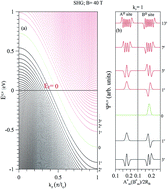
In the presence of a perpendicular magnetic field Bẑ, the planar motions of electrons are effectively quantized to form dispersionless Landau levels (LLs). Thus, in bulk graphite, the planar electrons’ motion turns into the Landau orbitals, while the motion along the field remains intact. The electronic bands of graphite are converted into one-dimensional ones, the so-called Landau subbands (LSs). The LSs of graphites exhibit many important features. Such as, SHG possesses very strong kz-dependent energy dispersions with a broad band width of about 1.4 eV (Fig. 1(a)), and each LS can be described by a simple relationship with kz.18,19 On the contrary, ABC-stacked rhombohedral graphite (RHG) presents weak kz-dependent dispersions with a narrow band width (∼10 meV).20 The energy dispersion of AB-stacked Bernal graphite (BG) has a band width of ∼0.2 eV,21,22 which lies between that of SHG and RHG, and two LSs cross EF. The low-lying LSs are complex and cannot be easily described by kz. The characteristics of LSs would be reflected in the magneto-optical spectra. For example, the magneto-optical absorption spectrum of SHG is dominated by intraband (c → c; v → v) and interband (v → c) excitations which induce a multi-channel peak, several two-channel peaks, and many double-peak structures.23 The prominent peaks of BG come from the interband excitations at both the K and H points. The peaks associated with the K point display double-peak structures.21,24


image file: c5ra08171h-f1.tif
Fig. 1 (a) The Landau subbands at B = 40 T, where the nc,v values are the quantum numbers. (b) The related wavefunctions associated with the Landau subbands at kz = 1, Ao and Bo represent the A and B sublattices with odd indices, respectively.

There are some theoretical studies on the magneto-electronic excitations in MG.8,25,26 The previous results show that single-particle excitations (SPE; e–h pairs) and collective excitations (plasmons) strongly depend on transferred momentum, magnetic-field strength, temperature, and the doped free carrier density. These two kinds of excitations, which are caused by Coulomb excitations from the occupied LLs to the unoccupied ones, can be clearly characterized by the special peak structures in the dielectric function and the energy loss function, respectively. The magnetoplasmons present non-monotonous momentum-dependence, indicating the strong competition between the longitudinal Coulomb oscillation and the transverse magnetic quantization. Furthermore, the critical momentum of the plasmon is determined by the Landau damping (the non-vanishing e–h pairs). An increase in temperature or free carrier density will induce new plasmon modes, but reduce the original plasmon intensities. Since the LSs have strong kz-dependent energy dispersions, SHG is expected to exhibit feature-rich magneto-electronic excitation spectra.

The magneto-electronic properties are studied by means of the Peierls tight-binding model and band-like matrix numerical techniques,23,24,27 through which the electronic structures at realistic magnetic fields can be solved. In the random-phase approximation (RPA), the complete structure of the dielectric function (ε) was determined. SPE and collective excitations can be presented as the imaginary part of the dielectric function ε2 and the loss function, respectively. The calculations of the electron-energy-loss spectroscopy (EELS) show that the π plasmon is characterized by the prominent peak. The π plasmon originates from interband excitations, and its cause will be studied. Electronic Coulomb excitations strongly depend on both the magnitude and direction of the transferred momentum q. The stacking order could further affect the anisotropy which is reflected in the main features of the dielectric function and thereby, the loss function. As a result of this anisotropy, the magnetoplasmon dispersions with respect to q are remarkably different between MG and AA-stacked graphite. Moreover, the group velocities of the magnetoplasmons in the long wavelength limit are typically positive as q is increased.

2 The Peierls tight-binding model and dielectric function

For simple hexagonal graphite, the geometric structure is formed by periodically stacked monolayer graphene along the z-direction. All the honeycomb structures in SHG have the same projections on the xy plane. The C–C bond length is b = 1.42 Å, and the interlayer distance is Ic = 3.50 Å.28 The primitive unit cell includes two atoms A and B; the intralayer and interlayer atomic interactions αi were obtained from the study by Charlier.15 When SHG is subjected to a Bẑ, the path integral of the vector potential induces a periodical Peierls phase.29 The phase term of the associated period is inversely proportional to the magnetic flux image file: c5ra08171h-t2.tif through a hexagon. To satisfy the integrity of the primitive cell, the ratio RB = Φ0/Φ(Φ0 = hc/e, flux quantum) has to be a positive integer. As a result, the extended rectangular unit cell has 4RB carbon atoms. The π-electronic Hamiltonian built from the 4RB tight-binding functions is a 4RB × 4RB Hermitian matrix. To solve this huge matrix problem, one can convert the Hamiltonian matrix into a band-like form by rearranging the tight-binding functions.23,24,27 Both eigenvalue Ec,v and eigenfunction Ψc,v are efficiently obtained, even for a small magnetic field. The superscripts c and v, respectively, represent the conduction and valence bands.

The main features of the magneto-electronic properties are directly manifested in the electronic Coulomb excitations. Electronic excitations are characterized by the transferred momentum q = (q[thin space (1/6-em)]sin[thin space (1/6-em)]θ, 0, q[thin space (1/6-em)]cos[thin space (1/6-em)]θ) = (q, 0, q) and the excitation energy ω; here, θ is the angle between q and the z-axis. At arbitrary temperature T, the dielectric function calculated for bulk graphite in the RPA30,31 is

 
image file: c5ra08171h-t3.tif(1)
where k and q are three-dimensional wave vectors, vq = 4πe2/q2 represents the bare Coulomb interactions, and ε0 = 2.4 is the background dielectric constant for graphite.32 Eh(k + q) and Eh(k) are the state energies of the final and initial states. The labels h(h′) denote the conduction or valence bands. Γ is the broadening parameter due to various de-excitation mechanisms and f(Eh(k)) is the Fermi–Dirac distribution function. In demonstrating the anisotropy of the dispersion relationship of the π-plasmons, it is considered that the inelastic scattering only involves q along the hexagonal plane in the Brillouin zone, i.e., kz is conserved and qz = 0.

3 Results and discussion

A magnetic field causes cyclotron motion in the xy plane; therefore, the LSs are formed along image file: c5ra08171h-t4.tif for SHG, as shown in Fig. 1(a). Each LS possesses two band-edge states K (kz = 0) and H (kz = π/Ic), respectively. The LS energies decrease as kz gradually grows. The main features of the wavefunctions could be utilized to define the quantum number of the LSs. The wavefunctions are composed of the subenvelope function (ϕn) of the harmonic oscillator, as shown in Fig. 1(b) for kz = 1 (π/Ic). The number of zero points (n) of (ϕn) is utilized to define the quantum number (nc or nv) of each LS. For the sake of convenience, the LS with a quantum number nc(nv) is represented as LSnc (LSnv). The wave function associated with the odd index Bo (Ao) sublattice of the LSnc,v=n is ϕn(ϕn−1). The numbers of zero points of ϕn values corresponding to the Bo sublattice are chosen as the quantum numbers of the LSs. The conduction (valence) LSs with small nc(nv) values crossing the EF imply that parts of these LSs are occupied states and the others are unoccupied states. Such a feature might cause intraband and interband transitions in the Coulomb excitations.

The calculated q-dependent SPE and collective plasmon modes due to the screened Coulomb interaction can be well described by the behavior of the imaginary part ε2 and the real part ε1 of the dielectric function. The special structures in ε2 and ε1 satisfy the Kramers–Kronig relationship because of the Coulomb response. The features display a peak structure in ε2, and a peak and dip structure along the zero points in ε1. As q = 0 and B = 40 T, the SPE spectrum ε2 only shows one peak which originates from intraband excitations (c → c; v → v), as shown in Fig. 2(a) by the blue curve. In the absence of a magnetic field, ε2 presents also only one prominent peak resulting from intraband excitation (circles in Fig. 2(a)). Such excitations come from the band states along the KH line.33 The dielectric functions in the B = 0 and B ≠ 0 cases are very similar to each other. The main reason is that a magnetic field causes cyclotron motion in the xy plane and q = 0 (k conserved). Furthermore, increasing qz reduces the peak intensity that occurs at higher frequencies, which involve lower LSs intraband and interband excitations (v → c) (Fig. 2(b)).


image file: c5ra08171h-f2.tif
Fig. 2 The real (ε1) and imaginary (ε2) parts of the dielectric function of SHG for different values of q and qz. (a) q = 0 and qz = 0.02, (b) q = 0 and qz = 0.04; q = 0 and qz = 0.08, (c) q = 0.02 and qz = 0. (d) The dielectric function of MG at q = 0.02 and qz = 0. For comparison, at B = 0 the dielectric function of SHG is also plotted. The unit of q (qz) is Å−1, here and elsewhere in this paper.

The electronic excitations are significantly changed by the direction of q; that is, they exhibit highly anisotropic behavior. As qz = 0 (kz conserved), the SPE spectrum is dominated by intraband and interband excitations. For B = 40 T, the first prominent peak of ε2 is associated with intraband excitations, as shown in Fig. 2(c) by the blue solid curve. For the frequency range ω > 0.1 eV, the SPE spectrum relates to interband excitations. For B = 0, SHG presents only one prominent peak in ε2 (circles in Fig. 2(c)), which is associated with intraband and interband excitations. In short, the special structures of ε exhibit a blue-shift and a weaker intensity in the increase of momentum, being determined by the LS energy dispersions and the q-dependent Coulomb interactions. The dielectric function might have more special structures for larger q.

To comprehend the effects in the absence of stacking on the ε, the spectra of MG are shown in Fig. 2(d). In the dielectric function of MG, each Landau level (LL) transition channel produces a symmetric peak in ε2 and a pair of asymmetric peaks along the zero points in ε1. MG does not exhibit any intraband excitation since the valence (conduction) LLs are occupied (unoccupied). In short, in the range of ω < 0.1 eV, q = 0 and a small qz value, the dielectric functions of SHG are alike in the B ≠ 0 and B = 0 cases. The absorption peaks (ε2) all originate from intraband excitations. However, under the condition that qz = 0, B ≠ 0, a small q value, and the frequency range ω > 0.1 eV, the dielectric function of SHG is related to interband excitations, and is similar to that of MG.

The energy loss function, defined as Im[−1/ε(q, ω)], is useful for comprehending the collective excitations and the directly measured excitation spectra. SHG presents only one peak in Fig. 3(a), for q = 0 and qz = 0.02 Å−1 at B = 40 T. The unit of q (qz) is Å−1, here and elsewhere in this paper. This peak is regarded to represent the collective excitations only arising from interband excitations. For ω < 0.6 eV, ε1 and ε2 are quite large and hardly contribute to the energy loss function. Furthermore, the temperature only has an effect on the composite threshold peak which is caused by intraband excitations.23 As a result, the temperature effects are negligible in the collective excitations. The higher plasmon intensity corresponds to a zero point in ε1 and a small value in ε2. At q = 0, the plasmon peaks are very prominent. The plasmon peaks diminish in their intensity and exhibit a blue-shift as qz increases (Fig. 3(b)). The loss spectra are very sensitive to a change in the direction of q. At q = 0.02 and qz = 0, the spectrum of SHG is shown in Fig. 3(c) by the solid blue curve. The plasmon peaks originating from the higher LS transitions have smaller heights mainly because of the reduced wave function overlap and the larger Landau damping out of the denser LS distribution. On the other hand, as the interlayer atomic interactions and the kz dependence are neglected, SHG can be considered as a MG in calculations. The loss spectrum of MG exhibits a lower threshold frequency and a higher intensity than that of SHG. These results indicate that SHG is subject to very strong Landau damping for a large value of ε2 in the low-frequency region (Fig. 2(c)). This reflects the fact that the LSs of SHG provide an effective kz-range, whereas the LLs of MG do not, as the weak van der Waals interlayer interactions4 induce many electrons and holes in the SHG configuration. At B = 0 and qz = 0, no prominent peak is shown in the low-frequency region. This clearly indicates that a uniform magnetic field can change the electron density of states and consequently enhances low-lying plasmon excitations. Apparently, the important differences between SHG and MG lie in the intensity, number and frequency of the plasmon peaks in the energy loss function. They come from dimension-dependent Coulomb interactions and magnetic energy subbands.


image file: c5ra08171h-f3.tif
Fig. 3 (a) At B = 40 T, the energy loss function of SHG for different values of q and qz. Panels (a) and (b) are at q = 0 and various qz values, and (c) q = 0.02 and qz = 0. The loss spectrum of MG at q = 0.02 and qz = 0 is plotted in panel (c). At B = 0, the energy loss function of SHG is illustrated for comparison.

The influence of the magnetic field strength on the loss spectrum deserves a closer examination. As Fig. 4 shows, at q = 0 one prominent peak is retained in the low-frequency range. When the field strength decreases, the loss spectrum presents red-shifted frequencies and a weaker intensity. This reflects the fact that the state degeneracy and effective kz range of the LSs are proportional to B. The variation of plasmon frequency with qz is shown in Fig. 5 for selected field strengths. The strong dispersion relationship of the plasmon frequency ωp with qz means that the plasmon oscillation behaves as a propagating wave with a wavelength of 2π/qz and a group velocity of ∇qzωp(qz). The group velocity of plasmon propagation along image file: c5ra08171h-t5.tif is typically positive for a fixed B. Moreover, ωp is finite when qz → 0 and is within the region of optical scattering spectroscopies. Therefore, the magnetoplasmon apparently belongs to an optical plasmon.34 The qz value significantly affects the plasmon frequency even at larger values. Moreover, the qz-dependence of ωp is gradually reduced with increasing field strength. This result directly reflects the characteristics of the LSs of SHG.


image file: c5ra08171h-f4.tif
Fig. 4 The energy loss functions at q = 0 and qz = 0.06 for different magnetic field strengths.

image file: c5ra08171h-f5.tif
Fig. 5 Plot of magnetoplasmon frequency as a function of qz and q = 0 for a certain field strength. The plasmon dispersion depends on the chosen magnetic field.

4 Conclusion

We have employed the Peierls tight-binding model to calculate the electron energy bands of SHG in a perpendicular magnetic field Bẑ. In the calculations, the intralayer and interlayer atomic interactions, magnetic fields and Coulomb interactions are taken into account simultaneously. A similar method can also be used to investigate magneto-electronic Coulomb excitations in AB- and ABC-stacked graphites. By means of rearranging the base functions, the eigenvalues and the wavefunctions can be efficiently obtained at a weaker field strength. With these results, we calculated the longitudinal dielectric function within the RPA. The dielectric function strongly depends on the direction, the magnitude of the transferred momentum q, and the magnetic field strength. In the range of ω < 0.1 eV, the qz-dependent dielectric functions of SHG are alike in the B ≠ 0 and B = 0 cases; the absorption peaks all originate from the intraband excitations. However, for the range ω > 0.1 eV (B ≠ 0), the q-dependent dielectric functions of SHG are related to interband excitations. The plasmon dispersions in the qz-dependent and q-dependent cases are very different from each other. The former only exhibits a single prominent peak whose plasmon frequency ωp increases with qz, while its intensity diminishes. In the latter case, many peaks are present. Moreover, the loss spectrum of monolayer graphene exhibits a lower threshold frequency and a higher intensity than that of SHG. As the field strength increases, the plasmon peaks of the energy loss function are intensified. The group velocity for plasmon propagation along image file: c5ra08171h-t6.tif is typically positive for a fixed B. Furthermore, the qz-dependence of ωp is gradually reduced with increasing field strength. Certain important differences exist between SHG and MG, such as the strength, number, and frequency of magnetoplasmons. Electron energy loss spectroscopy or magneto-optical spectroscopy could be utilized to verify the predicted plasmons.

Acknowledgements

This work is supported in part by the NSC, under Grant no. NSC 102-2112-M-006-007-MY3.

References

  1. J. S. Bunch, Y. Yaish, M. Brink, K. Bolotin and P. L. McEuen, Nano Lett., 2005, 5, 287 CrossRef CAS PubMed.
  2. C. Berger, Z. Song, T. Li, X. Li, A. Y. Ogbazghi, R. Feng, Z. Dai, A. N. Marchenkov, E. H. Conrad, P. N. First and W. A. de Heer, J. Phys. Chem. B, 2004, 108, 19912 CrossRef CAS.
  3. K. S. Novoselov, A. K. Geim, S. V. Morozov, D. Jiang, Y. Zhang, S. V. Dubonos, I. V. Grigorieva and A. A. Firsov, Science, 2004, 306, 666 CrossRef CAS PubMed.
  4. D. D. L. Chung, J. Mater. Sci., 2002, 37, 1475 CrossRef CAS.
  5. K. F. Mak, J. Shan and T. F. Heinz, Phys. Rev. Lett., 2010, 104, 176404 CrossRef.
  6. Y. Liu, W. S. Lew, S. Goolaup, H. F. Liew, S. K. Wong and T. Zhou, ACS Nano, 2011, 5, 5490 CrossRef CAS PubMed.
  7. M. Koshino, New J. Phys., 2013, 15, 015010 CrossRef.
  8. O. L. Berman, G. Gumbs and Y. E. Lozovik, Phys. Rev. B: Condens. Matter Mater. Phys., 2008, 78, 085401 CrossRef.
  9. Z. S. Wu, W. Ren, L. Gao, B. Liu, C. Jiang and H. M. Cheng, Carbon, 2009, 47, 493 CrossRef CAS PubMed.
  10. Y. Hao, Y. Wang, L. Wang, Z. Ni, Z. Wang, R. Wang, C. K. Koo, Z. Shen and J. T. L. Thong, Small, 2010, 6, 195 CrossRef CAS PubMed.
  11. M. V. Katkov, V. I. Sysoev, A. V. Gusel’nikov, I. P. Asanov, L. G. Bulusheva and A. V. Okotrub, Phys. Chem. Chem. Phys., 2015, 17, 444 RSC.
  12. B. Partoens and F. M. Peeters, Phys. Rev. B: Condens. Matter Mater. Phys., 2006, 74, 075404 CrossRef.
  13. K. S. Kumar, S. Pittala, S. Sanyadanam and P. Paik, RSC Adv., 2015, 5, 14768 RSC.
  14. L. Samuelson, I. P. Batra and C. Roetti, Solid State Commun., 1980, 33, 817 CrossRef CAS.
  15. J.-C. Charlier, J.-P. Michenaud and X. Gonze, Phys. Rev. B: Condens. Matter Mater. Phys., 1992, 46, 4531 CrossRef CAS.
  16. X. Zhang and M. Zhao, RSC Adv., 2015, 5, 9875 RSC.
  17. M. Kocman, M. Pykal and P. Jurečka, Phys. Chem. Chem. Phys., 2014, 16, 3144 RSC.
  18. R. B. Chen and Y. H. Chiu, J. Nanosci. Nanotechnol., 2012, 12, 2557 CrossRef CAS PubMed.
  19. B. A. Bernevig, T. L. Hughes, S. Raghu and D. P. Arovas, Phys. Rev. Lett., 2007, 99, 146804 CrossRef.
  20. C. H. Ho, C. P. Chang, W. P. Su and M. F. Lin, New J. Phys., 2013, 15, 053032 CrossRef.
  21. K.-C. Chuang, A. M. R. Baker and R. J. Nicholas, Phys. Rev. B: Condens. Matter Mater. Phys., 2009, 80, 161410(R) CrossRef.
  22. Y. H. Ho, Y. H. Chiu, W. P. Su and M. F. Lin, Appl. Phys. Lett., 2011, 99, 011914 CrossRef PubMed.
  23. R. B. Chen, Y. H. Chiu and M. F. Lin, Carbon, 2013, 54, 268 CrossRef CAS PubMed.
  24. Y. H. Ho, J. Wang, Y. H. Chiu, M. F. Lin and W. P. Su, Phys. Rev. B: Condens. Matter Mater. Phys., 2011, 83, 121201(R) CrossRef.
  25. R. Roldán, J.-N. Fuchs and M. O. Goerbig, Phys. Rev. B: Condens. Matter Mater. Phys., 2009, 80, 085408 CrossRef.
  26. J.-Y. Wu, S.-C. Chen, O. Roslyak, G. Gumbs and M. F. Lin, ACS Nano, 2011, 5, 1026 CrossRef CAS PubMed.
  27. Y. H. Lai, J. H. Ho, C. P. Chang and M. F. Lin, Phys. Rev. B: Condens. Matter Mater. Phys., 2008, 77, 085426 CrossRef.
  28. J. K. Lee, S. C. Lee, J. P. Ahn, S. C. Kim, J. I. B. Wilson and P. John, J. Chem. Phys., 2008, 129, 234709 CrossRef PubMed.
  29. R. Saito, G. Dresselhaus and M. S. Dresselhaus, Physical Properties of Carbon Nanotubes, Imperial College Press, London, 1998, p. 98 Search PubMed.
  30. H. Ehrenreich and M. H. Cohen, Phys. Rev. A: At., Mol., Opt. Phys., 1959, 115, 786 Search PubMed.
  31. K. W.-K. Shung, Phys. Rev. B: Condens. Matter Mater. Phys., 1986, 34, 979 CrossRef CAS.
  32. E. A. Taft and H. R. Philipp, Phys. Rev. A: At., Mol., Opt. Phys., 1965, 138, A197 Search PubMed.
  33. F. L. Shyu and M. F. Lin, J. Phys. Soc. Jpn., 2001, 70, 897 CrossRef CAS.
  34. C. Kittel, Introduction to Solid State Physics, John Wiley & Sons, Inc., 8th edn, 2005, p. 96 Search PubMed.

This journal is © The Royal Society of Chemistry 2015
Click here to see how this site uses Cookies. View our privacy policy here.