
Wenfei Shen†
a,
Manjun Xiao†b,
Jianguo Tang*a,
Xinzhi Wanga,
Weichao Chen*b,
Renqiang Yang*b,
Xichang Baob,
Yao Wanga,
Jiqing Jiaoa,
Linjun Huanga,
Jixian Liua,
Wei Wanga and
Laurence A. Belfiore*ac
aInstitute of Hybrid Materials, The Growing Base for State Key Laboratory, Qingdao University, 308 Ningxia Road, Qingdao 266071, P. R. China. E-mail: jianguotangde@hotmail.com; belfiore@engr.colostate.edu; Fax: +86 532 85951519; Tel: +86 532 85951519
bQingdao Institute of Bioenergy and Bioprocess Technology, Chinese Acadamy of Sciences, 189 Songling Road, Qingdao, 266101, P. R. China. E-mail: chenwc@qibebt.ac.cn; yangrq@qibebt.ac.cn
cDepartment of Chemical and Biological Engineering, Colorado State University, Fort Collins, Colorado 80523, USA
First published on 11th May 2015
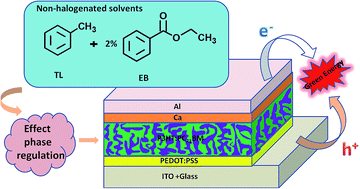
In this work, ethyl benzenecarboxylate (EB) was creatively selected as the additive in a blend of poly(3-hexylthiophene)/phenyl-C71-butyric acid methyl ester (P3HT/PC71BM) in non-halogenated solvent toluene (TL). With the optimized incorporating concentration of EB (i.e. 2 vol%) in toluene, a great power conversion efficiency (PCE) enhancement of 4.11% was achieved without thermal annealing, whereas a maximum PCE of 4.82% with thermal annealing was achieved under the same conditions. According to our systematic characterization results, we could conclude that we successfully regulated the micro-structures, including phase separation, the domain sizes of P3HT or PC71BM and the crystallinity of P3HT by incorporating 2 vol% EB in TL solution. The effectiveness of EB as a TL additive in P3HT/PC71BM can be interpreted based on its Hansen solubility parameters (HSPs) and its high boiling point.
A spontaneous interpenetrating network structure is formed in the drying process of the solvents, and therefore the choice of processing solvent can have a notable impact on the resulting microstructure and thus on the photovoltaic performance. At the very beginning of studying PSCs, researchers tried to utilize toluene and xylene, which were widely used as processing solvents for polymer light-emitting diodes (PLEDs)9 to fabricate PSCs;10 however, the results demonstrated that the PCE of devices fabricated with CB was 2.6 times higher than that of devices fabricated with toluene,11 and the photovoltaic performance of devices fabricated with o-DCB were considerably better than that of devices fabricated with xylene.10 Moreover, some other studies12–15 also demonstrated that utilizing only one single type of non-halogenated solvent could not achieve as good a photovoltaic performance as that of devices fabricated with halogenated solvents.
It has been well known that blend solvents offer the possibility to tailor the parameters of solvents such as solubility, boiling point, and viscosity;16–18 therefore, utilizing non-halogenated blend solvents or additives in non-halogenated solvents as the processing solvents of PSCs may be an effective method to achieve good photovoltaic performances. Alex K.-Y. Jen et al. reported high-efficiency PSCs based on PBDT-DNT/PC71BM with a PCE > 6% using xylene as the host processing solvent and 2.5% 1,2-dimethylnaphthalene (1,2-DMN) as the additive;8 in addition, they reported a PCE > 7% for PSCs based on PIDTT-DFBT/PC71BM with 1,2,4-trimethylbenzene (1,2,4-TMB) as the host processing solvent and 2.5% 1,2-DMN as the additive.8 Maojie Zhang et al.13 used a non-halogenated solvent as a processing solvent and N-methyl pyrrolidone (NMP) as a solvent additive to achieve a 6.6% PCE of PSCs based on P3HT/ICBA.
In this work, we utilized EB as an additive in a blend of P3HT/PC71BM in non-halogenated solvent toluene. We demonstrated the reasons why EB was selected by the Hansen solubility parameters (HSPs)19 of related materials. The optimized doping concentration of the EB additive in toluene was 2%, and with this doping concentration we demonstrated a PCE of 4.11% without thermal annealing and a maximum PCE of 4.82% with thermal annealing. UV-Vis spectra, XRD, AFM and TEM characterization results indicated that a better phase separation was achieved as well as larger P3HT or PC71BM domains and a larger crystallinity of P3HT were formed in the films cast from toluene solutions with the EB additive.
![]() | (1) |
| δ2 = δD2 + δP2 + δH2 | (2) |
The Hildebrand parameter is mainly determined by 3 factors, as shown in eqn (2), namely, the atomic dispersive interactions (δD), the permanent dipole interactions (δP), and the molecular hydrogen bonding interactions (δH). The HSPs of the solvent and solute can be plotted in a 3-dimentional coordinate system with δD, δP and δH as the X, Y and Z axis, respectively. Therefore, the solubility of a solute in various solvents can be demonstrated by the Hansen sphere, where the HSP plot of the solute is located at the center of the sphere and the interaction radius Ro spans the regime within which the solute is dissolved. The distance between the HSPs of the solvent and solute is defined as Ra, as represented in eqn (3), in which the 1 and 2 represent the solute and solvent, respectively.
| Ra2 = 4(δD1 − δD2)2 + (δP1 − δP2)2 + (δH1 − δH2)2 | (3) |
The ratio of Ra and Ro defines the relative energy difference (RED), which can be used to estimate the solubility of a solute in a particular solvent. For instance, the solubility of a solvent for a solute is high when the RED < 1, while a solute in a solvent is partially dissolved when RED = 1, and a solute in a solvent is insoluble when the RED > 1.8,21
It can be found in ref. 19 that the δD, δP and δH of toluene are 18.0, 1.4 and 2.0, respectively, whereas the HSPs of PC71BM are 20.2, 5.4 and 4.5.22 All the HSPs of toluene are located far away from that of PC71BM, which indicates a bad solubility of PC71BM in toluene. To improve the morphology of the active layers casted from the non-halogenated solvents, Alex K.-Y. Jen et al.8 incorporated 2.5 vol% 1,2-DMN additive to the o-xylene. They found a considerably finer D/A separation in the BHJ films cast from o-xylene solution with 2.5 vol% 1,2-DMN, which is very similar to that of BHJ films cast from o-DCB solutions. They ascribed the better morphology to the incorporation of 1,2-DMN, which increased the δD and δH of the solvents; in addition, the increased δD and δH led to a decreased RED and a better miscibility with PC71BM. Inspired by this concept, we found that the δP and δH of EB were 6.2 and 6.0, respectively, which are relatively high values, and so it can be used as the additive to increase the δP and δH values in the toluene blend solution. The Hansen solubility parameters diagram of P3HT, PC71BM and the related solvents is shown in Fig. 1, and the detailed HSPs of P3HT, PC71BM toluene and EB are summarized in Table 1. After careful calculations, we obtained the RED values of P3HT in toluene and EB as 0.75 and 1.25, respectively, and the RED values of PC71BM in toluene and EB as 0.77 and 0.58, respectively. These results demonstrate that toluene can dissolve P3HT and PC71BM, whereas comparatively speaking, EB is a bad solvent for P3HT and a good solvent for PC71BM. Based on these characteristics, a small amount of EB incorporated in toluene can improve the P3HT selective aggregation, which is propitious for phase separation. Hence, through the control of the incorporated concentration, we could effectively regulate the domain size of every phase. On the other hand, the boiling point of EB is 212.6 °C, which is considerably bigger than that of TL (110.6 °C). The incorporation of EB increases the drying time of the P3HT:PC71BM film, which benefit the self-assembly of P3HT and the aggregation of PC71BM. Moreover, it is worth noting that EB is micro-poisonous to humans, and it exists naturally in peach, pineapple and black tea. Therefore, EB is a type of environment-friendly additive that is not harmful to human health or the environment. To conclude, EB is very suitable as an additive for P3HT:PC71BM toluene solution.
| Material/solvents | HSPs [MPa1/2] | RED with | ||||
|---|---|---|---|---|---|---|
| δD | δP | δH | Ro | P3HT | PC71BM | |
| P3HT | 19.05 | 3.3 | 2.8 | 3.9 | ||
| PC71BM | 20.2 | 5.4 | 4.5 | 8.4 | ||
| Toluene | 18.0 | 1.4 | 2.0 | 0.75 | 0.77 | |
| EB | 17.9 | 6.2 | 6.0 | 1.25 | 0.58 | |
:
PC71BM (1
:
1) toluene solution. The blend solution was completely mixed before spin-coating. The substrates with PEDOT:PSS and blend solutions were then transferred into a nitrogen-filled glove box, and the P3HT
:
PCBM (1
:
1) toluene solutions were spin-coated on a PEDOT:PSS layer at 600 rpm for 40 seconds to form ∼330 nm thick active layers. The device fabrication parameters were optimized prior to this preparation of PSC. The fabricated PSC active layer was subjected to thermal annealing at 160 °C for 10 min if needed. Finally, Ca/Al electrodes were thermally evaporated onto the active layer with a thickness of 5 nm and 100 nm, respectively, to form a cathode under vacuum (≤10–6 Torr) conditions, and the active layer area of the device was 0.1 cm2 as defined by a shadow mask for all the solar cell devices discussed in this work.23
To investigate the hole carrier mobility of P3HT:PC71BM films casted from toluene solution and toluene solutions with EB, we fabricated devices that could only transport holes, and the structure of which was ITO/PEDOT:PSS/P3HT:PC71BM/Au. The charge carrier mobilities of the devices were studied by the trap-free-space-charge-limited-current (SCLC) method.12 All the fabrication processes before evaporating the metallic electrode were the same with that for fabricating the devices of PSCs; the only difference was that the evaporated electrode was a Au electrode.
| Voc (V) | Jsc (mA cm−2) | FF (%) | PCE (%) | |
|---|---|---|---|---|
| 0 | 0.82 | 2.72 | 35.65 | 0.80 |
| 1 | 0.61 | 9.99 | 56.03 | 3.41 |
| 2 | 0.56 | 11.22 | 65.42 | 4.11 |
| 3 | 0.54 | 11.19 | 63.92 | 3.86 |
| 0 anneal | 0.61 | 10.64 | 62.35 | 4.05 |
| 2 anneal | 0.60 | 11.48 | 69.97 | 4.82 |
External quantum efficiency (EQE) can verify the better photovoltaic performances of PSCs. Based on this concept, the EQE value reaches 100% when all the incident photons generate electron–hole excitons. However, the EQE value is usually less than 100% due to the reflection of incident light, weak absorption of photo-active materials and the recombination of electrons and holes.23 The EQE spectra of various devices are shown in Fig. 4. From the EQE spectra, we can observe that even without thermal annealing the EQE intensities can be greatly enhanced by incorporating the EB additive. In addition, after thermal annealing, the devices with 2% EB additive show a maximum EQE value, which is in accordance with the maximum photovoltaic performance. All of the results correspond to those of the device photovoltaic performances.
In order to uncover the reasons for the photovoltaic performance discrepancies of the devices casted from toluene solutions with or without EB additive, we carried out an absorption characterization of the P3HT:PC71BM films, and the results are shown in Fig. 5a. It is easy to see that there are significant red-shifts in the absorption spectra of P3HT:PC71BM films casted from toluene solutions with the EB additive, compared with that of P3HT:PC71BM film casted from pure toluene solution. It is worth noting that there are three distinct characteristic absorption peaks in the absorption spectra with the EB incorporation ratio >2%, which are a peak at ∼520 nm, and two shoulders at ∼550 nm and ∼610 nm. The peak at 520 nm corresponds to the π–π* electron transition, and the other two shoulder peaks are a manifestation of the strong interchain–interlayer interaction or high crystallinity of P3HT. Therefore, all of these results of the absorption spectra demonstrate an enhanced π–π stacking of the P3HT by incorporating EB into the toluene solutions.
To validate that it is the enhanced crystallinity of P3HT that causes the red shifts of the absorption spectra, we carried out XRD characterization on the films casted from different toluene solutions with various EB ratios, and the results are shown in Fig. 5b. The diffraction peak of 2θ ≈ 5.5° is the characteristic diffraction peak of the P3HT crystal, which corresponds to the (100) lattice plane of P3HT.12 As we can observe from the XRD spectra, all of the spectra of the films show strong diffraction peak at 2θ ≈ 5.5°, but the intensity of the films increase with increasing EB incorporation ratio. To eliminate the possible influence of film thickness on the XRD diffraction intensity, we measured the films thicknesses and found no big differences as 325 nm, 330 nm, 338 nm and 342 nm. In addition, there are small peaks at 2θ ≈ 11° in the spectra of films with EB additives, which correspond to the (200) lattice plane of P3HT, and the emerging of the (200) lattice plane of P3HT indicates a large crystallinity of P3HT. Therefore, it can be concluded that the incorporation of EB can increase the crystallinity of P3HT.
To further understand the development of the crystal structure of P3HT and PCBM during the film-processing process, we performed 2-D X-ray scattering in grazing incidence geometry (GIWAXS) measurements.16,24 The measurements were taken with the X-ray incident angle within the characteristic angles for the total angle reflection of P3HT and PCBM but below that of the Si substrate, which can probe the molecular ordering of the entire thickness of the active layer. The packing along the side chains of the P3HT crystal is denoted as the a-axis, (h00), and the π–π stacking direction within the P3HT crystal is denoted as the b-axis, (0k0). From the GIWAXS results (Fig. 6), we can see that the addition of EB in toluene solution greatly increased the diffraction intensity (in the range of 0–5 nm−1) of P3HT, which indicated that the crystallinity of P3HT was greatly enhanced. After treating by the annealing process, the P3HT:PCBM film processed without EB showed a higher diffraction intensity (∼0–7 nm−1), which corresponds to the higher crystallinity of (100) and (200). However, the P3HT:PCBM film processed with 2% EB showed no diffraction intensity difference after annealing treatment. Moreover, the diffraction intensity of the P3HT:PCBM film processed without EB was clearly lower than that of P3HT:PCBM film processed with 2% EB even after thermal annealing. Hence, it can be concluded that the micro-structure regulation effect of EB cannot be achieved by thermal annealing.
![]() | ||
| Fig. 6 2-D GIWAXS results of P3HT:PCBM processed with different amounts of EB (a–d) and with thermal annealing treatment (e and f). | ||
Previous studies showed that small amounts of additives still have a great influence on the morphology of the films that are formed. Therefore, we used AFM characterization to study the morphology changes of the P3HT:PC71BM casted from toluene solutions with different EB additive ratios. Fig. 7 shows the AFM topographic images of the films. From Fig. 7, we can observe that the P3HT:PC71BM film without EB additive shows a very smooth surface with a root mean square roughness (RMS) of 0.36 nm, and the films casted from solutions with EB additive show greatly enhanced RMS values, which are 2.2 nm, 8.9 nm and 9.2 nm. The larger roughness demonstrated the larger donor/acceptor domain size, which means a better donor/accepter interpenetrating network.13 Therefore, we can conclude that the better interpenetrating network benefits the extraction of holes and electrons. After careful analysis, we ascribed the greatly enhanced RMS values to the enhanced phase separation caused by the incorporation of EB. For instance, compared with toluene, EB is a poor solvent for P3HT and a good solvent for PC71BM. Therefore, small amounts of EB incorporation will lead to the aggregation of P3HT, which will be good for the phase separation. However, only appropriate phase separation is needed for the relatively short excitons diffusion length (<20 nm). Excess EB additive (3%) will lead to enlarged phase separation, which is not beneficial for the excitons diffusing to the interface of the donor material and acceptor material, and thus will decrease the photovoltaic performance.
![]() | ||
| Fig. 7 The AFM images of P3HT:PC71BM films casted from toluene solutions with (a) 0% EB, (b) 1% EB, (c) 2% EB and (d) 3% EB. | ||
To intuitively demonstrate the phase separation differences between films cast from toluene solution with or without EB additive, we utilized TEM characterization. Fig. 8 shows the TEM images of films casted from toluene solution without EB and with 2% EB. From the results, we can observe that a better interpenetrating network is formed after incorporating 2% EB additive, which is caused by its poor solubility for P3HT and good solubility for PC71BM. Fig. 8a demonstrated an intensively mixed P3HT:PC71BM film, and in that the film very small P3HT or PC71BM domains were formed, which goes against the transport of charge carriers. Moreover, there were instinct P3HT or PC71BM rich domains formed, as shown in Fig. 8b, which should definitely improve the charge carrier transportation and prevent the unfavorable electron–hole recombination. However, as mentioned above, only an appropriate domain size is needed for a balance of the excitons diffusion and charge carrier transportation, so only appropriate EB doping concentration is needed.
![]() | ||
| Fig. 8 The TEM images of P3HT:PC71BM films cast from toluene solutions with (a) 0% EB and (b) 2% EB. | ||
Charge carrier mobility mainly depends on the crystallinity of P3HT and the domain size of PC71BM; hence, according to the results of XRD and TEM, we speculated that the charge carrier mobility of the P3HT:PC71BM films casted from toluene solutions with EB additives are considerably larger than that of films casted from solutions without EB additives. To testify our speculations, we investigated the hole mobility of P3HT:PC71BM films by the trap-free-space-charge-limited-current (SCLC) method. The J–V curves of the devices with the structure of ITO/PEDOT:PSS/P3HT:PC71BM/Au are shown in Fig. 9. The calculated hole mobility (μh) of P3HT:PC71BM films casted from toluene solutions with 0%, 1%, 2% and 3% EB additives were 1.26 × 10⁻⁷ cm2 V−1 S−1, 3.24 × 10⁻³ cm2 V−1 S−1, 4.80 × 10⁻³ cm2 V−1 S−1 and 3.91 × 10⁻³ cm2 V−1 S−1, respectively. From the results, we can observe that the hole mobility of the films casted from toluene solutions with EB additive was improved more than 10
000 times compared with that of film casted from pristine toluene solution. As mentioned above, we ascribe this enhancement to the improved crystallinity of P3HT and the enlarged P3HT of the PC71BM domain sizes.
Footnote |
| † The authors contribute equally to this work. |
| This journal is © The Royal Society of Chemistry 2015 |