3D-gold superstructures grown on a poly(acrylic acid) brush

Wenqin Wang*, Guohong Ren and Wujin Cai
Faculty of Materials Science and Chemical Engineering, Ningbo University, Ningbo, China. E-mail: wqwang@126.com; Tel: +8657487609987

Received 12th April 2015 , Accepted 1st July 2015

First published on 1st July 2015


Abstract

3D-gold octahedral superstructures with microscale dimensions are fabricated on a poly(acrylic acid) (PAA) brush via the seed-mediated growth method. The influence of the thickness of the PAA brush on the gold structures is studied and the proposed mechanism is presented. The application of the as-prepared gold superstructures in SERS is investigated.
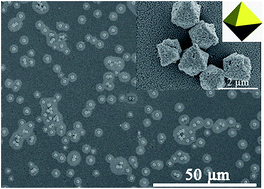

The achievements of superstructures have attracted great attention since these superstructures exhibit unique collective properties that are different to those of both individual nanoparticles (NPs) and bulk materials.1 Noble-metal superstructures with microscale dimensions are of particular interest because of their potential applications in optical waveguides, superlensing, and surface-enhanced Raman scattering.2 To date, noble metal superstructures are fabricated generally by a two-step process: (1) pre-synthesizing monodispersed nanocrystals with various geometric shapes as building blocks; (2) self-assembling the nanocrystals into 3D superstructures. The whole strategy involves rigorously manipulating the growth kinetics of the nanocrystals, and precisely controlling the self-assembly.3 However, even so, some irregular superstructures with variation in shape and size are still inevitable. Therefore, facile fabrication of noble-metal superstructures and the control of their morphological diversity are still a challenge for chemists and material scientists.

Polymer brushes have garnered ever-increasing scientific interest and emerged as versatile tool to tune the surface properties of material for protein-resistant coatings, switchable sensors, cell-growth control, and separation of biological molecules.4–8 In recent years, the synthesis of polymer brushes–metal NPs composite film becomes increasingly an extremely active research field.9–14 This strategy involves loading of the polymer brush with metal-ion precursors (Ag+ and AuCl4) followed by their in situ reduction to metal NPs. Although there are a considerable number of publications on growing noble metal NPs on polymer brushes, to our knowledge, almost all of the as-produced metal NPs by above strategy are small in size and spherical in shape, and little is known on producing noble-metal particles with microscale dimension. Very recent, we fabricated silver superstructures on the sulfonated polystyrene brush, which demonstrated novel noble-metal superstructures could be fabricated using polymer brush as substrates.15

In this contribution, we report synthesis of 3D-gold octahedra superstructures via the seed-mediated growth method on PAA brush. Our strategy involves in situ fabricating silver NPs in PAA brush, and the subsequent immersion of the resultant PAA brush–silver NPs composite films into the aqueous growth solution containing HAuCl4, ascorbic acid (AA), and cetyltrimethylammonium bromide (CTAB). Novel gold octahedral superstructures with microscale dimensions are obtained on PAA brush.

To obtain PAA brush, poly(sodium acrylate) (PNaAc) brush was first synthesized by surface-initiated atom-transfer radical polymerization (SI-ATRP). By time-controlled SI-ATRP, two kinds of PNaAc brushes with different dry thickness (about 30 nm and 100 nm) were prepared. The as-prepared PNaAc brushes were then protonated by immersing an acid solution (pH = 2.0), followed by copious rinsing with deionized water, to yield a PAA brush.16,17 PAA brush was selected as matrices due to the strong coordination interaction between the anionic PAA chain and Ag[(NH3)2]+ ions. Thus, when PAA brush was incubated with the aqueous Ag[(NH3)2]+ solution, the COOH-species allowed the complexation of [Ag(NH3)2]+ ions along the PAA chains. NaBH4 as a strong reducing agent can reduce quickly [Ag(NH3)2]+ ions to small silver NPs within PAA brush. When the PAA brushes–silver NPs composite films were immersed in a growth solution, these small silver NPs embedded in PAA brushes were acted as “nanoseeds” for growth of gold superstructures (as shown in Fig. 1).


image file: c5ra06547j-f1.tif
Fig. 1 Schematic illustration of formation of the gold octahedra superstructures on the PAA brush.

SEM images of gold nanostructures on PAA brush with 30 nm thickness in growth solution for different times are provided in Fig. 2. The spherical gold NPs with an average size of about 20 ± 5 nm form a uniform coverage on the PAA brush, as evidenced by Fig. 2A(a). Prolonging the growth time from 15 min to 30 min, in comparison to Fig. 2A(a), it is found that spherical gold NPs self-assemble to form different pattern. It is worth noting that some larger 3D aggregates composed of dozens of smaller spherical gold NPs are observed (Fig. 2B(b)). After 1 h in growth solution, more 3D gold aggregates are recognized on the PAA brush surfaces, and each aggregate is consisted of some nonspherical gold NPs (Fig. 2C(c)).


image file: c5ra06547j-f2.tif
Fig. 2 Low-and high magnification SEM images of the as-prepared gold nanostructure for different growth times (A: 15 min, B: 30 min, C: 60 min) on PAA brush with 30 nm thickness.

image file: c5ra06547j-f3.tif
Fig. 3 Low- and high magnification SEM images of as-prepared gold octahedra for different growth times (A: 15 min, B: 30 min, C: 60 min) on the PAA brush with 100 nm thickness. Inset (A) shows the SEM image of a broken octahedron. Inset (b) is the structural model.

The same seed-mediated growth procedure is carried out on the thicker PAA brush with 100 nm thickness. Interestingly, extensive 3D gold octahedra superstructures with microscale dimension instead of 3D gold aggregates are observed (Fig. 3). With increasing the growth time, the surfaces of the gold octahedra trend fusion, which should be attributed to reduction of more AuCl4 ions by AA in the growth solution to form gold atoms subsequently depositing on the initial gold octahedra. A SEM image of a broken gold octahedron (inset in Fig. 3A) exhibits distinctly its interior structure, which is composed of smaller gold NPs with diverse morphologies and sizes. Because of the presence of void spaces and connected channel interior, the AuCl4 ions can infiltrate into the superstructures interior, where is filled increasingly by reduced gold atoms to form ultimately a solid gold octahedron. Moreover, it also is found that some irregular gold nanostructures were formed on gold octahedra obtained in growth solution for 1 h, as shown in Fig. 3c. In contrast to previous methods for fabricating gold superstructures within an evaporating droplet,2,3 our method avoids pre-synthesis of gold nanocrystals with well-defined shapes and overcomes the drawbacks of as-obtained gold superstructures with variation in shape and size due to the lack of effective control self-assembly process.

Since AuCl4 ions can be reduced to zero-valent Au0 by AA in growth solution, a question is present: if the gold octahedra are produced from the growth solution? Thus, the pure growth solution containing HAuCl4, AA, and CTAB is centrifuged, and SEM images of the as-obtained precipitates are shown Fig. 4. Irregular tetrapods and star-shape gold nanostructures are obtained not than gold octahedra, which further confirm that the PAA brush is responsible for formation of gold superstructures.


image file: c5ra06547j-f4.tif
Fig. 4 SEM images of gold nanostructures in growth solution for different growth times (a: 15 min, b: 30 min, c: 60 min).

The gold nanostructures on PAA brush are characterized by X-ray photoelectron spectroscopy (XPS) and the result is shown in Fig. 5a. The wide scan spectrum reveals characteristic signals of Au 4f and Au 4d, and the presence of the carbon and oxygen of PAA brushes at characteristic binding energies is also clearly detected. The survey spectrum also displays small N 1s and Br 3d signals, which are due to CTAB molecules adsorbed on PAA brush. The peak-fitted Au 4f core-line spectrum shown in the inset of Fig. 5a illustrates that the Au 4f5/2 peak and Au 4f7/2 peak is centered at ca. 87.4 eV and 83.6 eV, respectively, corresponding to zero-valent gold (Au0).11 The results indicate the metallic gold nature of these aggregates. In addition, small components at ca. 84.8 eV and 88.5 eV, are assigned to the presence of Au(III) species, which are possibly due to incomplete reduction of AuCl4 ions.18 The gold superstructures were confirmed by EDX, as shown in Fig. 5b. The EDS spectrum shows only the gold signals except the Si arising from the Si substrate, confirming the formation of pure gold crystals.


image file: c5ra06547j-f5.tif
Fig. 5 (a) XPS survey spectrum of PAA brush–gold nanostructure composite film. The inset shows the Au 4f core-line spectrum. (b) EDS of gold octahedra superstructures, the area marked by the red square.

Although the actual formation mechanism is, as of now, unclear, we believe that 3D-gold superstructures might be formed by two-step process which involves firstly the formation of isolated Au NPs and secondly the self-assembly of them into gold superstructures. Previous reports has demonstrated that the polymer brush could act as organizing media to control the metal NPs arrangement, which strongly depend on particle size, brush grafting density and chain length (brush thickness).19–24 Once the [Ag(NH3)2]+ ions coordinated with PAA brush were reduced to small silver “nanoseeds”, these silver “nanoseeds” predominately stayed at the brush surface due to repulsive force imposed by the PAA chains.19,20 After PAA–silver “nanoseeds” composite films were immersed into growth solution, AuCl4 ions were reduced to Au0, which preferentially deposited on silver “nanoseeds” to form gold NPs. According to the previous reports,2,3 these gold NPs could act as building blocks and self-assemble to form gold superstructures by the inter-gold NPs van der Waals interactions. Based on the observation of Fig. S1 (see ESI), the rate of formation of gold NPs and self-assembly of them into 3D-gold superstructures should be very fast.

Compared with the shorter PAA brush, the longer PAA brush is in favor of formation of 3D-gold superstructures. The possible cause is that longer PAA brush can coordinate more [Ag(NH3)2]+ ions, which are reduced by NaBH4 resulting in in situ formation of more silver “nanoseeds” within polymer brush. The higher loading of silver “nanoseeds” could provide more nucleation sites for forming more gold NPs which are used as building blocks for subsequent self-assembly. However, in this process, because of the complicated interplay between PAA brush, silver “nanoseeds”, gold NPs and CTAB, efforts aimed at understanding growth mechanism of gold superstructures on polymer brush are underway.

The application of the as-prepared gold octahedra in surface enhanced Raman spectroscopy (SERS) is investigated using 4-aminothiophenol (4-ATP) as the model analyte. The SERS spectra were shown in Fig. 6. The noticeable differences between SERS and normal spectrum are frequency shifts for some bands, which imply that the –SH bond in 4-ATP directly contacts with gold surface by forming a strong Au–S bond.25 From Fig. 6, it is found that 3D-gold octahedra (c) can enhance the Raman signals more effectively than the other two gold substrates do. The possible reason is that some irregular gold nanostructures on the surface of the 3D-gold octahedra can provide more “hot spots”, which create stronger enhancement toward SERS.


image file: c5ra06547j-f6.tif
Fig. 6 SERS spectra of 4-ATP solution (10−5 M) on as-prepared gold octahedra and solid 4-ATP.

Conclusions

We had proved that our strategy worked very well for growth of gold octahedra superstructures on PAA brush. The thickness of PAA brush influenced the final morphology of gold micro-nanostructures in seed-mediated growth process. This method should be generally applicable to producing other noble-metal micro-nanostructures on appropriate polymer brush and it may open up a new possibility for shape-controlled growth of noble metal structures.

Acknowledgements

This work was sponsored by K. C. Wong Magna Fund in Ningbo University, Scientific Research Fund of Education of Zhejiang Province (Y201327028), Fund for Science and Technology Innovative Team in Zhejiang Province (2011R50001-03), and Ningbo Key Laboratory of Specialty Polymers (2014A22001).

Notes and references

  1. Z. H. Nie, A. Petukhova and E. Kumacheva, Nat. Nanotechnol., 2010, 5, 15–20 CrossRef CAS PubMed.
  2. Z. Zhu, H. Meng, W. Liu, X. Liu, J. Gong, X. Qiu, L. Jiang, D. Wang and Z. Tang, Angew. Chem., Int. Ed., 2011, 50, 1593–1596 CrossRef CAS PubMed.
  3. C. W. Liao, Y. S. Lin, K. Chanda, Y. F. Song and M. H. Huang, J. Am. Chem. Soc., 2013, 135, 2684–2693 CrossRef CAS PubMed.
  4. B. Zhao and W. J. Brittain, Prog. Polym. Sci., 2000, 25, 677–710 CrossRef CAS.
  5. P. Uhlmann, H. Merlitz, J.-U. Sommer and M. Stamm, Macromol. Rapid Commun., 2009, 30, 732–740 CrossRef CAS PubMed.
  6. T. Chen, R. Ferris, J. Zhang, R. Ducker and S. Zauscher, Prog. Polym. Sci., 2010, 35, 94–112 CrossRef CAS PubMed.
  7. R. Barbey, L. Lavanant, D. Paripovic, N. Schüwer, C. Sugnaux, S. Tugulu and H. A. Klok, Chem. Rev., 2009, 109, 5437–5517 CrossRef CAS PubMed.
  8. X. C. Zhou, X. Q. Liu, Z. Xie and Z. J. Zheng, Nanoscale, 2011, 3, 4929–4939 RSC.
  9. S. Gupta, M. Agrawal, M. Conrad, N. A. Hutter, P. Olk, F. Simon, L. M. Eng, M. Stamm and R. Jordan, Adv. Funct. Mater., 2010, 20, 1–6 CrossRef PubMed.
  10. E. M. Benetti, X. F. Sui, S. Zapotoczny and G. J. Vancso, Adv. Funct. Mater., 2010, 20, 939–944 CrossRef CAS PubMed.
  11. D. Paripovic and H. A. Klok, ACS Appl. Mater. Interfaces, 2011, 3, 910–917 CAS.
  12. O. Azzaroni, A. A. Brown, N. Cheng, A. Wei, A. M. Jonas and W. T. S. Huck, J. Mater. Chem., 2007, 17, 3433–3439 RSC.
  13. S. Gupta, P. Uhlmann, M. Agrawal, S. Chapuis, U. Oertel and M. Stamm, Macromolecules, 2008, 41, 2874–2879 CrossRef CAS.
  14. A. E. Fernandes, A. Dirani, C. d'Haese, G. Deumer, W. Guo, P. Hensenne, F. Nahra, X. Laloyaux, V. Haufroid, B. Nysten, O. Riant and A. M. Jonas, Chem.–Eur. J., 2012, 18, 16226–16233 CrossRef CAS PubMed.
  15. Y. Q. Yang, W. Q. Wang, T. Chen and Z.-R. Chen, ACS Appl. Mater. Interfaces, 2014, 6, 21468–21473 CAS.
  16. T. Chen, D. P. Chang and S. Zauscher, Small, 2010, 6, 1504–1508 CrossRef CAS PubMed.
  17. R. Dong, S. Krishnan, B. A. Baird, M. Lindau and C. K. Ober, Biomacromolecules, 2007, 8, 3082–3092 CrossRef CAS PubMed.
  18. C. Mangeney, S. Bousalem, C. Connan, M. J. Vaulay, S. Bernard and M. M. Chehimi, Langmuir, 2006, 22, 10163–10169 CrossRef CAS PubMed.
  19. J. U. Kim and B. O' Shaughnessy, Phys. Rev. Lett., 2002, 89, 238301 CrossRef.
  20. J. U. Kim and B. O' Shaughnessy, Macromolecules, 2006, 39, 413–425 CrossRef CAS.
  21. A. R. Ferhan and D.-H. Kim, J. Mater. Chem., 2012, 22, 1274–1277 RSC.
  22. A. E. Fernandes, A. Dirani, C. d' Haese, G. Deumer, W. Guo, P. Hensenne, F. Nahra, X. Laloyaux, V. Haufroid, B. Nysten, O. Riant and A. M. Jonas, Chem.–Eur. J., 2012, 18, 16226–16233 CrossRef CAS PubMed.
  23. Z. Liu, K. Pappacena, J. Cerise, J. Kim, C. J. Durning, B. O' Shaughnessy and R. Levicky, Nano Lett., 2002, 2, 219–224 CrossRef CAS.
  24. S. Christau, S. Thurandt, Z. Yenice and R. von Klitzing, Polymer, 2014, 6, 1877–1896 CAS.
  25. M. Osawa, N. Matsuda, K. Yoshii and I. Uchida, J. Phys. Chem., 1994, 98, 12702–12707 CrossRef CAS.

Footnote

Electronic supplementary information (ESI) available: Chemical and synthesis process, XRD pattern and SEM images of the samples. See DOI: 10.1039/c5ra06547j

This journal is © The Royal Society of Chemistry 2015
Click here to see how this site uses Cookies. View our privacy policy here.