
Junjie Liao,
Yashan Wang,
Liping Chang and
Weiren Bao*
State Key Laboratory Breeding Base of Coal Science and Technology Co-founded by Shanxi Province and Ministry of Science and Technology, Taiyuan University of Technology, Taiyuan 030024, P. R. China. E-mail: baoweiren@tyut.edu.cn; Fax: +86 351 6010482; Tel: +86 351 6010482
First published on 10th July 2015
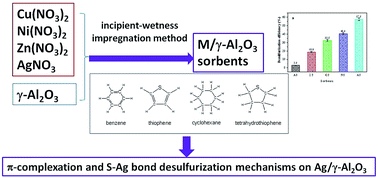
M/γ-Al2O3 sorbents with different metals (Ag, Cu, Ni, Zn) as the active component loaded on a γ-Al2O3 support were prepared by the incipient wetness impregnation method, and their adsorption behavior for thiophene was investigated. The results show that all these metals can obviously promote the desulfurization activity of the prepared sorbents, and Ag is the best one. Then silver was selected to modify γ-Al2O3 with a different loading amount, and the desulfurization behavior of Ag/γ-Al2O3 series sorbents in a thiophene–benzene solution was evaluated. It was found that the silver content has a significant impact on desulfurization efficiency, and the A15 sorbent with 13.7 wt% silver has the best adsorption desulfurization performance. XRD results show that the simple Ag0 is the main active component in Ag/γ-Al2O3 sorbent. SEM/EDS and BET characterization show that the specific surface area and pore volume decrease obviously when the silver loading amount is more than 13.7 wt%, because of the agglomeration of silver. The desulfurization mechanism of the Ag/γ-Al2O3 sorbent was explored by using thiophene which has both a conjugated pi bond and sulfur, tetrahydrothiophene which has sulfur but no conjugated pi bond, benzene which has a conjugated pi bond but no sulfur, cyclohexane which has no conjugated pi bonds or sulfur as the model compounds. The desulfurization efficiencies of A15 sorbent in thiophene–benzene, thiophene–cyclohexane, thiophene–tetrahydrothiophene–benzene and thiophene–tetrahydrothiophene–cyclohexane solutions were compared. The results indicate that the thiophene adsorption on Ag/γ-Al2O3 sorbent is mainly dominated by two kinds of connection between thiophene and silver. One is the connection between the conjugated pi bond and silver (π-complexation), and the other one is the connection between sulfur and silver (S–metal bond). This is also the main reason that benzene has the competitive adsorption behavior on thiophene.
However, lots of literature about selective adsorption method are all almost focused on the desulfurization in the transportation fuels,7–15 only a few on the purification of benzene.16–19 Some researchers reported that the transition metal-based sorbent is effective for selectively adsorbing the sulfur compounds in the liquid hydrocarbon fuels at ambient temperature under atmospheric pressure with low investment and operating cost.20 Transition metal (Cu, Zn, Ni or Ag) could enhance adsorption properties for thiophene and toluene on some sorbents, such as Y-zeolites,21,22 because Cu and Ag in sorbents are likely combine S-containing compounds by π-complexation,23 Ni and Zn in the S-sorb desulfurization catalyst invented by Sinopec and Philips companies play a very important role on the desulfurization process.24,25 Nevertheless, a common problem is that the aromatic compounds, e.g. benzene, have the competitive adsorption with thiophene,8,26,27 because benzene has very similar physical and chemical properties as that of thiophene, and thus have an obvious competitive effect on thiophene adsorption. Therefore, most of these sorbents reported for desulfurization of liquid fuel could not remove enough thiophene from benzene to give the required low sulfur concentration because the adsorptive removal of thiophene from liquid fuel and benzene is quite different. For liquid fuel, its main components are saturated hydrocarbons, the competitive effect of which is much less and can be ignored, whereas for conking benzene, the main component is benzene. Even though there is the study about the competitive adsorption of thiophene and benzene,28 it is only the removal of thiophene from fuel containing the similar level of benzene, in which the competitive adsorption is much smaller comparing with benzene solvent. Therefore, it is difficult to remove thiophene with the ppm level from benzene because of the competitive adsorption of aromatic compound with very similar physical and chemical properties. In order to improve the sulfur capacity and efficiency of sorbents removing thiophene from benzene, it is necessary to study their adsorption mechanism and optimize the technological parameters.
In this paper, γ-Al2O3 was selected as the support and different metal nitrates were chosen as the precursors of active components because of their high water solubility and the easy decomposition during heating. A series M/γ-Al2O3 sorbents were prepared by incipient wetness impregnation method. And then the removal of thiophene from benzene was investigated. In order to investigate the adsorption mechanism of thiophene on M/γ-Al2O3 sorbent, the adsorption behaviors of the aromatic hydrocarbon (benzene) and the unsaturated cyclic sulfur organic-compound (thiophene) and their saturated analogs (cyclohexane and tetrahydrothiophene, respectively) on M/γ-Al2O3 sorbent were compared.
The actual silver loading amount of the prepared samples was quantified using the Volhard method. The samples were first dried overnight at 220 °C, and dissolved with excess HNO3 and titrated with a standard thiocyanate solution with an Fe(III) indicator. And the amount of copper, nickel and zinc loaded on γ-Al2O3 was analyzed by atomic absorption spectrophotometer (AAS). The series sorbents prepared and their metal loaded amounts were shown in Table 1. A0 denotes the blank γ-Al2O3 support, which is the original γ-Al2O3 following the sorbent preparation procedure without adding any metal. A5, A10, A15 and A20 respectively denote the sorbent with different Ag content. C5, N5, Z5 denote the sorbent with Cu, Ni and Zn as the active component respectively.
| Sorbents | A0 | A5 | A10 | A15 | A20 | C5 | N5 | Z5 |
|---|---|---|---|---|---|---|---|---|
| Metal content (wt%) | 0.0 | 4.6 | 9.5 | 13.8 | 17.6 | 4.7 | 4.4 | 4.5 |
In order to investigate the influence of active metal component on thiophene adsorption and the corresponding adsorption mechanism, the sorbents with different active component and different content were put in 4.00 mL different organic sulfur-containing solutions shown in Table 2 at room temperature for 24 h. The reason why these sulfur-containing solutions were used is: thiophene molecule has a conjugated pi bond and a sulfur atom, tetrahydrothiophene molecule has a sulfur atom but does not have a conjugated pi bond, benzene molecule has a conjugated pi bond but does not have a sulfur atom, cyclohexane has no conjugated pi bonds and sulfur, and the structure diagram of those four compounds was shown in Fig. 1. The desulfurization efficiency for the sulfur-containing compounds in different solutions on the selected sorbent was measured. The effect of the conjugated pi bond on adsorption can be explored by comparing the desulfurization efficiency in thiophene–benzene solution (TH–B) and thiophene–cyclohexane solution (TH–C). The effect of the sulfur atom on adsorption can be explored by comparing the desulfurization efficiency in thiophene–benzene solution (TH–B) and tetrahydrothiophene–benzene solution (THT–B). While, tetrahydrothiophene–thiophene–benzene solution (TH–THT–B) and tetrahydrothiophene–thiophene–cyclohexane solution (TH–THT–C) were used to further explore the adsorption mechanism.
| Solutions | Sulfur-containing compounds | Solvent | Cthiophene (mg L−1) | Ctetrahydrothiophene (mg L−1) |
|---|---|---|---|---|
| TH–B | Thiophene | Benzene | 559.8 | 0.0 |
| THT–B | Tetrahydrothiophene | Benzene | 0.0 | 592.1 |
| TH–C | Thiophene | Cyclohexane | 592.5 | 0.0 |
| TH–THT–B | Thiophene/tetrahydrothiophene | Benzene | 545.2 | 592.1 |
| TH–THT–C | Thiophene/tetrahydrothiophene | Cyclohexane | 543.9 | 577.6 |
The desulfurization efficiency (η, %) and thiophene adsorption capacity (Q, mg g−1 sorbent) were calculated as eqn (1) and (2).
![]() | (1) |
![]() | (2) |
The saturation adsorption capacities, measured by weight method, for benzene, thiophene and hydrotetrathiophene of A15 sorbent are 19.36 mg g−1, 24.66 mg g−1 and 36.51 mg g−1. The best sorbent was put into 4.00 mL thiophene, tetrahydrothiophene and benzene with the analytically pure at room temperature for 24 h respectively, then filtrated and dried in a vacuum oven at 50 °C for 12 h, and the samples prepared were denoted by A15TH, A15THT and A15B respectively.
FT-IR spectra of samples were recorded on an Equinox55 spectrometer (Bruker, Germany) in the wavenumber range of 400–4000 cm−1, 16 scans were taken at a resolution of 4 cm−1. To prepare pellets, 1 mg samples were first ground to powder in an agate mortar and then mixed with 100 mg KBr. A hydraulic press was used to press the resulting mixtures to discs of 10 mm in diameter at 10 MPa for 2 min.
![]() | ||
| Fig. 2 Desulfurization efficiency (a) and thiophene adsorption capacity (b) of sorbents with different metal loaded in TH–B solution. | ||
![]() | ||
| Fig. 3 Desulfurization efficiency (a) and thiophene adsorption capacity (b) of Ag/γ-Al2O3 sorbents with different silver content in TH–B solution. | ||
XRD patterns of Ag/γ-Al2O3 sorbents with different Ag content are displayed in Fig. 4. Three diffraction peaks at 37.28°, 46.28° and 67.03° corresponding to γ-Al2O3, indicate that the crystal structure of γ-Al2O3 is retained after AgNO3 loading and followed heat treatment. Other peaks at 38.12°, 44.30°, 64.44° and 77.40°, corresponding to the simply Ag0 crystals,32 show that the active component mainly appears in the form of Ag0 after calcination step during preparation. Fig. 5 shows the thermal decomposition process of AgNO3 in air. The decomposition begins at about 450 °C, which is the same as the result reported by literature,29 and when the decomposition finished, about 64% of the total weight left, which is just the silver content in pure AgNO3. So from this point, AgNO3 loaded on sorbent should be decomposed under the experimental condition (calcination temperature was 500 °C) and the chemical reaction follows the equation of 2AgNO3 = 2Ag + O2 + 2NO2.33,34 In order to further investigate the silver existing form, XPS was carried out to characterize A15 sorbent. As shown in Fig. 6, for A15 sorbent, its XPS spectral of the core level of both Ag 3d3/2 (a) and O 1s all could be deconvoluted into three peaks. As demonstrated in Fig. 6(a), in the XPS spectral of Ag 3d3/2, the peaks at 373.7 eV, 374.6 eV and 375.5 eV are corresponding to Ag0,35,36 Ag2O and Ag–O–Al species, respectively. As listed in Fig. 6(b), on the XPS spectral of O 1s the peak at 530.6 eV is attributed to Al2O3, and the peaks at 532.2 eV and 533.0 eV should belong to Ag2O and Ag–O–Al species, respectively. As listed in Fig. 7, in the spectrum of A0, the peaks at 3438 cm−1 and 1636 cm−1 are attributed to –OH groups, the peaks at 760 cm−1 and 574 cm−1 belong to O–Al bond, whereas in the spectrum of A15, the intensity of peaks at 2955 cm−1, 2926 cm−1 and 2855 cm−1 are obviously increases, and some new peaks, 1385 cm−1, 1385 cm−1 and 1116 cm−1 appear, which are attributed to Ag2O, and the peak at 1743 cm−1 may be corresponding to Ag–O–Al. The XRD, XPS and FT-IR results all suggest that silver exists in Ag0, Ag2O and Ag–O–Al forms on γ-Al2O3 support, and among of them Ag is the main component.
Silver distribution on the surface of Ag/γ-Al2O3 sorbents was measured by SEM/EDS, and the results are shown in Fig. 8. On the surface of A10 sorbent, silver distributes homogeneously, and there is no sliver agglomeration in the surface EDS image, which could explain the relative high desulfurization efficiency of A10 sorbent. On A15 sorbent's surface, most of sliver is still distributed very well which should explain why the desulfurization efficiency of A15 sorbent is higher than that of A10 sorbent. Moreover, a few small particles, which are the sliver agglomeration verified from the EDS results, appear on A15 sorbent could explain why the desulfurization efficiency increment from A10 to A15 is not so obvious as that from A5 to A10. This should explain why the desulfurization efficiency of A15 sorbent is slightly higher than that of A10 sorbent. However, for A20 sorbent, most of its surface was covered by sliver agglomeration particles, which could aromatically decrease its desulfurization efficiency, and this is why the desulfurization activity of A20 sorbent is much lower than that of A15 sorbent.
Fig. 9 provides the nitrogen adsorption and desorption isotherms of sorbents. The adsorption isotherms of all the sorbents belong to the typical IV type, and all sorbents have mesoporous adsorption behavior. In adsorption isotherms, as the relative pressure increasing from 0.4 to 0.7, the curves rises up sharply, which can be attributed to the occurrence of capillary condensation. And in adsorption/desorption branches, a hysteresis loop is appeared, which indicates the mesopore characteristic of the adsorption–desorption isotherms. The corresponding surface area and pore size distribution of Ag/γ-Al2O3 sorbents are listed in Table 3. The pore volume and BET specific area (SBET) of Ag/γ-Al2O3 sorbents all decreases with the silver content increasing. The decrease of SBET for the A20 sorbent with 20% Ag content should be due to the agglomeration of the active component, which can be observed in its SEM/EDS image (Fig. 8), and this is also why the total pore volume and the average pore diameter (shown in Table 3) of A20 sorbent is much less than that of A15 sorbent.
| Sorbents | Specific surface area (m2 g−1) | Pore volume (cm3 g−1) | Average pore diameter (nm) |
|---|---|---|---|
| A0 | 156 | 0.208 | 36.8 |
| A5 | 146 | 0.180 | 35.0 |
| A10 | 132 | 0.170 | 33.5 |
| A15 | 132 | 0.154 | 31.5 |
| A20 | 120 | 0.145 | 27.9 |
![]() | ||
| Fig. 10 Comparison of desulfurization efficiency of different Ag/γ-Al2O3 sorbents in TH–B and TH–C solutions. | ||
Fig. 11 shows the desulfurization efficiency of Ag/γ-Al2O3 sorbents in TH–B and THT–B solutions. It can be found that the desulfurization efficiency of all the Ag/γ-Al2O3 sorbents in THT–B solution is higher than that in TH–B solution, which means that the removal of tetrahydrothiophene from benzene is much easier than that of thiophene from benzene, and the removal efficiency of tetrahydrothiophene from benzene over Ag/γ-Al2O3 sorbents is around 99%. It indicates that benzene almost has no competitive adsorption effect on the adsorption of tetrahydrothiophene on Ag/γ-Al2O3 sorbents' surface even benzene could connect to silver by π-complexation, which means that tetrahydrothiophene molecule could be adsorbed on Ag/γ-Al2O3 sorbents by a different way. And thus, in addition to the π-complexation adsorption mechanism discussed above, there should be another adsorption mechanism between thiophenes and silver. If a comparison is made between tetrahydrothiophene and thiophene molecules, it is very easy to find that both of them all have sulfur atoms, which have lone-pair electrons. So it is probable that tetrahydrothiophene and thiophene can act as the n-type donors by donating the lone-pair electrons that lie in the plane of the ring to the silver on Ag/γ-Al2O3 sorbents to form S–Ag bond (S–M mechanism37), because silver has unoccupied orbital, which could accept this donation.
Fig. 12 show the FT-IR spectral of different samples in the range of 4000 cm−1–400 cm−1 (a), 3100 cm−1–2700 cm−1 (b) and 1800 cm−1–1000 cm−1 (c). It can be seen that, after benzene, thiophene and tetrahydrothiophene absorbed on A15 sorbent, the intensity of the peaks at 2925 cm−1, 2926 cm−1, 2855 cm−1 and 1385 cm−1 all decreased significantly, and the peaks at 1743 cm−1, 1462 cm−1, 1116 cm−1 disappeared, which suggest that the Ag2O and Ag–O–Al spices all can combine to benzene, thiophene and tetrahydrothiophene.
![]() | ||
| Fig. 12 FT-IR spectral of different samples in the range of 4000 cm−1–400 cm−1 (a), 3100 cm−1–2700 cm−1 (b) and 1800 cm−1–1000 cm−1 (c). | ||
In order to further understand the π-complexation and S–M mechanisms proposed above, the desulfurization behavior in TH–THT–C and TH–THT–B solutions over Ag/γ-Al2O3 sorbents was studied, and the results were shown in Fig. 13. The desulfurization efficiency for tetrahydrothiophene and thiophene in TH–THT–C solution is 100%, whereas that for thiophene in TH–THT–B solution (95.8%) is relatively lower. It indicates that thiophene almost has no competitive effect on tetrahydrothiophene adsorption, which may because the S–Ag bond formed between tetrahydrothiophene and silver is stronger than that formed between thiophene and silver, for the sulfur atom in tetrahydrothiophene molecule has two lone-pair electrons, whereas the sulfur atom in thiophene molecule only has one lone-pair electrons. It could also explain why the adsorption rate of tetrahydrothiophene (shown in Fig. 14) in these two solutions is much higher than that of thiophene.
![]() | ||
| Fig. 14 Adsorption curves of thiophene and tetrahydrothiophene over A15 sorbent in thiophene–tetrahydrothiophene–cyclohexane and thiophene–tetrahydrothiophene–benzene solutions. | ||
| This journal is © The Royal Society of Chemistry 2015 |