Hong Liua,
Dong-Feng Chaia,
Yu-Long Zoub,
Shu-Jing Zhou*a,
Wei Wanga,
De-Feng Shen*a,
Yan-Yan Qua and
Guang-Gang Gao*a
aCollege of Pharmacy, Jiamusi University, Jiamusi 154007, China. E-mail: zhshj2003@jmsu.edu.cn; shenjms@163.com; gaogg@jmsu.edu.cn
bHongqi Hospital, Mudanjiang Medical University, Mudanjiang 157011, China
First published on 20th April 2015
A novel γ-type octamolybdate functionalized by decarboxylated norfloxacin (dNF), (dNF)2[γ-Mo8O26(dNF)2]·10H2O (1), has been synthesized. In the broad range of acidic solutions, even in the pH < 0 range, the fluorescent intensities of 1 almost linearly changed with acidity, indicating that a solution of 1 could be used as an acidity fluorescent sensor. The enhancing and quenching behavior also makes complex 1 a potential acid–base switch system. The successful synthesis of 1 demonstrates a new acidity sensor based on a fluorescent medicine and polyoxometalate anions.
In the synthesis of 1, pH value, temperature, and ErCl3 have key roles in the formation of the final product. The decarboxylation process of the Er3+-organic hybrid has been observed by Yang et al.29 The crystals would be in very low yield (0.5%) when the transition metals replace ErCl3. In the reaction system, it is speculated that the Er3+ ions possibly coordinate to a carboxyl group of norfloxacin and favor the coordination between norfloxacin and octamolybdate. Under hydrothermal conditions, the further reaction leads to the decarboxylation process and facilitates the final product of 1. This result indicates that the medicine molecules can be potentially transformed by reaction with POMs and rare earth salts under hydrothermal conditions and thus generate new medicine derivatives and functionalities. Despite the fact that decarboxylation has been observed in some organic compounds during hydrothermal reactions,30–32 this is however, the first time that decarboxylation has occurred for a medicine molecule under hydrothermal conditions, which opens a new approach to the modification of medicines with new properties.
Single-crystal X-ray diffraction reveals that complex 1 consists of octamolybdate subunits, decarboxylic norfloxacin ligands, and free water molecules (Fig. 1). The octamolybdate subunit in 1 is a γ-type octamolybdate, of which the Mo atoms are all in distorted octahedral environments with Mo–O distances ranging from 1.695(4) to 2.456(4) Å within the reported values.33–35 Bond valence sum calculations36 showed that the oxidation state of the Mo atoms is located in the range of 5.930–5.960, which is in agreement with the expected value of 6.000. Each octamolybdate polyoxoanion coordinates to two dNF ligands by Mo–O bonds arising from Mo and carbonyl O atoms. It should be noted that such a coordination style is firstly observed among medicine–ligand functionalized POMs. The C–O distance is 1.292(7) Å which is only slightly longer than the normal value for the carbonyl group in norfloxacin. The Mo–O carbonyl bond distance of 2.109(4) Å is similar to the reported values in organic-octamolybdates (2.133(9) Å).37 There also exist isolated dNF molecules located between two neighboring coordinated dNF ligands arising from different [Mo8O26(dNF)2]2− units. Weak π⋯π interactions were observed for neighboring dNF ligands with centroid-to-centroid distances in the range of 3.7253(2) Å to 3.9082(2) Å. By such weak interactions, [Mo8O26(dNF)2]2− and isolated dNF are linked each other to form 1D chain structures (Fig. 2).
![]() | ||
| Fig. 1 The coordination mode of octamolybdate and dNF ligands in 1. All the isolated water molecules and H atoms are omitted for clarity. | ||
![]() | ||
| Fig. 2 1D structure of complex 1. Green polyhedrons represent octamolybdate; the broken lines represent the π⋯π interactions between the neighbor dNF ligands. | ||
The antibacterial activity of 1 was studied using the minimum inhibitory concentration (MIC) and a modified Kirby–Bauer disc diffusion method. The antibacterial activity of 1 decreases compared to the NF precursor (Fig. S1†), in which the MIC values of 1.00 μg mL−1 and 4.20 μg mL−1 against Bacillus subtilis and Escherichia coli for 1 are slightly larger than those of NF of 0.94 μg mL−1 and 1.87 μg mL−1, respectively. This phenomenon is similar to the literature result that decarboxylation facilitates the decrease in antibacterial activity for quinolone medicines.38
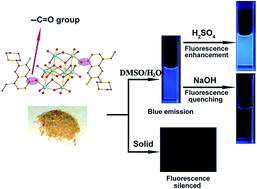
The fluorescence properties of 1 and NF have also been investigated. In the solid state, complex 1 is fluorescence silenced which is ascribed to the π⋯π interactions quenching the fluorescence of the dNF ligands. In DMSO solution, as shown in Fig. 3a, the fluorescence intensity of 1 is 6.5 times than the value of NF. The mixture of octamolybdate and NF only leads to a 3.5 times fluorescence enhancement; the stronger fluorescent intensity of 1 also relates to the decarboxylation feature of dNF. This can be explained by the fact that the carboxylate group generally is an electron-withdrawing group that can suppress the fluorescence emission.39 Moreover, in a DMSO/water mixture (v/v = 1/9), the addition of ammonium molybdate (Mo7) induces the expected fluorescence quenching of dNF (Fig. 3b), the phenomenon of which may be ascribed to a more favorable formation of hydrogen bonds between octamolybdate and dNF in aqueous solution. Here, the fluorescence enhancement of dNF by the introduction of octamolybdate in a non-aqueous solvent is firstly unveiled and opens a new method to modulate the fluorescence of a medicine complex by its inorganic component.
NF has been confirmed a fluorescence sensitive to pH.40 As a result of this fact, we investigated the fluorescence properties of 1 in different pH solutions. As shown in Fig. 4, in different pH solutions ranging from 1.0 to 3.5, the fluorescence intensity changed almost linearly with the pH variation, of which the regression equation is y = 142 − 38x (R2 = 0.9631). In the pH range of 5.0–9.0, the fluorescence intensity only presented a slight change upon pH increase, whilst the intensity value was almost unchanged in the range of 9.0–12.0, as shown in Fig. 5. To further confirm this speculation, 13C NMR spectra were recorded for 1 before and after addition of acid. As shown in Fig. S2,† there are two carbonyl peaks at 166.3 ppm and 175.5 ppm ascribed to bonded and free dNF ligands, respectively. After the addition of HCl acid, the carbonyl peak at 166.3 ppm ascribed to a bonded NF ligand disappeared due to the bond cleavage of the Mo–Ocarbonyl bond. Most interestingly, in H2SO4 solution (0.5 to 4.0 mol L−1), the fluorescence intensity also linearly varied with the increase in acidity with a regression equation of y = 67 + 9x (R2 = 0.9878). Generally, the pH value of the solution can be detected using a pH meter, while this is difficult for the acidity of solutions for pH < 0. The reactivity of 1 towards acidic solutions opens a new route to the fluorescence detection of strong acids by medicine–POM based sensors. In concentrated acidic solution, it should be noted that the fluorescence enhancement may relate to the weak hydrogen-bonds between the polyoxoanion and dNF in a strong protonated environment, which makes the quenching efficiency of polyoxoanion lower than that when in conditions with a higher pH.
![]() | ||
| Fig. 4 The dependence on different pH (Ex = 330 nm) of the emission intensity (Em = 440 nm) of 1 mmol L−1 1 in solution (vDMSO/vwater = 1/9). | ||
![]() | ||
| Fig. 5 Fluorescence intensity of 1 mmol L−1 1 in different concentrations of sulphuric acid. Inset shows the linear fit of c(H+) versus emission intensity at 440 nm. | ||
In addition to acidity sensitivity, complex 1 can also be considered as an acid–base switch system as its fluorescence can be modulated by the addition of acid and base. As shown in Fig. 6, with the addition of H2SO4 at pH = 3.5 to a solution of 1 (H2SO4 is controlled as 30 mmol L−1), fluorescence enhancement is observed as ca. 50% increase. When NaOH was added, the fluorescence is quenched for this system (NaOH is controlled as 60 mmol L−1). Considering that that the N of piperazine is protonated in a pH < 4.0 solution, we speculate that the acid induced fluorescence enhancement of 1 comes from the fact that octamolybdate undergoes a transformation to form new polymolybdate species leading to the cleavage of the Mo–Ocarbonyl bond. Accordingly, the release of free dNF ligands shows a more intense blue emission as POMs are usually effective quenching agents.41 A further investigation of the weak interactions between POMs and quinolone medicines will be conducted in due course by our group.
![]() | ||
| Fig. 6 The fluorescence spectra of 1 (1 mmol L−1) (black), addition of H2SO4 (red) and addition of NaOH (blue). | ||
In conclusion, complex 1 was synthesized by a hydrothermal reaction with a decarboxylation process for norfloxacin. The loss of an electron-withdrawing group makes 1 facilitate its fluorescence emission. In a broad range of acidic solutions, even in the pH < 0 range, the fluorescence intensities of 1 almost linearly changed with acidity, by which a solution of 1 can be considered as an acidity fluorescence sensor. Moreover, the enhancing and quenching behavior also makes complex 1 a potential acid–base switch. The successful synthesis of 1 demonstrates a new acidity sensor based on a fluorescent medicine and polyoxometalate anions.
Footnote |
| † Electronic supplementary information (ESI) available: Experimental details, CIF file, FTIR spectrum and tables. CCDC 948997. For ESI and crystallographic data in CIF or other electronic format see DOI: 10.1039/c5ra04108b |
| This journal is © The Royal Society of Chemistry 2015 |