DOI:
10.1039/C5RA03478G
(Paper)
RSC Adv., 2015,
5, 50306-50311
pH sensitive smart gels of cetylpyridinium chloride in binary solvent mixtures: phase behaviour, structure and composition†
Received
25th February 2015
, Accepted 28th May 2015
First published on 29th May 2015
1 Introduction
Soft materials have attracted potential interest due to the integral role they play in controlled drug delivery, fluorescence, sensing ability/stimuli-responsive nature in the field of smart gels. Their chemistry of self-assembly due to non-covalent interactions has been receiving considerable attention.1–3 Among various soft materials, supramolecular gels4–6 have interesting applications due to their ability to form highly ordered 3D-network structures either via covalent or by non-covalent interactions.7 The specific functional properties and biodegradability exhibited by these soft gels are different from that of polymer gels.8,9 In this context, any gelating species that use non-covalent interactions such as hydrogen bonds, π–π interactions, metal co-ordination, or host–guest inclusion can be described as supramolecular gels.10 Therefore, supramolecular gels have been further divided into supramolecular polymeric gels11 and low molecular weight gels (LMWGs),12–15 depending on molecular weight of the building blocks of the gels. Creating well-organized supramolecular self-assembled gelator aggregates from organic molecules is important owing to their potential applications in various optoelectronic fields, including enhanced charge transport and fluorescence emission.16–20 The self-assembled process was shown to be solvent dependent and is driven by the multiple dynamic non-covalent interactions as driving forces for numerous supramolecular assembles (viz. organogels, hydrogels and liquid crystalline materials etc.).21,22 These interactions are strong enough to overrule the loss of entropy caused by the organization of the building blocks and, as a result, self-assembly is thermodynamically favored. However, the non-covalent interactions are weak enough to keep the assembly reversible. Because of this reversibility, the self-assembled state remains dynamic and exchange with unassembled building blocks will always take place. This dynamicity of the self-assembled state, the spontaneity of self-assembly and fact that it is thermodynamically favored make self-assembly a very attractive tool for the formation of novel artificial functional systems.
Gels not only represent an intriguing case of self-assembly and phase separation, but also serve as a novel means for creating “smart materials”. Gelation of binary solvents mixtures of water–ethylammonium nitrate mediated by imidazolium-based catanionic surfactant, 1-butyl-3-methylimidazolium dodecylsulfate, was recently reported.23 Smart gels using 1-butyl-3-methylimidazolium tetrafluoroborate as a solvent had been reported from cholesterol-based low-molecular mass gelators.24 Structure-property correlation of organogelators based on organic salts and their selective gelation of p-xylene from p-xylene/water mixtures was also reported.25 Recently, crown ether based bolaamphiphilic low-molecular weight gelator which could form gels both in organic and aqueous media was reported by Zheng et al.26 Recent developments have also employed various triggers which include solvent composition,27 magnetic fields, addition of salts28 and photo-responsive UV light.29–31 The sensing and catalysis potentials of gels were investigated by the introduction of metal ions in the gel matrix.32 Bhuniya and Kim33 synthesized novel and highly efficient fluorescent hydrogelators that showed the ability to sense biological entities, such as, glucose and insulin at very low concentrations. Xue et al. recently synthesized a glutamide gelator and reported that a weak fluorescence emission and a small enhanced emission were observed during its gelation.34 Stimuli-responsive gels have received increased attention where the guest molecules can be entrapped or released by stimulating external factors such as pH or temperature, responsible for the supramolecular network.35 Stimuli responsive nature of the gels is a prerequisite for the development of smart and functional materials. Therefore, exploring supramolecular gels (organo/hydrogels) which are responsive to pH, temperature, light, mechanical and chemical entities including ionic/molecular additives by incorporating a spectroscopically active or a receptor unit as a part of the gelator molecule is also virtually important and has been extensively studied.36–38 Especially in regard to chemical stimuli, a diversity of responsive signals have been developed, such as host–guest interactions,39 the addition of acid/bases40–43 and/or ions,44,45 metal coordination,46–48 CO2 absorption,49,50 light,51–53 redox molecules.54–56
Various supramolecular gels based on macrocycles have also been reported till now.57,58 However, the full potential of self-assembly has not been reached and most of them only focused on the construction of dendrimer/macrocycle-containing supramolecular gels. The design of new supramolecular gels mainly arises from serendipitous discovery or from extension of previously discovered basic gelation elements. This problem is especially prominent for low-molecular weight gelators. For this reason, attempts to rationalize the gelling power between molecular structure and solvents are highly important. Therefore, enhanced functionality of supramolecular gels by external stimuli such as pH, light, temperature, mechanical force, and other stimuli need to be further explored to create new sensing/smart materials.
In literature, several supramolecular gels have been synthesized or studied in order to look at mainly the structural aspects. For instance, we have recently reported a fibrous gel formed from cetylpyridinium chloride in binary solvent mixtures with complete structural analysis.59 However, the effect of solvent polarity, pH on phase behavior and the emission characteristics of cetylpyridinium chloride gels were not focused. Therefore, the main objective of this work was to study the morphology, emission characteristics and phase behavior of cetylpyridinium chloride gels as a function of solvent polarity and pH using optical, HRTEM, DSC, UV-visible, fluorescence and 1H NMR spectroscopy.
2 Experimental
Cetylpyridinium chloride of 99% purity was purchased from S.D. fine-chemicals Ltd., India. The CPC gel in binary solvent mixture was synthesized according to the previously reported procedure.59 Ultrapure water from a Millipore Elix A3-MilliQ system (MilliQ, Germany) was used in preparing the aqueous buffer solutions of varying pH. Samples were prepared in freshly prepared aqueous solutions at 25 ± 0.1 °C. Electronic absorption spectra were recorded on a Cary 5E double-beam spectrophotometer using a 1 cm path length Infrasil quartz cuvette. 1H NMR measurements were carried out using Bruker 400 MHz NMR Spectrometer with tetramethylsilane used as a reference.
Optical microscopy
Optical microscopy was performed with a Euromex (Holland) microscope fitted to a Samsung SD-310 CCD camera and Olympus BX-60 microscope fitted with Media Cybernetics (Evaluation Series) camera. Snapshots of the samples were obtained through Aver TV-USB media image grabber.
Steady-state fluorescence spectroscopy
The emission spectra of the samples were obtained from a Jobin-Yvon Fluorolog spectrofluorimeter with 0.2 nm resolution with sample geometry at 90° to the excitation source.
High resolution transmission electron microscopy (HRTEM)
High Resolution Transmission Electron Microscopic (HRTEM) images were taken using a JEOL 3010 instrument. Samples were prepared on a carbon coated copper grid.
Differential scanning calorimetry (DSC)
Differential Scanning Calorimetry (DSC) thermograms were acquired using TA Instruments Q200 MDSC. The sample pan used in the experiment is made of aluminium (Tzero hermetically sealed aluminium pan). Scan rate: 10 °C min−1 (heating) & 5 °C min−1 (cooling).
High resolution scanning electron microscopy (HRSEM)
High resolution scanning electron microscopy (HRSEM) images were obtained using a FEI Quanta scanning electron microscope by placing a small drop of the sample on pre-treated Si (100) substrates, followed by natural drying at room temperature in field emission mode under low vacuum.
3 Results and discussion
Solvent polarity dependent morphology
As chlorinated solvents are commonly used for the fabrication and development of organic devices,60 the search for various self-assembling and existing gelator molecules continued to tune/modify the properties of the gels without using hard-core synthesis to prepare gelator molecules as the synthesis of specific organized assemblies from π-conjugated/dendritic gelator molecules requires complex synthetic modifications of the π-conjugated moieties.61 Self-assembly of the molecules observed in cast films of the lipids obtained from CCl4 solutions are different from those contained in the films prepared from aqueous solution. A slight increase in the solvent polarity results in cast film self-assembly that differ substantially from those observed from CCl4.
The CPC gels from binary solvent combination of chlorinated solvents of varying polarity (or dielectric constant) in the presence of water i.e., CHCl3
:
H2O, CH2Cl2
:
H2O, and CCl4
:
H2O in 3
:
1 v/v binary solvent mixture have been studied. CPC gels prepared from various chlorinated solvents in the presence of water appears differently, i.e., a turbid gel (appears blue color due to scattering) was observed with chloroform (as the organic solvent with dielectric constant, ε = 4.81) in the presence of water, a transparent gel with dichloromethane (ε = 9.08) in the presence of water, and a very weak opaque gel with carbon tetrachloride (ε = 2.24) was observed. This has prompted us to investigate the morphologies of CPC gels with solvents of varying polarities/dielectric constants of chlorinated solvents, in particular. To obtain a better insight into the morphology of the as-formed gels, high resolution transmission electron microscopic (HRTEM) investigations have been performed. The HRTEM images of the CPC gel from binary solvent mixtures of CH2Cl2
:
H2O and CHCl3
:
H2O shown in the Fig. 1 & 3 exhibited different morphologies in both the solvent combinations.
 |
| | Fig. 1 High resolution TEM images of the CPC gel formed at pH 7 at 25 °C showing (a) extended fibrillar and twisted tubes with end-to-end connected structures and (b) a uniform twisted tube with 300 nm width [6 wt% CPC in the binary solvent mixture DCM : H2O (3 : 1 v/v)]. Scale bars in (a & b) = 0.5 μm. | |
 |
| | Fig. 2 Optical images of the CPC gel phase (6 wt%) in CH2Cl2 : H2O (3 : 1 v/v) at pH 7 under crossed polarizers (a) 4×, (b) 4×. Inset shows the stable-to-inversion of the formed CPC gel at 25 °C. | |
 |
| | Fig. 3 High resolution TEM images of the CPC gel formed at pH 7 at 25 °C showing (a) lamellar sheets folding into (b) fibrous tubular structures with 0.4–1.5 μm width [6 wt% CPC in the binary solvent mixture CHCl3 : H2O (3 : 1 v/v)]. Inset shows the stable-to-inversion of the formed CPC gel. | |
The HRTEM images from Fig. 1(a & b) depicts twisted tube-like end-to-end connected structures with 200–400 nm width, whereas, Fig. 3(a & b) revealed lamellar sheets, tubular structures and also lamellar sheets folding into fibrous tubular structures with 0.4–2 μm width and several micrometers length. The gel remained stable without any change in its appearance for at least 6 months at ambient temperature. The xerogels exhibited strong birefringence as shown in Fig. 2(a & b) under polarizing radiation. The advantage of forming extended fibrous aggregates composed of functional molecules is the generation of soft materials that improve solution processability in the fabrication of optoelectronic devices. The formation of such extended aggregates in chlorinated solvents, which are commonly used for the fabrication of electronic devices because they are good solvents for π-conjugated systems.60
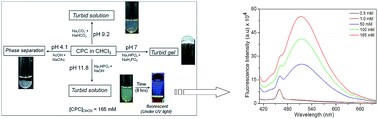
The gel forming ability of CPC has been studied in aqueous solutions at varied pH. The self-assembly of CPC was found to be strongly dependent on pH of the medium. Fig. S8 (ESI†) schematically illustrates its varied phase evolution. CPC formed the stable gel at a pH ∼ 7 and the strongly alkaline CPC turbid solution (0.025 M NaOH, pH ∼ 11.8), upon storing showed fluorescence under UV light. A turbid viscous solution at pH ∼ 9.2 was observed, whereas, the gel structure was lost at an acidic pH of 4.1 leading to phase separation, shown in Fig. S8 (ESI†).
Stimuli responsive behaviour of the CPC gels: effect of pH on CPC gel formation and pH dependent structural investigation
Fluorescence spectroscopy is an important tool to study the interactions among the molecules in the gel state.62 Fluorescence spectroscopic measurements have been performed to monitor the emission property and to investigate the fluorescence arising from the colored (orange brown) CPC viscous solution at pH 11.8. In order to know the excitation wavelength for performing fluorescence measurements, first UV-visible absorption measurements were carried out for the solutions prepared at various concentrations of CPC from 0.01 to 165 mM. The UV-visible absorption spectra of CPC solutions showed characteristic UV bands at 213 and 258 nm (vide Fig. 4(a)). The absorption and emission characteristics of CPC showed significant response upon the addition of alkaline NaOH solution of pH 11.8 as compared to aqueous CPC solutions. The UV-visible absorption profiles of CPC solutions in alkaline medium with below and above CMC of CPC (0.95 mM) are shown in Fig. 4(b), with a characteristic absorption at 396 nm. The emission spectra of fresh CPC solutions in alkaline medium when excited at 396 nm showed a well defined emission at ∼460 nm along with weak emissions, one at 438 nm and the other centered between 512 and 560 nm and the spectra are collected in Fig. 5(a). The emission spectra of the same CPC solutions in alkaline medium measured at various time periods shown in Fig. 5(b) and 6 evidence for the temporal effect. The solutions revealed a weak emission around 460 nm only at very low concentrations. However, at higher CPC concentrations (≥50 mM) as shown in Fig. 5(b), a broad and intense emission around 513 nm responsible for the strong fluorescence behavior of the strongly basic CPC solutions was observed.
 |
| | Fig. 4 (a) UV-visible absorption spectra of aqueous CPC solutions (b) UV-visible absorption spectra of freshly prepared CPC solutions in alkaline medium (pH = 11.8) at 25 °C. | |
 |
| | Fig. 5 Emission spectra of (a) freshly prepared CPC solutions in alkaline medium (pH = 11.8) at an excitation λ = 396 nm, and (b) CPC solutions at pH ∼ 11.8 after 8 h at 25 °C. | |
 |
| | Fig. 6 Visual snapshots of CPC in alkaline buffer (Na2HPO4 + NaOH) at 25 °C with temporal effect [CPC] = 165 mM (6 wt%). | |
The emission intensity of 460 nm band decreased and existed as a shoulder with time with the evolution of a new broad emission around 513 nm compared to freshly prepared alkaline CPC solutions. The results indicate interplay of prevalent intermolecular interactions, such as, the charge-transfer (CT) type between the hydroxyl group of the base and the pyridinium moiety of CPC, as evidenced in the absorption spectra (Fig. 4(b)) with a CT band at 396 nm. This observation suggests that the fluorescence arising from CPC solutions at pH 11.8 could be due to the alteration of the environment around the pyridine moiety, such as pH and the ionic strength of the medium. Hence, it can be stated that the pH dependent fluorescence of the CPC gel could be due to variation in the packing arrangements of CPC molecules at different pH.
In order to provide a concrete evidence for the probable charge transfer interaction between the hydroxyl ion and the pyridinium cation, other possible reactions/pathways were thought of. One such was the possibility of the pyridinium ring opening, leading to probable new chemical entities responsible for the observed fluorescence. Consequently, 1H NMR experiments were performed and the chemical shifts were recorded. Pyridinium or pyrylium salts are known to open their aromatic ring in presence of electron withdrawing groups, such as, cyano (von Braun reaction), 2,4-dinitrochlorobenzene (Zincke reaction), 4-pyridyl, or N,N-dimethylcarbamoyl63 attached to nitrogen of the pyridinium ring. A parallel approach with ring-opening reactions of pyrylium or chalcogenopyrylium salts was reported in presence of SO3− as electron withdrawing group. Structural analysis by 1H NMR chemical shifts in Fig. 7 revealed chemical shifts for pyridinium ring protons to be at 9.0, 8.6, and 8.1 ppm for ortho, meta and para positions respectively, which are indicative of aromatic protons in the pyridinium ring. The chemical shifts for methylene protons such as, α-CH2 and β-CH2 of CPC were observed at 1.9 and 1.1 ppm respectively with the terminal methyl protons in aqueous medium at 0.7 ppm. The above results thus indicate that the CPC retained its chemical structure with the aromatic pyridinium ring intact due to the electron donating nature of the alkyl chain attached to the ‘N’ hetero atom of the pyridinium ring in the aqueous alkaline medium. The 1H NMR chemical shifts of CPC in alkaline medium are assigned in Fig. 7(c).
 |
| | Fig. 7 (a) 1H NMR spectrum (400 MHz) of alkaline CPC in D2O. (b) Expanded aromatic region of 1H NMR spectrum. (c) 1H NMR chemical shift assignments for CPC in alkaline medium, at pH = 11.8 at 25 °C. | |
4 Conclusions
Cetylpyridinium chloride gels from CHCl3
:
H2O, CH2Cl2
:
H2O, and CCl4
:
H2O binary solvent combinations at a specific 3
:
1 v/v composition ratio were studied. At a specific binary solvent composition, while a transparent gel from dichloromethane was observed, chloroform and carbon tetrachloride at pH 7 resulted in a turbid and a very weak opaque gel respectively. The absorption and emission characteristics of CPC gels showed significant response in a strong alkaline medium at pH 11.8. The evolution of a new broad emission at 513 nm was attributed to a charge transfer interaction between the hydroxyl group of the base and the pyridinium moiety of CPC. This characteristic emission could be of considerable importance in organic light emitting diodes. The results showed that the pH dependent behavior of the CPC gels can be tuned by changing the strength of intermolecular interactions between the gelator molecules in the solution. The fibres of the supramolecular gels can also be used as templates to assemble nanoparticles in two or three-dimensional architectures.
Acknowledgements
The authors acknowledge partial support from the project CZ.1.05/1.1.00/02.0070 (IT4Innovations), PostDoc II project Opportunity for young researchers Reg. no. CZ.1.07/2.3.00/30.0055 and GACR 13-30397S. The authors acknowledge Prof. Archita Patnaik, IIT Madras, for helping us in improving the manuscript. IRK acknowledges Mr A. Narayanan, IIT Madras, for making available the DSC facility.
References
- T. Z. Grove, C. O. Osuji, J. D. Forster, E. R. Dufresne and L. Regan, J. Am. Chem. Soc., 2010, 132, 14024–14026 CrossRef CAS PubMed.
- J.-M. Lehn, Supramolecular Chemistry. Concepts and Perspectives, VCH, Weinheim, 1995 Search PubMed.
- A. R. Hirst, B. Escuder, J. F. Miravet and D. K. Smith, Angew. Chem., Int. Ed., 2008, 47, 8002 CrossRef CAS PubMed.
- J. Liu, G. Chen, M. Guo and M. Jiang, Macromolecules, 2010, 43, 8086–8093 CrossRef CAS.
- P. Du, J. Liu, G. Chen and M. Jiang, Langmuir, 2011, 27, 9602–9608 CrossRef CAS PubMed.
- J. Liu, G. Chen and M. Jiang, Macromolecules, 2011, 44, 7682–7691 CrossRef CAS.
- N. M. Sangeetha and U. Maitra, Chem. Soc. Rev., 2005, 34, 821–836 RSC.
- S. Malik and A. K. Nandi, J. Phys. Chem. B, 2004, 108(597), 13 Search PubMed.
- Z. Yang, H. Gu, Y. Zhang, L. Wang and B. Xu, Chem. Commun., 2004, 208 RSC.
- L. E. Buerkle and S. J. Rowan, Chem. Soc. Rev., 2012, 41, 6089–6102 RSC.
- P. Terech and R. G. Weiss, Chem. Rev., 1997, 97, 3133 CrossRef CAS PubMed.
- P. Terech and R. G. Weiss, Chem. Rev., 1997, 97, 3133–3160 CrossRef CAS PubMed.
- L. A. Estroff and A. D. Hamilton, Chem. Rev., 2004, 104, 1201–1218 CrossRef CAS PubMed.
- L. E. Buerkle and S. J. Rowan, Chem. Soc. Rev., 2012, 41, 6089–6102 RSC.
- M. de Loos, B. L. Feringa and J. H. van Esch, Eur. J. Org. Chem., 2005, 2005, 3615–3631 CrossRef PubMed.
- Y. J. Seo, S. Bhuniya and B. H. Kim, Chem. Commun., 2007, 1804 RSC.
- K. Sugiyasu, N. Fujita and S. Shinkai, Angew. Chem., Int. Ed., 2004, 43, 1229 CrossRef CAS PubMed.
- S. Y. Ryu, S. Kim, J. Seo, Y. Kim, O. Kwon, D. Jang and S. Y. Park, Chem. Commun., 2004, 70 RSC.
- H. Engelkamp, S. Middelbeek and R. J. M. Nolte, Science, 1999, 284, 785 CrossRef CAS.
- M. Ikeda, M. Takeuchi and S. Shinkai, Chem. Commun., 2003, 1354 RSC.
- A. Friggeri, O. Gronwald, K. J. C. van Bommel, S. Shinkai and D. N. Reinhoudt, J. Am. Chem. Soc., 2002, 124, 10754 CrossRef CAS PubMed.
- G.-C. Kuang, Y. Ji, X.-R. Jia, Y. Li, E.-Q. Chen and Y. Wei, Chem. Mater., 2008, 20, 4173 CrossRef CAS.
- N. Cheng, Q. Hu, Y. Bi, W. Xu, Y. Gong and L. Yu, Langmuir, 2014, 30, 9076–9084 CrossRef CAS PubMed.
- J. Yan, J. Liu, P. Jing, C. Xu, J. Wu, D. Gao and Y. Fang, Soft Matter, 2012, 8, 11697–11703 RSC.
- D. R. Trivedi, A. Ballabh, P. Dastidar and B. Ganguly, Chem.–Eur. J., 2004, 10, 5311 CrossRef CAS PubMed.
- L. Gao, D. Xu and B. Zheng, Chem. Commun., 2014, 50, 12142–12145 RSC.
- T. Tanaka, Phys. Rev. Lett., 1978, 40, 820 CrossRef CAS.
- O. Rosen, J. Sjostrom and L. Piculell, Langmuir, 1998, 14, 5795 CrossRef CAS.
- K. Murata, M. Aoki, T. Suzuki, T. Harada, H. Kawabata, T. Komori, F. Ohseto, K. Ueda and S. Shinkai, J. Am. Chem. Soc., 1994, 116, 6664 CrossRef CAS.
- M. Ayabe, T. Kishida, N. Fujita, K. Sada and S. Shinkai, Org. Biomol. Chem., 2003, 1, 2744 CAS.
- J. Eastoe, M. Sanchez-Dominguez, P. Wyatt and R. K. Heenan, Chem. Commun., 2004, 2608 RSC.
- J. E. Sohna and F. Fages, Chem. Commun., 1997, 327 RSC.
- S. Bhuniya and B. H. Kim, Chem. Commun., 2006, 1842 RSC.
- P. Xue, R. Lu, P. Zhang, J. Jia, Q. Xu, T. Zhang, M. Takafuji and H. Ihara, Langmuir, 2013, 29, 417–425 CrossRef CAS PubMed.
- O. Gronwald and S. Shinkai, Chem.–Eur. J., 2001, 7, 4328 CrossRef CAS.
- S.-k. Ahn, R. M. Kasi, S.-C. Kim, N. Sharma and Y. Zhou, Soft Matter, 2008, 4, 1151–1157 RSC.
- O. Kuksenok, P. Dayal, A. Bhattacharya, V. V. Yashin, D. Deb, I. C. Chen, K. J. Van Vliet and A. C. Balazs, Chem. Soc. Rev., 2013, 42, 7257–7277 RSC.
- M. D. Segarra-Maset, V. J. Nebot, J. F. Miravet and B. Escuder, Chem. Soc. Rev., 2013, 42, 7086–7098 RSC.
- W. Deng, H. Yamaguchi, Y. Takashima and A. Harada, Angew. Chem., Int. Ed., 2007, 46, 5144–5147 CrossRef CAS PubMed.
- Z. Ge, J. Hu, F. Huang and S. Liu, Angew. Chem., Int. Ed., 2009, 48, 1798–1802 CrossRef CAS PubMed.
- S.-Y. Hsueh, C.-T. Kuo, T.-W. Lu, C.-C. Lai, Y.-H. Liu, H.-F. Hsu, S.-M. Peng, C.-H. Chen and S.-H. Chiu, Angew. Chem., Int. Ed., 2010, 49, 9170–9173 CrossRef CAS PubMed.
- Y.-S. Su, J.-W. Liu, Y. Jiang and C.-F. Chen, Chem.–Eur. J., 2011, 17, 2435–2441 CrossRef CAS PubMed.
- F. Cai, J.-S. Shen, J.-H. Wang, H. Zhang, J.-S. Zhao, E.-M. Zeng and Y.-B. Jiang, Org. Biomol. Chem., 2012, 10, 1418–1423 CAS.
- H. Maeda, Chem.–Eur. J., 2008, 14, 11274–11282 CrossRef CAS PubMed.
- B. Verdejo, F. Rodriguez-Llansola, B. Escuder, J. F. Miravet and P. Ballester, Chem. Commun., 2011, 47, 2017–2019 RSC.
- M.-O. M. Piepenbrock, G. O. Lloyd, N. Clarke and J. W. Steed, Chem. Rev., 2009, 110, 1960–2004 CrossRef PubMed.
- X. Yan, D. Xu, X. Chi, J. Chen, S. Dong, X. Ding, Y. Yu and F. Huang, Adv. Mater., 2012, 24, 362–369 CrossRef CAS PubMed.
- S. Tamesue, Y. Takashima, H. Yamaguchi, S. Shinkai and A. Harada, Angew. Chem., Int. Ed., 2010, 49, 7461–7464 CrossRef CAS PubMed.
- H. Xu and D. M. Rudkevich, J. Org. Chem., 2004, 69, 8609–8617 CrossRef CAS PubMed.
- H. Xu and D. M. Rudkevich, Chem.–Eur. J., 2004, 10, 5432–5442 CrossRef CAS PubMed.
- Y.-L. Zhao and J. F. Stoddart, Langmuir, 2009, 25, 8442–8446 CrossRef CAS.
- I. Hwang, W. S. Jeon, H.-J. Kim, D. Kim, H. Kim, N. Selvapalam, N. Fujita, S. Shinkai and K. Kim, Angew. Chem., Int. Ed., 2007, 46, 210–213 CrossRef CAS PubMed.
- X. Liao, G. Chen, X. Liu, W. Chen, F. Chen and M. Jiang, Angew. Chem., Int. Ed., 2010, 49, 4409–4413 CrossRef CAS PubMed.
- M. Nakahata, Y. Takashima, H. Yamaguchi and A. Harada, Nat. Commun., 2011, 2, 511 CrossRef PubMed.
- A. L. Gasnier, G. Royal and P. Terech, Langmuir, 2009, 25, 8751–8762 CrossRef CAS PubMed.
- T. Oku, Y. Furusho and T. Takata, Angew. Chem., Int. Ed., 2004, 43, 966–969 CrossRef CAS PubMed.
- J. A. Foster and J. W. Steed, Angew. Chem., Int. Ed., 2010, 49, 6718–6724 CrossRef CAS PubMed.
- Y. Suzaki, T. Taira and K. Osakada, J. Mater. Chem., 2011, 21, 930–938 RSC.
- I. Ramakanth, N. Ramesh and A. Patnaik, J. Mater. Chem., 2012, 22, 17842–17847 RSC.
- X. Lin, M. Hirono, H. Kurata, T. Seki, Y. Maruya, K.-I. Nakayama and S. Yagai, Asian J. Org. Chem., 2014, 3, 128–132 CrossRef CAS PubMed.
- G. Palui, A. Garai, J. Nanda, A. K. Nandi and A. Banerjee, J. Phys. Chem. B, 2010, 114, 1249–1256 CrossRef CAS PubMed.
- J. Nanda, A. Biswas and A. Banerjee, Soft Matter, 2013, 9, 4198 RSC.
- T. M. Krygowski and M. K. Cyranski, Topics in Heterocyclic Chemistry, Springer Verlag, Berlin, Heidelberg, 2009 Search PubMed.
Footnote |
| † Electronic supplementary information (ESI) available: DSC thermograms, HRTEM, HRSEM and optical/polarizing images of the CPC gels from chlorinated solvents in presence of aqueous buffer solution. See DOI: 10.1039/c5ra03478g |
|
| This journal is © The Royal Society of Chemistry 2015 |
Click here to see how this site uses Cookies. View our privacy policy here.