Yi Liu‡
ab,
Tongwen Yu‡ac,
Rui Cai*a,
Yanshuo Lia,
Weishen Yang*a and
Jürgen Carob
aState Key Laboratory of Catalysis, Dalian Institute of Chemical Physics, Chinese Academy of Sciences, Dalian, 116023, China. E-mail: cairui@dicp.ac.cn; yangws@dicp.ac.cn
bInstitute of Physical Chemistry and Electrochemistry, Leibniz University Hannover, Callinstr. 3A, D-30167 Hannover, Germany
cUniversity of Chinese Academy of Sciences, Beijing, 100039, China
First published on 19th March 2015
Anti-corrosive coatings based on layered double hydroxides (LDHs) have been considered as promising alternatives to conventional chromate-containing conversion coatings. Among various LDHs, carbonate-intercalated LDH coatings with a c-axis preferred orientation should be the optimum structure for protecting metals against corrosion. Herein we successfully prepared NiAl–CO3 LDH coatings on aluminium plates in one step. Particularly it was found that CO2 dissolved in the precursor solution exerted great influence on the microstructure and anti-corrosion capacity of prepared LDH coatings. Trace amounts of CO2 in the precursor solution led to the formation of ab-oriented 7 μm-thick LDH coatings, while preferentially c-oriented LDH coatings with an average thickness of 12 μm were formed from CO2-saturated precursor solutions. A DC polarization test demonstrated that preferentially c-oriented LDH coatings exhibited much higher anti-corrosion performance than ab-oriented LDH coatings possibly due to the decreased density of mesoscopic defects. Simultaneously, CO2, the green gas, was also positively utilized.
Using aluminum as a probe substrate, F. Z. Zhang recently reported the synthesis of a laurate-intercalated ZnAl LDH film which involved an anion exchange step.4a The prepared LDH film showed a corrosion current density (abbreviated as Icorr) as low as 10−9 A cm−2 in a direct current (DC) polarization test. X. Duan prepared a ZnAl–NO3 LDH film7 and further revealed that the film not only acted as an anti-corrosive coating but also initiated a self-healing process via the dissolution–recrystallization process upon exposure to a chloride-containing environment.8
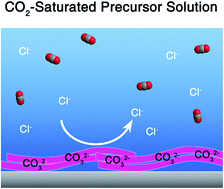
The most striking feature of LDHs is their compositional flexibility. In terms of anti-corrosive capacity, carbonate-intercalated LDHs should be the optimum choice. This is because the ion-exchange equilibrium constants of charge-compensating anions follow the sequence CO32− > SO42− > OH− > F− > Cl− > Br− > NO3−.9 In principle, once a carbonate-intercalated LDH film is formed, most of the corrosive components, like the Cl−, SO42−, Br− and F− anions commonly found in water, will not easily exchange these carbonate anions, thereby retarding the corrosion of the underlying metals.10 Besides chemical composition, also the crystallographic orientation of the LDH films may exert a strong influence on their anticorrosive capacity. Under ideal conditions, c-oriented LDH films are preferred as corrosion-resistant coatings, because in this case, plate-like LDH crystallites are arranged parallel to the substrate and thus will minimize intercrystalline voids and grain boundaries. In particular these boundaries may become inter-crystalline defects upon excessive exposure to the corrosive medium. Inspired by the above-mentioned principles, we report here a one-step, hydrothermal crystallization of preferentially c-oriented NiAl–CO3 LDH coatings on Al substrates. Prepared LDH coatings showed excellent anticorrosive performance, considerable long-term corrosion durability as well as strong mechanical stability (schematically shown in Fig. 1).
The precursor solution was prepared by adding 5.8 g Ni(NO3)2·6H2O (98.0 wt%, Merke) and 4.8 g NH4NO3 (98.0 wt%, Aldrich) into 100 ml CO2-saturated water (Vitalitasia Classic, containing saturated CO2). Consequently 10 ml NH3·H2O (1 wt%, Aldrich) was slowly added into the aqueous solution and stirred in an ice bath for 10 min.
An Al plate was first horizontally placed into a 50 ml Teflon-lined stainless vessel. 35 ml of the precursor solution was then poured into the vessel and sealed. The vessel was put into convective oven pre-heated to 85 °C. After an elapsed time of 40 h, the vessel was taken out and cooled to room temperature in air. Finally the film was washed with copious amounts of Distilled De-Ionized (DDI) water. Before the DC polarization test, the LDH film was dried in a convective oven at 60 °C for 12 h.
Besides CO2-saturated water, deionized (DI) water was also used as a solvent to prepare LDH films following the same procedure and recipe as shown above. Note: DI water was left in open air for at least 1 month to reach equilibrium of dissolved CO2 with the surrounding atmosphere.
A 3.5 wt% aqueous solution of sodium chloride was used as the corrosive medium. Before the test, the samples were immersed in the corrosive medium to measure the open-circuit-potential for 30 min. The sweep rate, potential range of DC polarization test was −1.5–+2.5 V (vs. reference), 10 mV s−1.
![]() | ||
| Fig. 2 SEM images of NiAl–CO3 LDH films prepared from (a–c) aged DI water and (d–f) CO2-saturated water solvents, respectively. | ||
In contrast, the LDH layer synthesized from the CO2-saturated precursor solution [abbreviated as NiAl–CO3 LDH (CO2-satur.)], which contained a much higher concentration of dissolved CO2 (∼3.3 × 10⁻² M),11 showed a distinct morphology. After in situ growth, the Al substrate had been fully covered with well-intergrown LDH crystallites with no visible defects (Fig. 2d), thus indicating that the new layer was highly compact. Higher magnification of the image demonstrated that the LDH crystal faces were well-developed and that the grain size was reduced to ∼200 nm (Fig. 2e). Nevertheless, the thickness of the LDH layer had reached ∼12 μm (Fig. 2f). Different from the NiAl–CO3 LDH (DI aged) film, only (0 0 3) and (0 0 6) diffraction peaks were found in the whole XRD pattern of the NiAl–CO3 LDH (CO2-satur.) film (Fig. 3d).
The different morphology of the NiAl–CO3 LDH (DI aged) and NiAl–CO3 LDH (CO2-satur.) layers is mainly attributed to the differences in the concentration of dissolved CO2 in the precursor solution. Owing to the much higher concentration of CO2 in the CO2-saturated precursor solution, the concentration of CO32−, which acts as the intercalating anions, is also higher, which will further increase both the nucleation density and growth rate of the NiAl–CO3 LDH film (as demonstrated in ESI-2†).11 In addition, the sufficient supply of CO2 also effectively suppresses the generation of intercrystalline defects in the NiAl–CO3 LDH layer during the in situ hydrothermal growth. In contrast, substantial defects are formed in the case of aged DI water (Fig. 2a) since the concentration of nutrient CO2 in the precursor solution is insufficient to guarantee complete sealing of the void spaces in the NiAl–CO3 LDH (DI aged) layer.
Preferred orientation of NiAl–CO3 LDH films was further investigated due to its potential impact on the anti-corrosive capacity. The intensity ratio I(0 0 3)/I(0 1 2) was employed here to evaluate the preferred orientation of LDH films,7 in which I(0 0 3) and I(0 1 2) represented peak heights of the (0 0 3) and (0 1 2) diffractions, respectively. A higher I(0 0 3)/I(0 1 2) value indicates that the LDH film has a c-axis preferred orientation, while a lower value demonstrates that prepared film is preferentially ab-oriented. Simultaneously, NiAl–CO3 LDH powders, which were scraped from corresponding LDH film samples, were also characterized as a reference (Fig. 3b). As was shown in the figure, all (0 0 3), (0 0 6), (0 1 2), (1 1 0) and (1 1 3) diffraction peaks were clearly observable and the I(0 0 3)/I(0 1 2) ratio reached 2.7 for the NiAl–CO3 LDH powders. As for the NiAl–CO3 LDH (DI aged) layer (Fig. 3c), this ratio was reduced significantly to 0.2, thus revealing that this film was dominantly ab-oriented and most LDH crystallites should be vertically aligned on the substrate (Fig. 2a). Additionally, a strong (1 1 0) diffraction peak at 2θ value of 60.4° further convinced its preferred ab-orientation. On the contrary, for the NiAl–CO3 LDH (CO2-satur.) layer, the (0 1 2) diffraction peak was totally undetectable (Fig. 3d) and the I(0 0 3)/I(0 1 2) ratio reached +∞. Although the relative low crystallinity of LDH crystallites in the NiAl–CO3 LDH (CO2-satur.) film may affect accurate evaluation of the preferred orientation of LDH films, it was believed that prepared LDH film was still preferentially c-oriented to a certain extent since after all, the (0 1 2) diffraction peak did not appear in the XRD pattern. The preferred c-orientation of the NiAl–CO3 (CO2-satur.) LDH layer could be further confirmed by its layer-like structure (Fig. 2f). Conventionally, c-oriented LDH films could be prepared by physical deposition of pre-formed LDH crystallites on substrates considering their plate-like shapes.14 Nevertheless, the adhesion between the film and substrate was very weak, making them unsuitable as anti-corrosive coatings.6b In comparison, in situ growth method provided better adhesion to the substrate. So far, most of LDH films prepared in this way showed random or ab-axis preferred orientation,15 the preparation of preferentially c-oriented LDH films, however, has turned out to be very difficult unless substrates were pre-modified with appropriate organic structure-directing agents.16 X. Duan et al. reported the in situ crystallization of ab-oriented and c-oriented MgAl–CO3 LDH films on bare and PVA-modified glass substrates, respectively.16 The ab-oriented LDH film was interpreted by the “evolution selection” growth mechanism. In such case the growth of LDH film was under kinetic control. On the contrary, the formation of preferentially c-oriented MgAl–CO3 LDH film on the PVA-modified glass side was attributed to the strong hydrogen bonding interactions between PVA and MgAl–CO3 LDH crystallites. The hydrogen-bonding energy, which referred to the thermodynamic parameter, indicated that the film formation process was in fact under thermodynamic control.
It was generally accepted that preferred orientation of inorganic crystalline films was driven by the interaction between thermodynamic and kinetic factors, as in the case of MFI zeolite films.17–20 Based on the previous research, in this study we try to elucidate the change in preferred orientation of NiAl–CO3 LDH coatings as follow: in most cases in situ hydrothermal growth of LDH films is a kinetically controlled process. Under this condition, prepared LDHs film will show ab-axis preferred orientation via the “evolution selection” mechanism as in the case of the NiAl–CO3 LDH (DI aged) coatings. In contrast, formation of c-oriented NiAl–CO3 LDH coatings is a thermodynamically favourable process since the most stable configuration for them to settle onto the surface is to lie on their flat surface (ab-face) parallel to substrates. Since concentration of CO2 in the CO2-saturated precursor solution is much higher (∼0.03 M), evolution of the NiAl–CO3 LDH (CO2-satur.) coatings is no longer under kinetic control and instead, thermodynamic factors gradually dominate the hydrothermal reaction, which ultimately leads to the formation of preferentially c-orientated NiAl–CO3 LDH films.
DC polarization is an effective tool for evaluating anti-corrosive coatings.21 In addition to the NiAl–CO3 LDH (DI aged) and LDH (CO2-satur.)-modified Al plates, a bare Al plate was also subject to the test for reference. Before the DC experiment, all samples were immersed in a corrosive medium (3.5 wt% aqueous NaCl solution) for 30 min. The horizontal-like anodic current curve of the Al substrate implied that it readily corroded in the NaCl solution.7 The Icorr for the bare Al substrate was ∼10−6 A cm−2 (Fig. 4a). After coating the Al plate with a NiAl–CO3 LDH (DI aged) layer, the Icorr was reduced by one order of magnitude (∼10−7 A cm−2, Fig. 4b). A further large decrease of Icorr to ∼10−9 A cm−2 could be achieved with the NiAl–CO3 LDH (CO2-satur.) coating (Fig. 4c), which was rarely observed previously for simple anion (like CO32−, NO3−, Cl− and CrO4−) intercalated LDH coatings22 and comparable with various organic anion (like laurate and 8-hydroxyquinoline) intercalated LDH coatings4a,22f (summarized in Table 1). This implied that NiAl–CO3 LDH (CO2-satur.) layers were competent as high-performance, anti-corrosive coatings. In addition, the much lower Icorr for the NiAl–CO3 LDH (CO2-satur.) film, when compared with the NiAl–CO3 LDH (DI aged) film, was expected because substantial defects were present in the latter (shown in ESI-2†).
| LDH film | Icorr bare | Icorr modified |
|---|---|---|
| (A cm−2) | (A cm−2) | |
| ZnAl–V10O28 LDH-epoxy22a | 10−6 | 10−7 |
| ZnAl–EDTA LDH-epoxy22b | 4.2 × 10⁻⁷ | 3.0 × 10⁻⁷ |
| ZnAl–CO3 LDH-epoxy22b | 4.2 × 10⁻⁷ | 3.9 × 10⁻⁷ |
| ZnAl–CrO4 LDH-epoxy22b | 4.2 × 10⁻⁷ | 0.7 × 10⁻⁷ |
| ZnAl–Cl LDH-epoxy22b | 4.2 × 10⁻⁷ | 2.5 × 10⁻⁷ |
| MgAl–CO3 LDH22c | 5.9 × 10⁻⁷ | 4.5 × 10⁻⁶ |
| MgAl–CO3 LDH22d | 6.3 × 10⁻⁶ | 1.5 × 10⁻⁶ |
| ZnAl–NO3 LDH4a | 10−6 | 10−8 |
| ZnAl–laurate LDH4a | 10−6 | 10−9 |
| MgAl–CO3 LDH22e | 1.9 × 10⁻⁴ | 4.9 × 10⁻⁶ |
| MgAl–NO3 LDH22f | 7.4 × 10⁻⁸ | 1.1 × 10⁻⁸ |
| MgAl–8HQ LDH22f | 7.4 × 10⁻⁸ | 0.9 × 10⁻⁹ |
| This work | 10−6 | 10−9 |
We further investigated the long-term durability of the NiAl–CO3 LDH (CO2-satur.) layer against corrosion. Results showed that even after immersion in a corrosive medium (3.5 wt% NaCl solution) for 15 days, the Icorr of the NiAl–CO3 LDH layer-coated Al plate remained as low as ∼10−8 A cm−2 (Fig. 4d). Simultaneously, the surface morphology of the LDH layer after the immersion process was characterized (shown in ESI-3†). Still no conspicuous cracking was observed in the NiAl–CO3 LDH (CO2-satur.) layer. In comparison, the bare Al plate had been badly corroded after immersion in the NaCl solution. It was supposed that both the intercalation of carbonate anions and preferred c-orientation of the NiAl–CO3 LDH (CO2-satur.) layer may contribute to the long-term durability.
Strong adhesion of anti-corrosion coatings to the metal surface is of vital importance for their practical applications.21a,23 Herein scratch test was employed to evaluate the adhesion strength of NiAl–CO3 LDH (CO2-satur.) coatings to substrates. It was found that no peeling off or delamination occurred after the cross cutting through LDH coatings, which indicated strong adhesion of LDH coatings to aluminium plate surface (Fig. 5). The excellent anti-corrosive capacity, considerable long-term durability as well as strong adhesion of NiAl–CO3 LDH (CO2-satur.) coatings will make them find wide applications in the field of corrosion protection.
Footnotes |
| † Electronic supplementary information (ESI) available: Experimental details: XRD pattern of NiAl–CO3 LDH powders, magnified cross-sectional SEM images of NiAl–CO3 LDH films prepared from DI aged and CO2-saturated precursor solutions, SEM images of the LDH film after long-term corrosion in NaCl solution. See DOI: 10.1039/c5ra01969a |
| ‡ These authors contribute equally to this work. |
| This journal is © The Royal Society of Chemistry 2015 |