
Electrosynthesis of cyclic carbonates from CO2 and epoxides on a reusable copper nanoparticle cathode

Laxia Wuab, Hengpan Yangb, Huan Wangb and Jiaxing Lu*b
aSchool of Chemistry and Chemical Engineering, Anqing Normal University, Anqing 246011, China
bShanghai Key Laboratory of Green Chemistry and Chemical Processes, School of Chemistry and Molecular Engineering, East China Normal University, Shanghai 200062, China. E-mail: jxlu@chem.ecnu.edu.cn; Tel: +86-21-62233491

Received 31st December 2014 , Accepted 24th February 2015

First published on 24th February 2015


Abstract

A highly stable and reusable Cu NP cathode was prepared by a simple method and used for the electrosynthesis of cyclic carbonates by electroreduction of CO2 in the presence of epoxides under mild conditions. No added metal catalyst is required and the yields vary from moderate to very good. Furthermore, the activity of the cathode was shown to depend on the size of the Cu NPs.

Carbon dioxide is expected to be a non-toxic, inexpensive, abundant and renewable C1 feedstock.1 Much effort has been made to develop effective processes for desirable, economically competitive products from carbon dioxide.2–8 Among them, cyclic carbonates have commercial importance because of their extensive applications in chemical and pharmaceutical industries. They can be used as electrolytes for lithium ion batteries, as organic solvents, fuel additives, and green reagents.9 In addition, cyclic carbonates are important raw materials for polyurethane synthesis, production of urea derivatives, and as alternatives to phosgene or dimethyl sulfate for methylation reactions.10 Due to their important roles, much attention has been attracted to developing synthesis methods. One of the most promising and atom economical methodologies for the synthesis of five-membered cyclic carbonates is the carboxylation of epoxides with CO2. However, metal complex catalysts are often used in typical synthesis procedures, because CO2 is very stable thermodynamically and quite kinetically inert.11–15 Recently, organic–inorganic hybrid zeolites have also been used for the synthesis of a variety of cyclic carbonates from epoxides and CO2 with very good TONs.16 Therefore, the development of a simple and efficient methodology for the activation of CO2 is a demanding challenge for organic chemists.

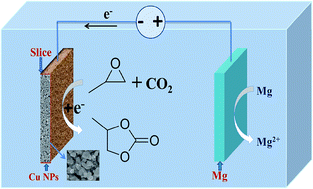
In our former work, electrocatalysis was demonstrated to be an efficient method for the activation of CO2, which could be performed under mild conditions with a remarkable efficiency.17–20 In addition, we employed NHCs as CO2 transformation catalysts with diols, thereby providing a new procedure to the synthesis of cyclic carbonates.21 In the continuity of our previous works, we further develop synthesis methods of cyclic carbonates. In this work, copper nanoparticles (Cu NPs) were successfully prepared by the direct reduction of copper sulfate with hydrazine hydrate in aqueous solution. They were compacted into a coin (Fig. S1) and used as cathode for the reaction of CO2 with epoxides (Fig. 1). Cyclic carbonates were obtained in yields ranging from 31% to 86%. Both the synthesis of Cu NPs and cyclic carbonates were performed under mild conditions, without any added metal catalyst.


image file: c4ra17287f-f1.tif
Fig. 1 Electrosynthesis of cyclic carbonates from CO2 and epoxides on copper nanoparticles cathode.

The synthesis of Cu NPs involved the reduction of CuSO4 by N2H4·H2O in an aqueous solution. Powder with metallic luster was achieved after filtration and drying. They were compacted into a coin using a tablet press. Firstly, the Cu NPs electrode was characterized by multiple methods. Fig. 2D displays the X-ray diffraction (XRD) patterns of a Cu NPs electrode. Typical diffraction peaks of Cu are observed (Fig. 2D, a), and there is no trace of any other substance such as copper oxides. The SEM pattern shows that Cu NPs have a porous structure (Fig. 2A) resulting from the aggregation of Cu nanograins of the ∼100 nm size range. After being compacted into a coin of 2 cm diameter with a tablet press, the size range and porous structures of Cu NPs electrode (Fig. 2B and E) didn't change. The Cu NPs (100 nm) have an average specific surface area of 4.3 m2 g−1 according to nitrogen adsorption–desorption isotherms. 2 g Cu NPs were compacted into an electrode of 3.14 cm2 geometric area, which corresponds to a real surface area of 8.6 m2. Namely, the real surface area of Cu NPs electrode is 2.7 × 10⁴ times larger than its geometric area.


image file: c4ra17287f-f2.tif
Fig. 2 Characterization of Cu NPs. FE-SEM patterns of Cu NPs (100 nm) before compacting (A), after compacting by tablet press (B, E), after being used for 10 times (C); XRD patterns of Cu NPs electrode before use (a) and after 10 runs (b) (D). FE-SEM patterns of Cu NPs in the size range of ∼300 nm (F) and 50 nm (G). TEM patterns of Cu NPs in the size range of 10 nm (H).

Propylene oxide (1a) was chosen as the model compound to be investigated. A typical galvanostatic electrosynthesis was carried out in a mixture of 0.1 M 1a, 0.1 M tetraethylammonium iodide (TEAI) in 10 mL acetonitrile (MeCN) using an undivided glass cell, with a Cu NPs (100 nm) cathode and sacrificial magnesium (Mg) anode. Correspondingly, propylene carbonate (2a) was obtained (Fig. 1).

To optimize the yield of 2a, the effect of various parameters on the process such as the charge passed, the current density, and the temperature was investigated. The results of the electrolyses are summarized in Table 1.

Table 1 Electrosynthesis of 2a from 1a and CO2 on Cu NPs (100 nm) cathodea
Entry Cathode Charge (F mol−1) Current density (mA cm−2) Temperature (°C) Yieldb (%)
a General conditions, 1a concentration: 0.1 M, MeCN: 10 mL, TEAI concentration: 0.1 M, anode: Mg, cathode diameter: 2 cm, CO2 pressure: 1 atm.b Mass yield, determined by gas chromatograph (GC).c Cu NPs (300 nm) cathode.d Cu NPs (50 nm) cathode.e Cu NPs (10 nm) cathode.
1 Cu flake 2.5 3.0 25 21
2 Cu NPs 1.0 3.0 25 52
3 Cu NPs 1.5 3.0 25 66
4 Cu NPs 2.0 3.0 25 73
5 Cu NPs 2.5 3.0 25 86
6 Cu NPs 3.0 3.0 25 85
7 Cu NPs 2.5 2.0 25 71
8 Cu NPs 2.5 4.0 25 69
9 Cu NPs 2.5 6.0 25 59
10 Cu NPs 2.5 9.0 25 41
11 Cu NPs 2.5 3.0 15 54
12 Cu NPs 2.5 3.0 35 60
13 Cu NPs 2.5 3.0 50 52
14 Cu NPsc 2.5 3.0 25 72
15 Cu NPsd 2.5 3.0 25 89
16 Cu NPse 2.5 3.0 25 93


The charge passed during electrolysis strongly influenced the yield of product 2a (Table 1, entries 2–6). The yield increased linearly with the charge from 1.0 to 2.5 F mol−1. Whereas the yield did not increase further by increasing the charge to 3.0 F mol−1 (Table 1, entry 6). The current density also influenced the yield of 2a (Table 1, entries 5 and 7–10). The highest yield was obtained at 3 mA cm−2. Both lower and higher current densities led to lower yields. At lower current densities, there might not be enough CO2 radical anions produced to react efficiently with the epoxide. At higher current densities, the amount of CO2 radical anions would also be less due to their conversion to CO and oxalate dianion.22

The temperature is also a crucial factor for this reaction. Normally, the lower the temperature is, the more CO2 could be dissolved in MeCN. As CO2 is the key reagent in this reaction, the concentration of CO2, which in fact depends on the temperature,23 may affect the 2a yield. On the other hand, the temperature will influence the over potential and reaction rate of the electrochemical reaction, which may have an impact on the 2a yield too. Therefore, the effect of the reaction temperature was examined (Table 1, entries 5 and 11–13). Increasing the temperature from 15 °C to 25 °C favored the reaction (Table 1, entries 6 and 11), but a further increase resulted in lower yields (Table 1, entries 12 and 13). The highest yield was achieved at 25 °C.

The effectiveness of different Cu cathodes was also studied. Parallel tests were carried out under the same conditions, expect for the cathode. A 21% yield was obtained at the Cu flake cathode as compared to an 86% yield at the Cu NPs (100 nm) cathode (Table 1, entries 1 and 5). Cu NPs are obviously superior to Cu flakes. To confirm this superiority, Cu NPs with different particle sizes (300 nm: Fig. 2F, 50 nm: Fig. 2G, 10 nm: Fig. 2H) but similar crystal form (Fig. S2) were prepared using multiple methods (see ESI) and used for the same reaction. The highest yield was obtained with the smallest 10 nm particles (Table 1, entry 16) and the lowest yield with the largest 300 nm particles (entry 14). The 100 and 50 nm particles gave similar yields (entries 5 and 15). These results show that a compacted Cu NPs electrode is much more effective than a Cu flake electrode. This agrees with the reports of other workers showing that smaller particles of Cu NPs are more active for the electroreduction of CO2.24 In addition, the electroreduction of CO2 was demonstrated to be the first and key step for the synthesis of cyclic carbonates.20 Hence, the higher effectiveness might be partially attributed to the far smaller particle size and higher surface area of Cu NPs electrodes. The electrocatalytic activity of Cu flake and Cu NPs cathode were further compared by cyclic voltammetry.

The cyclic voltammograms were recorded in 0.1 M TEAI–MeCN solution at a sweep rate of 0.2 V s−1 (Fig. 3). Compared to those in N2-saturated solution, a more positive onset potential and a higher current density were observed in CO2-saturated solution, which were due to the electroreduction of CO2. In comparison to the Cu flake cathode, the Cu NPs cathode exhibited a significantly higher catalytic activity (larger current density). This activity increases as the particle size decreases, the cathode with the smallest Cu NPs (∼10 nm) being almost six times as active as the Cu flake cathode. This is in agreement with the electrolysis results: the yield of carbonate increases as the particle size of the Cu NPs cathode decreases.


image file: c4ra17287f-f3.tif
Fig. 3 Cyclic voltammograms recorded at different cathodes in 0.1 M TEAI–MeCN solution at a sweep rate of 0.2 V s−1 at 25 °C.

The major disadvantage of typical method for the synthesis of cyclic carbonates involves the utilization of valuable and hardly recyclable catalysts.11–15 In contrast, no additive catalysts were needed in our synthesis system. What's more, Cu NPs electrode has remarkable stability and reusability. It could be easily cleaned after each electrolysis and reused. The process was repeated 10 times with the Cu NPs electrode under the electrolysis conditions of Table 1, entry 5. As shown in Fig. 4, the 2a yield remained around 85% after 10 runs. To further investigate the stability of the Cu NPs electrode, it was characterized by X-ray diffraction before (Fig. 2D, a) and after (Fig. 2D, b) 10 electrolyses. According to the XRD patterns, its composition did not change. Moreover, it retained its porous structures and had the same particle size (Fig. 2C). Therefore, the Cu NPs electrode is stable and reusable.


image file: c4ra17287f-f4.tif
Fig. 4 Reuse of Cu NPs electrode. Reaction conditions as Table 1 entry 5.

Encouraged by the excellent results obtained with propylene oxide (1a), the reaction was further studied under the conditions of Table 1, entry 5, with the following epoxides: epichlorohydrin (1b), 1-butene oxide (1c), 1-pentene oxide (1d), 2-butene oxide (1e), cyclopentene oxide (1f), cyclohexene oxide (1g), and styrene oxide (1h). The results are summarized in Table 2. The low yield of cyclic carbonate 2b (entry 2) might be attributed to secondary reactions involving the CH2Cl substituent. The yield of cyclic carbonates decreases in the order 2a, 2c, and 2d (entries 1, 3 and 4) as the size of the alkyl substituent of the epoxide varies from methyl, ethyl, and propyl. The lowest yields of cyclic carbonates were obtained with the disubstituted epoxides 1e, 1f, and 1g (entries 5–7) probably as a result of the lesser reactivity of a methine carbon as compared to a methylene carbon (steric effect). The yield of 2h (entry 8) is comparable to that of 2c (entry 3) and higher than that of 2d, which might be due to the weakening of the benzylic C–O bond of the oxirane ring of 1h by conjugation to the phenyl ring.

Table 2 Electrosynthesis of cyclic carbonates from CO2 and different substrates on Cu NPs (100 nm) electrodea
Entry Substrate Product Yieldb (%)
a Substrate concentration: 100 mM, charge: 2.5 F mol−1, current density: 3 mA cm−2, temperature: 25 °C, MeCN: 10 mL, TEAI concentration: 0.1 M, anode: Mg, cathode: Cu NPs, CO2 pressure: 1 atm.b Mass yield, determined by gas chromatograph (GC).
1 image file: c4ra17287f-u1.tif 1a image file: c4ra17287f-u2.tif 2a 86
2 image file: c4ra17287f-u3.tif 1b image file: c4ra17287f-u4.tif 2b 39
3 image file: c4ra17287f-u5.tif 1c image file: c4ra17287f-u6.tif 2c 68
4 image file: c4ra17287f-u7.tif 1d image file: c4ra17287f-u8.tif 2d 54
5 image file: c4ra17287f-u9.tif 1e image file: c4ra17287f-u10.tif 2e 42
6 image file: c4ra17287f-u11.tif 1f image file: c4ra17287f-u12.tif 2f 36
7 image file: c4ra17287f-u13.tif 1g image file: c4ra17287f-u14.tif 2g 31
8 image file: c4ra17287f-u15.tif 1h image file: c4ra17287f-u16.tif 2h 70


In conclusion, an effective and easily prepared compact Cu NPs electrode has been used in the electrochemical reaction of CO2 with various epoxides. The corresponding cyclic carbonates were obtained in moderate to very good yields, without any metal-catalyst additives. The Cu NPs electrode has remarkable stability and can be recycled many times.

Acknowledgements

Financial support from National Natural Science Foundation of China (21173085, 21203066, 21373090) is gratefully acknowledged.

Notes and references

  1. T. Sakakura, J. Choi and H. Yasuda, Chem. Rev., 2007, 107, 2365–2387 CrossRef CAS PubMed.
  2. C. A. Huff and M. S. Sanford, J. Am. Chem. Soc., 2011, 133, 18122–18125 CrossRef CAS PubMed.
  3. Z. F. Zhang, S. Q. Hu, J. L. Song, W. J. Li, G. Y. Yang and B. X. Han, ChemSusChem, 2009, 2, 234–238 CrossRef CAS PubMed.
  4. S. G. Liang, H. Z. Liu, T. Jiang, J. L. Song, G. Y. Yang and B. X. Han, Chem. Commun., 2011, 47, 2131–2133 RSC.
  5. F. Shi, Y. Q. Deng, T. L. SiMa, J. J. Peng, Y. L. Gu and B. T. Qiao, Angew. Chem., Int. Ed., 2003, 42, 3257–3260 CrossRef CAS PubMed.
  6. B. Yu, H. Y. Zhang, Y. F. Zhao, S. Chen, J. L. Xu, C. L. Huang and Z. M. Liu, Green Chem., 2013, 15, 95–99 RSC.
  7. O. Jacquet, C. D. Gomes, M. Ephritikhine and T. Cantat, ChemCatChem, 2013, 5, 117–120 CrossRef CAS.
  8. M. North, R. Pasquale and C. Young, Green Chem., 2010, 12, 1514–1539 RSC.
  9. P. Tundo and M. Selva, Acc. Chem. Res., 2002, 35, 706–716 CrossRef CAS PubMed.
  10. W. N. Haworth and H. Machemer, J. Chem. Soc., 1932, 2270–2277 RSC.
  11. H. W. Jing, T. Chang, L. L. Jin, M. Wu and W. Y. Qiu, Catal. Commun., 2007, 8, 1630–1634 CrossRef CAS PubMed.
  12. C. X. Miao, J. Q. Wang, Y. Wu, Y. Du and L. N. He, ChemSusChem, 2008, 1, 236–241 CrossRef CAS PubMed.
  13. J. Melendez, M. North and P. Villuendas, Chem. Commun., 2009, 18, 2577–2579 RSC.
  14. X. Zhang, Y. B. Jia, X. B. Lu, B. Li, H. Wang and L. C. Sun, Tetrahedron Lett., 2008, 49, 6589–6592 CrossRef CAS PubMed.
  15. C. J. Whiteoak, E. Martin, M. M. Belmonate, J. Benet-Buchholz and A. W. Kleij, Adv. Synth. Catal., 2012, 354, 469–476 CrossRef CAS.
  16. C. G. Li, L. Xu, P. Wu, H. H. Wu and M. Y. He, Chem. Commun., 2014, 50, 15764–15767 RSC.
  17. L. Zhang, D. F. Niu, K. Zhang, G. R. Zhang, Y. W. Luo and J. X. Lu, Green Chem., 2008, 10, 202–206 RSC.
  18. H. Wang, L. X. Wu, J. Q. Zhao, R. N. Li, A. J. Zhang, H. Kajiura, Y. M. Li and J. X. Lu, Greenhouse Gases: Sci. Technol., 2012, 2, 59–65 CrossRef CAS.
  19. L. X. Wu, H. Wang, Y. Xiao, Z. Y. Tu, B. B. Ding and J. X. Lu, Electrochem. Commun., 2012, 25, 116–118 CrossRef CAS PubMed.
  20. Y. Xiao, B. L. Chen, H. P. Yang, H. Wang and J. X. Lu, Electrochem. Commun., 2014, 43, 71–74 CrossRef CAS PubMed.
  21. L. X. Wu, H. Wang, Z. Y. Tu, B. B. Ding, Y. Xiao and J. X. Lu, Int. J. Electrochem. Sci., 2012, 7, 11540–11549 CAS.
  22. A. Gennaro, A. A. Isse, M. G. Severin, E. Vianello, I. Bhugun and J. M. Savéant, J. Chem. Soc., Faraday Trans., 1996, 92, 3963–3968 RSC.
  23. A. Gennaro, A. A. Isse and E. Vianello, J. Electroanal. Chem., 1990, 289, 203–215 CrossRef CAS.
  24. R. Reske, H. Mistry, F. Behafarid, B. R. Cuenya and P. Strasser, J. Am. Chem. Soc., 2014, 136, 6978–6986 CrossRef CAS PubMed.

Footnote

Electronic supplementary information (ESI) available: Materials, instruments, experimental details, characterization of Cu nanoparticles and characterization data for all products. See DOI: 10.1039/c4ra17287f

This journal is © The Royal Society of Chemistry 2015
Click here to see how this site uses Cookies. View our privacy policy here.