One-pot synthesis of poly(L-lactide)-b-poly(methyl methacrylate) block copolymers

Junzhe Songa, Jinbao Xub, Stergios Pispas*c and Guangzhao Zhang*ab
aHefei National Laboratory for Physical Sciences at Microscale, Department of Chemical Physics, University of Science and Technology of China, Hefei, P. R. China 230026. E-mail: gzzhang@ustc.edu.cn
bFaculty of Materials Science and Engineering, South China University of Technology, Guangzhou, P. R. China 510640
cTheoretical and Physical Chemistry Institute, National Hellenic Research Foundation, 48 Vassileos Constantinou Ave., Athens 11635, Greece. E-mail: pispas@eie.gr

Received 29th December 2014 , Accepted 22nd April 2015

First published on 22nd April 2015


Abstract

By using 1,8-diazabicyclo-[5.4.0]undec-7-ene (DBU) as both the atom transfer radical polymerization (ATRP) ligand and ring-opening polymerization (ROP) catalyst, we have combined copper-catalyzed ATRP and organo-catalyzed ROP in one-pot, and successfully synthesized poly(L-lactide)-b-poly(methyl methacrylate) (PLA-b-PMMA) diblock copolymers. The structure of the block copolymers is confirmed by nuclear magnetic resonance (NMR), size exclusion chromatography (SEC) and differential scanning calorimetry (DSC).

Introduction

Block copolymers have received increasing attention in the past decades due to their applications as thermoplastic elastomers (TPEs),1 polymeric surfactants2 and polymer blend compatibilizers.3 Most block copolymers are commonly synthesized by either sequential addition of the second monomer to an active chain-end through a single living polymerization process,4 or quenching of a homopolymer which is subsequently converted to a macroinitiator, which then starts the polymerization of the second block under adequate conditions.5 Recently, the combination of ring-opening polymerization (ROP) for the controlled synthesis of biodegradable aliphatic polyesters and controlled radical polymerization (CRP) of acrylate monomers is recognized as an efficient tool for synthesis of novel block copolymers with interesting properties.6,7 Such copolymers are expected to find biomedical applications in sutures, implants for bone fixation, drug delivery vehicles, tissue engineering scaffolds and other biomedical areas.8,9 Yet, the macroinitiators in the conventional sequential approach generally have to be separated from the monomers before the synthesis of the second block.6,10–12 The tedious separation and purification of the intermediates not only reduce the yield but also cost a lot of time and resources. Certainly, an one-pot approach to synthesize block copolymers is desired. Actually, block copolymers with predesigned functionalities and structures have been synthesized by one-pot process, namely a combination of CRP and ROP running sequentially/in parallel using a dual initiator.7,13–28 Well-defined block copolymers are also obtained through the one-pot combination of atom transfer radical polymerization (ATRP) and ROP,14,19 or reversible addition fragmentation chain transfer (RAFT) and ROP in a controlled manner.17,18

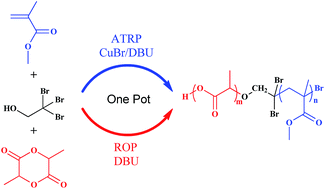
Organocatalysts have been rapidly developed in polymer chemistry and have recently been used in ROP of cyclic esters to afford metal free aliphatic polyesters.29–31 On the other hand, ATRP is one of the most powerful strategies to precisely control the molecular weight, composition, functionality, and architecture of vinyl polymers.32–34 In the present work, we have used the combination of ROP and ATRP with 1,8-diazabicyclo-[5.4.0]undec-7-ene (DBU) both as the ATRP ligand and ROP catalyst to synthesize a series of diblock copolymers containing a degradable block from L-lactide (LA) and a second one based on methyl methacrylate (MMA) in an one-pot procedure (Scheme 1). Our aim is to develop a facile approach to synthesize block copolymers.


image file: c4ra17202g-s1.tif
Scheme 1 Combination of ROP and ATRP in an one-pot process with DBU as ATRP ligand and ROP catalyst.

Experimental section

Materials

L-Lactide (LA) from Aldrich was recrystallized from ethyl acetate three times before use. Trimethylene carbonate (TMC) from JiNan GangDai was dissolved in THF at a concentration of 1 mg mL−1 and stirred over CaH2 for 1 day before being filtered, recrystallized twice from cold THF and finally dried. Methyl methacrylate (MMA) and styrene (St) from Aldrich were dried over CaH2 for 24 h and distilled under reduced pressure before use. Toluene (TOL) and tetrahydrofuran (THF) from Sinopharm were freshly distilled from sodium/benzophenone and stored under an argon atmosphere. 2,2,2-Tribromoethanol and DBU from Aldrich were used as received. Other reagents from Sinopharm were used as received.

Characterization

NMR measurements. Proton nuclear magnetic resonance (1H NMR) spectra were recorded on a Bruker AV400 NMR spectrometer by using deuterated chloroform (CDCl3) as the solvent and tetramethylsilane (TMS) as the internal standard.
Size exclusion chromatography (SEC). The number average molecular weight (Mn) and polydispersity index (PDI) were measured at 35 °C on a Waters size exclusion chromatography (SEC) equipped with a model 510 pump, a differential refractive index detector model 410 (RI) and a Waters 2487 UV detector working at a wavelength of 254 nm. A series of monodisperse polystyrenes were used as the standards with THF as the eluent at a flow rate of 1.0 mL min−1.
Thermal analysis. Differential scanning calorimetry (DSC) was conducted on a TA Instruments Q2000 under a nitrogen flow of 50 mL min−1. Samples were quickly heated to 200 °C and kept for 10 min to remove thermal history and then cooled to −80 °C at a rate of 10 °C min−1. Finally, they were reheated to 200 °C at the same rate. Dynamic mechanical analysis (DMA) was measured using a DMA Q800 apparatus (TA Instruments Inc., USA) from −30 to 150 °C at a heating rate of 5 °C min−1. The frequency of dynamic oscillatory loading was 10 Hz.
Transmission electron microscope (TEM). The TEM samples were measured on a JEOL JEM-2100 by drop casting the aggregate solution on a carbon coated copper grid. The samples were allowed to dry at room temperature under a slight nitrogen flux for at least 16 h prior to examination.
Dynamic laser light scattering measurements (LLS). A modified commercial LLS spectrometer (ALV/SP-125) equipped with an ALV-5000 multi-τ digital time correlator and a solid state laser (ADLAS DPY425II, out-put power of ∼400 mW at λ = 633 nm) was used. The copolymer solutions were clarified by 0.45 μm Millipore filter before LLS measurements. All experiments were conducted in situ inside the LLS cuvette at 25 °C at a scattering angle of 30°.

Synthesis of PLA-b-PMMA

A typical procedure for the one-pot copolymerization of LA and MMA is as follows: LA (0.2 g, 1.5 mmol), MMA (0.15 g, 1.5 mmol), CBr3CH2OH (4.0 mg, 0.015 mmol), and toluene (1.0 mL) were placed in a flamed and nitrogen purged Schlenk tube A. The resulting solution was then degassed through three freeze–pump–thaw cycles. In the mean time, CuBr (2 mg, 0.015 mmol), DBU (9.0 mg, 0.06 mmol) were added into another Schlenk tube B equipped with a magnetic stir bar followed by three freeze–pump–thaw cycles. Then the thawed solution in tube A was cannulated into tube B under nitrogen atmosphere. The final reaction mixture was put into an oil bath maintained at 85 °C. In order to calculate the conversion and molecular weight, samples were withdrawn periodically from the reaction mixture. After the predesigned time, the mixture was passed through a short neutral alumina column and purified via precipitation to methanol. The obtained polymers were dried under vacuum for further characterization (0.22 g, yield: 62.8%). Other polymers in this study were obtained following a similar approach.

Hydrolysis of PLA-b-PMMA

An aliquot of block copolymer (0.10–0.15 g) was dissolved in 10 mL of N,N-dimethylformamide (DMF) containing 0.1 g of NaOH. After 4 hours of stirring at 50 °C, The product was redissolved in THF and precipitated into a large excess of hexane. The polymer was dried under vacuum.

Micelle preparation

The polymeric nanoaggregates for TEM measurement and LLS measurement were prepared as follows: copolymer dispersion was prepared by slowly adding a dilute copolymer solution (Run 2, Table 1) in THF (10.0 mg mL−1) into a large amount of ethanol/water (80/20 wt%) solvent mixture with a boost pump at a speed of 12 mL h−1 under magnetic stirring. Then samples were dialyzed against 3 × 1 L of ethanol/water (80/20 wt%) solvent for a total of 48 h.
Table 1 DBU-catalyzed ATRP/ROP of MMA and LA
Run [MMA]0/[LA]0/[I]0a T (°C) Mn,theo × 10−4 (g mol−1) Mn,SEC × 10−4b (g mol−1) PDIb fLAc (mol%)
a [I]0/[CuBr]0/[DBU]0 = 1/1/4 in toluene.b Determined by SEC.c The molar content of LA in the polymer was calculated by 1H NMR.d [St]0/[TMC]0/[I]0.e The molar content of TMC.
1 140/60/1 85 2.0 2.3 1.45 33
2 100/100/1 85 2.0 2.2 1.43 54
3 60/140/1 85 2.0 1.7 1.47 75
4 30/30/1 85 0.6 0.7 1.40 55
5 300/300/1 85 6.0 5.6 1.75 46
6 560/240/1d 85 8.0 8.5 1.88 35e


Results and discussion

Commercially available DBU was reported to be an efficient ligand in ATRP.35 Here, it was used to catalyze the ring-opening polymerization of L-lactide (LA). The excellent tolerance of many functional groups in the ATRP process allows for its combination with the DBU-catalyzed ring-opening polymerization. The one-pot reaction was performed with CuBr and DBU ligand as the catalyst for the ATRP and ROP, and 2,2,2-tribromoethanol as the dual functional initiator.

Temperature plays a crucial role in ATRP. We first investigated the temperature effect on the polymerization in a series of preliminary experiments and found that the optimal temperature is 85 °C, where CuBr/DBU is effective for the ATRP of MMA and the ROP of LA.

Fig. 1(a) shows a typical 1H NMR spectrum of the resulting copolymer. The peaks at 5.18 and 1.58 ppm are assigned to –CH– and –CH3 in the PLA block. The peaks at 3.60, 1.85, 1.02 and 0.84 ppm are due to –OCH3, –CH2– and –CH3 groups in PMMA block, respectively. After purification, each copolymer has a molar ratio of LA/MMA almost equal to the corresponding feed ratio (Table 1), indicating that the one-pot polymerization is controlled. Fig. 1(b) shows the 13C NMR spectrum of the resulting copolymer. The peaks at 169.56, 69.04 and 16.35 ppm are attributed to C[double bond, length as m-dash]O, –CH– and –CH3 in PLA, respectively. The peaks at 169.56, 53.63, 51.75, 44.58 and 16.35 ppm correspond to C[double bond, length as m-dash]O, –CH2–, –OCH3, –C– and –CH3 groups in PMMA, respectively. Clearly, 13C NMR data further indicate the successful synthesis of the desired block copolymer.


image file: c4ra17202g-f1.tif
Fig. 1 (a) 1H NMR spectrum (in CDCl3) and (b) 13C NMR spectrum (in CDCl3) of PLA-b-PMMA (Table 1, Run 4).

In order to get a better picture on the mechanism, we have investigated the kinetics of the one-pot polymerization. Fig. 2(a) shows the kinetics of polymerization with a feed ratio of [MMA]0/[LA]0/[I]0/[CuBr]0/[DBU]0 = 140/60/1/1/4. ln([M]0/[M]) linearly increases with reaction time, indicating that the ROP and ATRP are conducted in a controlled manner. Note that the one-pot polymerization of LA and MMA with DBU as the ROP catalyst and ATRP ligand might be impossible due to their difference in reaction rate. Yet, we can observe a distinct NMR shift from 5.05 ppm to 5.18 ppm (Fig. 3). This is evidence that almost all LA monomers are polymerized in the first 10 minutes, followed by the polymerization of MMA. The molar fraction of PLA in the copolymer varies from 1 to 0.4 shown in Fig. 2(a), further indicating that LA monomer is polymerized more rapidly. Fig. 2(b) shows the linear relation between the number-average molecular weight and conversions. Besides, the molecular weight increases with the monomer conversion, and the polydispersity index (PDI) is relatively small. All experimental evidence indicates that the one-pot process is controlled.


image file: c4ra17202g-f2.tif
Fig. 2 (a) Time dependence of ln(M0/M) of PLA block (■) and PMMA block (□) independently, and molar fraction (fPLA) of PLA block (▼); (b) the dependence of the number-average molecular weight (Mn) (□) and polydispersity index (PDI) (○) on conversion.

image file: c4ra17202g-f3.tif
Fig. 3 1H NMR spectrum (in CDCl3) of the polymerization mixture at 10 min.

SEC can provide useful information for distinguishing a block copolymer from a homopolymer mixture. If the product has a narrow unimodal distribution in SEC curve, it is generally a block copolymer. In contrast, homopolymer mixtures usually have a bimodal distribution.36 The relatively narrow unimodal peak (PDI = 1.45) in Fig. 4 suggests that the product is a block copolymer. Actually, the DBU catalyzed ring-opening polymerization of LA completed in the first 10 minutes, which leads to the formation of a small amount of PLA homopolymer inevitably.37 Thanks to the low feed ratio of LA to MMA (60/140), the unreacted PLA is readily removed by precipitating the product in methanol (Fig. 4). However, when the feed ratio increases up to 300/300/1 (Table 1), it is difficult to extract the PLA homopolymer from the polymer mixture because of its higher molecular weight.


image file: c4ra17202g-f4.tif
Fig. 4 SEC curves of the copolymers (Table 1, Run 1).

The block copolymers were characterized also by DSC. Fig. 5 shows the DSC curves for the resulting polymers together with those of PMMA and PLA homopolymers. PMMA is amorphous with a glass transition temperature (Tg) at about 120 °C, and PLA is semicrystalline with melting temperature (Tm) at about 140 °C and Tg of 43 °C. For PLA-b-PMMA copolymer, we can observe one single Tg at 60 °C, and no melting peak is observed. The lack of the second glass transition may be due to a decreased chain flexibility in one of the blocks. To detect the other Tg, the copolymers were also characterized by DMA (Fig. S1) which is more sensitive than DSC, and two Tgs were found at 67 °C and 123 °C, respectively. Considering that PLA and PMMA homopolymer mixture also exhibits such behavior, the obtained polymer was hydrolyzed in the presence of NaOH, and we examined the molecular weight during the hydrolysis.


image file: c4ra17202g-f5.tif
Fig. 5 DSC curves of copolymer through the one-pot DBU-catalyzed ATRP/ROP (Table 1, Run 2) at a heating rate of 10 °C min−1.

Fig. 6(a) shows that the peaks at 5.18 and 1.58 ppm assigned to –CH– and –CH3 in PLA disappear after hydrolysis, that is, PLA is completely hydrolyzed and the left material is PMMA. Fig. 6(b) shows that the decrease in the average molecular weight (Mn) after the hydrolysis is equal to 9000 g mol−1, close to that expected for PLA block (8640 g mol−1). PDI of the hydrolyzed product slightly increases and should reflect the PDI of the PMMA block in the copolymer.


image file: c4ra17202g-f6.tif
Fig. 6 (a) 1H NMR spectrum of copolymers before and after hydrolysis; (b) SEC curves of polymers before (red) and after (blue) hydrolysis of PLA (Table 1, Run 1).

The block structure is further supported by TEM analysis. Fig. 7 shows TEM image of the micelles formed by the PLA-b-PMMA copolymer in ethanol/water (80/20 wt%) solvent mixture, which have an average diameter of 80 nm. It is known that block copolymers can form core–shell micelles in a selective solvent.38 As PMMA can dissolve in ethanol/water (80/20 wt%) solvent mixture,39 and PLA will precipitate in it, the images of micelles support the formation of a block copolymer during polymerization. The size of micelles is further measured by LLS analysis. Fig. S2 shows that the micelles formed by the PLA-b-PMMA copolymer are narrowly distributed and have an average hydrodynamic radius 〈Rh〉 of 285 nm. All data presented so far indicate that the polymer resulting from the one-pot polymerization of LA and MMA is a block copolymer, and not a PLA/PMMA homopolymer mixture.


image file: c4ra17202g-f7.tif
Fig. 7 TEM image of PLA-b-PMMA in ethanol/water (80/20 wt%) solvent mixture, a selective solvent for PMMA (Table 1, Run 2).

To shed more light on the synthetic potential of this novel methodology for block polymer synthesis, trimethylcarbonate (TMC) and styrene (St) as a cyclic and a vinyl monomer, respectively, were also utilized for the one-pot polymerization (Table 1). The PDI of the resulting copolymer is somewhat broader since the residual homopolymer can be hardly washed by methanol (Fig. S3). The block copolymer nature of PTMC-b-PS was confirmed by 1H NMR measurements (Fig. S4) and DSC analysis (Fig. S5).

Conclusions

By the combination of copper-catalytic ATRP and organo-catalytic ROP, we can synthesize PLA-b-PMMA copolymers in a one-pot process, where DBU acts as both the ATRP ligand and ROP catalyst. The procedure is facile and versatile, and it is expected to be used for the synthesis of several block copolymers composed of a variety of different types of monomers.

Acknowledgements

The financial support of Ministry of Science and Technology of China (2012CB933800) is acknowledged.

References

  1. J. E. Puskas and Y. Chen, Biomacromolecules, 2004, 5, 1141–1154 CrossRef CAS PubMed.
  2. L. Li, J. Yang and J. Zhou, Macromolecules, 2013, 46, 2808–2817 CrossRef CAS.
  3. E. A. Eastwood and M. D. Dadmun, Macromolecules, 2002, 35, 5069–5077 CrossRef CAS.
  4. O. W. Webster, Science, 1991, 251, 887–893 CrossRef CAS PubMed.
  5. N. Hadjichristidis, M. Pitsikalis and H. Iatrou, in Block Copolymers I, ed. V. Abetz, Springer Berlin, Heidelberg, 2005, vol. 189 Search PubMed.
  6. M. Schappacher, N. Fur and S. M. Guillaume, Macromolecules, 2007, 40, 8887–8896 CrossRef CAS.
  7. E. Themistou, G. Battaglia and S. P. Armes, Polym. Chem., 2014, 5, 1405–1417 RSC.
  8. B. Jeong, Y. H. Bae, D. S. Lee and S. W. Kim, Nature, 1997, 388, 860–862 CrossRef CAS PubMed.
  9. J. K. Oh, Soft Matter, 2011, 7, 5096–5108 RSC.
  10. M. Barz, F. K. Wolf, F. Canal, K. Koynov, M. J. Vicent, H. Frey and R. Zentel, Macromol. Rapid Commun., 2010, 31, 1492–1500 CrossRef CAS PubMed.
  11. A. Tardy, V. Delplace, D. Siri, C. Lefay, S. Harrisson, B. de Fatima Albergaria Pereira, L. Charles, D. Gigmes, J. Nicolas and Y. Guillaneuf, Polym. Chem., 2013, 4, 4776–4787 RSC.
  12. J. Du and S. P. Armes, Soft Matter, 2010, 6, 4851–4857 RSC.
  13. S. J. Shin, Y. C. Yu, J. D. Seo, S. J. Cho and J. H. Youk, J. Polym. Sci., Part A: Polym. Chem., 2014, 52, 1607–1613 CrossRef CAS PubMed.
  14. F. F. Wolf, N. Friedemann and H. Frey, Macromolecules, 2009, 42, 5622–5628 CrossRef CAS.
  15. M. A. Kryuchkov, C. Detrembleur and C. G. Bazuin, Polymer, 2014, 55, 2316–2324 CrossRef CAS PubMed.
  16. D. Mecerreyes, G. Moineau, P. Dubois, R. Jérôme, J. L. Hedrick, C. J. Hawker, E. E. Malmström and M. Trollsas, Angew. Chem., Int. Ed., 1998, 37, 1274–1276 CrossRef CAS.
  17. H. U. Kang, Y. C. Yu, S. J. Shin and J. H. Youk, J. Polym. Sci., Part A: Polym. Chem., 2013, 51, 774–779 CrossRef CAS PubMed.
  18. Y. C. Yu, G. Li, H. U. Kang and J. H. Youk, Colloid Polym. Sci., 2012, 290, 1707–1712 CAS.
  19. F. K. Wolf, A. M. Hofmann and H. Frey, Macromolecules, 2010, 43, 3314–3324 CrossRef CAS.
  20. C. Cheng, E. Khoshdel and K. L. Wooley, Nano Lett., 2006, 6, 1741–1746 CrossRef CAS PubMed.
  21. Y. Li, E. Themistou, J. Zou, B. P. Das, M. Tsianou and C. Cheng, ACS Macro Lett., 2012, 1, 52–56 CrossRef CAS.
  22. Y. Zheng, W. Turner, M. Zong, D. J. Irvine, S. M. Howdle and K. J. Thurecht, Macromolecules, 2011, 44, 1347–1354 CrossRef CAS.
  23. N. Chagneux, T. Trimaille, M. Rollet, E. Beaudoin, P. Gérard, D. Bertin and D. Gigmes, Macromolecules, 2009, 42, 9435–9442 CrossRef CAS.
  24. B. Gorzolnik, P. Davidson, I. Beurroies, R. Denoyel and D. Grande, Macromol. Symp., 2010, 287, 127–134 CrossRef CAS PubMed.
  25. X. Liu, P. Ni, J. He and M. Zhang, Macromolecules, 2010, 43, 4771–4781 CrossRef CAS.
  26. M. Dirany, P. Lacroix-Desmazes, M. Vayer, R. Erre, B. Boutevin and C. Sinturel, J. Appl. Polym. Sci., 2011, 122, 2944–2951 CrossRef CAS PubMed.
  27. J. Mao, X. Ji and S. Bo, Macromol. Chem. Phys., 2011, 212, 744–752 CrossRef CAS PubMed.
  28. W. W. Wang, W. Y. Ren, L. Jiang and Y. Dan, J. Appl. Polym. Sci., 2010, 118, 2379–2388 CAS.
  29. M. K. Kiesewetter, E. J. Shin, J. L. Hedrick and R. M. Waymouth, Macromolecules, 2010, 43, 2093–2107 CrossRef CAS.
  30. N. E. Kamber, W. Jeong, R. M. Waymouth, R. C. Pratt, B. G. G. Lohmeijer and J. L. Hedrick, Chem. Rev., 2007, 107, 5813–5840 CrossRef CAS PubMed.
  31. H. A. Brown, A. G. De Crisci, J. L. Hedrick and R. M. Waymouth, ACS Macro Lett., 2012, 1, 1113–1115 CrossRef CAS.
  32. K. Matyjaszewski, Macromolecules, 2012, 45, 4015–4039 CrossRef CAS.
  33. H. Gao and K. Matyjaszewski, J. Am. Chem. Soc., 2007, 129, 6633–6639 CrossRef CAS PubMed.
  34. K. Matyjaszewski and N. V. Tsarevsky, J. Am. Chem. Soc., 2014, 136, 6513–6533 CrossRef CAS PubMed.
  35. D. Fournier, M. L. Romagné, S. Pascual, V. Montembault and L. Fontaine, Eur. Polym. J., 2005, 41, 1576–1581 CrossRef CAS PubMed.
  36. Y. C. Wang, Y. Li, X. Z. Yang, Y. Y. Yuan, L. F. Yan and J. Wang, Macromolecules, 2009, 42, 3026–3032 CrossRef CAS.
  37. B. G. G. Lohmeijer, R. C. Pratt, F. Leibfarth, J. W. Logan, D. A. Long, A. P. Dove, F. Nederberg, J. Choi, C. Wade, R. M. Waymouth and J. L. Hedrick, Macromolecules, 2006, 39, 8574–8583 CrossRef CAS.
  38. R. Hoogenboom, C. R. Becer, C. Guerrero-Sanchez, S. Hoeppener and U. S. Schubert, Aust. J. Chem., 2010, 63, 1173–1178 CrossRef CAS.
  39. J. M. G. Cowie, M. A. Mohsin and I. J. McEwen, Polymer, 1987, 28, 1569–1572 CrossRef CAS.

Footnote

Electronic supplementary information (ESI) available. See DOI: 10.1039/c4ra17202g

This journal is © The Royal Society of Chemistry 2015
Click here to see how this site uses Cookies. View our privacy policy here.