Takuhiro Ishiia,
Toshiaki Enokib,
Tomonobu Mizumob,
Joji Ohshitab and
Yoshiro Kaneko*a
aGraduate School of Science and Engineering, Kagoshima University, 1-21-40 Korimoto, Kagoshima 890-0065, Japan. E-mail: ykaneko@eng.kagoshima-u.ac.jp; Fax: +81 99 285 7794; Tel: +81 99 285 7794
bGraduate School of Engineering, Hiroshima University, Higashi-Hiroshima 739-8527, Japan
First published on 23rd January 2015
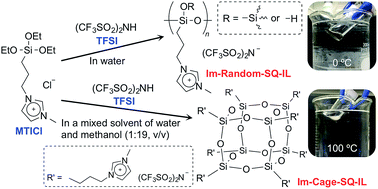
An ionic liquid containing a random-structured oligosilsesquioxane (Im-Random-SQ-IL) was successfully prepared by the hydrolytic condensation of 1-methyl-3-[3-(triethoxysilyl)propyl]imidazolium chloride (MTICl) in aqueous bis(trifluoromethanesulfonyl)imide (TFSI). Im-Random-SQ-IL exhibited a glass transition temperature (Tg) at −25 °C as indicated by an endothermic peak in the differential scanning calorimetry (DSC) curve. In addition, fluidity was visually observed at ca. 0 °C, i.e. Im-Random-SQ-IL is a room temperature ionic liquid. Conversely, when the hydrolytic condensation of MTICl was performed using a water/methanol (1
:
19 v/v) solution of TFSI, an ionic liquid containing a cage-like oligosilsesquioxane (Im-Cage-SQ-IL) was obtained. The Tg of Im-Cage-SQ-IL was −22 °C, and its melting temperature (Tm) was 105 °C according to the DSC analysis. In addition, fluidity was observed for this ionic liquid at ca. 100 °C. These results suggest that both the amorphous structure of Im-Random-SQ-IL and the type of substituent groups in the silsesquioxane contributed to the ionic liquid behaviour below room temperature. In addition, these ionic liquids exhibited high thermal stabilities (Im-Random-SQ-IL: Td3 = 429 °C, Td5 = 437 °C and Td10 = 447 °C, Im-Cage-SQ-IL: Td3 = 427 °C, Td5 = 436 °C and Td10 = 446 °C) and relatively high ion conductivities (10−4–10−3 S cm−1, at ∼100 °C).
Recently, cage-like oligoSQ compounds (POSS) with an ionic liquid nature were developed by Chujo and Tanaka et al.11,12 Ionic liquids are molten salts below 100 °C or 150 °C and have been widely studied for their remarkable potential as reaction solvents,13,14 extraction solvents15,16 and electrolyte materials17–19 due to their superior properties, indicating a negligible vapour pressure, high thermal stability and high ionic conductivity. Ionic liquids that are fluid below room temperature, i.e. room temperature ionic liquids, are particularly useful for the aforementioned applications. Ionic liquids consist of organic cations with either organic or inorganic anions, i.e. most ionic liquids are regarded as organic compounds due to the presence of at least one organic ion. Conversely, because the aforementioned POSS ionic liquids developed by Chujo and Tanaka et al. have inorganic frameworks including Si–O–Si bonds, they exhibit higher thermal stabilities compared to an ionic liquid with the structure of the side chains of this POSS compound.11,12 Due to this higher thermal stability, ionic liquids containing SQ frameworks have the potential for application in a wide range of materials research fields.
To date, we have reported the preparation of soluble rod-like and ladder-like polySQs with hexagonally stacked structures by the hydrolytic polycondensation of trifunctional silane compounds containing substituent groups that can be converted into ionic groups during the reaction, such as amino groups (converted to ammonium cations),20–28 a cyano group (converted to a carboxylate anion),29 or a mercapto group (converted to a sulfonate anion).30 In addition, POSS compounds can be prepared in higher yields with shorter reaction time by hydrolytic condensation of amino group-containing organotrialkoxysilanes using an aqueous superacid solution as a catalyst.31,32 These results suggest that the presence of ionic substituent groups is important for controlling the structures of SQs.
Considering the results of our previous studies, we investigated the hydrolytic condensation of various organotrialkoxysilanes and catalysts for the preparation of specially structured ionic SQs. During these studies, we coincidentally found that a quaternary ammonium-type ionic liquid containing random-structured oligoSQ (Am-Random-SQ-IL) was successfully prepared by the hydrolytic condensation of quaternary ammonium group-containing organotrialkoxysilane, trimethyl[3-(triethoxysilyl)propyl]ammonium chloride (TMTESPAC), in aqueous bis(trifluoromethanesulfonyl)imide (TFSI).33 However, Am-Random-SQ-IL had a glass-transition temperature (Tg) of 15 °C and exhibited fluidity at ca. 35 °C, i.e. it was not a room temperature ionic liquid.
Generally, imidazolium-type ionic liquids have relatively low melting points (Tm).34 Therefore, in the present study, to prepare a room temperature ionic liquid containing an SQ framework, the hydrolytic condensation of the imidazolium group-containing organotrialkoxysilane, 1-methyl-3-[3-(triethoxysilyl)propyl]imidazolium chloride (MTICl), in aqueous TFSI was investigated. Herein, we report the preparation and characterization of the ionic liquids with SQ structures, the relationship between their SQ structures and flow temperatures and the thermal and ionic conductance properties of the resulting SQ ionic liquids.
:
19 v/v) was added with stirring at room temperature, and the resulting solution was further stirred for 2 h. This solution was then heated at ca. 60 °C in an open system until the solvent completely evaporated. Subsequently, the resulting solid was maintained at 100 °C for ca. 2 h, and then water (ca. 10 mL) was added at room temperature. The water-insoluble product was isolated by decantation, washed with water (ca. 10 mL × 10) and then dried under reduced pressure at room temperature. To remove the small amount of water remaining in the resulting crude, the product was dissolved in methanol (4 mL) and the solution was heated at ca. 60 °C in an open system until the solvent completely evaporated. The resulting product was then maintained at 150 °C for ca. 10 h to yield 0.430 g of a viscous substance (yield, ca. 94%; the ideal chemical formula of one unit of the product [SiO1.5(CH2)3(C3H3N2)CH3·(CF3SO2)2N, FW = 456.0] was used for the determination). This product is hereafter denoted as Im-Cage-SQ-IL. 1H NMR (400 MHz, DMSO-d6): δ 9.01 (1H, s, –NCHN–), δ 7.72 and 7.62 (2H, –NCHCHN–), δ 4.09 (2H, t, J = 6.87 Hz, –CH2N–), δ 3.86 (3H, s, –NCH3), δ 1.85–1.59 (2H, br, –SiCH2CH2CH2N–), δ 0.64–0.35 (2H, br, –SiCH2–). 29Si NMR (80 MHz, DMSO-d6): δ −66.5 (T8), δ −68.7 (T10).
:
S in Im-Random-SQ-IL and Im-Cage-SQ-IL were confirmed by the energy-dispersive X-ray (EDX) analyses using an XL30 scanning electron microscope (FEI Co.). The weight-average molecular weights (Mws) of Im-Random-SQ-IL and Im-Cage-SQ-IL were estimated from Zimm plots generated with data obtained by static light scattering (SLS) analyses in methanol using an Otsuka Electronics DLS-8000 spectrophotometer. X-ray diffraction (XRD) patterns were recorded at a scanning speed of 2θ = 1.8° min−1 using an X'Pert Pro diffractometer (PANalytical) with Ni-filtered Cu Kα radiation (0.15418 nm). The differential scanning calorimetry (DSC) analyses were performed on an Exstar DSC6200 (Seiko Instruments). The sample was placed in an open aluminium pan and heated to 150 °C at a rate of 10 °C min−1 under a nitrogen flow (10 mL min−1) and subsequently cooled from 150 °C to −100 °C at the same rate. The Tg and Tm values were determined as the onset of the third (for Im-Random-SQ-IL) or fifth (for Im-Cage-SQ-IL) curves (from −100 °C to 150 °C at a rate of 10 °C min−1) to eliminate the heat histories in the samples. Thermogravimetric analyses (TGA) were performed on an Exstar TG/DTA6200 (Seiko Instruments) at a heating rate of 10 °C min−1 up to 500 °C a under nitrogen flow (250 mL min−1). The decomposition temperatures were determined from the 3% (Td3), 5% (Td5) and 10% (Td10) weight losses. The matrix-assisted laser desorption ionization-time of fight mass spectral (MALDI-TOF MS) analysis of Im-Cage-SQ-IL was performed using a Shimadzu Voyager Biospectrometry Workstation Ver. 5.1 with 2,5-dihydroxybenzoic acid (DHB) as the matrix under positive ion mode. The ion conductivities were determined by complex impedance spectroscopy using a Solation 1260 impedance gain/phase analyser (Solation Analytical) in the temperature range from 20 °C to 100 °C.
The 1H NMR spectrum of Im-Random-SQ-IL in DMSO-d6 exhibited signals attributable to the 1-methyl-3-propyl imidazolium groups, but signals for the ethoxy groups of MTICl and the NH group of TFSI were not observed (Fig. 1a), indicating that the MTICl reagent and the TFSI catalyst were not present in the product. The EDX pattern of Im-Random-SQ-IL also indicated the absence of Cl (2.6 and 2.8 keV) (Fig. 2a). In addition, the Si
:
S elemental ratio of Im-Random-SQ-IL was estimated to be 1
:
2.03, indicating that the molar ratio of imidazolium cations to TFSI anions in Im-Random-SQ-IL was ca. 1
:
1. Furthermore, the 29Si NMR spectrum of Im-Random-SQ-IL in DMSO-d6 at 60 °C exhibited two multiplet signals in the T2 (−53–−61 ppm) and T3 (−64–−70 ppm) regions with an integrated ratio of ca. 0.40
:
0.60 (Fig. 3a). This result indicated that the hydrolytic condensation of MTICl to form the main chain of the siloxane bond was complete. The Mw of Im-Random-SQ-IL estimated by the Zimm plot method using SLS data obtained in methanol was ca. 8.8 × 10². The degree of polymerization (number of Si atom: n) was then calculated to be ca. 10.4 from the Mw value, the formula weights of the imidazolium cation repeating unit (176.3) and the TFSI anion (280.1) using the following equation: Mw (8.8 × 10²) = {[1 × (176.3 × n)2] + (n × 280.12)}/[(1 × 176.3 × n) + (n × 280.1)], i.e. Im-Random-SQ-IL is composed of 10.4 TFSI anions and one oligomer containing 10.4 imidazolium cations. In addition, no diffraction peaks were observed in the XRD pattern of Im-Random-SQ-IL (Fig. 4a). Based on all of these results, it was concluded that Im-Random-SQ-IL was an amorphous-structured oligomeric SQ compound composed of imidazolium cations and TFSI anions.
![]() | ||
| Fig. 1 1H NMR spectra of (a) Im-Random-SQ-IL and (b) Im-Cage-SQ-IL in DMSO-d6. Chemical shifts were referenced to DMSO (δ 2.5). | ||
![]() | ||
| Fig. 3 29Si NMR spectra of (a) Im-Random-SQ-IL and (b) Im-Cage-SQ-IL in DMSO-d6. Chemical shifts were referenced to tetramethylsilane (TMS) (δ 0.0). | ||
DSC analysis of Im-Random-SQ-IL was performed at a heating rate of 10 °C min−1 (Fig. 5a). The endothermic peak assigned to the Tg was observed at −25 °C. Conversely, a peak due to the Tm was not detected. The amorphous structure of Im-Random-SQ-IL may give rise to poor packing of the ions. Therefore, the phase transition from amorphous solid (or supercooled liquid) to fluid occurred above the Tg. To date, ionic liquids without Tm have been reported (e.g. 1-butyl-3-methylimidazolium tetrafluoroborate42 and 1-ethyl-3-methylimidazolium phosphonate derivatives,43 in addition to our previous report33). The flow temperature of Im-Random-SQ-IL was confirmed as follows: Im-Random-SQ-IL in a glass vessel was maintained in a horizontal position at 100 °C for 15 min, and then the vessel was cooled to room temperature in the horizontal state. Next the vessel was maintained in a horizontal position at various temperatures (with 5 °C intervals) for 10 min and then 15 min with tilting. Consequently, Im-Random-SQ-IL showed obvious fluidity at ca. 0 °C (Fig. 6a). Based on these results, it was concluded that Im-Random-SQ-IL had a Tg of −25 °C and showed fluidity at ca. 0 °C, i.e. it is a room temperature ionic liquid.
When the hydrolytic condensation of MTICl was performed using a water/methanol (1
:
19 v/v) solution of TFSI instead of the aforementioned aqueous solution, a cage-like oligoSQ with ionic liquid properties (Im-Cage-SQ-IL) was obtained (Scheme 1b). Im-Cage-SQ-IL was soluble in ethyl acetate, THF, acetone, methanol, DMF and DMSO, but insoluble in hexane, toluene, diethyl ether, chloroform, 2-propanol, 1-propanol, ethanol and water. Im-Cage-SQ-IL was characterized using 1H NMR, EDX, 29Si NMR, SLS, MALDI-TOF MS and XRD analysis techniques.
The 1H NMR spectrum of Im-Cage-SQ-IL in DMSO-d6 exhibited signals attributable to the 1-methyl-3-propyl imidazolium groups, but signals for the ethoxy groups of MTICl and the NH group of TFSI were not observed (Fig. 1b), indicating that the MTICl reagent and TFSI catalyst were not present in the product. The EDX pattern of Im-Cage-SQ-IL also did not include any peaks due to Cl (2.6 and 2.8 keV), and the Si
:
S elemental ratio was estimated to be 1
:
2.02, indicating that the molar ratio of imidazolium cations to TFSI anions in Im-Cage-SQ-IL was ca. 1
:
1 (Fig. 2b). These 1H NMR and EDX results for Im-Cage-SQ-IL were nearly the same as those for Im-Random-SQ-IL.
The 29Si NMR spectrum of Im-Cage-SQ-IL in DMSO-d6 at 40 °C exhibited two signals in the T3 region at −66.5 ppm (a main signal) and at −68.7 ppm (a minor signal), indicating the absence of silanol groups (Fig. 3b). These signals were probably derived from T8 and T10, respectively, because it has been reported that the signal due to T10 is shifted upfield (ca. 2 ppm) compared to that of T8.44 Because the integrated ratio of these signals was estimated to be 0.75
:
0.25, the molar ratio of T8
:
T10 was calculated to be 0.79
:
0.21 (=0.75/8
:
0.25/10). The Mw of Im-Cage-SQ-IL estimated by the Zimm plot method using SLS data obtained in methanol was ca. 5.9 × 10², and the corresponding to the DP value was ca. 6.1, which was calculated using the aforementioned equation. Furthermore, in the MALDI-TOF MS spectrum of Im-Cage-SQ-IL, seven peaks were observed that corresponded to the masses of the cage-like octamer (T8) with the structures as shown in Fig. 7. Such carbenes and their radical cations are often formed on the imidazolium groups.45,46 It should also be noted that even though the 29Si NMR spectrum of Im-Cage-SQ-IL included a signal due to T10 (Fig. 3b), its MALDI-TOF MS spectrum did not exhibit any peaks assignable to T10 (Fig. 7) due to the insufficient quantity of this component. Based on the results of the 29Si NMR and MALDI-TOF MS analyses, it was therefore concluded that Im-Cage-SQ-IL possessed the T8 structure as the main product and the T10 structure as the minor product, as shown in Scheme 1b. Finally, the XRD pattern of Im-Cage-SQ-IL included many sharp diffraction peaks (Fig. 4b), indicating the formation of a crystalline structure, unlike that of Im-Random-SQ-IL, which did not exhibit any diffraction peaks, as described above (Fig. 4a).
The DSC curve for Im-Cage-SQ-IL indicated the presence of a Tg at −22 °C and a Tm at 105 °C (Fig. 5b). In addition, Im-Cage-SQ-IL showed fluidity at ca. 100 °C (Fig. 6b), which was confirmed using the same technique as described above for Im-Random-SQ-IL. This behaviour indicated that Im-Cage-SQ-IL was not a room temperature ionic liquid. Because Im-Cage-SQ-IL had a crystalline architecture, it exhibited fluidity near its Tm (ca. 100 °C). Conversely, Im-Random-SQ-IL with an amorphous structure exhibited fluidity above its Tg. These results suggest that, in addition to the types of substituent groups in the SQs, the amorphous structure of Im-Random-SQ-IL is essential for achieving ionic liquid behaviour below room temperature.
![]() | ||
| Fig. 8 TGA thermograms of (a) Im-Random-SQ-IL, (b) Im-Cage-SQ-IL and (c) [C3mim][NTf2] under a nitrogen flow. | ||
![]() | ||
| Fig. 9 Temperature dependence of the conductivity of Im-Random-SQ-IL, Im-Cage-SQ-IL and Am-Random-SQ-IL. | ||
:
19 v/v) solution of TFSI rather than an aqueous TFSI, an imidazolium-type ionic liquid containing a cage-like oligoSQ (Im-Cage-SQ-IL) with a Tg of −22 °C, a Tm of 105 °C and a flow temperature of ca. 100 °C was obtained. These results suggest that, in addition to the types of substituent groups in the SQs, the amorphous structure of Im-Random-SQ-IL is an important factor contributing to its ionic liquid behaviour below room temperature. In addition, these ionic liquids exhibited high thermal stabilities and relatively high ion conductivities.
| This journal is © The Royal Society of Chemistry 2015 |