Prussian blue analogues as heterogeneous catalysts for epoxidation of styrene

Yanling Lianga, Chaoyong Yia, Simon Tricardc, Jian Fanga, Jihua Zhao*a and Weiguo Shenb
aKey Laboratory of Nonferrous Metal Chemistry and Resources Utilization of Gansu Province, College of Chemistry and Chemical Engineering, Lanzhou University, Lanzhou 730000, P. R. China. E-mail: zhaojihua@lzu.edu.cn; Fax: +86 931 891 2582; Tel: +86 931 891 2541
bSchool of Chemistry and Chemical Engineering, East China University of Science and Technology, Shanghai 200237, P. R. China
cLaboratoire de Physique et Chimie de Nano-Objets, Université de Toulouse, INSA, UPS, CNRS, 135 avenue de Rangueil, 31077 Toulouse, France

Received 17th December 2014 , Accepted 5th February 2015

First published on 5th February 2015


Abstract

The catalytic epoxidation of styrene was carried out using tert-butyl hydroperoxide (TBHP) in the presence of Prussian blue analogues (PBA) as catalysts and the reaction parameters of the epoxidation, such as temperature, solvent and reaction time, have been optimized. Optimum reaction conditions led to 96% conversion of styrene with selectivity in styrene epoxide equal to 64%. Furthermore, a kinetic investigation of the epoxidation of styrene with TBHP has been studied, a first order with respect to the concentrations of styrene, TBHP and catalyst were determined and an apparent activation energy value of 100.4 kJ mol−1 was obtained.

Introduction

Prussian blue analogues (PBA) possess zeolite-like cage structures and have gained considerable attention for their spectacular electrochemical,1,2 magnetic,3 photomagnetic4 and gas sorption properties.5,6 A general formula of PBA catalysts is Mu[M′(CN)n]v·xH2O, where M and M′ are transition metals: they can be the same kind of metal or different ones. PBA catalysts are part of the class of double metal cyanide (DMC) catalysts. Previous studies reported that DMC catalysts can be useful for Prins condensation reactions,7 transesterification,8 copolymerization of epoxides and CO2,9,10 synthesis of polyether-polyols,11,12 synthesis of β-amino alcohols13 and β-alkoxy alcohols,14 production of biofuels and lubricants,15,16 and preparation of hyperbranched polymers.17,18

Here, we use PBA as heterogeneous catalysts for the epoxidation of styrene as styrene oxide which is an important organic intermediate to synthesize fine chemicals and pharmaceuticals. Traditionally, styrene oxide is synthesized using two main methods, namely dehydrohalogenation of styrene halide alcohol with sodium hydroxide and direct oxidation of styrene using organic peroxyacids.19 Both methods not only have low selectivity for styrene oxide, but also involve corrosive and toxic chemicals giving rise to serious problems of equipment deterioration and environmental pollution. Thus current approaches proposed the use of heterogeneous catalysts for epoxidation of styrene.20,21 To the best of our knowledge, PBA catalysts have not been reported for the epoxidation of styrene.

In the present work, we explored the use of PBA catalysts for the epoxidation of styrene with tert-butyl hydroperoxide (TBHP), and studied the effects of temperature, solvent, and reaction time on the conversion and the selectivity of the reaction. Secondly, we investigated the kinetic of the epoxidation of styrene with TBHP using the initial rate method. Our results confirmed that the PBA compounds as heterogeneous catalysts have potential applications for low toxicity, lower dosage reactions, simple preparation processes and cheap, thanks to their high catalytic activity.

Experimental

Materials

K3Co(CN)6 (≥90%) was procured from American Alfa Aesar, and was used without further purification. Styrene was distilled under reduced pressure before use. Cu(NO3)2·3H2O (≥99.5%), tert-butyl hydroperoxide (TBHP, 70%), H2O2 (30%), acetonitrile, methanol, ethanol, hexane, cyclohexane, N,N-dimethylformamide (DMF), ethyl acetate, toluene, chloroform, acetone, cyclohexene, norbornene and bromobenzene were all analytical grade reagents and were used without further purification.

Catalyst preparation

The catalyst preparations involved slight modifications from a procedure from the literature.5 As an example, the Cu–Co PBA catalyst was prepared as follows. 10 mmol L−1 of K3Co(CN)6 was dissolved in 25 mL of double-distilled water to prepare solution 1. 18 mmol L−1 of Cu(NO3)2 was dissolved in 25 mL of double-distilled water to prepare solution 2. Solution 1 was added dropwise into solution 2 under magnetic stirring at room temperature. The resulting precipitate was allowed to anneal in the mother liquor for 48 h, then filtered, and washed several times with distilled water. The precipitate was then dried in air to give Cu–Co PBA compound.

Characterization apparatus

X-ray energy dispersive spectroscopy (EDS) data were collected using EDS Instrument on JSM-5600LV. Elemental analysis was performed using a VarioEL cube (Elemetar analysensysteme GmbH). Infrared spectra (IR) were recorded in a TENSOR27 FT-IR spectrophotometer with a resolution of 4 cm−1 and 32 scans in the region of 4000–400 cm−1 using the KBr pressed disk technique. X-ray powder diffraction (XRD) measurements were performed on a Rigaku D/MAX-2400 X-ray diffractometer with graphite-monochromatized Cu Kα radiation (λ = 0.15406 nm) from 10° to 90° with a scanning speed of 10° min−1. Transmission electron microscope (TEM) measurements were made on a Hitachi H-600 transmission electron microscope (Hitachi, Tokyo, Japan).

Catalytic reactions

The PBA catalyst was used for the catalytic studies without further activation. In a typical reaction, 3 mg of catalyst, 0.5 mmol of styrene, 0.75 mmol of tert-butyl hydroperoxide were added to a 10 mL round-bottomed flask in 2 mL of acetonitrile. The flask was equipped with a water condenser and was maintained in an oil bath at 345 ± 2 K under continuous stirring. After 6 h of reaction, the catalyst was separated by centrifugation. The products are identified by analyzing the reaction mixture with a gas chromatograph-mass spectrometer (GC-MS, Shimadzu GC-MS-QP-2010SE) having a programmed oven (temperature range 323–573 K). The conversion and product selectivity were monitored by gas chromatographic analysis with bromobenzene as internal standard. We used a gas chromatograph (Varian CP-3380) equipped with a flame ionisation detector and a KF1701 capillary column (15 m-long, 0.2 mm-wide, and with a 0.5 μm-thick coated film), a programmed oven (temperature range 323–533 K), and N2 as the carrier gas.

Results and discussion

Catalyst characterization

X-ray energy dispersive spectroscopy (EDS) and elemental analysis. The EDS results indicated that the Cu[thin space (1/6-em)]:[thin space (1/6-em)]Co molar ratio was close to 3[thin space (1/6-em)]:[thin space (1/6-em)]2. Combined with the data of elemental analysis, the formula of Cu–Co PBA catalyst could be determined, namely Cu3[Co(CN)6]2·11H2O[thin space (1/6-em)]:[thin space (1/6-em)]Cu = 61.86% (61.18%), Co = 37.64% (38.34%), K = 0.50% (0.48%), C = 17.58% (17.65%), N = 20.06% (20.04%), H = 2.68% (2.65%) (where the contents of Cu and Co were measured by EDS and the contents of C, N and H were measured by elemental analysis – the values in brackets corresponds to the percentage calculated from the formula).

Infrared spectroscopy (IR)

Infrared spectra of K3Co(CN)6 and Cu–Co PBA catalyst (Fig. 1) showed a shift of the cyanide band frequency ν(CN) band from 2128 cm−1 for K3Co(CN)6 to 2188 cm−1 for the Cu–Co PBA catalyst, the ν(CN) of free CN is equal to 2080 cm−1 (aqueous solution).22 The frequency of δ(Co–CN) band increased from 416 cm−1 for K3Co(CN)6 to 468 cm−1 for Cu–Co PBA catalyst. Above 3500 cm−1, the ν(OH) vibrations (asymmetric and symmetric) of coordinated water were observed in the Cu–Co PBA catalyst,6 water molecules filled the interstitial cavities of Prussian blue.23
image file: c4ra16570e-f1.tif
Fig. 1 Infrared spectra of (a) K3Co(CN)6, (b) the Cu–Co PBA catalyst.

X-ray diffraction (XRD)

The crystal structure of the catalyst was confirmed by XRD measurements. We observed that the catalyst had a very high crystallinity (Fig. 2), and confirmed its cubic lattice structure – typical of a Prussian blue structure – by comparison with XRD analysis of the Cu3[Co(CN)6]2·11H2O compound, already published in XRD databases (JCPDS 51-1895).
image file: c4ra16570e-f2.tif
Fig. 2 Powder XRD pattern of the Cu–Co PBA catalyst.

Catalytic activity for styrene epoxidation with the Cu–Co PBA catalyst

Catalytic performances of the Cu–Co PBA catalyst. First, the effect of the reaction temperature on the conversion and selectivity in the epoxidation products was investigated (Fig. 3(a)). Increasing the reaction temperature sped up the reaction rate, but too high reaction temperature accelerated the decomposition of tert-butyl hydroperoxide as well as the polymerization of styrene, and therefore was unfavorable for the reaction. Then concerning the influence of the reaction time on the epoxidation reaction was observed (Fig. 3(b)). When the reaction time exceeded 6 h, the conversion rate stayed almost constant, while the selectivity began to decrease.
image file: c4ra16570e-f3.tif
Fig. 3 (a) Effect of temperature on conversion and selectivity with the Cu–Co PBA catalyst; reaction conditions: Cu–Co PBA catalyst: 3 mg, styrene: 0.5 mmol, TBHP: 0.75 mmol, acetonitrile: 2 mL, reaction time: 6 h, reaction temperature: 325 K, 335 K, 345 K, 355 K. (b) Effect of reaction time on conversion and selectivity with the Cu–Co PBA catalyst; reaction conditions: Cu–Co PBA catalyst: 3 mg, styrene: 0.5 mmol, TBHP: 0.75 mmol, acetonitrile: 2 mL, reaction temperature: 345 K, reaction time: 1 h, 2 h, 3 h, 4 h, 5 h, 6 h, 7 h. (c) Effect of the TBHP/styrene ratio on conversion and selectivity; reaction conditions: Cu–Co PBA catalyst: 3 mg, styrene: 0.5 mmol, TBHP: 0.5 mmol, 0.75 mmol, 1.0 mmol, 1.5 mmol, acetonitrile: 2 mL, reaction temperature: 345 K, reaction time: 6 h.

In the reaction conditions as far optimized, we further tested three kinds of oxidants for the epoxidation of styrene (Table 1). When the reaction was carried out under bubbling O2, no epoxidation reaction occurred at all, this may be because there was no a sacrificial reductant in the reaction system which could combine with O2. Lastly, results in (Fig. 3(c)) reflected the influence of TBHP/styrene molar ratio in the reaction mixture on the styrene epoxidation with the Cu–Co PBA catalyst. The styrene oxide selectivity reached a maximum when the TBHP/styrene molar ratio was equal to 1.5. Therefore, the optimal experimental conditions were 6 h, 345 K, TBHP/styrene = 1.5.

Table 1 Effect of different oxidants on conversion and selectivitya
Oxidants Styrene conversion (mol%) Selectivity (mol%)
So Bza Others
a Reaction conditions: catalyst: Cu–Co PBA catalyst 3 mg, styrene: 0.5 mmol, solvent: acetonitrile (2 mL), reaction temperature: 345 K, reaction time: 6 h, oxidants: H2O2 (30%), 0.75 mmol; TBHP (70%) 0.75 mmol; O2, bubbling; conversion and selectivity were determined by GC analysis. So: styrene oxide, Bza: benzaldehyde, others: acetophenone.
O2
H2O2 (30%) 15 29 72
TBHP (70%) 96 64 35 1


The effect of various solvents on the epoxidation of styrene was summarized in Table 2. We confirmed that aprotic solvents facilitated styrene epoxidation, compared to protic solvents (such as methanol, ethanol), but we did not observed that the catalytic activity was directly related to the polarity of solvent, with the Cu–Co PBA catalyst. The solvent effect on the epoxidation reactions is very complex, as many parameters can compete with each other: polarity, solubility of reactants and products, diffusion effects, reactivity of the solvent with the active center of the catalyst, etc.24,25 In this study, acetonitrile was the best solvent for the epoxidation of styrene as it gave the best conversion and epoxidation selectivity.

Table 2 Effect of the solvents on conversion and selectivitya
Solvent Polarity Styrene conversion (mol%) Selectivity (mol%)
So Bza Others
a Reaction conditions: catalyst: Cu–Co PBA catalyst 3 mg, styrene: 0.5 mmol, TBHP: 0.75 mmol, solvent: 2 mL, reaction temperature: 345 K, reaction time: 6 h, conversion and selectivity were determined by GC analysis. So: styrene oxide, Bza: benzaldehyde, others: acetophenone.
DMF 6.4 56 56 44
Acetonitrile 6.2 96 64 35 1
Acetone 5.4 49 21 64 15
Chloroform 4.4 75 32 54 14
Ethyl acetate 4.3 85 51 45 4
Toluene 2.4 74 33 63 4
Cyclohexane 0.1 64 48 51 1
Hexane 0.06 78 52 44 4
Methanol 6.6 37 58 42
Ethanol 4.3 31 60 40


Stability of the catalyst

To study the stability of the structure of the Cu–Co PBA catalyst after the reaction, we compared its IR spectra and TEM images before and after catalysis. As shown in Fig. 4, the frequencies of the ν(CN) band and the δ(Co–CN) bands remained constant. Meanwhile, there was no change in the morphology of the catalyst (Fig. 5), the catalyst material had the mixed morphology of sphericity and cube.
image file: c4ra16570e-f4.tif
Fig. 4 Infrared spectra of the Cu–Co PBA catalyst before (a) and after (b) catalysis.

image file: c4ra16570e-f5.tif
Fig. 5 TEM image of the Cu–Co PBA catalyst before (a) and after (b) catalysis.

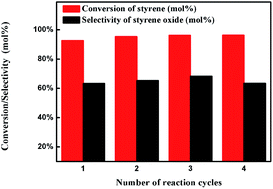
The catalyst was recovered from the reaction mixture by filtration, washed with acetonitrile, dried at room temperature and reused for the epoxidation reaction under the optimal reaction conditions (acetonitrile, 6 h, 345 K, TBHP/styrene = 1.5) without any further purification and regeneration process. The Cu–Co PBA catalyst could be reused with similar conversion and selectivity as fresh catalyst at least four cycles, as shown in Fig. 6.


image file: c4ra16570e-f6.tif
Fig. 6 Reusability of the Cu–Co PBA catalyst.

Reaction conditions: catalyst: Cu–Co PBA catalyst 3 mg, styrene: 0.5 mmol, TBHP: 0.75 mmol, solvent: acetonitrile (2 mL), reaction temperature: 345 K, reaction time: 6 h.

Epoxidation of other olefins

A similar procedure was employed for the epoxidation of cyclohexene and norbornene, the results were shown in Table 3.
Table 3 Epoxidation of olefins catalyzed by Cu–Co PBA catalysta
Substrate Olefin conversion (mol%) Selectivity of epoxide (mol%)
a Reaction conditions: catalyst: Cu–Co PBA catalyst 3 mg, substrate: 0.5 mmol, TBHP: 0.75 mmol, solvent: acetonitrile (2 mL), reaction temperature: 345 K, reaction time: 6 h, conversion and selectivity were determined by GC analysis.
Styrene 96 64
Cyclohexene 93 67
Norbornene 91 99


The conversion of cyclohexene and norbornene were 93% and 91%, respectively, and the product selectivity achieved 67% and 99%, respectively. Therefore, it was noteworthy that the Cu–Co PBA catalyst was not specific of styrene, but it was also a highly efficient catalyst for epoxidation of other olefins.

Kinetic measurements

In order to determine the kinetic parameters, the external or internal diffusional effects were ignored in this work. As the concentration of styrene, TBHP and catalyst might affect the reaction rate. We supposed the kinetic equation was r = k[styrene]α[TBHP]β[catalyst]γ when the reaction temperature was fixed (345 K). To determine α, β, the reaction was carried out with the concentration of acetonitrile and catalyst fixed. When the styrene and TBHP had the same initial concentration (a), the styrene conversion (x) and the reaction time (t) can be related applying the integral method through second order eqn (1), the 1/(ax) had a line relationship with time (t) as listed in Fig. 7(a). That meant the reaction was second order in whole to the concentration of TBHP and styrene. (α + β = 2).
 
image file: c4ra16570e-t1.tif(1)

a = [styrene] = [TBHP], C = 1/a, kobs = k[catalyst]γ

image file: c4ra16570e-f7.tif
Fig. 7 (a) Plot of 1/(ax) vs. reaction time; (b) plot of [1/(ab)]ln[b(ax)/a(bx)] vs. reaction time; (c) plot of kobs vs. catalyst concentration. Reaction conditions: acetonitrile (2 mL), reaction temperature: 345 K. (a) Catalyst: 3 mg, styrene: 0.24 mol L−1, 0.35 mol L−1, TBHP: 0.24 mol L−1, 0.35 mol L−1; (b) styrene: 0.12 mol L−1, 0.24 mol L−1, TBHP: 0.35 mol L−1, 0.68 mol L−1; (c) styrene: 0.24 mol L−1, TBHP: 0.35 mol L−1, catalyst: 0.46 g L−1, 1.41 g L−1, 2.35 g L−1.

When the styrene and TBHP has different initial concentration, the styrene conversion (x) and the reaction time (t) can be related applying the integral method through eqn (2).

 
image file: c4ra16570e-t2.tif(2)

a = [styrene], b = [TBHP], kobs = k[catalyst]γ

Fig. 7 (b) Displayed the graph obtained plotting expression (2) versus reaction time (t). Therefore, the epoxidation of styrene was a first order respect to TBHP and styrene, respectively (α = 1, β = 1).

To determine γ, the reaction was carried out at different catalyst concentration and the other conditions was kept (acetonitrile 2 mL, 6 h, 345 K, TBHP/styrene = 1.5), we found that the rate constant (kobs) increased linearly with increasing catalyst concentration as revealed in Fig. 7(c) suggesting a first order dependence to catalyst concentration.

Therefore, the above results suggested a first order respect to TBHP, styrene and catalyst, respectively. And the kinetic expression was r = k[styrene][TBHP][catalyst].

To obtain the apparent activation energy of the epoxidation of styrene, a series of experiments were carried out at 325 K, 335 K, 345 K and 355 K, respectively, as shown in Fig. 8(a). Table 4 listed the fitting parameters and the correlation coefficients, and the k values were the slope of these fittings. It can be seen that the plot of ln[thin space (1/6-em)]k versus 1/T was linear between 325 K and 345 K as shown in Fig. 8(b). An apparent activation energy of 100.4 kJ mol−1 was obtained for styrene epoxidation in the 325–345 K, using the Arrheniuś equation. However, the linearity was broken at 355 K, this was because the epoxidation of styrene was a multi-step reaction, and the effect of temperature was complex, meanwhile, the adsorption quantity of every step decreased when the reaction temperature exceeded 345 K.26,27


image file: c4ra16570e-f8.tif
Fig. 8 (a) Plot of [1/(ab)]ln[b(ax)/a(bx)] vs. reaction time at different temperatures; (b) Arrhenius plot of the specific rate kinetic constants of styrene oxidation over Cu–Co PBA.
Table 4 Fitting parameters of the experimental points in Fig. 8(a)a
T (K) Slope Intercept R-square
a Reaction conditions: catalyst: Cu–Co PBA catalyst 3 mg, styrene: 0.5 mmol, TBHP: 0.75 mmol, solvent: acetonitrile (2 mL), conversion and selectivity were determined by GC analysis.
323 0.41 0.34 0.99
333 1.65 0.75 0.98
343 3.52 −1.02 0.99
353 2.26 1.78 0.97


Mechanism of styrene epoxidation with the Cu–Co PBA catalyst

Based on the results of this study, a possible mechanism was proposed (Fig. 9). The active metal of the PBA catalyst (species 1) reacted with the TBHP to form a hydroperoxy compound (species 2) in a preequilibrium step. Species 2 lost a t-butanol molecule to render the species 3, which interacted with styrene to form a metalloepoxy intermediate (species 4), then species 4 decomposed to the product and regenerated to the PBA catalyst. And styrene oxide attacked the species 3 to form the species 6, which would generate the PBA catalyst and benzaldehyde, it explained the formation of the benzaldehyde was more favored when the reaction time exceeded 6 h.20,28
image file: c4ra16570e-f9.tif
Fig. 9 Mechanism proposed for styrene epoxidation with Cu–Co PBA catalysts.

Conclusions

An efficient catalytic system has been studied for liquid-phase epoxidation of styrene in acetonitrile with tert-butyl hydroperoxide. Reaction conditions such as temperature, time of reaction, nature of the solvent were optimized. The catalysts could be reused four times after centrifuging and washing with acetonitrile without significantly losing their initial epoxidation activity. In addition, the Cu–Co PBA catalyst was also a highly efficient catalyst for epoxidation of other olefins such as cyclohexene and norbornene. A first reaction order was found respect to styrene, TBHP and catalyst concentration. The apparent reaction activation energy obtained was 100.4 kJ mol−1. Our results confirmed that the PBA compounds as heterogeneous catalysts have potential applications for lower dosage reactions, and simple preparation processes, thanks to their high catalytic activity. Further work is under investigation to describe the mechanism of the epoxidation reaction in detail.

Acknowledgements

This work was supported by the National Natural Science Foundation of China (Projects 20603014, 20673059, 20973061 and 20903051), the Chinese Ministry of Education (Key project 105074), the Committee of Science and Technology of Shanghai (Projects nos 0652nm010 and 08JC1408100), and the Fundamental Research Funds for the Central Universities (Projects lzujbky-2011-116).

Notes and references

  1. V. D. Neff, J. Electrochem. Soc., 1978, 125, 886–887 CrossRef CAS PubMed.
  2. L. J. Han, S. Tricard, J. Fang, J. H. Zhao and W. G. Shen, Biosens. Bioelectron., 2013, 43, 120–124 CrossRef CAS PubMed.
  3. V. Gadet, T. Mallah, I. Castro and M. Verdaguer, J. Am. Chem. Soc., 1992, 114, 9213–9214 CrossRef CAS.
  4. D. M. Pajerowski, M. J. Andrus, J. E. Gardner, E. S. Knowles, M. W. Meisel and D. R. Talham, J. Am. Chem. Soc., 2010, 132, 4058–4059 CrossRef CAS PubMed.
  5. S. S. Kaye and J. R. Long, J. Am. Chem. Soc., 2005, 127, 6506–6507 CrossRef CAS PubMed.
  6. L. Reguera, C. P. Krap, J. Balmaseda and E. Reguera, J. Phys. Chem. C, 2008, 112, 15893–15899 CAS.
  7. M. V. Patil, M. K. Yadav and R. V. Jasra, J. Mol. Catal. A: Chem., 2007, 273, 39–47 CrossRef CAS PubMed.
  8. R. Srivastava, D. Srinivas and P. Ratnasamy, J. Catal., 2006, 241, 34–44 CrossRef CAS PubMed.
  9. M. M. Dharman, J. I. Yu, J. Y. Ahn and D. W. Park, Green Chem., 2009, 11, 1754–1757 RSC.
  10. S. Chen, G. R. Qi, Z. J. Hua and H. Q. Yan, J. Polym. Sci., Part A: Polym. Chem., 2004, 42, 5284–5291 CrossRef CAS.
  11. Y. J. Huang, G. R. Qi and L. S. Chen, Appl. Catal., A, 2003, 240, 263–271 CrossRef CAS.
  12. I. L. Kim, S. H. Byun and C. S. Ha, J. Polym. Sci., Part A: Polym. Chem., 2005, 43, 4393–4404 CrossRef CAS.
  13. L. Saikia, J. K. Satyarthi, R. Gonnade, D. Srinivas and P. Ratnasamy, Catal. Lett., 2008, 123, 24–31 CrossRef CAS.
  14. S. H. Lee, I. K. Lee, J. Y. Ha, J. K. Jo, I. Park, C. S. Ha, H. Suh and I. L. Kim, Ind. Eng. Chem. Res., 2010, 49, 4107–4116 CrossRef CAS.
  15. F. Yan, Z. H. Yuan, P. M. Lu, W. Luo, L. M. Yang and L. Deng, Renew. Energ., 2011, 36, 2026–2031 CrossRef CAS PubMed.
  16. J. K. Satyarthi, D. Srinivas and P. Ratnasamy, Appl. Catal., A, 2011, 391, 427–435 CrossRef CAS PubMed.
  17. J. Sebastian and D. Srinivas, Chem. Commun., 2011, 47, 10449–10451 RSC.
  18. J. Sebastian and D. Srinivas, Appl. Catal., A, 2013, 464–465, 51–60 CrossRef CAS PubMed.
  19. B. Tyagi, U. Sharma and R. V. Jasra, Appl. Catal., A, 2010, 408, 171–177 CrossRef PubMed.
  20. J. Sebastian, K. M. Jinka and R. V. Jasra, J. Catal., 2006, 244, 208–218 CrossRef CAS PubMed.
  21. D. H. Zhang, G. D. Li, J. X. Li and J. S. Chen, Chem. Commun., 2008, 3414–3416 RSC.
  22. K. Nakamoto, Infrared and Raman spectra of inorganic and coordination compounds, part B: applications in coordination, organometallic, and bioinorganic chemistry, 6th edn, Wiley, New York, 2009, p. 110 Search PubMed.
  23. E. Garnier, P. Gravereau and A. Hardy, Acta Crystallogr., 1982, B38, 1401–1405 CrossRef CAS.
  24. A. Corma, P. Esteve and A. Martínez, J. Catal., 1996, 161, 11–19 CrossRef CAS.
  25. Z. Opre, T. Mallat and A. Baiker, J. Catal., 2007, 245, 482–486 CrossRef CAS PubMed.
  26. M. V. Cagnoli, S. G. Casuscelli, A. M. Alvarez, J. F. Bengoa, N. G. Gallegos, N. M. Samaniego, M. E. Crivello, G. E. Ghione, C. F. Pérez, E. R. Herrero and S. G. Marchetti, App. Catal., A, 2005, 287, 227–235 CrossRef CAS PubMed.
  27. S. Pathan and A. Patel, Ind. Eng. Chem. Res., 2013, 52, 11913–11919 CrossRef CAS.
  28. J. H. Liu, F. Wang, Z. G. Gu and X. L. Xu, Catal. Commun., 2009, 10, 868–871 CrossRef CAS PubMed.

This journal is © The Royal Society of Chemistry 2015
Click here to see how this site uses Cookies. View our privacy policy here.