
Xin Zhaoab,
Bingzhe Wangab,
Wenwen Yuab,
Xin Gaoab and
Guangzhe Piao*abc
aKey Laboratory of Rubber-Plastics Ministry of Education, Qingdao University of Science and Technology(QUST), Qingdao 266042, P. R. China. E-mail: piao@qust.edu.cn; Fax: +86 532 840 22725; Tel: +86 532 840 23640
bShandong Provincial Key Laboratory of Rubber-Plastics, QUST, Qingdao 266042, P. R. China
cSchool of Polymer Science and Engineering, QUST, Qingdao 266042, P. R. China
First published on 19th February 2015
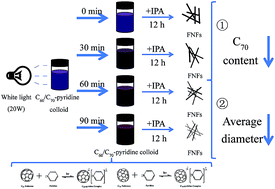
C60–C70 nanofibers (FNFs) were prepared using a modified liquid–liquid interfacial precipitation (LLIP) method in a pyridine solution of C60–C70 soot and isopropyl alcohol (IPA) under illumination with white light in the region of 300–700 nm. The composition of the C60–C70 FNFs was analysed by high-pressure liquid chromatography. It is found that the concentration of C70 in the C60–C70 FNFs is decreased with an increase of irradiation time in the C60–C70–pyridine solution. Regarding the morphology aspect, polarizing optical microscope (POM) and scanning electron microscope (SEM) were used and changing the irradiation time may well be a method to control the length or diameter of those fibers. In an analysis of the mechanism, it was speculated that the charge transfer (CT) complexes between fullerenes C60, C70 and pyridine that could be excited by photons was an explanation for this phenomenon.
Consequently, much research focused on the application designs of this material based on the property or structure of those fibers. For example, due to their larger specific surface area, FNFs have been frequently reported as catalyst carriers.2,3 With the nature of semiconductors and higher Young’s modulus compared to C60 crystals,4 FNFs could be used as electronic devices.5 The discovery of their superconductivity established on an electron accepter characteristic by Takeya et al. through intercalation of potassium extends their application to maglev, radiation detectors, microwave generators and so on.6 At the same time, FNFs polymer hybrid with potential application in electromagnetic shielding materials, highly hydrophobic materials, and antistatic materials emerged.7,8 Even a new nanoporous carbon 1-D material, which is obtained from FNFs through thermal conversion, shows excellent electrochemical capacitance and superior sensing properties for aromatic compounds compared to commercial activated carbons.9
Due to their marvellous potential application in many areas, several methods have been developed for the construction of FNFs. They are (1) solution evaporation,10,11 (2) template techniques,12,13 (3) surfactant-assisted methods,14 volatile diffusion method,15 and (4) LLIP method.16,17 With the advantages of no requirement of physical templates and catalysts, the LLIP method is generally acknowledged as a way of great promise for self-assembly of this 1D structure.18,19
Meanwhile, great attention has been paid to the growth of these 1-D materials and the further development of this method, not only in the morphologies, such as aspect ratio, tube containing rate, formation mechanism discussion,20 but also their compositions. Various FNFs are composed of not only C60, but also C70, C60[C(COOC2H5)2](η2-C60)Pt(PPh3)2 or even C60–C70 mixtures and have been successfully fabricated using LLIP method.21–24 Indeed, construction of C60–C70 FNFs has been widely studied, since a C60–C70 mixture is much cheaper than C60 or C70 and low-cost fullerene fibers are mostly studied for practical applications. The Young’s moduli of C60–C70 FNFs were tested by a transmission electron microscope equipped with an atomic force microscope functionality and were found to increase with increasing C70 content in the mother solutions.25,26 However, quantitative analysis of the C60–C70 ratio in solid C60–C70 FNFs is still an urgent problem and quite meaningful for better understanding of the Young’s moduli, optical properties or even the formation process of C60–C70 FNFs.
Herein, based on our former research on the significant relationships between the formation of FNFs and the charge transfer (CT) adducts,27,28 we used a CT complex, formed between C60 or C70 and pyridine, which is susceptible to light irradiation, to fabricate C60–C70 nanofibers with different C60–C70 ratios. By changing the irradiation time, we fabricated FNFs with different but linearly C60–C70 ratios characterised by using high-pressure liquid chromatography analysis (HPLC). In addition, changing the irradiation time may well be a method to control the length or diameter of those fibers through polarizing optical microscope (POM) and scanning electron microscope (SEM) analysis. An ultraviolet-visible (UV-Vis) spectrometer was used to study the mechanism.
![]() | ||
| Fig. 1 Optical microscope images of C60–C70 FNFs prepared in C60–C70–pyridine colloid with different time of light irradiation (a: 0 min; b: 30 min; c: 60 min; d: 90 min). | ||
These C60–C70 fibers are quite long and some of them could reach millimetres in scale. The fibers in Fig. 1(b)–(d) are similar, which all tend to be fine and tangled. In comparison, a few crude and straight fibers emerged in Fig. 1(a). That shows that fibers without light irradiation have a larger distribution in diameter. Thus, we conclude that light irradiation may have a good effect on the fine morphology of the C60–C70 nanofibers.
Fig. 2 shows the SEM images of FNFs prepared in a C60–C70–pyridine colloid following (a) 0 min, (b) 30 min, (c) 60 min and (d) 90 min light irradiation, respectively. The surfaces of the fibers are flat. Meanwhile the diameters of those fibers tend to have a wide distribution from hundreds of nanometers to several microns. A random statistical analysis of FNFs shows that the average diameters of fibers prepared in C60–C70–pyridine solution following 0, 30, 60 and 90 min irradiation are 690, 680, 450 and 360 nm, respectively. The longer the irradiation time, the thinner the fibers. And from the SEM imagines we can see that some of them are hollow structures. Also, with lengthening the irradiation time, the diameter distribution of the FNFs gets smaller.
![]() | ||
| Fig. 2 SEM images of C60–C70 FNFs prepared in a C60–C70–pyridine colloid with different time of light irradiation (a: 0 min; b: 30 min; c: 60 min; d: 90 min). | ||
In fact, the size distribution of C60 FNFs aroused great attention since the discovery of those 1-D materials. Solvent ratio, growth temperature,20 solution volume,30 operation process,17 and even the area size of the interface.31 But for C60–C70 nanofibers, the composition becomes another important factor and this, apparently, is related to the distribution of the morphologies.
![]() | ||
| Fig. 3 HPLC of C60–C70 soot (a) and FNFs prepared in C60–C70–pyridine colloid with different times of light irradiation (b: 0 min, c: 30 min, d: 60 min, e: 90 min). | ||
By increasing the length of light irradiation, the C70 content in the FNFs decreased from 28 mol% to 11 mol%. The values of C70 content (yC70 content) are shown in Fig. 4 and fitted by the following curve as a function of length of light irradiation (t).
| yC70 content = −0.19t + 26.90 | (1) |
![]() | ||
| Fig. 5 UV-Vis spectra of C60–C70–pyridine solution with different irradiation times (a: 0 min; b: 30 min; c: 60 min; d: 90 min). | ||
In Fig. 5, four peaks emerged in the region of 350–700 nm in the UV-Vis spectra of the C60–C70–pyridine solution. The absorption at 380 nm and 600 nm are characteristic of C60.34 And the peak at 406 nm corresponds to the C70 molecule.35 Additionally, in the UV-Vis spectra of the C60–C70–pyridine solution, a strong absorption at the region of 400–500 nm appears. It should be noted that the absorption in this region refer to CT adducts.36,37 Similar absorption has been reported for various thin films of C60 and C70 and attributed to aggregate of fullerene molecule. Fullerene C60 or C70 has the ability to accept multiple electrons.38,39 On the other hand, pyridine has a nitrogen atom with a lone pair, which allows the molecule to be an electron donor.37,40 So, it is possible that CT adducts exist in the C60–C70–pyridine system in these conditions. Charge transfer reactions through photo excitation between C60, C70 and pyridine happened37 as follows:
Such interaction between C60, C70 and pyridine in the pressure of light may have an influence on the fullerene cluster, which serves as nucleation site or building materials for larger structures.41 Thus, when different times of light irradiation are applied, different balances between C60, C70 and pyridine are established. The differentiation of each balance in cluster stucture or concentration leads to the distinction o size and component ratio of FNFs. From Fig. 5, we can see that the content of CT increases with increasing time of light irradiation. We supposed that CT can only serve C60 molecules during crystal growth, but not during crystal nucleation.28 When the content of CT is increasing, the speed of crystal growth will slow down. According to the theory of H. Ji,14 C60 molecules prefer the corners of a hexagonal cross section, over the edges of the hexagonal cross section, and least the center portion of the hexagonal cross. With the existence of CT, the C60 molecules can choose the growth sites more independently, resulting in better selectivity of the C60 molecules attached to the crystal seeds, and a more uniform distribution of the diameter distribution. Additionally, we suppose that C60 finds it easier to form a CT complex with pyridine compared to C70, and this explains why there is a decreasing C70 content with longer irradiation times.
Footnote |
| † Electronic supplementary information (ESI) available. See DOI: 10.1039/c4ra14937h |
| This journal is © The Royal Society of Chemistry 2015 |