Continuous sol–gel derived SiOC/HfO2 fibers with high strength

Yao Xua, Dong Su*a, Hongjun Fenga, Xiao Yan*ab, Ning Liua and Yong Suna
aKey Laboratory of Advanced Ceramics and Machining Technology, Ministry of Education, School of Materials Science and Engineering, Tianjin University, Tianjin, 300072, China. E-mail: sudong@tju.edu.cn; Fax: +86-22-27402187; Tel: +86-22-27402187
bGuangdong Key Laboratory of Membrane Materials and Membrane Separation, Guangzhou Institute of Advanced Technology, Chinese Academy of Sciences, Guangzhou 511458, China. E-mail: xiao.yan@giat.ac.cn

Received 14th November 2014 , Accepted 27th February 2015

First published on 2nd March 2015


Abstract

This study presents the fabrication and characterization of continuous SiOC/HfO2 fibers with high strength by the sol–gel process. Continuous polyhafnosiloxane (PHfSO) gel fibers are spun from the solutions of silicon alkoxides and hafnium dichloride using polyvinyl pyrrolidone as a spinning reagent, and then transform into dense SiOC/HfO2 fibers with homogeneous shrinkage by subsequent drying and pyrolysis treatment. Fourier transform infrared and X-ray photoelectron spectra together with X-ray diffraction analysis indicate that the amorphous SiOC/HfO2 fibers consist of mixed silicon oxycarbide (SiOxC4−x, x = 1–4) and tetravalent hafnium–oxygen units embraced with a certain free-carbon phase. Scanning electron microscopy and transmission electron microscopy observations reveal that the SiOC/HfO2 fibers with homogenous Hf distribution exhibit a circular-shaped or an elliptical-shaped cross-section depending on their thickness when employed as gel fibers. Mechanical testing shows that the SiOC/HfO2 fibers exhibit good mechanical property with the maximum tensile strength of 1.5 GPa arising from the incorporation of Hf in the SiOC network.

Introduction

Hafnium-containing polymer-derived ceramics (for instance SiHfCNO1–4 and SiOC/HfO2 (ref. 5–8)) have excellent thermal stability,6 oxidation resistance1,4 and crystallization resistance,2,5,6 which makes them promising candidates as thermal and environmental protection barriers in the high-temperature field of energy, environment and transportation. Moreover, they have potential applications in nuclear industry and electronic field due to their absorptive nuclear capacity and high dielectric constant.2,6

SiOC/HfO2 ceramics exhibit a remarkably improved thermal stability up to 1600 °C compared with Hf-free SiOC ceramics6 and have been synthesized from hafnium modified polysiloxanes (PSO) precursors through the polymer-to-ceramic transformation process. They exhibit a single Si–Hf–O–C phase at low temperatures below 1000 °C, and subsequently convert into SiOC/HfO2 nanocomposites through phase separation under high-temperature annealing.5,7 The microstructure and pyrolysis behavior of an Hf-containing PSO precursor, and the structural changes, phase evolution, microstructure evolution and high-temperature stability of SiOC/HfO2 ceramics have been systematically studied in recent years.5–8 However, relevant studies on SiOC/HfO2 fiber materials are still limited.

Sol–gel process can not only easily incorporate Hf into SiOC utilizing the hydrolysis and condensation reaction of hafnium alkoxides/salts and silicon alkoxides, but also allow for the spinning of fiber materials from the sol or solution by adjusting its molecular structure, viscosity and rheological property. In this study, continuous SiOC/HfO2 fibers have been successfully fabricated from the ethanol solution of HfOCl2 and silicon alkoxide precursors using the sol–gel method through spinning, drying and pyrolysis. The fiber compositions, chemical structures and morphologies were studied along with their mechanical properties.

Experimental

Hafnium dichloride oxide octahydrate (HfOCl2·8H2O, ABCR GmbH & Co. KG) was used as the hafnium source, whereas tetraethoxysilane (TEOS, Si(OC2H5)4, Tianjin Jiangtian Co. Ltd., Tianjin, China) and dimethyldiethoxylsilane (DMDES, Si(CH3)2(OC2H5)2, Shanghai Yumei Co. Ltd., Shanghai, China) were used as silicon alkoxide precursors. Polyvinyl pyrrolidone (PVP, –[C6H9NO]n–, K30, Tianjin Jiangtian Co. Ltd., Tianjin, China), which is widely used in fabricating ceramic fibers such as Al2O3 and mullite fibers as well as in electrospinning,9,10 was used as a spinning reagent. The average molecular weight of PVP is 50[thin space (1/6-em)]000 with the polymerization degree (n) of ∼450. Ethanol (CH3CH2OH, Tianjin Jiangtian Co. Ltd., Tianjin, China) was used as the solvent.

In a typical experiment, TEOS (2.08 g, 10 mmol), DMDES (2.88 g, 20 mmol), water (0.32 g, 18 mmol), ethanol (2 g) and HfOCl2·8H2O (0.24 g, 0.6 mmol) were charged sequentially in a beaker and mixed with magnetic stirring to form a transparent solution, and then PVP (0.70 g) was added to form a viscous solution with stirring for ∼1 h. The spinnability of the solution was evaluated by continuously dipping a glass bar in it until a 5 cm long fiber could be drawn. The viscosity of the spinnable solution was in the range of 10–150 P according to the viscosity measurement at 25 °C under a rotating velocity of 25 rpm. Polyhafnosiloxane (PHfSO) gel fibers were hand-drawn from the solution with a glass bar at a velocity of 5–10 cm s−1, and then dried at 50 °C for 5 h. The PHfSO gel fibers were converted to SiOC/HfO2 ceramic fibers by pyrolysis at 1000 °C for 1 h at a rate of 5 °C min−1 under flowing argon.

The chemical structures of the PHfSO fibers and SiHfOC fibers were characterized by Fourier transform infrared spectroscopy (FTIR, Rayleigh WQF-510, Beijing, China) in the frequency range of 400–4000 cm−1 using the standard KBr pellet technique. Their surface chemical compositions and structures were detected by X-ray photoelectron spectroscopy (XPS, K-alpha, Thermo Fisher Scientific, East Grinstead, UK) using an Al Kα X-ray source as an excitation source on the analyzed area with a diameter of about 400 μm. Phase analysis was performed on an X-ray diffractometer (XRD, Rigaku D/max 2500 v/pc, Tokyo, Japan) using Cu Kα radiations (λ = 1.54 Å) in the range of 10°–90° at scanning rate of 5° min−1. The morphologies of the PHfSO fibers and the SiHfOC fibers were observed by scanning electron microscopy (SEM, s4800, Hitachi, Japan) after gold coating and transmission electron microscopy (TEM, Tecnai G2 F20, Philips, Eindhoven, the Netherlands), respectively. The accelerating voltage of 5 kV and secondary electron mode were exploited in SEM observation. The pyrolysis behavior of PHfSO fibers was analyzed by thermal gravimetric analysis (TGA, NETZSCH STA 449F3, Waldkraiburg, Germany) under flowing argon with a heating rate of 10 °C min−1 up to 1000 °C (sample mass: about 10 mg). Tensile tests were conducted on a fiber microtester (JSF08, Shanghai Zhongchen Co. Ltd., Shanghai, China) with 2 mm gauge length at a strain rate of 0.3 mm min−1.

Results and discussion

HfOCl2 is used as the hafnium source and as an acid catalyst in our spinning sol–gel system. The hydrolysis of HfOCl2 provides HCl, which catalyzes the hydrolysis of TEOS and DMDES, and then Hf will be incorporated into the polysiloxane (PSO) network through the condensation between hafnium hydrolysates and silicon hydrolysates, therefore no additional catalyst is needed in this system. In situ HCl catalyzed sol–gel system makes it easy to realize fabrication of continuous fibers because molecules with a linear structure are preferentially formed in an acidic condition.11–13 The amount of HfOCl2 is critical on fiber spinning and the mole ratio of HfOCl2/ALK (ALK = TEOS + DMDES) should be lower than 0.05. Two factors contribute to this: (1) the formation of branched molecules and (2) the decrease in solubility of the PVP in the solution. First, excess of HfOCl2 will increase the HCl concentration, and therefore this causes silicon alkoxides to form some branched structures rather than linear structures,11–13 which is detrimental to spinnability of the solution. Second, the solubility of PVP in ethanol decreases with increasing HfOCl2, which leads to a phase separation and affects the fiber spinning.

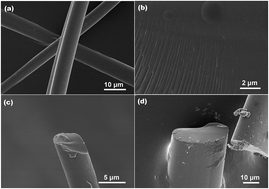
Solutions with various compositions were prepared with the mole ratio of HfOCl2/ALK = 0.01–0.1 and PVP/ALK = 0.1–0.4, and the optimal mole ratios of HfOCl2/ALK and PVP/ALK were 0.02 and 0.2, respectively. Under this condition, the solution shows an excellent spinnability and stability; moreover, tens of meters long PHfSO fibers with a smooth surface are obtained. The fibers are white, flexible and monodispersed (Fig. 1a and b). The fibers are 5–60 μm thick, which could be closely related to the sol viscosity and spinning speed according to the experimental observation. Hand-drawn fibers do not have a constant diameter or a unique shape in cross-section. They show a circular- or elliptical-shaped cross-section depending on the thickness, as determined from observations on 50 fibers (circular: <20 μm, Fig. 1c; elliptical: >30 μm, Fig. 1d). The out-of-round shape of the thicker fibers is attributed to the non-homogeneous shrinkage and collapse during gelation and drying, as previously observed in the silica gel fibers drawn from a TEOS solution.12


image file: c4ra14540b-f1.tif
Fig. 1 SEM images of PHfSO gel fibers: (a) monodispersed fibers, (b) enlarged image of a fiber surface, (c) circular-shaped fiber and (d) elliptical-shaped fiber.

The composition and surface chemical structure of PHfSO fibers are analyzed by XPS. The signals are detected for Si, O, C, N and Hf (Fig. 2a) with the percentages of 18.4, 27.9, 49.5, 3.5 and 0.7 at.%, corresponding to the formula of SiHf0.04O1.52C2.69N0.20. Si2p, C1s and Hf4f peak fittings are given in Fig. 2b–d in order to illustrate the corresponding components of PHfSO fibers. The Si2p peak suggests the presence of SiO4 and C2SiO2 units at 103.3 and 102.2 eV,14,15 respectively. The C1s peak shows a predominant peak at 284.8 eV, which is assigned to CH3 units14,15 corresponding to the methyl groups of DMDES and PVP. Moreover, there are two weak peaks at 288.2 and 286.2 eV (ref. 14 and 15) due to C[double bond, length as m-dash]O and CH/CH2 units arising from PVP, respectively. The Hf4f5/2 and Hf4f7/2 peaks at 19.2 and 17.5 eV, respectively, with an area ratio of 3[thin space (1/6-em)]:[thin space (1/6-em)]4 can be assigned to HfO2(IV). The higher bonding energy of Hf–O compared with that of reported HfO2 (Hf4f5/2 and Hf4f7/2: 18.4 and 16.7 eV, respectively16) may result from the presence of Hf–O–Si units in the fibers. FTIR (Fig. 3) spectrum shows that Hf–O–Si vibration5 appears at ∼950 cm−1, indicating that Hf has been incorporated into Si–O tetrahedron through the co-condensation of HfOCl2 and silicon alkoxides. The formation of Hf–O–Si makes the Hf4f peak shift toward a higher binding energy due to the lower electronegativity of Hf than Si. In the FTIR spectra, an intense broad band at 1090 cm−1 can be assigned to the Si–O–Si stretching vibration arising from the condensation units of DMDES and TEOS. The sharp peaks at 1272, 847 and 800 cm−1 can be assigned to the bending, rocking and stretching vibration, respectively, of Si–Me17 corresponding to –Si(Me)2– units from DMDES, and the C–H stretching vibration appears at ∼2900 cm−1. The peak at 1661 cm−1 can be assigned to the stretching vibration of C[double bond, length as m-dash]O from PVP. Therefore, PHfSO fibers should mainly consist of SiO4 and C2SiO2 units with the incorporation of Hf in the form of Hf–O–Si and Hf–O–Hf.


image file: c4ra14540b-f2.tif
Fig. 2 XPS spectrum of PHfSO gel fibers (a) and their Si2p (b), C1s (c) and Hf4f (d) peak fittings.

image file: c4ra14540b-f3.tif
Fig. 3 (a) FTIR spectrum of the PHfSO fibers. (b) Enlarged detail in the range of 1200–400 cm−1.

The pyrolysis behavior of the PHfSO fibers was analyzed by TGA and the data are presented in Fig. 4. The TGA results show three stages of weight loss: 11 wt% between 142 and 372 °C, 22 wt% between 372 and 460 °C, and 17 wt% between 460 and 800 °C. The total weight loss is 50 wt%, corresponding to a ceramic yield of 50 wt%. The small weight loss at the initial stage results from the release of small molecules and/or some oligomers, such as alcohol and water.18,19 The large weight loss (22 wt%) at the second stage is mainly due to the thermal degradation and evaporation of PVP during heating, and a distinct exothermic peak of PVP appears at 425 °C. The third stage corresponds to the stage of organic-to-inorganic transformation from the PHfSO gel to SiHfOC ceramics along with the release of hydrocarbons and hydrogen and the structural rearrangement of Si–C and Si–O bond as a sol–gel derived SiOC.18,19


image file: c4ra14540b-f4.tif
Fig. 4 TGA and DSC curves of PHfSO fiber.

PHfSO gel fibers are transformed to SiOC/HfO2 ceramic fibers without cracking after drying at 50 °C for 5 h and pyrolysis at 1000 °C for 1 h in argon. XRD analysis shows that the obtained SiOC/HfO2 fibers are amorphous without the formation of SiC, SiO2 or HfO2 nanocrystallites, as shown in Fig. 5a. SEM observation shows that the SiOC/HfO2 fibers are dense on both the surface and cross-section (Fig. 6a and b), indicating that the addition of PVP does not introduce pores in the fibers after pyrolysis. The SiOC/HfO2 fibers retain the circular-shaped cross-section for the thin ones (Fig. 6c) and elliptical-shaped cross-section for the thick ones (Fig. 6d) but with a smaller thickness of 4–55 μm, indicating the homogeneous shrinkage during pyrolysis. The shrinkage of the fibers after pyrolysis is due to the structure adjustment during the organic-to-inorganic transformation, which is similar to the shrinkage of the polymer-derived ceramics during pyrolysis. High-resolution TEM (Fig. 7) observation reveals that the SiOC/HfO2 fiber is fully amorphous and there is no clear evidence for SiC and HfO2 nanocrystallites, which is consistent with XRD analysis. Energy-filtered elemental mapping analysis shows Si, C, O and Hf are homogenously distributed in the fibers without the agglomeration of Hf (Fig. 8).


image file: c4ra14540b-f5.tif
Fig. 5 XRD (a) and FTIR (b) spectra of SiOC/HfO2 fibers from PHfSO fibers pyrolyzed at 1000 °C for 1 h under argon.

image file: c4ra14540b-f6.tif
Fig. 6 SEM images of SiOC/HfO2 fibers from PHfSO fibers pyrolyzed at 1000 °C for 1 h under argon. (a) Monodispersed fibers, (b) dense cross-section of SiOC/HfO2 fibers, (c) circular-shaped fiber and (d) elliptical-shaped fiber.

image file: c4ra14540b-f7.tif
Fig. 7 High-resolution TEM images of SiOC/HfO2 fibers pyrolyzed at 1000 °C for 1 h under argon. (b) is an enlarged image of (a).

image file: c4ra14540b-f8.tif
Fig. 8 Energy filtered elemental maps of SiOC/HfO2 fiber pyrolyzed at 1000 °C for 1 h under argon.

The SiOC/HfO2 fibers consist of Si, O, C and Hf with the percentage of 27.7, 43.2, 28.8 and 0.3 at.%, respectively, corresponding to the empirical formula of SiHf0.01O1.56C1.04 as calculated from the XPS results (Fig. 9a). No nitrogen is detected in the fibers, which further confirms the complete decomposition of PVP after pyrolysis. The carbon content decreases from 49.5 at.% to 28.8 at.% due to the decomposition of the hydrocarbon groups during organic-to-inorganic transformation, which is consistent with the FTIR and TGA results. Si2p peak (Fig. 9b) is assigned to the presence of mixed silicon oxycarbide units such as SiO4 (105.0 eV), CSiO3 (104.1 eV), C2SiO2 (103.3 eV) and C3SiO (102.4 eV).14,15 The binding energy of the Si2p peak of the SiOC/HfO2 fibers is 1.2 eV higher than that of the PHfSO fiber due to the breakage of Si–C bonds and the formation of new Si–O bonds during pyrolysis. C1s peak (Fig. 9c) shows a main peak at 285.0 eV for aromatic carbon environment,14,15 indicating the presence of free carbon in the fibers. The Hf4f5/2 and Hf4f7/2 peaks (Fig. 9d) appearing at 19.7 and 18.1 eV are mainly assigned to HfO2(IV).16 The shift of Hf4f7/2 peak to higher binding energy from 17.5 to 18.1 eV can be attributed to the formation of hafnium silicate.16 The FTIR spectrum of the SiHfOC fibers shows a characteristic absorption band of SiOC glass with an intense broad peak at 1090 cm−1 for Si–O–Si stretching vibration and a peak at 823 cm−1 for Si–C stretching vibration, as shown in Fig. 5b. Therefore, the SiOC/HfO2 fibers consist of mixed silicon oxycarbide (SiOxC4−x, x = 1–4) and tetravalent hafnium–oxygen units embraced with some free carbon phase, similar to the hafnium modified PSO precursor derived SiOC/HfO2 ceramics.5–8


image file: c4ra14540b-f9.tif
Fig. 9 XPS spectrum of SiOC/HfO2 fibers from PHfSO fibers pyrolyzed at 1000 °C for 1 h under argon (a) and their Si2p (b), C1s (c) and Hf4f (d) peak fittings.

The SiOC/HfO2 fibers exhibit good mechanical properties, which are measured by tensile tests. The maximum breaking force of up to 22 cN with corresponding tensile strength of 1.56 GPa is obtained from a fiber with a diameter of 12 μm, which is confirmed by SEM. The strength of the SiOC/HfO2 fibers is higher than that of the sol–gel derived SiOC fibers13,20 and close to that of the sol–gel derived silica fibers (highest strength 1.7 GPa (ref. 21)). Kamiya et al.13 measured the tensile strength of a large number of sol–gel derived SiOC fibers and attributed the scattered strength data of the hand-drawn fibers (0.1–1.2 GPa) to factors such as fiber diameter, uneven surface, fiber twisting and accidental torsion during measurement.13 Chen et al.20 fabricated SiOC fibers from vinyltrimethoxysilane using secondary cellulose acetate as a spinning reagent by the sol–gel method, and the measured tensile strength was in the range of 184–940 MPa. The high strength of our fibers should arise from the dense structure of the fibers, benefiting from the incorporation of Hf in the SiOC network.

The tensile strength of the SiOC/HfO2 fibers is scattered and mainly depends on the fiber diameters, this has also been observed in many other ceramic fibers (such as SiC, Al2O3 and SiO2 fibers). The thin fibers (diameter less than 12 μm) show high strengths with the average data of more than 500 MPa. However, if the fiber diameter is higher than 15 μm, the strength reduces to ∼200 MPa. The Griffith theory of brittle failure believes that the strength of brittle materials is governed by the initial presence of small cracks, and failure occurs when the most vulnerably oriented crack in a population of randomly oriented cracks begins to extend under the applied stress.22 As the size of a brittle material grows, for instance, 2-D fiber materials, the probability that it will fracture from a single crack increases. The SiOC/HfO2 fibers exhibit a single-stage stress–strain curve, indicating its brittle character (Fig. 10), and its tensile strength is determined by various defects, thus resulting in polydispersity due to the random distribution of defects. Therefore, the fabrication of fine fibers is one of the effective approaches to further improve their strengths, and future studies will be focused on the fabrication of small-diameter SiOC/HfO2 fibers by further controlling the solution viscosity and spinning process.


image file: c4ra14540b-f10.tif
Fig. 10 A stress–strain curve of SiOC/HfO2 fibers from PHfSO fibers pyrolyzed at 1000 °C for 1 h under argon.

Conclusions

To conclude, continuous PHfSO gel fibers have been drawn from the optimized TEOS–DMDES–HfOCl2–EtOH solution using PVP as a spinning reagent, and subsequent pyrolysis gives out dense SiOC/HfO2 fibers with high strength. The high strength of SiOC/HfO2 fibers makes it possible for them to function as the basic and key reinforced materials for fabricating high performance ceramic matrix composites (CMCs), which are considered as the most promising candidates for (ultra)high-temperature structural components in energy, chemical and transportation industries. Moreover, this sol–gel process provides a simple and effective method to incorporate Hf into SiOC fibers, which may be expanded to fabricate other multi-component high-temperature Si(M)OC fibers (M = B, Ti, Al and Zr).

Acknowledgements

We thank Prof. Dr Ya-li Li of the Tianjin university of China for lab support. We acknowledge the funding supports from the National Natural Science Foundation of China (Grant. no. 51202157), the Tianjin Research Program of Application Foundation and the Advanced Technology (Grant. no. 14JCQNJC02800), and the Independent Innovation Foundation of Tianjin University (Grant. no. 2013XQ–0004).

Notes and references

  1. S. Brahmandam and R. Raj, J. Am. Ceram. Soc., 2007, 90, 3171 CrossRef CAS PubMed.
  2. R. Sujith, A. B. Kousaalya and R. Kumar, J. Am. Ceram. Soc., 2011, 94, 2788 CrossRef PubMed.
  3. B. Papendorf, K. Nonnenmacher, E. Ionescu, H. J. Kleebe and R. Riedel, Small, 2011, 7, 970 CrossRef PubMed.
  4. K. Terauds, D. B. Marshall and R. Raj, J. Am. Ceram. Soc., 2013, 96, 1278 CrossRef PubMed.
  5. E. Ionescu, B. Papendorf, H. J. Kleebe, F. Poli, K. Muller and R. Riedel, J. Am. Ceram. Soc., 2010, 93, 1774 CrossRef PubMed.
  6. E. Ionescu, B. Papendorf, H. J. Kleebe and R. Riedel, J. Am. Ceram. Soc., 2010, 93, 1783 CrossRef PubMed.
  7. H. J. Kleebe, K. Nonnenmacher, E. Ionescu and R. Riedel, J. Am. Ceram. Soc., 2012, 95, 2290 CrossRef PubMed.
  8. K. Nonnenmacher, H. J. Kleebe, J. Rohrer, E. Ionescu and R. Riedel, J. Am. Ceram. Soc., 2013, 96, 2058 CrossRef PubMed.
  9. C. B. Jing, X. G. Xu and J. X. Hou, J. Sol-Gel Sci. Technol., 2008, 45, 109 CrossRef PubMed.
  10. D. G. Yu, G. R. Williams, X. Wang, X. K. Liu, H. L. Li and S. W. A. Bligh, RSC Adv., 2013, 3, 4652 RSC.
  11. S. Sakka and K. Kamiya, J. Non-Cryst. Solids, 1982, 48, 31 CrossRef.
  12. K. Matsuzaki, D. Arai, N. Taneda, T. Mukaiyama and M. Ikemura, J. Non-Cryst. Solids, 1989, 112, 437 CrossRef.
  13. K. Kamiya, A. Katayama, H. Suzuki, K. Nishida, T. Hashimoto, J. Matsuoka and H. Nasu, J. Sol-Gel Sci. Technol., 1999, 14, 95 CrossRef.
  14. G. D. Soraru, G. D. Andrea and A. Glisenti, Mater. Lett., 1996, 27, 1 CrossRef.
  15. A. Karakuscu, R. Guider, L. Pavesi and G. D. Soraru, J. Am. Ceram. Soc., 2009, 92, 2969 CrossRef PubMed.
  16. T. C. Chen, C. Y. Peng and C. H. Tseng, IEEE Trans. Electron Devices, 2007, 54, 759 CrossRef.
  17. G. M. Renlund, S. Prochazka and R. H. Doremus, J. Mater. Res., 1991, 6, 2716 CrossRef.
  18. G. Trimmel, R. Badheka, F. Babonneau, J. Latournerie, P. Dempsey and D. Bahloul-Houlier, et al., J. Sol-Gel Sci. Technol., 2003, 26, 279 CrossRef.
  19. V. Gualandris, D. Hourlier-Bahloul and F. Babonneau, J. Sol-Gel Sci. Technol., 1999, 14, 39 CrossRef.
  20. L. F. Chen, Z. H. Cai and L. Zhang, et al., J. Mater. Sci., 2007, 42, 1004 CrossRef.
  21. T. Hashimoto, K. Kamiya and H. Nasu, J. Non-Cryst. Solids, 1992, 143, 31 CrossRef.
  22. A. Griffith, Philos. Trans. R. Soc., A, 1921, 221, 163 CrossRef.

This journal is © The Royal Society of Chemistry 2015
Click here to see how this site uses Cookies. View our privacy policy here.