E. Gordaniana,
S. Jalali-Asadabadi*a,
Iftikhar Ahmad*bc,
S. Rahimia and
M. Yazdani-Kachoeia
aDepartment of Physics, Faculty of Science, University of Isfahan (UI), HezarGerib Avenue, Isfahan 81746-73441, Iran. E-mail: saeid.jalali.asdabadi@gmail.com
bCenter for Computational Materials Science, University of Malakand, Chakdara, Pakistan. E-mail: ahma5532@gmail.com; Tel: +092-332-906-7866
cDepartment of Physics, University of Malakand, Chakdara, Pakistan
First published on 24th February 2015
In this article we explore the effects of dangling bonds and diameter on the electronic properties of the wurtzite InAs nanowires (NWs) using the density functional theory. The NWs are confined in the hexagonal supercell and are simulated in the [0001] direction. The calculations have been carried out by applying the periodic boundary conditions along the NW axis, i.e., z-Cartesian coordinate, providing enough vacuum to isolate the system from its neighbors. The optical properties of a material are directly related to the band-gap; therefore a relationship between the band-gap and diameter of the nanowires is obtained by using two models, where the band-gap for a larger diameter NW can be estimated. The results of these models are compared with each other and the effects of the dangling bonds on the band-gaps are also investigated. The band-gap of the nanowires decreases and the dangling bond ratio increases with the increase in the diameter of the nanowire, and hence we expect that for large diameter nanowires the band-gap will approach the band gap of the bulk material. An interesting feature of the shift in the band-gap from indirect to direct, i.e. optically inactive to active, is also observed in these NWs with the increase in the diameter.
The electrons in semiconductor nanowires are free to move along their axis and are confined within the NW diameters (D). Therefore, it is expected that quantization of energy occurs perpendicular to the NW axis. Thus, NW diameter may determine the electronic structure, and as a result the band gaps of the wires. In some cases, the band gaps of wires are related to their diameters by the relation, 1/D2.9 In nanowires the edge and the surface atoms also influence the electronic structure of the material.10
The InAs nanowires can be experimentally grown using the vapor–liquid–solid mechanism with a gold particle seed. InAs nanowires are grown on different substrates with various methods like: metal organic chemical vapor deposition (MOCVD) and molecular beam epitaxy (MBE).8,9 They have shown that the crystal structure of the nanowires is strongly dependent on the growth conditions and the experimental methods. InAs compound crystallizes in both, zinc blende (ZB) and wurtzite (WZ) phases. The former structure, i.e., ZB, is more stable phase in the bulk form of the compound, however, the stability is exchanged when the scale is reduced towards the nanometer, where the WZ becomes more stable than the ZB phase for the small diameters of InAs nanowires.11
In this paper, the band structures of the bulk and nanowires of InAs in the wurtzite phase are plotted in the [0001] direction to explore the electronic properties of the compound. The band-gaps are calculated for five samples of different diameters of the nanowires and by the extrapolation of the results, variation in the band-gap of the nanowires can be estimated for larger diameters by using two models. For the clear picture of the internal behavior of the NWs, their total density of states are plotted, while partial density of states are plotted for p and s orbitals of the center and surface indium and arsenic atoms. The calculations are carried out by utilizing the density functional theory (DFT)12,13 using the WIEN2k14 code. All the calculations are performed at zero temperature and zero pressure. Furthermore, the edge atoms are not saturated by other atoms such as hydrogen.
The calculated lattice parameters with LDA and GGA approximations for the wurtzite InAs, having space group p63mc21 are a = 4.26 Å, c = 7.01 Å and a = 4.36 Å, c = 7.13 Å, respectively. The LDA results for the lattice constants are in closer agreement with the experimental results, a = 4.284 Å and c = 6.996 Å,20 than the GGA. The calculated lattice parameters by the ultrasoft pseudopotential with LDA approximation are a = 4.327 Å, c = 7.092 Å (ref. 21) and a = 4.192 Å, c = 6.844 Å.22 As the LDA provides better lattice parameters, therefore this approximation is further used to simulate the InAs nanowires. The vacuum is optimized to 12 Å in order to prevent the interaction between the neighboring nanowires. After truncating the nanowire from the bulk, we have calculated forces on atoms and found them very large. To reduce the forces, we relaxed the supercell until the forces become less than 2 mRy Bohr−1. It is important to notice that the accuracy of our non-passivated nanowire calculations can be increased by saturating nanowire surface bonds with a variety of the chemical functional groups such as –H, –OH and –NH2. In anticipation of further investigations, we report our results for the non-passivated NWs.
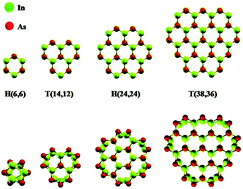
All the modeled nanowires with different diameters before and after relaxation are shown in Fig. 1. After relaxation, the As atoms on the surface moved out, so we observed outward relaxation, while the In atoms moved in, so the In atoms have inward relaxation. The movement of atoms depends on its electronegativity and hence furthest movement is observed in atoms with larger electronegativity (for example As than In atoms). The bond-length is also changed and the variation in bond-length on the surface and center of NWs is different. By increasing the diameter of NW the variation in the bond-length of the center is small, while in the large diameter NW it is usually equal to the bulk value. The C lattice parameter along the axis of the growth of the nanowires are optimized by calculating the supercell energies at different values of C and then fitting parabolic curve to the energy versus C parameter diagram, our calculated results are shown in Table 1. This behavior is a kind of surface effect that occurs in the supercell and this is the reason that why relaxation is an important effect due to the dangling bonds at the surface.
| System | Diameter (Å) | C-lattice parameter (Å) |
|---|---|---|
| Wz-H(6,6) | 5.50 | 6.43 |
| Wz-T(14,12) | 8.95 | 6.77 |
| Wz-H(24,24) | 13.05 | 6.79 |
| Wz-T(38,36) | 17.20 | 6.89 |
![]() | ||
| Fig. 2 The band structure and total density of states for InAs bulk. The Fermi energies are adjusted at zero. | ||
For the determination of the electronic properties of the NWs and investigation of the quantum confinement effect, the band-gaps of the nanowires are calculated by plotting their band structures in Fig. 3. The results of the band-gaps are presented in Table 3. The band-gaps reveal that all the NWs are semiconductors with band-gaps larger than the band-gap of the bulk InAs.
| System | Diameter (Å) | Gap type | Band gap energy (eV) |
|---|---|---|---|
| Wz-H(6,6) | 5.50 | Indirect | 0.998 |
| Wz-T(14,12) | 8.95 | Indirect | 0.876 |
| Wz-H(24,24) | 13.05 | Indirect | 0.795 |
| Wz-T(38,36) | 17.20 | Direct | 0.742 |
An interesting feature of shift in the band-gap from indirect to direct with the increase in the diameter is a unique property of these wutrzite InAs nanowires. It is clear from Table 3 that the band-gap of the nanowire changes with the change in its diameter. It is clear from Fig. 3 that the nature of band-gap is indirect for nanowires with diameter smaller than 13 Å, i.e., for WZ-H(24,24), while for WZ-T(38,36) the band gap is direct at G symmetry point. The reason of the indirect band-gap for the small diameter InAS nanowires is the influence of surface atoms that miss their bonds on NWs which is more prominent in small diameter NWs as compared to the large diameters. Hence, by increasing the diameter, the effect of surface atoms becomes lesser than the small diameter ones, so for larger NWs the band-gap is direct.
The difference between the band-gaps of the NWs and bulk sample (ΔEg) is clear from Table 4 as well as from Fig. 2 and 3. The results presented in the figures reveal that for all the nanowires under study except T(38,36), the valence band maximum (VBM) and level immediately below in energy (VBM-1) are degenerate levels with a high energy dispersion, while for T(38,36) both of them are nondegenerate and have high energy dispersions. Compared with those for the bulk InAs, we note that VBM and VBM-1 are nondegenerate T(38,36). Except for T(38,36), the levels at the top of the valence band for the InAs NWs have a great dispersion, that is indirect and different than the bulk InAs. So, we expect that the increase in the diameter of the nanowire will definitely change the behavior of the NWs band structure to the bulk sample.
| System | ΔEg (eV) |
|---|---|
| H(6,6) | 0.618 |
| T(14,12) | 0.496 |
| H(24,24) | 0.415 |
| T(38,36) | 0.362 |
The band structure for the wurtzite nanowires by passivation dangling bonds are plotted by dos Santos et al.24 and their results show that for all NWs the VBM and VBM-1 are nondegenerate and have low energy dispersion, so we could see the effect of passivation in band structure. The NWs have one type of dangling bond, shown in Fig. 4. For the first, second, third, and fourth diameter of NWs; the variation in the band-gap increases. The increase in the variation in the band-gap in the small diameter nanowires may be due to the quantum confinement, which increases the energy separation among the sub-levels when the diameter decreases.
By decreasing the diameter of the NW, the In and As atoms gets closer to each other and the ratio of the dangling bonds in the supercell also becomes large. The variation in the band-gap versus dangling bonds ratio and diameter are plotted in Fig. 5. The figure shows that the band-gap decreases and the dangling bonds ratio (number of dangling-bonds/total bands) increases with the increase in the diameter of the NW. So, we expect that for large diameters the NWs band-gap approaches to the bulk material.
To estimate variation in the band-gap of the lager diameter nanowires, we use the EMA-PIB model, based on particle in a box to predict that how quantum confinement depends on the shape, so that we can evaluate the relation between variation in the band-gap and hole as well as electron effective mass. The EMA-PIB model uses particle in a box expression for the calculation of the kinetic confinement energy of quantum well, quantum dot and quantum wire, where the quantum wire variation band-gap is shown in eqn (1):25
![]() | (1) |
![]() | (2) |
![]() | ||
| Fig. 6 Variation of band-gap of NWs versus D−2 and variation of band-gap with D of NWs by using EMA-PIB model. | ||
The electronic arrangement of arsenic and indium are [Ar]3d104s24p3 and [Kr]4d105s25p1, respectively. For the determination of the electronic properties of InAs nanowires, first of all the partial density of states of the bulk material are plotted in Fig. 8. The total density of states of the InAs nanowires are plotted in Fig. 9. For all the NWs the valence band is divided into two sub-bands, so we have labeled starting from the top (zero energy) as VB1 and VB2. By increasing the NWs diameter the widths of these sub-bands are increased and the band-gap between VB1 and VB2 is decreased. To investigate the effect of the core and surface atoms in the total densities of states, partial density of states for s and p orbitals of In and As surface and center atoms are plotted in Fig. 10 except for the first diameter which has only surface atoms because of its small diameter. The partial density of states shows that for VB1 the 4p orbital of As overlaps with the 5p orbital of In, while the VB2 is formed by the overlap of the 4s orbital of As and 5s orbital of In. Because of the dangling-bonds in the surface, the average energy of the surface states is larger than the center states. It is clear from the total and partial DOSs that, except for the H(6,6) which is the smallest nanostructure, the behavior of the highest occupied (HO) states does not change for all nanowires. In other words, the peak of surface states lies below the valence band maximum and most likely this is the cause of the less reduced band gap with respect to the bulk value, where such results are also reported for BeS nanowires.26
Footnote |
| † Electronic supplementary information (ESI) available. See DOI: 10.1039/c4ra13168a |
| This journal is © The Royal Society of Chemistry 2015 |