
Tianming Chenab,
Yanqiu Zhang*a,
Jinlong Yanb,
Cheng Dingb,
Chuntao Yinb and
Hui Liub
aSchool of Environment Science and Spatial Information of China, University of Mining and Technology, Xuzhou 221008, China. E-mail: ycchentm@163.com; Fax: +86 515 88298806; Tel: +86 515 88298806
bSchool of Environmental Science and Engineering, Yancheng Institute of Technology, Yancheng 224051, China
First published on 7th January 2015
The aim of this study is to investigate the behavior of mesotrione herbicide photodegradation under UV light irradiation with co-existence of iron oxides and oxalic acid. α-Fe2O3 and oxalate can set up a novel photo-Fenton-like system under UV irradiation in nature environment without H2O2 additional. The adsorption capacity of mesotrione was investigated in the dark by batch experiment, and the results were well fitted by Langmuir model. The effects of the iron oxide dosage, initial concentration of oxalic acid (C0ox), mesotrione, and initial pH on the mesotrione photodegradation were investigated. The photoproduction of hydroxyl radicals (˙OH) during the photochemical process was also examined in diverse catalytic systems. The results indicated that mesotrione photodegradation follows pseudo-first-order kinetics. The mesotrione photodegradation moves slowly in the presence of α-Fe2O3 or oxalic acid. Interestingly, we found out that mesotrione photodegradation was distinctly enhanced when α-Fe2O3 and oxalic acid co-existed under UV irradiation. We learned that the combination of α-Fe2O3 and an oxalate system is an excellent agent to accelerate mesotrione herbicide decomposition. Results from this study could be further applied in the natural environment to facilitate environmental protection.
Iron oxides (including oxy-hydroxides) comprise 5.1% of the mass ratio of the earth's crust. Oxalic acid, mainly secreted by plant roots, is ubiquitous in water and soil.2 Iron oxides coexist with oxalic acid in nature and can set up a so-called photo-Fenton-like system under light irradiation.2,3 In fact, this photo-Fenton-like system can generate a series of strong oxidant species, such as O2˙−, H2O2, HO2˙and ˙OH, which have high efficiency for degradation of aqueous organic compounds, especially at very low concentrations.4 Thus, such degradation eventually influences the environmental fate and ecological risk of herbicides in the environment. Many studies show that herbicides could be degraded in the presence of Fe(III)-oxalate complexes under solar light irradiation.5–7
Mesotrione (2-[4-(methylsulfonyl)-2-nitrobenzoyl]-1,3-cyclohexanedione;8 see Fig. 1 for molecular structure), a selective herbicide9 in the triketone group, was developed as a substitute for atrazine by Syngenta Crop Protection, and registered in Europe in 2000.10 It was marketed in 2001 under the commercial name Callisto,11 and consumption has increased significantly since then. Because of its extensive use, several new and advanced technologies were developed for mesotrione degradation, such as the Fenton process,12 electro-Fenton,13 photochemical degradation,14 ozonization,15 dielectric barrier discharge (DBD reactor),15 and biodegradation,16–20 but little is known about the photochemical behavior of herbicides in α-Fe2O3 and oxalate systems.
The goal of this study was to investigate the photodegradation behavior of mesotrione alongside iron oxides and oxalic acid. The mechanisms of its degradation in heterogeneous systems are also discussed here. We focused on the α-Fe2O3/oxalate system due to its abundance in soil and surface water in the natural environment. Photochemical degradation of mesotrione was examined in an α-Fe2O3/oxalate system under UV irradiation under various conditions that may coexist with mesotrione in the environment, including diverse α-Fe2O3 dosages, initial concentrations of oxalate, and initial pH values. To investigate the mechanism of heterogeneous mesotrione photodegradation, the concentration of ˙OH in the reaction process was detected. Additional mechanistic tests were performed by adding phenol to scavenge hydroxyl radical in irradiation experiments. There are no current reports on the photodegradation of mesotrione in an α-Fe2O3/oxalate system under UV irradiation.
Aromatic hydroxylation has proved to be one of typical ˙OH reactions and used for ˙OH reactions in the case of Fenton/Fenton-like reactions.21–23 Scavenging of ˙OH by excessive benzene was introduced into different reaction systems to determine the ˙OH quantum yield under irradiation of a 500 W Hg lamp. Formation of phenol from the reaction of benzene and ˙OH was detected at 254 nm by HPLC (PerkinElmer Flexar with XDB-C18; 5 μm, 4.6 × 250 mm). A 25% (v/v) acetonitrile was used as a mobile phase at a flowing rate of 1.0 mL min−1 under isocratic conditions at 25 °C. Samples of 10 μL were injected into the column through the sample loop for analysis.
![]() | (1) |
![]() | ||
| Fig. 2 Adsorption isotherm of mesotrione on α-Fe2O3 obtained by plotting Ce versus Qe. Inset graph shows dependence of Ce/Qe on Ce. | ||
When 0.2 g L−1 α-Fe2O3 was present with the same conditions as curve a, the rate of mesotrione degradation was nearly same as curve a; removal of mesotrione was 9.7% after 60 min (curve c). Mesotrione removal significantly increased up to 21.5% level at 60 min under UV light with 2.0 mM oxalic acid (curve b). When both 2.0 mM oxalic acid and α-Fe2O3 with 0.2 g L−1 dosage were added to the reaction suspension under UV irradiation (curve d), removal of mesotrione rose to 85.9%.
The photocatalytic degradation of mesotrione followed first-order reaction kinetics; the first-order kinetics constants (k) for mesotrione degradation were 0.51 × 10⁻², 0.53 × 10⁻², 1.20 × 10⁻², 31.49 × 10⁻² under different conditions (Fig. 3). From curves b to d, it can be seen that α-Fe2O3 had low photocatalytic activity with the absence of oxalic acid, and mesotrione can be efficiently degraded by α-Fe2O3/oxaliate system under UV light irradiation. The results showed that iron oxides, oxalate and UV light play important roles in mesotrione degradation, and mesotrione photodegradation should be greatly enhanced with the cooperation of iron oxide and oxalate.
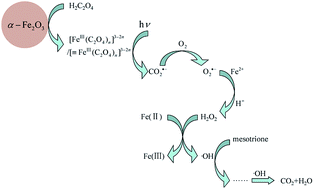
In order to understand the photoreaction process of mesotrione degradation in an α-Fe2O3/oxalate system, the interaction of α-Fe2O3 and oxalate under UV light irradiation was examined. On the surface of α-Fe2O3, oxalic acid is first adsorbed by α-Fe2O3 particles to form α-Fe2O3/oxalate complexes with high photochemical activity as described in eqn (2). Fe(II) and CO2˙− under UV excitation can be generated both on the surface or in solutions, as described by eqn (3) and (4). Obviously, the higher oxalate concentration leads to greater Fe(II) concentration. Then CO2˙− reacts with oxygen to produce superoxide ions O2˙− as described in eqn (5) and (6), and Fe(II) reacts with O2˙− to form H2O2 in acid solution as described by eqn (7). After H2O2 was formed, ˙OH could be generated by reaction of H2O2 with Fe(II) as described by eqn (8). Finally, mesotrione was oxidized by ˙OH as described by eqn (9), which has strong oxidation potential. Note that the photochemical reactions happened both on the surface of α-Fe2O3 as a heterogeneous photo-Fenton process and in the solution as a homogeneous one.24
Iron oxide + nH2C2O4 → [FeIII(C2O4)n]3−2n/[ FeIII(C2O4)n]3−2n + nH2O
| (2) |
[ FeIII(C2O4)n](2n−3)− + hν → [FeII(C2O4)n]2−/[ FeIII(C2O4)n]2− + (CO2)˙−
| (3) |
| [FeIII(C2O4)n](2n−3)− + hν → [FeII(C2O4)(n−1)](2n−4)− + (C2O4)˙− | (4) |
| (C2O4)˙− → CO2 + CO2˙− | (5) |
| CO2˙− + O2 → CO2 + O2˙− | (6) |
| O2˙−/˙OOH + nH+ + Fe2+ → Fe3+ + H2O2 | (7) |
| Fe2+ + H2O2 → Fe3+ + OH + ˙OH | (8) |
| ˙OH + mesotrione → ⋯ → CO2 + H2O | (9) |
However, addition of α-Fe2O3 markedly accelerated the degradation of mesotrione. Mesotrione with an initial concentration of 10 mg L−1 nearly reached equilibrium in 5 min in the presence of 0.2 g L−1 α-Fe2O3, suggesting that α-Fe2O3 was an excellent photocatalyst for mesotrione degradation assisted by oxalic acid. Mesotrione removal increased from 72.0% to 85.9% when α-Fe2O3 was increased from 0.1 to 0.2 g L−1, but decreased slightly when α-Fe2O3 increased from 0.2 to 0.6 g L−1. Excessive dosage of α-Fe2O3 may block the scattering of UVA light in the reaction suspension and decrease formation of ˙OH.
Mesotrione photodegradation in an α-Fe2O3/oxalate system was followed by first-order kinetics. The first-order kinetic constants (k) versus dosage of α-Fe2O3 are plotted in Fig. 4: 1.2 × 10⁻², 7.44 × 10⁻², 31.49 × 10⁻², 15.63 × 10⁻², 16.0 × 10⁻² min−1 with 0, 0.10, 0.20, 0.4 and 0.6 g L−1 α-Fe2O3, respectively. This suggests that the dosage of 0.2 g L−1 was an optimal concentration of α-Fe2O3 for mesotrione photodegradation with oxalate present. α-Fe2O3 as a heterogeneous photocatalyst can significantly accelerate formation of [
FeIII(C2O4)n]3−2n. Under UV irradiation, more ˙OH can be produced during the photochemical reaction with greater [
FeIII(C2O4)n]3−2n formed. In fact, excessive dosage of α-Fe2O3 limits penetration of UV light in the solution and leads to quick decay of UV light intensity. A similar phenomenon was observed while investigating the schwertmannite (γ-Fe2O3) photocatalytic degradation of methyl orange by oxalate under UV irradiation.23
![]() | ||
| Fig. 4 Effect of α-Fe2O3 dosage on photodegradation of 10 mg L−1 mesotrione under UV irradiation (500 W Hg lamp) in presence of 2.0 mM oxalic acid. Inset shows dependence of k on iron oxide dosage. | ||
![]() | ||
| Fig. 5 Effect of initial concentration of oxalic acid on photodegradation of 10 mg L−1 mesotrione under UV irradiation by 0.2 g L−1 Fe2O3. Inset shows dependence of k on C0ox. | ||
Mesotrione photodegradation in α-Fe2O3/oxalate system was followed by first-order kinetics. First-order kinetic constants (k) versus C0ox are plotted in Fig. 5. The k values of mesotrione degradation were 0.53 × 10⁻², 10.24 × 10⁻², 31.49 × 10⁻², 30.35 × 10⁻² and 32.89 × 10⁻² when the initial concentration of oxalic acid was 0.0, 1.0, 2.0, 3.0 and 4.0 mM, respectively. The possible reason is that excessive oxalic acid occupied the adsorbed sites on the α-Fe2O3 surface, and could also react competitively with generated ˙OH together with mesotrione. Thus, controlling optimal concentrations of α-Fe2O3 and oxalate for mesotrione photodegradation is necessary.
![]() | ||
| Fig. 6 Effect of initial concentration of mesotrione on photodegradation in presence of 0.2 g L−1 α-Fe2O3 and 2.0 mM oxalic acid under UV irradiation. Inset shows dependence of k on C0me. | ||
Several studies had reported that the main Fe(III)-oxalate species were FeIII(C2O4)2− and FeIII(C2O4)33−, which are highly photoactive when the pH was around 4.25–27 The degradation of mesotrione would be inhibited considerably when the initial pH value interval ranges from 4 to 6. Furthermore, the degradation of mesotrione was almost neglected with the initial pH of 8.0 and 10.0, respectively. The α-Fe2O3/oxalate system at a lower initial pH value might have a higher concentration of [
FeIII(C2O4)n]3−2n. In addition, the H2O2 produced at a high rate in the α-Fe2O3/oxalate system under irradiation with pH value ranging from 1.5 to 4.0, but decreased when pH was over 4.0. When pH was over 6.0, the Fe(III) species led to formation of Fe(OH)2 and Fe(OH)3 precipitate in the solution, which inhibited the photochemical reaction. On the other hand, the dissolution of α-Fe2O3 by H+ was excessive at the lower initial pH 2.0. Therefore, formation of the α-Fe2O3/oxalate complex would be hindered, and less [
FeIII(C2O4)n]3−2n formed. Thus, the yields of ˙OH decreased, leading to a lower rate of mesotrione degradation.
![]() | ||
| Fig. 8 Production of hydroxyl radicals (˙OH) in different reaction systems under UV irradiation (500 W Hg lamp). | ||
˙OH concentration in the system depends on both generation and consumption rates. As illustrated in Fig. 8, both α-Fe2O3 and oxalate alone showed low yields of ˙OH under UV irradiation via a 500 W Hg lamp. However, in the presence of both α-Fe2O3 and oxalate, a considerable number of ˙OH were detected. Hydroxyl radicals were quickly produced in the initial 10 min, and then the amount of ˙OH in the reaction system decreased with ˙OH consumption by degradation of certain organic compounds. The maximum concentration of ˙OH observed in 10 min was approximately 60 μM.
Benzene was selected as the hydroxyl radical scavenger due to its fast reaction with ˙OH. In contrast, photodegradation of mesotrione was significantly inhibited when benzene was added. Fig. 9 shows that with 0.32 mM and 0.64 mM benzene added, mesotrione degradation rates after 30 min were 15.17% and 5.65%, respectively, indicating that the higher benzene concentration would scavenge most of the ˙OH generated in the system, and block mesotrione photodegradation.
![]() | ||
| Fig. 9 Effect of hydroxyl radical scavenger on mesotrione-degradation performance under UV irradiation (500 W Hg lamp) with (a) blank; (b) 0.64 mM benzene; (c) 0.32 mM benzene; and (d) control. | ||
FeIII(C2O4)n]3−2n; (2) Fe(II) are generated and H2O2 are formed under UV irradiation; (3) ˙OH are generated in the Fenton-like system; and (4) mesotrione are decomposed by ˙OH. The photodegradation of the herbicide mesotrione depended strongly on initial pH value, doses of α-Fe2O3, and initial concentration of oxalate and mesotrione. The optimal α-Fe2O3 dosage was 0.2 g L−1 and the optimal C0ox was 2.0 mM with UV light irradiation (500 W Hg lamp), respectively. The results obtained in this study are helpful for understanding the fate of mesotrione in the environment and to assess the risk of herbicide mesotrione used on crops, and also provide a viable technology for removal of mesotrione from water.
| This journal is © The Royal Society of Chemistry 2015 |