
T. Serdiukab,
I. Bakanovichc,
V. Lysenkod,
S. A. Alekseevb,
V. A. Skryshevskyb,
S. Afonine,
E. Bergera,
A. Géloëna and
I. V. Komarov*b
aUniversity of Lyon, CarMeN Laboratory, INSA de Lyon, UMR INSERM 1060, France
bTaras Shevchenko National University of Kyiv, Volodymyrs`ka 64, 01601 Kyiv, Ukraine. E-mail: ik214@yahoo.com
cEnamine Ltd, Matrosova 23, 01103 Kyiv, Ukraine
dUniversity of Lyon, Nanotechnology Institute of Lyon (INL), INSA de Lyon, UMR CNRS 5270, France
eInstitute of Biological Interfaces (IBG-2), Karlsruhe Institute of Technology, POB 3640, 76021 Karlsruhe, Germany
First published on 6th February 2015
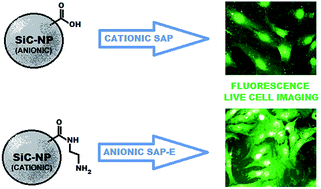
The delivery of SiC-based nanoparticles (SiC-NPs) into living eukaryotic cells is facilitated in the presence of cell-penetrating peptides, both cationic (SAP) and anionic (SAP-E). The SiC-NP surface functional group modification combined with rational CPP selection introduces an additional mode of delivery control.
The main problems that need to be addressed in the fluorescence labelling using NPs are the inefficient penetration of the NPs through cell membranes and their non-specific delivery inside the cells. Many studies were devoted to develop various strategies for NP internalization into the living cells, with special emphasis on the selective targeting of the NPs to different cellular organelles and compartments.16 Most of the reported delivering strategies were based on the conjugation of the NPs to biomolecules,16,17 which might also drive them to specific cellular locations. The use of cell-penetrating peptides (CPPs) as carrier molecules is of the particular interest in this respect. The CPPs linked to nano-cargoes efficiently promote cargo internalization without significant cytotoxic effects,18 and in many cases, they were shown to target specific cellular organelles like nuclei or mitochondria.19 Therefore, the CPPs can not only facilitate the NP uptake by cells, but also deliver them to specific sites inside the cells.20–22
Among the numerous NP types reported to date, ZnS-covered CdSe quantum dots (CdSe@ZnS QDs) are probably the most studied ones. Important advances in their preparation23–25 and conjugation to different biomolecules, including CPPs,16 have led to spectacular bioimaging applications. However, other NP types that might offer advantages in comparison with the CdSe@ZnS QDs are not studied much; obviously, their potential has to be explored as well. We disclose in this study our results of such an exploration into the intra-cellular delivery of NPs prepared by the electrochemical anodization of a low resistivity grade (<1 Ω cm) bulk 3C-SiC polycrystalline wafer (SiC-based NPs, SiC-NPs‡).26 Using this type of NPs for bioimaging application, one can benefit from the simplicity of their preparation procedures, low potential toxicity,27,28 as well as from their ability to form stable colloidal solutions in water and other polar solvents.
Recently, the charge-driven selective localization of fluorescent SiC-NPs in cells was reported.29 The manipulation of the SiC-NP surface functional groups was shown to actively govern the intracellular fate of the SiC-NPs. The as-prepared SiC-NPs, possessing carboxylic groups on their surface,30 are deprotonated and charged negatively at physiological pH (SiC-NPs(−), Fig. 1). The reaction shown in Fig. 1a transformed the carboxylic moieties into positively charged aminoethylcarboxamide functional groups, protonated under the physiological conditions (SiC-NPs(+), Fig. 1b).29 The negatively charged SiC-NPs(−) targeted the cell nuclei; moreover, under the same conditions, the positively charged SiC-NPs(+) were unable to penetrate the nuclei and accumulated in the cytosol. The excellent fluorescence of the SiC-NPs(+) and SiC-NPs(−) (Fig. 1c) allowed the efficient visualization of the cells treated by the NPs of this type using a fluorescence microscope.
Targeting the cell nuclei by the as-prepared negatively charged SiC-NPs(−) was shown to be closely associated with the process of cell division. In the normal fibroblast or epithelial cells, the overall uptake of SiC-NPs(−) and their accumulation in the nuclei are both markedly reduced when cells are confluent and do not divide with no nucleus targeting at the full confluence state.31
In this study, we report on an improved strategy to achieve the efficient and selective internalization of the SiC-NPs into live cells, which is based on the CPP-assisted delivery. This strategy can be applied to both normally dividing and confluent cells. For each given surface modification of the SiC-NPs, we propose to choose the corresponding carrier CPP, selecting it from a large known pool,18 so that the SiC-NP surface functional groups could form non-covalent bonds with the complementary side-chain groups of the CPP and are therefore “matched”. In particular, amphiphilic arginine-containing CPP “Sweet Arrow Peptide” (SAP, (Val-Arg-Leu-Pro-Pro-Pro)3)32,33 and its analogue, glutamate-containing SAP-E (Val-Glu-Leu-Pro-Pro-Pro)3)34 were chosen to be used as the carrier peptides. We chose them because they possess differently charged side chains (positively charged SAP and negatively charged SAP-E); both cationic SAP and anionic SAP-E were artificially designed and reported to efficiently internalize into eukaryotic cells.31–33 In accordance with our “matching” hypothesis, the positively charged SAP can form non-covalent conjugates with the negatively charged SiC-NPs(−). Coulombic attraction between the charged groups should be reinforced in this case by the hydrogen bonds between the carboxylic and guanidinium moieties (Fig. 2a), which is important for the CPP to compete efficiently for the binding sites with the “protein corona” of the nanoparticles formed in living systems.35–37 Analogously, the anionic SAP-E can interact with the positively charged SiC-NPs(+), as schematically shown in the Fig. 2b. Importantly, the SAP and SAP-E peptides were purposely designed as amphipathic PPII helices,31–33 so their charged functional groups are located at one side of their molecules, positioned to form multiple non-covalent bonds with one nanoparticle.
Only a small fraction of the peptide might interact reversibly with the NP surface, due to the non-covalent nature of the interaction. The indirect indication of this is the zeta-potential of the nanoparticles, which changed only slightly upon the peptide addition (for example, from +100 to +97 mV in the SiC-NPs(+)/SAP-E system). However, this might be sufficient to affect the transport of the NPs through the cell membrane.
The experimental procedure for the (SiC-NPs)/(carrier peptide) conjugation, as it relied upon the non-covalent interactions, was very simple. The corresponding nanoparticle solutions were just mixed with the SAP or SAP-E solutions and kept at room temperature for several hours (see ESI† for the details). The cell cultures of 3T3-L1 murine fibroblasts (American Type Culture Collection, Manassas, VA, USA) were exposed to the formed solutions overnight. The fluorescence of the cell cultures incubated with the NP solutions and that of the non-treated (control) cells was observed by means of a fluorescence microscope, and increase in the fluorescence over the background in the presence of the NPs alone or their complexes with the CPPs in different combinations was determined. The results are illustrated in Fig. 3.
As can be seen from Fig. 3, the treatment of the SiC-NPs by a carrier peptide indeed facilitated the intracellular entry of the nanoparticles, but only for certain SiC-NPs/carrier combinations, in agreement to our “matching” hypothesis. For example, SiC-NPs(−) treated by SAP increased the fluorescence of the cells higher than that observed upon treatment with the SiC-NPs(−) alone, as can be judged from the average fluorescence per cell counting (compare the Fig. 3a–e, and see the ESI†). The most pronounced effect of the CPP presence was observed when the cells were at full confluence: the non-proliferating confluent cells were efficiently labelled by the SiC-NPs(−) incubated with SAP (Fig. 3e), contrary to the as-prepared peptide-free SiC-NPs(−) (Fig. 3d). Therefore, the presence of SAP conferred the SiC-NP(−) the ability to enter densely grown non-dividing cells, and increased the overall cell entry of the particles. In addition, the CPP-driven delivery of the SiC-NPs(−) into the proliferating living cells was nuclei-selective, as can be seen in Fig. 3e (inset). Similar selectivity was previously observed29 when the peptide-free SiC-NPs(−) penetrated inside the nuclei of the non-confluent cells (Fig. 3a).
The enhancement of the intracellular SiC-NPs(+) delivery was observed when the nanoparticles were treated by SAP-E (compare Fig. 3g and i, j and l). Drastic difference in the imaging ability between the SiC-NPs(+) alone and the SiC-NPs(+)/SAP-E pair was noticed: while the bare SiC-NPs(+) stayed predominantly in the cytosol (Fig. 3g), the nanoparticles treated with SAP-E accumulated exclusively in the cell nuclei (Fig. 3i). This difference cannot be explained simply by recharging the SiC-NPs(+) in the presence of SAP-E: as we noticed above, the zeta-potential of the SiC-NPs(+)/SAP-E complex (+97 mV) was only slightly lower than that of the as-prepared SiC-NPs(+) (+100 mV). Obviously, the CPP-induced NPs intracellular delivery should be explained by a different mechanism than in the case of NPs without SAP.
Most importantly, while the SiC-NPs(−)/SAP complex penetrated efficiently into the confluent cells (see Fig. 3e, the CPP–cargo pair is “matched”), the incubation of the cell cultures close to the confluent state in the presence of the SiC-NPs(+)/SAP complexes did not lead to significant fluorescent labelling (Fig. 3k), most probably because stable conjugates did not form in this case (the CPP–cargo pair is “mismatched”). Obviously, in order to achieve efficient NPs cell delivery, the choice of the carrier peptide is highly important. It should consider the SiC-NPs functional groups, their ionization state, as well as the nature of the peptide side chains.
It is also important to note that SAP, SAP-E and their complexes with the SiC-NPs in different combinations at the concentration of 0.4 mg mL−1 had no significant effect on the cell proliferation and did not induce cell death. This was confirmed by real-time cell analysis (see the ESI†). We also measured the gene expression of the specific cell markers of stress, cell death, and inflammation. In all the cases the transcription of the selection of genes specifically activated by apoptosis, inflammation, mitochondrial stress or unfolded protein response did not significantly modulate in response to SAP or SAP-E at 0.4 mg mL−1. This indicated that the cells were perfectly safe under the experimental conditions, and the SAP/SAP-E did not induce significant traumatic shock to the cells.
Footnotes |
| † Electronic supplementary information (ESI) available: Preparation of the SiC-derived nanoparticles, synthesis of the cell-penetrating peptides, treatment of the SiC-NPs with the cell-penetrating peptides SAP and SAP-E, details of the study of the SiC-NPs delivery into the cells. See DOI: 10.1039/c4ra10688 |
| ‡ Elemental composition of the nanoparticles can be described as C100.0H104.1F19.5O51.0 brutto formula. |
| This journal is © The Royal Society of Chemistry 2015 |