DOI:
10.1039/C4RA08337G
(Communication)
RSC Adv., 2015,
5, 13307-13310
A highly selective fluorescent probe for fast detection of nitric oxide in aqueous solution†
Received
8th August 2014
, Accepted 12th January 2015
First published on 16th January 2015
Abstract
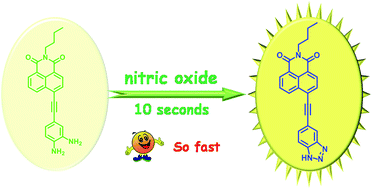
A new naphthalimide-based fluorescent probe NPA for detection of nitric oxide (NO) is reported. NPA responds to NO quickly and shows a 25-fold fluorescence enhancement within 10 seconds. To the best of our knowledge, NPA exhibits the fastest detection rate for NO based on o-phenylenediamine receptor. Moreover, NPA can detect NO quantitatively in aqueous solution with an estimated detection limit of 0.87 × 10⁻⁸ M.
Nitric oxide (NO), as an important signaling molecule in the immune, cardiovascular, and nervous systems, has attracted increasing attention from chemists and biochemists over the past few decades.1 It is well-known that NO plays critical roles in diverse physiological and biological processes such as vasodilation, carcinogenesis, neurodegenerative disorders, and neurotransmission.2 Furthermore, recent studies have indicated that the misregulation of NO is implicated with various diseases ranging from stroke, heart disease, hypertension, neurodegeneration, and erectile dysfunction.3 Therefore, the development of highly efficient methods for the selective detection of NO is extremely desirable.
Many approaches, such as colorimetric, electrochemical, electron-paramagnetic resonance spectroscopy, and chemiluminescence techniques have been employed to measure and trace NO.4 However, the most known approaches suffered from relatively high cost, time-consuming processes, and lack of temporal and spatial resolution, which limit their applications especially in many biological studies. In view of its simplicity, high sensitivity and real-time detection, fluorescent technique has been regarded as one of the most promising method to detect nitric oxide.5
To date, many fluorescent probes for NO have been reported. The reported fluorescent probes can be cataloged into two main types. One type6 is based on the specific reaction of electron-rich o-phenylenediamine with NO through the principle of photoinduced electron transfer and the other type7 is usually employed transition metal complexes (including Cu2+, Fe2+, Ru2+, or Rh2+) as NO receptors. Among these works, those of Nagano's group and Lippard's group are pioneering. These probes allowed for the effective detection of NO. Recently, many advances, such as the successful development of the subcellular targeting NO probes and ratiometric NO probes, have been made in this field.6l–n For example, Xiao and co-worker have developed a lysosomal-specific and two-photon fluorescent probe Lyso-NINO for detection of NO with high selectivity and sensitivity.6m,n
However, for the most of the reported known NO probes, it usually takes more than 5 minutes for the response of NO to reach the highest level of fluorescence enhancement. Recently, Anslyn and Shear reported the most quickly fluorescent probe NO550 for NO, which allowed that the fluorescent intensity to reach the maximum within 25 seconds through reacting with NO.5f Thus, the reported kinetics of NO detection is not yet optimal and the design of fluorescent probes for NO with improved kinetics is of pressing need.
In continuation of our group's interests in the development of fluorescent probes8 and fluorescent materials,9 herein, we reported a new naphthalimide-based fluorescent probe NPA. 1,8-naphthalimide was chosen as the fluorophore by virtue of its outstanding chemical, thermal and photochemical stability as well as its fluorescence quantum yield.10 o-Phenylenediamine was introduced as the receptor because of its high selectivity toward NO.6
The probe NPA was easily obtained in a satisfactory yield through two simple coupling reactions and one deprotection reaction, which avoid the complicated oxidation–reduction reaction that usually employed in the synthesis of o-phenylenediamine-containing NO probes.6e,f The structure of NPA was well characterized by 1H NMR, 13C NMR, and HR-ESI-MS spectra (ESI, Scheme S1–3†) (Scheme 1).
 |
| | Scheme 1 Synthetic route for probe NPA. | |
In order to eliminate the disturbance by protons during the detection of NO and to find out the optimal sensing conditions, the fluorescence intensity of NPA at various pH values was firstly determined in aqueous solution (ethanol–water, 1
:
1, v/v) (ESI, Fig. S1†). It was found that there was nearly no change in the fluorescence intensity of NPA in the pH range from 6.8 to 10.0, suggesting that NPA was very stable in this pH range. The emission intensity of NPA was found to gradually increase below pH 6.0, which might be caused by the protonation of o-phenylenediamine. Therefore, it was demonstrated that NPA could work under physiological condition with very low background fluorescence.
Since the half-life of NO is only several seconds in vivo, the time-dependent fluorescence response of NPA in the presence of NO was investigated in sodium phosphate buffer in aerobic environment. As shown in Fig. 1, the responses of NPA and NO with various concentrations were complete in less than 10 seconds. To the best of our knowledge, NPA exhibits the fastest detection rate for NO based on o-phenylenediamine receptor.
 |
| | Fig. 1 Time-dependent fluorescence intensity at 490 nm of NPA (100 μM) in the presence of NO at various amounts (λex = 400 nm). The experiments were carried out one time. | |
To evaluate the selectivity of NPA, various reactive oxygen species (ROS) and reactive nitrogen species (RNS) including NO, 1O2, H2O2, KO2, ClO−, NO2−, NO3−, ˙OH, and ONO2− were explored. As expected, NPA showed a weak fluorescence in aqueous solution. As shown in Fig. 2a, the addition of 2.5 equivalents NO to the solution of NPA in aerobic environment induced a significant enhancement of fluorescence (ca. 25-fold) with the emission maximum at 490 nm. However, even 100 equivalents of other ROS/RNS were added, the fluorescence behavior of NPA showed almost negligible changes. The above results suggested that NPA was a highly selective fluorescence “turn-on” probe for NO in aqueous solution.
 |
| | Fig. 2 (a) The fluorescence spectra and (b) fluorescent intensity at 490 nm of NPA (100 μM) in the presence of 2.5 equivalents NO and 100 equivalents of other ROS/RNS such as 1O2, H2O2, KO2, ClO−, NO2−, NO3−, ˙OH, and ONO2− in sodium phosphate buffer (50 mM, ethanol–water, 1 : 1, pH 7.4) (λex = 400 nm). The experiments were carried out one time. | |
The response of NPA to NO was investigated in detail as shown in Fig. 3. In the absence of NO, the free probe NPA displayed a strong absorption band around 442 nm. With the addition of NO (2.5 equiv.), the absorption of NPA centered at 442 nm gradually decreased and the peak at 405 nm increased simultaneously with a distinct isosbestic point at 425 nm. Upon adding NO (2.5 equiv.), the fluorescence increased by about 25- fold, accompanied by a slightly hypsochromic shift (8 nm) in the emission maximum. Significantly, a linear relationship (R2 = 0.984) was found between the fluorescence enhancement at 490 nm and the NO concentration below 60 μM (Fig. 4). The detection limit of the probe NPA for sensing NO was estimated to be 0.87 × 10⁻⁸ M. These results demonstrated that NPA was sensitive to NO and could be potentially used to quantitatively detect NO concentration.
 |
| | Fig. 3 (a) The absorption and (b) fluorescence spectra of NPA (100 μM) upon addition of NO (10–250 μM) in sodium phosphate buffer (50 mM, ethanol–water, 1 : 1, pH 7.4) (λex = 400 nm). The experiments were carried out one time. | |
 |
| | Fig. 4 Curve of fluorescence intensity at 490 nm of NPA (100 μM) versus increasing concentrations of NO (10–60 μM) (λex = 400 nm). The experiments were carried out one time. | |
Considering the previous reports that the o-phenylenediamine can react with NO to produce benzotriazole, the proposed sensing mechanism of NPA for NO was given as shown in Scheme 2 according to the above results. The reaction of NPA with NO produced the corresponding triazole compound NPT. Different from the electron-rich o-phenylenediamine, benzotriazole was an electron deficient heterocycle containing two electron-withdrawing nitrogens and possessed a higher oxidation potential. Thus, the blueshift of the absorption wavelength as well as the increase of the fluorescence intensity with the addition of NO were attributed to the inhibition of the ICT processes. In order to further verify the sensing mechanism, the compound NPT was synthesized through the reaction of NPA with NaNO2 in HCl solution (ESI, Scheme S4†). As shown in Fig. S2,† the presynthesized compound NPT had the maximum absorption and emission wavelength at 405 nm and 488 nm, respectively, which were nearly identical to those of NPA in the presence of 2.5 equivalents NO in aqueous solution. The results further support the proposed sensing mechanism.
 |
| | Scheme 2 The proposed sensing mechanism of NPA for NO. | |
Conclusions
In summary, through a simple three-step synthetic approach, a new naphthalimide-based fluorescent probe NPA for sensitive and selective detection of NO was prepared. NPA could detect NO quantitatively in aqueous solution with the detection limit of 0.87 × 10⁻⁸ M. More importantly, NPA responded to NO quickly and showed a 25-fold fluorescence enhancement within 10 seconds. To the best of our knowledge, NPA exhibited the fastest detection rate for NO based on o-phenylenediamine receptor. Although the detection of NO in living cells was unsuccessful, considering the fast reaction of NPA with NO, the probe NPA has the potential application in the quick detection of NO in aqueous solution or blood.
Acknowledgements
Lin Xu acknowledges support of the National Natural Science Foundation of China (no. 21302058), the Research Fund for the Doctoral Program of Higher Education of China (no. 20130076120006), the Fundamental Research Funds for the Central Universities, and the Opening Projects of Shanghai Key Laboratory of Chemical Biology and Chongqing Key Laboratory of Environmental Materials and Remediation Technology (no. CEK1402). Junhai Huang acknowledges support of the Shanghai Rising-Star Program (no. 14QB1404800). We also appreciate valuable discussion with Prof. Hai-Bo Yang (East China Normal University).
Notes and references
-
(a) H. Bult, G. E. Boeckxstaens, P. A. Pelckmans, F. H. Jordaens, Y. M. Van Maercke and A. G. Herman, Nature, 1990, 345, 346 CrossRef CAS PubMed;
(b) C. Bogdan, Nat. Immunol., 2001, 2, 907 CrossRef CAS PubMed.
-
(a) L. J. Ignarro, Angew. Chem., Int. Ed., 1999, 38, 1882 CrossRef CAS;
(b) B. G. Hill, B. P. Dranka, S. M. Bailey, J. R. Lancaster and V. M. Darley-Usmar, J. Biol. Chem., 2010, 285, 19699 CrossRef CAS PubMed;
(c) M. T. Galdwin, J. R. Lancaster Jr, B. A. Freeman and A. N. Schechter, Nat. Med., 2003, 9, 496 CrossRef PubMed.
-
(a) S. P. L. Cary, J. A. Winger, E. R. Derbyshire and M. A. Marletta, Trends Biochem. Sci., 2006, 31, 231 CrossRef CAS PubMed;
(b) C. E. Thomas and V. Darley-Usmar, Free Radicals Biol. Med., 2000, 28, 1449 CrossRef CAS.
-
(a) F. Brown, N. J. Finnerty, F. B. Bolger, J. Millar and J. P. Lowry, Anal. Bioanal. Chem., 2005, 381, 964 CrossRef CAS PubMed;
(b) F. Bedioui and N. Villeneuve, Electroanalysis, 2003, 15, 15 CrossRef;
(c) S. Izumi, Y. Urano, K. Hanaoka, T. Terai and T. Nagano, J. Am. Chem. Soc., 2009, 131, 10189 CrossRef CAS PubMed;
(d) Y. Katayama, N. Soh and M. Maeda, ChemPhysChem, 2001, 2, 655 CrossRef CAS.
-
(a) E. W. Miller and C. J. Chang, Curr. Opin. Chem. Biol., 2007, 11, 620 CrossRef CAS PubMed;
(b) L. E. McQuade and S. J. Lippard, Curr. Opin. Chem. Biol., 2010, 14, 43 CrossRef CAS PubMed;
(c) M. Hee Lim and S. J. Lippard, Acc. Chem. Res., 2007, 40, 41 CrossRef PubMed;
(d) C. Sun, W. Shi, Y. Song, W. Chen and H. Ma, Chem. Commun., 2011, 47, 8638 RSC;
(e) T.-W. Shiue, Y.-H. Chen, C.-M. Wu, G. Singh, H.-Y. Chen, C.-H. Hung, W.-F. Liaw and Y.-M. Wang, Inorg. Chem., 2012, 51, 5400 CrossRef CAS PubMed;
(f) Y. Yang, S. K. Seidlits, M. M. Adams, V. M. Lynch, C. E. Schmidt, E. V. Anslyn and J. B. Shear, J. Am. Chem. Soc., 2010, 132, 13114 CrossRef CAS PubMed;
(g) H. Zheng, G.-Q. Shang, S.-Y. Yang, X. Gao and J.-G. Xu, Org. Lett., 2008, 10, 2357 CrossRef CAS PubMed.
-
(a) H. Kojima, N. Nakatsubo, K. Kikuchi, S. Kawahara, Y. Kirino, H. Nagoshi, Y. Hirata and T. Nagano, Anal. Chem., 1998, 70, 2446 CrossRef CAS;
(b) Y. Gabe, Y. Urano, K. Kikuchi, H. Kojima and T. Nagano, J. Am. Chem. Soc., 2004, 126, 3357 CrossRef CAS PubMed;
(c) E. Sasaki, H. Kojima, H. Nishimatsu, Y. Urano, K. Kikuchi, Y. Hirata and T. Nagano, J. Am. Chem. Soc., 2005, 127, 3684 CrossRef CAS PubMed;
(d) M. J. Plater, I. Greig, M. H. Helfrich and S. H. Ralston, J. Chem. Soc., Perkin Trans. 1, 2001, 1, 2553 RSC;
(e) J.-B. Chen, H.-X. Zhang, X.-F. Guo, H. Wang and H.-S. Zhang, Anal. Chim. Acta, 2013, 800, 77 CrossRef CAS PubMed;
(f) M. Wang, Z. Xu, X. Wang and J. Cui, Dyes Pigm., 2013, 96, 333 CrossRef CAS PubMed;
(g) R. Zhang, Z. Ye, G. Wang, W. Zhang and J. Yuan, Chem.–Eur. J., 2010, 16, 6884 CrossRef CAS PubMed;
(h) E. W. Seo, J. H. Han, C. H. Heo, J. H. Shin, H. M. Kim and B. R. Cho, Chem.–Eur. J., 2012, 18, 12388 CrossRef CAS PubMed;
(i) G. K. Vegesna, S. R. Sripathi, J. Zhang, S. Zhu, W. He, F.-T. Luo, W. J. Jahng, M. Frost and H. Liu, ACS Appl. Mater. Interfaces, 2013, 5, 4107 Search PubMed;
(j) L. Yuan, W. Lin, Y. Xie, B. Chen and J. Song, Chem. Commun., 2011, 47, 9372 RSC;
(k) N. G. Zhegalova, G. Gonzales and M. Y. Berezin, Org. Biomol. Chem., 2013, 11, 8228 RSC;
(l) H. Yu, Y. Xiao and L. Jin, J. Am. Chem. Soc., 2012, 134, 17486 CrossRef CAS PubMed;
(m) H. Yu, X. Zhang, Y. Xiao, W. Zou, L. Wang and L. Jin, Anal. Chem., 2013, 85, 7076 CrossRef CAS PubMed;
(n) H. Yu, L. Jin, Y. Dai, H. Li and Y. Xiao, New J. Chem., 2013, 37, 1688 RSC;
(o) L.-Y. Lin, X.-Y. Lin, F. Lin and K.-T. Wong, Org. Lett., 2011, 13, 2216 CrossRef CAS PubMed.
-
(a) S. A. Hilderbrand, M. H. Lim and S. J. Lippard, J. Am. Chem. Soc., 2004, 126, 4972 CrossRef CAS PubMed;
(b) L. E. McQuade, J. Ma, G. Lowe, A. Ghatpande, A. Gelperin and S. J. Lippard, Proc. Natl. Acad. Sci. U. S. A., 2010, 107, 8525 CrossRef CAS PubMed;
(c) X. Hu, J. Wang, X. Zhu, D. Dong, X. Zhang, S. Wu and C. Duan, Chem. Commun., 2011, 47, 11507 RSC;
(d) C. Xing, M. Yu, S. Wang, Z. Shi, Y. Li and D. Zhu, Macromol. Rapid Commun., 2007, 28, 241 CrossRef CAS;
(e) N. Soh, Y. Katayama and M. Maeda, Analyst, 2001, 126, 564 RSC;
(f) B. Mondal, P. Kumar, P. Ghosh and A. Kalita, Chem. Commun., 2011, 47, 2964 RSC;
(g) Y. Chen, W. Guo, Z. Ye, G. Wang and J. Yuan, Chem. Commun., 2011, 47, 6266 RSC;
(h) P. Kumar, A. Kalita and B. Mondal, Dalton Trans., 2012, 41, 10543 RSC;
(i) L. Tan, A. Wan and H. Li, Analyst, 2013, 138, 879 RSC.
-
(a) L. Xu, M.-L. He, H.-B. Yang and X. Qian, Dalton Trans., 2013, 42, 8218 RSC;
(b) C.-B. Huang, H.-R. Li, Y. Luo and L. Xu, Dalton Trans., 2014, 43, 8102 RSC;
(c) L. Xu, Y. Xu, W. Zhu, C. Yang, L. Han and X. Qian, Dalton Trans., 2012, 41, 7212 RSC;
(d) H.-I. Un, C.-B. Huang, C. Huang, T. Jia, X.-L. Zhao, C.-H. Wang, L. Xu and H.-B. Yang, Org. Chem. Front., 2014, 1, 1083 RSC;
(e) H.-I. Un, C.-B. Huang, J. Huang, C. Huang, T. Jia and L. Xu, Chem.–Asian J., 2014, 9, 3397 CrossRef CAS PubMed;
(f) L. Xu, Y. Xu, W. Zhu, B. Zeng, C. Yang, B. Wu and X. Qian, Org. Biomol. Chem., 2011, 9, 8284 RSC;
(g) L. Xu, Y. Xu, W. Zhu, X. Sun, Z. Xu and X. Qian, RSC Adv., 2012, 2, 6323 RSC;
(h) L. Xu, Y. Xu, W. Zhu, Z. Xu, M. Chen and X. Qian, New J. Chem., 2012, 36, 1435 RSC;
(i) Z. Xu, L. Xu, J. Zhou, Y. Xu, W. Zhu and X. Qian, Chem. Commun., 2012, 48, 10871 RSC;
(j) H.-I. Un, S. Wu, C.-B. Huang, Z. Xu and L. Xu, Chem. Commun., 2015 10.1039/c4cc09488c.
-
(a) L. Xu, Y.-X. Wang and H.-B. Yang, Dalton Trans., 2015, 44, 867 RSC;
(b) B. Jiang, L.-J. Chen, L. Xu, S.-Y. Liu and H.-B. Yang, Chem. Commun., 2013, 49, 6977 RSC;
(c) Z.-Y. Li, L. Xu, C.-H. Wang, X.-L. Zhao and H.-B. Yang, Chem. Commun., 2013, 49, 6194 RSC;
(d) X.-D. Xu, J. Zhang, L.-J. Chen, X.-L. Zhao, D.-X. Wang and H.-B. Yang, Chem.–Eur. J., 2012, 18, 1659 CrossRef CAS PubMed;
(e) X.-D. Xu, J. Zhang, L.-J. Chen, R. Guo, D.-X. Wang and H.-B. Yang, Chem. Commun., 2012, 48, 11223 RSC;
(f) X.-D. Xu, J. Zhang, X. Yu, L.-J. Chen, D.-X. Wang, T. Yi, F. Li and H.-B. Yang, Chem.–Eur. J., 2012, 18, 16000 CrossRef CAS PubMed;
(g) S. Chen, L.-J. Chen, H.-B. Yang, H. Tian and W. Zhu, J. Am. Chem. Soc., 2012, 134, 13596 CrossRef CAS PubMed;
(h) M. He, Q. Han, J. He, Q. Li, Z. Abliz, H. Tan, L. Xu and H. Yang, Chin. J. Chem., 2013, 31, 663 CrossRef CAS;
(i) N.-W. Wu, J. Zhang, X.-D. Xu and H.-B. Yang, Chem. Commun., 2014, 50, 10269 RSC;
(j) W. Wang and H.-B. Yang, Chem. Commun., 2014, 50, 5171 RSC;
(k) N.-W. Wu, J. Zhang, D. Ciren, Q. Han, L.-J. Chen, L. Xu and H.-B. Yang, Organometallics, 2013, 32, 2536 CrossRef CAS;
(l) Z.-Y. Li, W. Wu, Q. Zhang, B. Jin, J. Hua, H.-B. Yang and H. Tian, Chem.–Asian J., 2013, 8, 2660 CrossRef CAS PubMed;
(m) W. Wu, J. Zhang, H. Yang, B. Jin, Y. Hu, J. Hua, C. Jing, Y. Long and H. Tian, J. Mater. Chem., 2012, 22, 5382 RSC;
(n) L.-J. Chen, J. Zhang, J. He, X.-D. Xu, N.-W. Wu, D.-X. Wang, Z. Abliz and H.-B. Yang, Organometallics, 2011, 30, 5590 CrossRef CAS;
(o) W. Wu, X. Xu, H. Yang, J. Hua, X. Zhang, L. Zhang, Y. Long and H. Tian, J. Mater. Chem., 2011, 21, 10666 RSC;
(p) J. Zhang, X.-D. Xu, L.-J. Chen, Q. Luo, N.-W. Wu, D.-X. Wang, X.-L. Zhao and H.-B. Yang, Organometallics, 2011, 30, 4032 CrossRef CAS.
-
(a) S. Banerjee, E. B. Veale, C. M. Phelan, S. A. Murphy, G. M. Tocci, L. J. Gillespie, D. O. Frimannsson, J. M. Kelly and T. Gunnlaugsson, Chem. Soc. Rev., 2013, 42, 1601 RSC;
(b) T. Liu, Z. Xu, D. R. Spring and J. Cui, Org. Lett., 2013, 15, 2310 CrossRef CAS PubMed;
(c) X. Meng, W. Zhu, Q. Zhang, Y. Feng, W. Tan and H. Tian, J. Phys. Chem. B, 2008, 112, 15636 CrossRef CAS PubMed;
(d) B. Zhu, X. Zhang, Y. Li, P. Wang, H. Zhang and X. Zhuang, Chem. Commun., 2010, 46, 5710 RSC;
(e) H. Jiang, J. Jiang, J. Cheng, W. Dou, X. Tang, L. Yang, W. Liu and D. Bai, New J. Chem., 2014, 38, 109 RSC.
Footnote |
| † Electronic supplementary information (ESI) available: Experimental procedures and spectraldata. See DOI: 10.1039/c4ra08337g |
|
| This journal is © The Royal Society of Chemistry 2015 |
Click here to see how this site uses Cookies. View our privacy policy here.