DOI:
10.1039/C4RA12248H
(Paper)
RSC Adv., 2014,
4, 65121-65126
Cocrystal explosive hydrate of a powerful explosive, HNIW, with enhanced safety†
Received
12th October 2014
, Accepted 21st November 2014
First published on 21st November 2014
Abstract
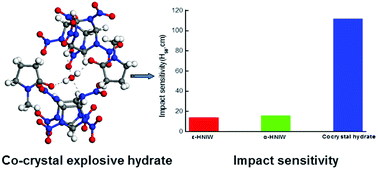
A novel cocrystal explosive hydrate containing HNIW (hexanitrohexaazaisowurtzitane), NMP (N-methyl-2-pyrrolidone) and water was synthesized through cocrystallization. The crystal structure was characterized by power X-ray diffraction (PXRD) and single crystal X-ray diffraction (SXRD). This crystalline structure belongs to the monoclinic crystal system with space group P2(1)/c. The properties of the cocrystal hydrate including thermal behavior, impact sensitivity and detonation performance were also evaluated. The cocrystal hydrate shows a unique thermal behavior with an endothermic peak and a decomposition peak at 91 and 252 °C, respectively. Besides, the cocrystal hydrate displays an impact height with a 50% ignition probability of 112 cm, indicating a substantial reduction in impact sensitivity compared to pure α-HNIW and ε-HNIW. Furthermore, although the power is diluted, the cocrystal hydrate is predicted to have better detonation performance than pure DNAN (2,4-dinitroanisole) and TNT (trinitrotoluene). Therefore, the cocrystal hydrate may be a promising low sensitivity explosive.
1. Introduction
Energetic materials such as explosives, propellants and pyrotechnics are a class of chemical substances generally containing nitro, amino and azide groups, which release a large amount of potential energy accompanied with high temperature and high pressure through a rapid decomposition.1,2 Energetic materials have thus been widely used in the military and civil fields for a long time. HNIW (hexanitrohexaazaisowurtzitane), HMX (cyclotetramethylenetetranitramine) and RDX (cyclotrimethylenetrinitramine) are used in bombs, shells and warheads due to their high explosive performances. Contrarily, TATB (trinitrotriaminobenzene), NTO (nitrotriazolone) and Fox-7 (diaminodinitroethylene) are used as explosive filling for insensitive ammunition owing to their excellent safety. However, performance runs parallel to sensitivity among existing explosives, failing to meet the requirements of insensitive high energy explosives for modern weapon applications.3 Therefore, researchers all over the world in energetic material fields have performed extensive studies on the development of novel energetic materials that have excellent performance with reduced sensitivity to external stimuli such as impact, friction and shock waves.
To reduce sensitivity while maintaining high performance, one strategy is to synthesize new insensitive high power energetic materials, but which is a complex and time-consuming process.4–6 Fortunately, another intriguing strategy is to utilize the cocrystallization methodology to achieve explosive cocrystals, integrating both an explosive and a coformer into one crystal structure by intermolecular interactions such as hydrogen bonds, π-stacking, or van der Waals forces.7,8 Currently, cocrystals are emerging as a promising method to synthesize enhanced energetic materials as well as tune properties of energetic materials owing to the alterations of components and structures for explosives in energetic material fields. However, reports on the cocrystallization of energetic materials are very scarce from open literatures so far, whereas several studies indicated that apart from offering potential improvements in density, melting point and decomposition temperature, cocrystal explosives can enhance other key properties of the existing explosives including sensitivity, detonation velocity and detonation pressure. For example, the impact sensitivity of HNIW, HMX and BTF (benzotrifuroxan) were large reduced by cocrystallizing with some aromatic explosives and some non-energetic compounds.9–14 Therefore, explosive cocrystals open an effective strategy to improve properties of energetic materials and attract increasing attention in energetic science at present. Nowadays, to our knowledge, the reported explosive cocrystals only contain two components, but in terms of the power to modify properties, it may be concluded that multi-component cocrystals will produce a much wider range of alternations in properties to achieve energetic materials with further improved performance.
HNIW (commonly referred to CL-20, Fig. 1) has four known different polymorphs, α, β, γ, and ε, with ambient conditions α-HNIW containing water molecule (HNIW–H2O) and ε-HNIW having highest density (2.04 g cm−3).15 HNIW is considered one of the most powerful explosive, possessing higher oxygen balance, density and energy. However, it is too sensitive to mechanical stimuli (impact or friction) and shock wave to meet the stringent safety requirements for modern weapons, consequently hampering its further applications.16,17 NMP (N-methyl-2-pyrrolidone, Fig. 1) represents one of the most unique functional groups in crystal engineering, featuring a carbonyl group, in spite of it belonging to a nonenergetic material.18 Additionally, the O atom in carbonyl groups and water molecules is one of the stronger hydrogen bond acceptor, which readily forms a hydrogen bond with a weak donor. Therefore, cocrystallizing them together may help us to further reduce the sensitivity of HNIW. Besides, explosive molecules commonly possess nearly saturated with nitro groups, which give very few predictable interactions and synthons for designing cocrystals among energetic materials. Fortunately, Matzger and Millar research groups analyzed the intermolecular interactions of the structures of cocrystals, offering some insights into designing energetic cocrystals.10,19–21 In comparison with similar cocrystals reported by Millar, we present a novel ternary cocrystal of HNIW and characterize its properties in detail. Our study will further contribute to the rational design of HNIW cocrystals and the exploitation for multi-component cocrystals, which may promote the development and application of cocrystals in energetic materials.
 |
| | Fig. 1 Molecular structure of ε-HNIW (left), NMP (middle) and α-HNIW (right). | |
In this work, a novel 1
:
2
:
1 HNIW–NMP–H2O cocrystal explosive hydrate was discovered and synthesized by cocrystallizing from slow evaporation solvent. The crystal structure of the cocrystal explosive hydrate was determined by single crystal X-ray diffraction (SXRD). Additionally, we also study properties of the cocrystal explosive hydrate including thermolysis, sensitivity and detonation performance in detail.
2. Experimental section
2.1 Materials
ε-HNIW and α-HNIW were supplied by Liaoning Qingyang Chemical Industry Co., Ltd. NMP was obtained from Mianyang Rongsheng Chemical Industry Co., Ltd. Solvents and other reagents were purchased from trade and used as received.
2.2 Synthesis of the HNIW/NMP/H2O cocrystal explosive hydrate
ε-HNIW (438 mg, 1 mmol) was added to a mixture of 2 ml of NMP and 0.5 ml of water, mildly heated to all ε-HNIW dissolution. The solution was allowed to evaporate slowly at room temperature over several days. The colorless cocrystal hydrates were precipitated, filtered and dried under ambient conditions.
2.3 Morphology characterization
The morphologies of cocrystal hydrates, α-HNIW and ε-HNIW were carried out by a Zeiss axio scope A1 microscope.
2.4 Power X-ray diffraction (PXRD)
XRD data were collected on a Bruker D8 Advance diffractometer using Cu-Kα radiation (λ = 1.54056 Å) at 35 kV and 40 mA. The samples were scanned within the scan range of 2θ = 7.5° to 45° continuous san with a step size of 0.015° and a scan speed of 0.2 s per step. Moreover, the PXRD pattern of the cocrystal hydrate was simulated by its CIF file and Reflex Module in Materials Studio package with the same sets as experiment.22
2.5 Single crystal X-ray diffraction (SXRD)
Single crystal of suitable quality was chosen and purged with a cooled nitrogen gas stream at 293 K throughout the data collection. X-ray reflections were collected on a Xcalibur Eos CCD detector with graphite-monochromated Mo-Kα radiation (λ = 0.71073 Å). Data were collected and processed using Olex2 software. Structure was solved by direct methods and SHELX was used for structure solution and least-squares refinement.23
2.6 Thermal analysis
Differential Scanning Calorimetery (DSC) was performed on a TA Q100 instrument. 1–2 mg of cocrystal hydrate was heated from 25 to 350 °C at a heating rate of 10 °C min−1 under nitrogen (50 ml min−1) atmosphere.
Thermogravimetry (TG) test was recorded on a TA Q600 instrument by heating about 2 mg of cocrystal hydrate at a rate of 10 °C min−1 under nitrogen (50 ml min−1) atmosphere.
Hot-stage optical microscopy (HSM) was examined using a Caikon CK-3000 hot stage and a HIROX-1300 optical microscope. The heating rate was 5 °C min−1.
2.7 Impact sensitivity
The impact sensitivity was performed with a WL-1 type impact sensitivity instrument according to GJB-772A-97 standard method 601.2.24 The experimental conditions were: drop weight, 2 kg; sample mass, 30 mg. The impact sensitivity of test sample was expressed by the drop height of 50% explosion probability (H50).
2.8 Detonation performance prediction
The detonation performances of the cocrystal hydrate, ε-HNIW, α-HNIW and DNAN were evaluated by the linear output thermodynamic user-friendly software code.25
3. Results and discussion
3.1 Morphologies
The optical microscopy images for the cocrystal hydrate, ε-HNIW and α-HNIW are shown in Fig. 2. The observed crystal morphologies of them are distinctly different. The cocrystal hydrates exhibit colorless prism type crystal morphology with smooth and integrated surfaces, whereas the α-HNIW and ε-HNIW present a block type microstructure and a spindle-like shape, respectively. These differences in crystal morphologies can be attributed to their different microscopic structures, suggesting a new structure formation. Additionally, an average particle size of the cocrystal hydrate is about 400 μm, which is clearly larger than that of α-HNIW and ε-HNIW. Therefore, cocrystallization provides a potential methodology to control morphologies and sizes of explosive crystals.
 |
| | Fig. 2 Optical microscopy images of α-HNIW (a), cocrystal hydrate (b), and ε-HNIW (c). | |
3.2 Solid-state characterization
As shown in Fig. 3, cocrystal hydrate has a unique powder X-ray diffraction (PXRD) pattern that differs from those of α-HNIW and ε-HNIW. In particular, a series of new strong peaks occur in the PXRD curve of cocrystal hydrate, whereas no corresponding peaks appear in the PXRD patterns of α-HNIW and ε-HNIW. Furthermore, the differences in PXRD curves among them, further indicate that the cocrystal hydrate is a new crystalline form rather than a phase transformation of HNIW polymorphs. Moreover, as presented in Fig. 3, the experimental and simulated PXRD profiles of the cocrystal hydrate match with each other. Additionally, the cocrystal exhibits a pattern due to preferred orientation, as it exhibits in a shape of block prism shown in Fig. 2.
 |
| | Fig. 3 PXRD patterns of cocrystal hydrate, α-HNIW and ε-HNIW. | |
3.3 Structure of the cocrystal hydrate
Single crystal X-ray diffraction (SXRD) analysis of HNIW–NMP–H2O (1
:
2
:
1) cocrystal shows that they crystallize in the monoclinic system with space group P2(1)/c. The asymmetric unit consists of two molecules of NMP and one molecule each of HNIW and water. In the cocrystal, the skeleton is made of HNIW and NMP. As shown in Fig. 4, the two components represent good layer structure, which are connected by mid-strength hydrogen bonds. The hydrogen bonds involve the interactions of nitro-O⋯alky-H (2.28–2.68 Å) and carbonyl-O⋯alky-H (2.34–2.56 Å). Moreover, the two components compose the larger cavities, in which the water molecules are located. Actually, water molecules play an important role in the cocrystal formation, such that they interact with all other components of the asymmetric unit. Via one water molecule, four new hydrogen bonds form to make crystal more stable, in which the hydrogen bonds between O–H⋯O
C are stronger with 1.95–2.21 Å, while hydrogen bonds of O⋯HC are weaker with 2.40–2.64 Å.
 |
| | Fig. 4 Crystal structure of the cocrystal hydrate: (a) structure of the super cell; (b) typical intermolecular interactions in the super cell unit. | |
3.4 Thermal analysis
The thermal behavior of cocrystal hydrate was investigated by DSC and TG analyses. A smaller endotherm between 80 to 105 °C (Fig. 5), can be attributed to the melting of the cocrystal hydrate accompanying water release, whereas which is not present in α-HNIW and ε-HNIW. A unique endothermic peak occurs at 91 °C, which is significantly higher 115 °C than the melting point of NMP (M.P. = −24 °C).26 Besides, the DSC trace of cocrystal hydrate shows a strong exothermic peak at 252 °C, which corresponds to the decomposition event of cocrystal hydrate, slightly higher than those of α-HNIW (Tmax = 245 °C)27 and ε-HNIW (Tmax = 249 °C).27 In addition, the cocrystal hydrate displays two weight loss steps in TG curve (Fig. 5), suggesting heterogeneous decomposition process. A stable weight loss starts at 80 °C, due to the evaporation of H2O and NMP, followed by the weak decomposition of NMP. Another rapid weight loss appears in the temperature range of 220–255 °C, mainly attributed to the intense thermal decomposition of HNIW. Furthermore, the thermal behavior of crystal hydrate was assessed by HSM (Fig. 6). Water release and partial melting of cocrystal hydrate was observed between 82 to 91 °C. The crystal converts to liquids with temperature increasing. In short, compared with the melting point or decomposition temperature of α-HNIW, ε-HNIW and NMP, cocrystal hydrate exhibits a new distinct thermal behavior, due to incorporating NMP into α-HNIW through cocrystallization, implying that multi-component cocrystal may generate a wider range alteration in properties of energetic materials.
 |
| | Fig. 5 DSC and TG curves of cocrystal hydrate. | |
 |
| | Fig. 6 HSM images of cocrystal hydrate. | |
3.5 Sensitivity
Sensitivity is one of the most important properties of energetic materials that affect their developments and applications. Sensitivity of energetic materials to different stimuli (such as impact, friction and shock) is often used to assess their safeties. The cocrystal hydrate, α-HNIW and ε-HNIW were subjected to impact sensitivity test. The results were expressed by the drop height of 50% explosion (H50) and tabulated in Table 1. The H50 values for α-HNIW and ε-HNIW is 16 and 14 cm, respectively, but the cocrystal hydrate displays H50 of 112 cm. Additionally, the drop height for cocrystal hydrate is about seven times higher than that of pure α-HNIW, suggesting a remarkable reduction in impact sensitivity relative to pure α-HNIW and ε-HNIW. This observation further indicated that multi-component cocrystal offers a potential methodology to tune the sensitivity of explosives.
Table 1 Results of impact sensitivity
| Samples |
Impact sensitivity (H50, cm) |
| ε-HNIW |
14 |
| α-HNIW |
16 |
| Cocrystal hydrate |
112 |
The reasons accounted for the decreased sensitivity of the cocrystal hydrate are mainly the results of the incorporation of the non-energetic coformers into HNIW through cocrystallization. Besides, enhanced hydrogen bonds formed in cocrystal hydrate may act as an energy pathway to dissipate heat effectively for hindering formation of hot spots and thereby, this decreases the probability of initiation via hot spots, leading to a decrease in sensitivity.28
3.6 Detonation performance prediction
Detonation performances including detonation velocity and detonation pressure are another critical property to evaluate the energy of explosives. Although the power of cocrystal hydrate is diluted via cocrystallization with nonenergetic materials. Both the detonation velocity and detonation pressure of cocrystal hydrate are predicted to be 7098 m s−1 and 21.2 GPa, respectively, which are less than those of pure α-HNIW and pure ε-HNIW (Table 2). It may be explained by the fact that cocrystal hydrate has lower density and lower oxygen balance compared with α-HNIW and ε-HNIW. However, the cocrystal hydrate is potentially useful, which may be used as a novel low sensitive explosive due to higher safety and higher power relative to DNAN and TNT.
Table 2 Results of detonation performance prediction
| Samples |
Densitya (g m−3) |
Detonation performance |
| Detonation velocity (m s−1) |
Detonation pressure (GPa) |
| Crystallographic density at room temperature. |
| ε-HNIW |
2.035 |
9385 |
44.9 |
| α-HNIW |
1.952 |
9378 |
43.4 |
| DNAN |
1.341 |
5706 |
11.9 |
| TNT |
1.654 |
6650 |
19.1 |
| Cocrystal hydrate |
1.602 |
7098 |
21.2 |
4. Conclusions
A novel cocrystal explosive hydrate (three component cocrystal) composed of HNIW, NMP and water in a 1
:
2
:
1 molar ratio was synthesized and characterized. This cocrystal hydrate is mainly stacked through OH⋯O and CH⋯O hydrogen bonds, offering further insight into designing HNIW cocrystals. The cocrystal hydrate displays a unique thermal behavior with an entire melting and a decomposition peak at 100 and 252 °C, respectively. Moreover, the cocrystal hydrate exhibits significantly reduced impact sensitivity compared with α-HNIW and ε-HNIW and more excellent predicted detonation performances relative to pure DNAN and TNT. Therefore, the cocrystal hydrate may be used as a promising low sensitive explosive. In summary, cocrystal methodology offers an effective strategy to achieve energetic materials with improved performances.
Abbreviations
| HNIW or CL-20 | Hexanitrohexaazaisowurtzitane |
| NMP | N-Methyl-2-pyrrolidone |
| DNAN | 2,4-Dinitroanisole |
| HMX | Cyclotetramethylenetetranitramine |
| RDX | Cyclotrimethylenetrinitramine |
| TATB | Trinitrotriaminobenzene |
| NTO | Nitrotriazolone |
| FOX-7 | Diaminodinitroethylene |
| BTF | Benzotrifuroxan |
| TNT | Trinitrotoluene |
| DNB | Dinitrobenzene |
Acknowledgements
This work was supported by National Natural Science Foundation of China (no. 11402236).
Notes and references
- L. E. Fried, M. R. Manaa, P. F. Pagoria and R. L. Simpson, Annu. Rev. Mater. Res., 2001, 31, 291–321 CrossRef CAS.
- J. P. Agrawal and R. D. Hodgson, Organic chemistry of explosives, Johy Wiley & Sons Ltd., England, 1st edn, 2007 Search PubMed.
- A. K. Sikder and N. Sikder, J. Hazard. Mater., 2004, A112, 1–15 CrossRef PubMed.
- D. M. Badgujar, M. B. Talawar, S. N. Asthana and P. P. Mahulikar, J. Hazard. Mater., 2008, 151, 289–305 CrossRef CAS PubMed.
- P. W. Millar, J. Hamid, R. Endson, P. F. Swinton and J. Cooper, Propellants, Explos., Pyrotech., 2008, 33, 66–72 CrossRef.
- V. Thottempudi, H. X. Gao and J. M. Shreeve, J. Am. Chem. Soc., 2011, 133, 6464–6471 CrossRef CAS PubMed.
- N. Qiao, M. Z. Li, W. Schlindwein, N. Malek, A. Davies and G. Trappitt, Int. J. Pharm., 2011, 419, 1–11 CrossRef CAS PubMed.
- Y. P. Wang, Z. W. Yang, H. Z. Li, J. H. Wang, X. Q. Zhou and Q. Zhang, Chin. J. Energ. Mater., 2012, 21, 554–555 Search PubMed.
- O. Bolton and A. J. Matzger, Angew. Chem., Int. Ed., 2011, 50, 8960–8963 CrossRef CAS PubMed.
- K. B. Landenberger and A. J. Matzger, Cryst. Growth Des., 2012, 12, 3603–3609 CAS.
- O. Bolton, L. R. Simke, P. F. Pagoria and A. J. Matzger, Cryst. Growth Des., 2012, 12, 4311–4314 CAS.
- Z. W. Yang, H. Z. Li, X. Q. Zhou, C. Y. Zhang, H. Huang, J. S. Li and F. D. Nie, Cryst. Growth Des., 2012, 12, 5155–5185 CAS.
- H. B. Zhang, C. Y. Guo, X. C. Wang, J. J. Xu, X. He, Y. Liu, X. F. Liu, H. Huang and J. Sun, Cryst. Growth Des., 2013, 13, 679–687 CAS.
- Z. W. Yang, Y. P. Wang, J. H. Zhou, H. Z. Li, H. Huang and F. D. Nie, Propellants, Explos., Pyrotech., 2014, 39, 9–13 CrossRef CAS.
- M. Ghost, V. Venkatesan, N. Sikder and A. K. Sikder, Cent. Eur. J. Energ. Mater., 2013, 10, 419–438 Search PubMed.
- M. Geetha, U. R. Nair, D. B. Sarwade, G. M. Gore, S. N. Asthana and H. Singh, J. Therm. Anal. Calorim., 2003, 73, 913–922 CrossRef CAS.
- U. R. Nair, R. Sivabalan, G. M. Gore, M. Geetha, S. N. Asthana and H. Singh, Combust., Explos. Shock Waves, 2005, 41, 121–132 CrossRef PubMed.
- A. Jouyban and M. A. A. Fakhree, J. Pharm. Pharm. Sci., 2010, 13, 524–535 CAS.
- K. B. Landenberger and A. J. Matzger, Cryst. Growth Des., 2010, 10, 5341–5347 CAS.
- K. B. Landenberger, O. Bolton and A. J. Matzger, Angew. Chem., Int. Ed., 2013, 52, 6468–6471 CrossRef CAS PubMed.
- D. I. A. Millar, H. E. Maynard-Casely, D. R. Allan, A. S. Cumming, A. R. Lennie, A. J. Mackay, I. D. Oswald, C. C. Tang and C. R. Pulham, CrystEngComm, 2012, 14, 3742–3749 RSC.
- Materials Studio, Version 6.0, Accelrys, San Diego, CA, 2001 Search PubMed.
- G. M. Sheldrik, Acta Crystallogr., Sect. A: Found. Crystallogr., 2008, 64, 112–122 CrossRef PubMed.
- National military stand of China, experimental methods of sensitivity and safety GJB/772A-97, 1997, in Chinese.
- H. Muthurajan, R. Sivabalan, M. B. Talawar and S. N. Asthana, J. Hazard. Mater., 2004, A112, 17–33 CrossRef PubMed.
- G. Muller, M. Lutz and S. Harder, Acta Crystallogr., Sect. B: Struct. Sci., 1996, 52, 1014–1022 Search PubMed.
- O. Y. Xiang, Explosive Science, Beijing Institute of Technology Press, Beijing, 1st edn, 2006, in Chinese Search PubMed.
- X. Cao, B. Xiang and C. Y. Zhang, Chin. J. Energ. Mater., 2012, 20, 643–649 CAS , in Chinese.
|
| This journal is © The Royal Society of Chemistry 2014 |
Click here to see how this site uses Cookies. View our privacy policy here.