Jielin Yuana,
Qiongzhi Gao*a,
Xin Lia,
Yingju Liua,
Yueping Fang*a,
Siyuan Yangc,
Feng Pengc and
Xiaosong Zhou*b
aInstitute of Biomaterial, College of Science, South China Agricultural University, Guangzhou 510642, China. E-mail: ypfang@scau.edu.cn; Fax: +86-20-85285565; Tel: +86-20-85285565
bSchool of Chemistry Science & Technology, Institute of Physical Chemistry, Zhanjiang Normal University, Zhanjiang 524048, China. E-mail: zxs801213@163.com
cSchool of Chemistry and Chemical Engineering, South China University of Technology, Guangzhou, China
First published on 8th October 2014
Phosphorus-doped g-C3N4 (P-C3N4) nanosheets with unique 3-D nanoporous structures are synthesized for the first time in this work; such functional porous architectures coupled with BiPO4 nanorods can exhibit superior photocatalytic activity for hydrogen production. X-ray diffraction (XRD), transmission electron microscopy (TEM), scanning electron microscopy (SEM), X-ray photoelectron spectroscopy (XPS) and UV-vis diffusive reflectance spectroscopy have been employed to characterize the heterostructured photocatalytic materials. The as-prepared composite photocatalyst show outstanding activity for photocatalytic hydrogen production under visible light (λ > 420 nm). The composite photocatalyst with 3.0 wt% BiPO4 shows an optimum photocatalytic activity with a H2-production rate of 1110 μmol h−1 g−1. The enhanced photocatalytic activity for P-C3N4 coupled with BiPO4 comes from the high migration efficiency of photoinduced electrons on the interface of P-C3N4 and BiPO4.
To overcome this problem and enhance the photocatalytic performance of the carbon nitride system, a series of research strategies have been developed, including (i) design and synthesis of favourable nanostructures of g-C3N4 such as nanoporous structures4 and low-dimension nano architectures (e.g. nanorods,5 nanotubes6 and nanosheets7), and (ii) resorting to heterostructure modification of g-C3N4 such as chemical element doping (e.g. Boron,8 Iron9 and Sulfur10) and synergistic component coupling (e.g. TiO2,11 graphene12 and Ag3PO4 (ref. 13)). First of all, the well-defined nanostructured materials especially allow for enhancing the efficiency of energy conversion by increasing the material surface area and shorting the bulk-to-surface distances. Furthermore, heterostructured modification often improves the photocatalytic activity of photocatalysts, when the recombination of photogenerated electrons and holes is effectively decreased, thus increasing the quantum efficiency.
In this investigation, we demonstrate unique 3-D nanoporous g-C3N4 nanosheets endowed with heterostructured modification by the binary phosphorus doping and BiPO4 coupling, as a new complex catalyst system for visible-light photocatalytic hydrogen production. The novel complex catalyst system is designed on the basis of the following considerations: (i) the 3-D nanoporous structures of nanosheets will provide the maximum accessibility for active species to the catalysts to ensure an effective mass transfer of reactants and/or products.14 (ii) Phosphorus-doped g-C3N4 has showed remarkably enhanced photocurrent since the anticipated change of electronic structure for the g-C3N4.15 (iii) The new type of BiPO4 oxyacid salt proved a high photocatalytic activity photocatalyst with high position of valence band and high separation efficiency of electron–hole pairs.16 With these merits, we testify that visible-light photocatalytic hydrogen production with high efficiency can be designed on the basis of this hybrid nanomaterial.
![]() | ||
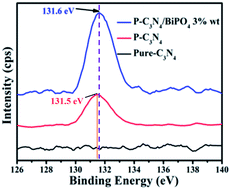
| Fig. 1 (A) XPS spectrum of phosphors recorded from pristine surface of pure-C3N4, P-C3N4 and P-C3N4/BiPO4 3 wt%, and (B) molecule structure model of P-C3N4 constitution unit. | ||
The microstructures of P-C3N4 nanosheets were first investigated by TEM. The TEM image reveals that the spatially 3-D P-C3N4 were stacked up by 2-D nanosheets layer by layer in three or more layers (Fig. 2(A)). From the edges of P-C3N4 nanosheets, it is clearly to see the smooth surface, mesoporous structure and a rolling up edges, which clearly showed that the thickness of single P-C3N4 layer was about 30 nm (Fig. 2(B)). The SEM images of phosphorus doped graphene like carbon nitride samples were further presented in Fig. 3. It can be seen that the P-C3N4 are pages-like overlapped by means of larger integrated nanosheets and well associated assembled by smaller fractured nanosheets from a front (Fig. 3(A)) and aside view (Fig. 3(B)), respectively. The flat surface and porous structure of nanosheets were more clearly identified from the high-magnification SEM images (Fig. 3(C) and (D)). Specially, it is interesting that the space gaps between layers hinting at the confined sites may gave chance to those nano-sized species, such as nanorods and nanoparticles, grow in or out directly. We can grandly call these space gaps as “growth sits”. Furthermore, nitrogen adsorption–desorption measurement (see Fig. S1†) show that the BET surface areas and total pore volumes of the porous g-C3N4 nanosheets were 45.72 m2 g−1 and 0.183 cm3 g−1, respectively. The pore size distribution (inset of Fig. S1†) indicates that the sample has a satisfactory nanoporous texture (10–150 nm).
![]() | ||
| Fig. 3 Typical SEM image of the P-C3N4 nanosheets from different viewpoints. (A) Front and (B) side, (C and D) high-magnification image from (A) and (B). | ||
Fig. 4 shows the contrastive TEM images of P-C3N4 and P-C3N4/BiPO4 (3 wt%) samples. The TEM images of P-C3N4 clearly show a hierarchical and inter-connected 3-D nanoporous architecture and the pore size is in the range from 10 to 100 nm (Fig. 4(A) and (B)). On the other hand, well-defined and fairly long nanorods, whose average diameter is about 200 nm and whose surface is distinctly enwrapped with smooth, flayers and gauze-like P-C3N4 nanosheets, could be obtained in the cases of P-C3N4/BiPO4 nanocomposites (Fig. 4(C)). The results well indicated that BiPO4 nanorods were distributed into P-C3N4 nanosheets in the composite samples, there are no apparent aggregation of BiPO4 which means the formation of interfaces between BiPO4 and P-C3N4. It is also observed that the P-C3N4 still has the mesoporous nanosheets structure after coupling with BiPO4 nanorods. Fig. 4(D) shows the HRTEM images of the interfaces between BiPO4 nanorods and P-C3N4 nanosheets. From the HRTEM images we can infer: (i) on the basis of the lattice spacing of 0.303 nm was correspond to the (200) planes of BiPO4 (shown in Fig. S2†), indicating that the nanorods in Fig. 4(C) were exactly BiPO4 nanorods. (ii) The existence of some BiPO4 nanorods were between P-C3N4 layers, apparently, the bright portions (in the yellow line) were attributed to the pore of P-C3N4 nanosheets and the dark parts on BiPO4 nanorods were refer to the existence of P-C3N4, all these demonstrate that there are at least one layer of P-C3N4 nanosheet covered on the surface of BiPO4 nanorods. (iii) The natural existed of “growth sits” on 3-D porous nanosheets architectural structure, which may efficient avoid strongly aggregation of BiPO4 nanorods during the synthesised process. The TEM image of comparing experiment pure BiPO4 nanorods was showed in Fig. S3,† whose length (about 600 nm) is much shorter than that in P-C3N4/BiPO4 (about 2000 nm). Taken together, a novel sandwich-like heterocrystals have been obtained by a simple one-step hydrothermal synthesis progress. In addition, as the lattice and energy level between C3N4 and BiPO4 is match well, the heterojunctions could promote the transfer and separation of photoexcited electron–hole pairs under visible light irradiation.
The XRD pattern of P-C3N4 nanosheets and P-C3N4/BiPO4 composited photocatalysts were shown in Fig. 5(A). From XRD pattern, two peaks at around 13° and 27.4° of P-C3N4 were corresponding to in-plane structural packing motif of tri-s-triazine which is indexed as (100) peak and interlayer graphitic packing motif of aromatic segments which is indexed as the (002) peak for graphitic materials,1 respectively. These two feature diffraction peaks of g-C3N4 suggest that the original atomic structure is largely retained, which the evidence is denoted as graphitic 3-D P-C3N4 with layer by layer structure. The P-C3N4/BiPO4 samples with different proportion (defined as BiPO4
:
P-C3N4 wt% discriminated by the mass of initial reaction precursors) were synthesized. The diffraction peaks of P-C3N4/BiPO4 compounds clearly revealed the cubic phase of BiPO4 (JCPDS no: 15-0766) and crystalline P-C3N4 peak. All the P-C3N4/BiPO4 samples exhibit diffraction peaks corresponding to both g-C3N4 and BiPO4, and no other impure peaks can be observed, suggesting a two-phase composition of g-C3N4 and BiPO4 in these composites. Combining with TEM analysis the two-phase materials connected so closely that they advantageously formed heterojunction structure which is proved that could decrease the recombination rate of photogenerated electrons and holes, and contribute to promote the utilization efficiency of photo-generated electrons.18 As we all know, the improvement in mobility of the charge is important to photocatalysts. Fig. 5(B) shows the result of UV-visible diffuse reflectance (DRS) spectra of P-C3N4 and P-C3N4/BiPO4 composited photocatalysts. It has been reported that the absorption edge of the pure BiPO4 occurred at about 330 nm.19,20 However, when BiPO4 loaded on the inter-surface of 3-D P-C3N4 nanosheets, the ability of light absorption was enhanced in all of the wavelength range from 200 to 700 nm. Interestingly, it is also found that the absorption of the P-C3N4/BiPO4 composites increased upon the addition of BiPO4 nanorods. These results may be attributed to two major reasons. First of all, the interaction of heterojunction between BiPO4 and P-C3N4 effectively accelerates the separation of electron–hole pairs account for the band-gap transition of photo-generated electrons, and then enhanced the absorption in the visible-light region. Secondly, as a colour change of the composites samples, which become darker, that is, from pale yellow to grey, along with a higher amount of BiPO4 was introduced into the 3-D P-C3N4 nanosheets would also cause the absorbance enhanced.
![]() | ||
| Fig. 5 (A) XRD pattern and (B) UV-vis diffuse-reflectance spectra of all the synthesised samples. a: Pure mpg P-C3N4, b: P-C3N4/BiPO4-1, c: P-C3N4/BiPO4-3, d: P-C3N4/BiPO4-5, e: P-C3N4/BiPO4-7. | ||
It has been investigated that BiPO4 possesses a wide band gap which limits its photo-absorption to only the UV region, normally accounting for ca. 5% of the total sunlight, which is undoubtedly important to develop photocatalytic materials that harvest a wide range of visible photons.20 In addition, there are few research has applied bismuth phosphate as a photocatalyst using in water splitting for producing hydrogen. In this study, the BiPO4 nanorods were successfully growing in the inter space of 3-D mesoporous P-C3N4 nanosheets, and the novel 3-D structure composited photocatalysts were first detected the performance of visible light photocatalytic activity in direct water splitting into H2.
Fig. 6(A) shows a standard curve obtained by plotting the peak area, which was detected by a Labsolar H2 photocatalytic hydrogen evolution system (Perfect light, Beijing) with gas chromatography (GC-14C, Shimadzu, Japan, TCD), against the known number of hydrogen counts, such as 0, 100, 200, 300, 400, 500 μmol per tube. The line has a slope of 9.015 × 10⁻⁴ and corresponding coefficient of determination R2 of 0.998. As the curve was passing through the origin point, the H2 content can be calculated as the following standard equation:
| YH2 (μmol) = 0 + bX = 9.015 × 10⁻⁴X (peak area) |
In corresponding experiment, no hydrogen was detected when BiPO4 nanorods were used as the photocatalyst with Pt as a cocatalyst under visible light irradiation, suggesting that the bare BiPO4 without P-C3N4 nanosheets is likely not active for photocatalytic H2 production under the experimental conditions studied (shown in Fig. 6(C) and (D)). On the basis of the above results, a photocatalytic mechanism of the P-C3N4/BiPO4 under visible-light irradiation can be proposed (Fig. 7). Under visible-light irradiation, electrons (e−) are excited from the valence band (VB) to the conduction band (CB) and created holes (h+) in the VB. Normally, for pure P-C3N4, the charges are likely transfer in one of three following ways: (i) injected to Pt nanoparticles located on the P-C3N4 nanosheets; (ii) directly onto the surface of P-C3N4 nanosheets; (iii) quickly recombine with the h+ one the VB. The accumulated e− on the Pt and the CB of P-C3N4 can effectively reduce H2O (or H+) to produce H2, while holes at the VB of P-C3N4 accumulated and can react with methanol as a sacrificial reagent. Once BiPO4 was introduced to the P-C3N4 nanosheets, as the reported previously, the highest occupied molecular orbital (HOMO) of g-C3N4 was more negative than the conduction band of BiPO4 (−1.12 V vs. −0.65 V)3,21 the photo-generated charge on P-C3N4 can directly transfer to the CB of BiPO4 (occurred step (i) or (ii)), eventually the electrons react with the adsorbed H+ ions to form H2, and reducing the probability of electron–hole recombination and resulting in an enhanced photocatalytic activity which driven by band potentials between two semiconductors. Furthermore, the interaction of heterojunction between BiPO4 and P-C3N4 effectively accelerated the charge transfer the two semiconductor would be more spatially smooth, which is fundamental for the improvement of photocatalytic activity. The unique 3-D structure of P-C3N4/BiPO4 allowed the photocatalytic reactions to take place not only on the surface of semiconductor catalysts, but also on the inset space between the layers of P-C3N4 nanosheets, effectively increasing the reaction sites.
![]() | ||
| Fig. 7 Schematic illustration of the charge separation and transformation in the P-C3N4 nanosheets/BiPO4 nanorods system under visible light irradiation. | ||
Footnote |
| † Electronic supplementary information (ESI) available. See DOI: 10.1039/c4ra10038g |
| This journal is © The Royal Society of Chemistry 2014 |