
Laser-assisted calcium phosphate deposition on polymer substrates in supersaturated solutions

Ayako Oyane*a, Ikuko Sakamakia, Alexander Pyatenkoa, Maki Nakamuraa, Yoshie Ishikawaa, Yoshiki Shimizua, Kenji Kawaguchia and Naoto Koshizakiab
aNanosystem Research Institute, National Institute of Advanced Industrial Science and Technology (AIST), Central 4, 1-1-1 Higashi, Tsukuba, Ibaraki 305-8562, Japan. E-mail: a-oyane@aist.go.jp; Fax: +81-29-861-3005; Tel: +81-29-861-4693
bGraduate School of Engineering, Hokkaido University, Nishi 8, Kita 13, Kita-ku, Sapporo, Hokkaido 060-8628, Japan

Received 27th August 2014 , Accepted 10th October 2014

First published on 14th October 2014


Abstract

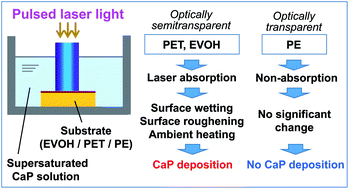
Calcium phosphate deposition was induced on optically semitransparent polymers, but not on a transparent polymer, by a pulsed laser irradiation process in a supersaturated solution. This process would be useful as a tool for depositing calcium phosphate on laser-absorbing polymers.

Calcium phosphate (CaP) is a major mineral component in vertebrate hard tissues. Thus, some CaP compounds, such as hydroxyapatite and octacalcium phosphate, show good biocompatibility and osteoconductivity.1 The physiological formation of CaP in body fluids can also be reproduced or mimicked in ex vivo acellular CaP solutions (typical example is a simulated body fluid) that are supersaturated with respect to CaPs.2 Such supersaturated CaP solutions are useful as reaction media for inducing in vitro biomimetic CaP deposition on the surfaces of biomedical materials.3,4 The in vitro biomimetic CaP deposition processes using supersaturated CaP solutions offer the advantages of safe and pseudo-physiological reaction conditions compared to conventional physical processes (plasma-splaying, pulsed laser deposition, ion-beam sputtering, etc.). Such mild reaction conditions enable fine control of composition and structure of CaPs.5 Furthermore, CaPs can be loaded with a wide range of cell-stimulating substances, such as trace elements, functional proteins, genes, and antigens.4 Hence biomimetic CaP deposition processes using supersaturated CaP solutions have recently attracted increased attention as tools for the production and surface functionalization of biomedical materials.

Conventional biomimetic CaP deposition processes generally involve two steps: pretreatment of the substrate followed by immersion in a supersaturated CaP solution.3,6 In the pretreatment step, a substrate is surface-modified with functional groups or CaP seeds or both. The surface-modified substrate material is then immersed in a supersaturated CaP solution to grow a continuous CaP layer on the surface. Due to the relatively slow reaction rate, the duration of this immersion step is usually as long as one day or more.

Recently, we developed a laser-assisted biomimetic (LAB) process for CaP deposition on a polymer substrate in which the pretreatment6 and immersion steps are combined into a single step.7 In the LAB process, a substrate of ethylene-vinyl alcohol copolymer (EVOH) is immersed in a supersaturated CaP solution (a so-called CP solution)4,7,8 and is irradiated on the surface with a weak Nd-YAG nanosecond pulsed laser (355 nm, 30 Hz, 4–6 W cm−2). Within just 30 min of irradiation, CaP is formed in situ on the laser-irradiated region of the substrate. This LAB process is quick and accomplished in a single step without any pretreatment or postimmersion step; hence, it is advantageous over conventional two-step biomimetic processes.

Here, we provide theoretical insight into the LAB process and demonstrate its applicability to polymer substrates other than EVOH. We hypothesize that laser absorption by the substrate should be an essential requirement for inducing CaP deposition at the laser-irradiated surface. To verify this hypothesis, the LAB process was applied to two different polymers: optically transparent polyethylene (PE) and semitransparent polyethylene terephthalate (PET). Substrates of PE, PET, and EVOH as a control were prepared by hot-pressing (ESI). Absorption spectroscopy confirmed that both the EVOH and PET substrates absorb light energy at 355 nm, whereas the PE substrate hardly absorbs any (Fig. 1).


image file: c4ra09313e-f1.tif
Fig. 1 Absorption spectra of the PE, PET, and EVOH substrates.

The LAB process was conducted for each substrate in a CP solution (NaCl 142 mM, K2HPO4·3H2O 1.50 mM, CaCl2 3.75 mM, buffered to pH = 7.40 at 25 °C).4,7,8 First, the substrate was immersed in 10 mL of the CP solution that was maintained at 25 °C via a temperature-controlled water bath. Laser irradiation was performed for 30 min using the output of the third harmonic (355 nm) of a Nd-YAG laser (Quanta-Ray LAB-150-30, Spectra-Physics, USA) operated at a frequency of 30 Hz and an energy density of 2, 4, or 6 W cm−2. The laser beam possessed an output diameter of approximately 8 mm and was passed without focusing through a 5 mm-diameter hole of a metallic mask to irradiate the substrate. After irradiation, the substrate was washed with ultrapure water and then examined for structural changes on the laser-irradiated surface.

After the LAB process, CaP deposited on the PET substrate as reported for the EVOH substrate,7 but did not form on the PE substrate. On the PE substrate, neither morphological (by scanning electron microscopy (SEM)) nor compositional (by energy-dispersive X-ray spectroscopy (EDX)) changes were found after the LAB process, irrespective of the energy density (Fig. S1). In contrast to the PE substrate, microscale deformation was observed on the PET substrate after the LAB process (Fig. 2). In the EDX spectra, Ca and P peaks appeared after the LAB process at 4 W cm−2, suggesting CaP deposition on the PET surface (Fig. 3a). Similar EDX results were also obtained for the PET substrates after the LAB process at 2 and 6 W cm−2. According to electron diffraction analysis by transmission electron microscopy (Fig. 3b and c), the deposited CaP included hydroxyapatite. Coexistence of undetectable amounts of other CaP phases, such as amorphous CaP and octacalcium phosphate, cannot be denied.


image file: c4ra09313e-f2.tif
Fig. 2 SEM images of the surface of the PET substrate before and after the LAB process at 2, 4, or 6 W cm−2.

image file: c4ra09313e-f3.tif
Fig. 3 (a) EDX spectra of the surface of the PET substrate before and after the LAB process at 4 W cm−2. (b) TEM image and (c) electron diffraction pattern of the deposit formed on the LAB (4 W cm−2) -treated PET substrate.

In the LAB process, laser absorption by the substrate should be prerequisite for CaP deposition. As described above, the LAB process was inapplicable to the optically transparent PE substrate, but applicable to the semitransparent (at 355 nm) PET and EVOH7 substrates. It should be noted here that the CP solution has very little laser absorption7 and remained apparently clear without inducing homogeneous CaP nucleation even after the LAB process. Thus, the CaP formation on the PET surface was not due to sedimentation of homogeneously nucleated CaP particles but due to heterogeneous CaP nucleation at the solid–liquid interface. This CaP nucleation should be triggered by laser irradiation in the CP solution, since CaP deposited only on the laser-irradiated surface of the PET substrate and the non-irradiated surface (outside the irradiated region) of the same substrate was kept unchanged.

The mechanism of CaP deposition on the PET substrate is considered to be similar to that proposed for the EVOH substrate.7 Briefly, laser absorption by the substrate causes heat generation and surface modifications, thereby providing a favourable environment for CaP deposition at the surface as described below.

Laser-induced heat generation was confirmed by a comparative experiment in which the temperature-controlled water bath was not used in the LAB process. As shown in Fig. 4, for both the PET and EVOH substrates, the temperature of the CP solution increased monotonically from 25 °C over time during the LAB process at 4 W cm−2. However, such a significant temperature increase was not observed for the PE substrate (the temperature profile corresponded to that without a substrate). Thus, the temperature increase observed for the PET and EVOH substrates was due to laser–substrate interactions. The laser-induced heat generation would accelerate CaP deposition by increasing the mass transfer rate and the degree of supersaturation9 of the solution near the substrate surface.


image file: c4ra09313e-f4.tif
Fig. 4 Changes in temperature of the CP solution during the LAB process at 4 W cm−2 for the PE, PET, and EVOH substrates, without a temperature-controlled water bath.

Laser-induced surface modification of the PET substrate was confirmed by a comparative experiment in which laser irradiation (4 W cm−2) was performed in ultrapure water instead of in the CP solution. On increasing the irradiation time from 0 to 10 and 30 min, surface roughness of the PET substrate increased (Fig. 5), and the water contact angle decreased from 92° ± 6° to 65° ± 6° and 49° ± 9° (n = 5), respectively. The increased surface hydrophilicity after irradiation might be caused by cleavage of ester linkages in PET, as revealed by infrared spectroscopy (Fig. S2).10 The thus-modified PET surface with ester-derived functional groups (COOH, CHO, OH, etc.) would provide a favourable environment for CaP deposition.11 Similar behavior was observed on the EVOH surface that was irradiated in ultrapure water.7


image file: c4ra09313e-f5.tif
Fig. 5 SEM images of the PET substrate before and after laser irradiation at 4 W cm−2 in ultrapure water for 10 min and 30 min.

We consider that the laser-induced surface modifications on the PET and EVOH substrates did not result from thermal deformation or melting. According to the Beer–Lambert law for one-dimensional propagation of light in semitransparent media, we have,

 
I = I0ekx (1)
where x is the path length, I is the laser-beam energy flow density, and k is an attenuation coefficient that depends on wavelength. The initial laser-beam energy flow density I0 is obtained from:
 
image file: c4ra09313e-t1.tif(2)
where E0 is the energy of one individual laser pulse, S0 is the laser-beam cross section, and τ0 is the duration of the laser pulse. The attenuation coefficient k can be easily found from the boundary conditions for the inlet and outlet surfaces of the substrate: E = E0 at x = 0; E = EΔ at x = Δ (1 mm in our case) by,
 
image file: c4ra09313e-t2.tif(3)
where EΔ is found experimentally in our light absorption data (Fig. 1). Assuming that all the energy absorbed by a hypothetical ultrathin layer with coordinate x is used to heat the part of this layer restricted by the laser-beam cross section (heat transfer is negligible during the pulse propagation time of 10 ns), we can find the temperature of this layer, Tx:
 
image file: c4ra09313e-t3.tif(4)

Here, T0 is the initial temperature of the substrate (25 °C in our case), while cp and ρ are the heat capacity and density of the substrate material, respectively. Therefore, for the inlet surface of the substrate (i.e., at x = 0), we have,

 
image file: c4ra09313e-t4.tif(5)

For PET and EVOH, ρ ≈ 1 g cm−3 = 103 kg m−3, and cp ≈ 1–2 kJ kg−1 K−1. Since the interval between laser pulses is long enough (33 ms) to completely cool the substrate, the heating process for one individual laser pulse can be considered. Our numerical estimate shows that the inlet surface temperatures of these polymer substrates increase by just several degrees from their initial temperatures. Nonthermal photochemical reactions10 might be involved in the laser-induced surface modification in the LAB process, although this should be clarified in a future study.

Not only laser absorption but also the chemistry of the polymers affects the LAB process. In fact, the PET substrate, despite having a smaller light absorption at 355 nm (Fig. 1), showed higher reactivity in the LAB process than the EVOH substrate. According to the SEM (Fig. 2) and EDX results, the PET substrate formed CaP on its surface even by the LAB process at 2 W cm−2. However, at this energy level, the EVOH substrate was neither surface-modified nor coated with CaP: it required at least 4 W cm−2 for CaP deposition.7 This might be due to the higher stability of ethylene linkages in EVOH compared to that of the ester linkages in PET.

The LAB process is simple (single-step process), quick, and found to be applicable to several polymers that absorb laser energy. Given these advantages, the LAB process would be useful as a new tool for the production and surface functionalization of biomedical materials made of laser-absorbing polymers. Note that the PET surface was deformed under the tested irradiation conditions and the deposited CaP was not in the form of a dense and continuous layer. Further optimization of the irradiation conditions and in vitro and in vivo studies should be needed in terms of biomedical applications.

Conclusions

The LAB process for CaP deposition is not specific to EVOH substrates but is potentially applicable to other polymer substrates that absorb laser energy. Laser absorption and the chemistry of the polymer substrate are important factors in the LAB process.

Acknowledgements

This work was supported by KAKENHI (25108517) from The Ministry of Education, Culture, Sports, Science and Technology (MEXT), Japan.

Notes and references

  1. M. Jarcho, J. F. Kay, K. I. Gumaer, R. H. Doremus and H. P. Drobeck, J. Bioeng., 1977, 1, 79 CAS; H. Aoki, Science and medical applications of hydroxyapatite, Takayama Press System Center, Tokyo, 1991 Search PubMed.
  2. P. Koutsoukos, Z. Amjad, M. B. Tomson and G. H. Nancollas, J. Am. Chem. Soc., 1980, 102, 1553 CrossRef CAS; J. C. Heughebaert, S. J. Zawacki and G. H. Nancollas, J. Colloid Interface Sci., 1990, 135, 20 CrossRef; T. Kokubo, H. Kushitani, S. Sakka, T. Kutsugi and T. Yamamuro, J. Biomed. Mater. Res., 1990, 24, 721 CrossRef PubMed; T. Kokubo and H. Takadama, Biomaterials, 2006, 27, 2907 CrossRef PubMed.
  3. M. Tanahashi, T. Yao, T. Kokubo, M. Minoda, T. Miyamoto, T. Nakamura and T. Yamamuro, J. Am. Ceram. Soc., 1994, 77, 2805 CrossRef CAS; A. Oyane, M. Uchida, C. Choong, J. Triffitt, J. Jones and A. Ito, Biomaterials, 2005, 26, 2407 CrossRef PubMed; A. Oyane, M. Uchida, Y. Yokoyama, C. Choong, J. Triffitt and A. Ito, J. Biomed. Mater. Res., Part A, 2005, 75A, 138 CrossRef PubMed.
  4. A. Oyane, J. Ceram. Soc. Jpn., 2010, 118, 77 CrossRef CAS; X. P. Wang, A. Ito, X. Li, Y. Sogo and A. Oyane, Biofabrication, 2011, 3, 22001 CrossRef PubMed; A. Oyane, X. P. Wang, Y. Sogo, A. Ito and H. Tsurushima, Acta Biomater., 2012, 8, 2034 CrossRef PubMed.
  5. H. M. Kim, K. Kishimoto, F. Miyaji, T. Kokubo, T. Yao, Y. Suetsugu, J. Tanaka and T. Nakamura, J. Biomed. Mater. Res., 1999, 46, 228 CrossRef CAS PubMed; H. M. Kim, K. Kishimoto, F. Miyaji, T. Kokubo, T. Yao, Y. Suetsugu, J. Tanaka and T. Nakamura, J. Mater. Sci.: Mater. Med., 2000, 11, 421 CrossRef PubMed.
  6. E. Pecheva, T. Petrov, C. Lungu, P. Montgomery and L. Pramatarova, Chem. Eng. J., 2008, 137, 144 CrossRef CAS; B. H. Lee, A. Oyane, H. Tsurushima, Y. Shimizu, T. Sasaki and N. Koshizaki, ACS Appl. Mater. Interfaces, 2009, 1, 1520 Search PubMed.
  7. A. Oyane, I. Sakamaki, Y. Shimizu, K. Kawaguchi and N. Koshizaki, J. Biomed. Mater. Res., 2012, 100A, 2573 CrossRef CAS PubMed.
  8. M. Uchida, A. Oyane, H. M. Kim, T. Kokubo and A. Ito, Adv. Mater., 2004, 16, 1071 CrossRef CAS.
  9. M. R. Christoffersen, J. Christoffersen and W. Kibalczyc, J. Cryst. Growth, 1990, 106, 349 CrossRef CAS; H. McDowell, T. Gregory and W. Brown, J. Res. Natl. Bur. Stand., 1972, 81, 273 Search PubMed.
  10. Z. Zhu and M. J. Kelley, Polymer, 2005, 46, 8883 CrossRef CAS; M. Dadsetana, H. Mirzadehb and N. Shari, Radiat. Phys. Chem., 1999, 56, 597 CrossRef.
  11. M. Tanahashi and T. Matsuda, J. Biomed. Mater. Res., 1997, 34, 305 CrossRef CAS PubMed; K. Sato, T. Kogure, Y. Kumagai and J. Tanaka, J. Colloid Interface Sci., 2001, 240, 133 CrossRef PubMed; M. Kawashita, M. Nakao, M. Minoda, H. M. Kim, T. Beppu, T. Miyamoto, T. Kokubo and T. Nakamura, Biomaterials, 2003, 24, 2477 Search PubMed.

Footnote

Electronic supplementary information (ESI) available: Details of substrate preparation and figures for SEM images, and EDX and FT-IR spectra. See DOI: 10.1039/c4ra09313e

This journal is © The Royal Society of Chemistry 2014
Click here to see how this site uses Cookies. View our privacy policy here.