
Weijie Zhanga,
Pingping Jiang*a,
Ying Wanga,
Jian Zhangb,
Yongxue Gaoa and
Pingbo Zhanga
aThe Key Laboratory of Food Colloids and Biotechnology, School of Chemical and Material Engineering, Jiangnan University, Wuxi 214122, P.R. China. E-mail: ppjiang@jiangnan.edu.cn
bSchool of Chemistry and Environmental Science, Lanzhou City University, Lanzhou 730000, P.R. China
First published on 24th September 2014
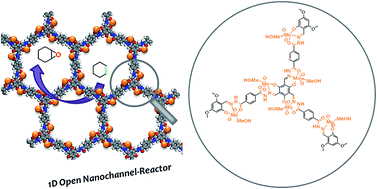
We synthesized a readily accessible molybdenum-doped covalent-organic framework catalyst (Mo-COF) linked by a hydrazine linkage via a facile two-step bottom-up approach. This Mo-COF catalyst, as an open nanochannel-reactor, exhibited promising catalytic activity for the selective oxidation reaction.
Recently, the inclusion of catalytic functionality into covalent organic frameworks (COFs) has become a flourishing field of research.4 COFs are a novel class of porous crystalline organic materials assembled from molecular building blocks by linking light elements (e.g. B, C, N, O) via covalent bond formation (boronic acid trimerization, boronate ester formation, the Schiff base reaction, hydrazone and squaraine linkage) in a periodic manner.5 In addition, ordered one-dimensional open channels represent the typical porous structure of two-dimensional COFs, which provide a desirable micro-environment for the incorporation of open docking sites into an ordered alignment. The crystallinity of COFs enables the direct visualization of the structure and makes it possible to obtain a detailed insight into the relationship between the structure and catalytic activity by structural interrogation. Nevertheless, the development of efficient COF catalysts is limited.
Here, we report a facile bottom-up strategy to direct a molybdenum-doped covalent organic framework, henceforth denoted as Mo-COF, acting as an efficient catalyst in selective oxidation. More precisely, the Mo sites were ordered into the channel walls of π-arrays through robust coordination between molybdenyl acetylacetonate (MoO2(acac)2) and the π-connected benzoyl salicylal hydrazone ligand, forming an effective nanochannel-reactor. This design allows the easy access of guest molecules through the 1D channel to the docking sites (Scheme 1). Based on the structural features, the vertex unit of this COF plays two different roles in this bottom-up strategy, i.e., connecting the building blocks and providing free positions for loading Mo sites. Thus, this entire strategy can be divided into two steps. In the first step, a reaction leads to the formation of a crystalline hydrazone-linked COF with a predetermined topological design using the appropriate symmetry combinations (C2 + C3) of the building block framework.5b,c The second step involves the introduction of a Mo resource into this porous network. Overall, the aforementioned points provide a fundamental understanding of this heterogeneous catalyst regarding the accessibility of the open channels. To the best of our knowledge, there are no reports of COF catalysts synthesized using this approach.
The valence state of the Mo element in the Mo-COF catalyst was characterized by XPS. The survey scan of the Mo 3d region is shown in Fig. S3.† Mo 3d lines were observed at 232.6 eV (3d5/4) and 235.6 eV (3d3/2), which are characteristic of molybdenum metal in the +6 oxidation state.6 On the other hand, the 3d5/4 peak for Mo in Mo-COF shifted positively compared with that of the standard MoO2(acac)2 (233.3 eV).7 This positive shift indicates the strong coordination of Mo with the benzoyl salicylal hydrazone groups of COF; this group further withdrew electrons from Mo, which made the Mo species more electron-deficient. Fig. S4† shows the UV-vis electronic absorption spectra of the complex Mo-benzoyl salicylal hydrazine Schiff base, namely Mo(HSY)2. The absorption band for the ligand–metal (π*–dπ) charge transfer transition was centred at 400 nm.3a The steady-state electronic absorption spectra (steady-state UV-vis) indicated the formation of charge transfer in the insoluble Mo-COF material. As a COF, for example, there was a wide absorption band around 400–500 nm, which indicated extended π conjugation over the 2D sheet of the COF.4b However, it is notable that a higher energy ligand transition of Mo-COF was moved to a lower energy relative to Mo(HSY)2 and COF. This suggests that there was a significant effect on the electronic energy levels of the Mo sites.
The reported Mo-COF was obtained as an orange-red microcrystalline powder that remained insoluble in common organic solvents (See the ESI†). As shown in Fig. S5,† the powder X-ray diffraction (PXRD) patterns of COF showed the most intense peaks at 3.2° 2θ, which corresponded to the d100 plane reflections. The XRD patterns of COF and Mo-COF in Fig. S5† indicated certain accordance between the experimental patterns and the simulated patterns based on the modelled structure. Although the intensity of the XRD pattern for COF and Mo-COF was poor, the experimental XRD pattern of COF and Mo-COF also partly matched well with the simulated pattern of the AA stacking model relative to AB stacking model (Fig. S6†). The cross-linking of the COF network may result in an uncertain conformation (20–30°). Hence, we proposed a structure close to the P6/m space group for COF. The unit cell values of COF were calculated to be a = b = 31 Å and c = 3.4 Å using Material Studio software. In addition, the intensity of the d100 reflection of Mo-COF decreased and the d100 spacing shifted to a higher angle compared to pristine COF. This suggests a decrease in the uniformity of its porous structure and hole size due to the catalytic sites being encapsulated into the channels. On the other hand, there was no obvious framework collapse or any crystalline phase of MoO2(acac)2 species (Fig. S5†).
The new peak at 911 cm−1 confirmed the existence of the Mo–O bond in Mo-COF, relative to pure COF (Fig. S7†). Interestingly, the Mo–O peak at 905 cm−1 in MoO2(acac)2 shifted to a higher peak at 911 cm−1 (Fig. S8†). This result confirmed the successful incorporation into the framework backbone through a stable coordination bond. In addition, both the compound COF and Mo-COF exhibited a typical type III isotherm with a surface area of 244 m2 g−1 for CPF-1 and 63 m2 g−1, respectively (Fig. S9†). The prepared COF showed N2 adsorption isotherms with a low BET surface areas. It can be speculated that the synthesized COF adopts a thin layer morphology. Because of the thin-layered structures, long-rang pore formation was hindered, rendering N2 adsorption possible only in the shallowest, most accessible pores.8 Thermogravimetric analysis (TGA) of the activated COF showed no obvious weight loss until 280 °C (Fig. S10†), leading to the complete collapse of the COF framework. One may observe that the frameworks of Mo-COF started to decompose at around 260 °C, which might be attributed to the destruction of hydrogen bonding located in this 2D framework.9 SEM showed that Mo-COF was composed of a uniform micrometre-scale bet morphology with dimensions of ca. 200 nm (Fig. S11†).
Inductively coupled plasma atomic mass spectrometry analysis (ICP-MS) showed that the density of the active Mo sites reached as high as 2.0 mmol g−1, which was also in good agreement with the data obtained from TGA. The highest amount of theoretical Mo sites in Mo-COF was 3.6 mmol g−1. The Mo content of Mo-COF was found to be 5–10 times higher than ever reported for a Mo complex grafted on insoluble materials such as a mesoporous sieve, MWCNT and polymer.3a,10 In this regard, the bottom-up strategy could facilitate a catalyst with a high active site density due to their accessibility, facile derivatization and ability to bind to a wide variety of metal ions such as Cu, Mn and W ions.
To show that Mo-COF was catalytically active, we evaluated the performance of Mo-COF as a nanochannel-reactor in the context of the epoxidation of cyclohexene. Catalytic assays for the epoxidation of cyclohexene were carried out using tert-butyl hydroperoxide (TBHP) as an oxidant in 1,2-dichloroethane. The control experiments were conducted for Mo-COF, homogeneous Mo(HSY)2 and a blank under the same conditions. As revealed in Table 1, Mo-COF showed efficient catalytic activity for the epoxidation of cyclohexene in terms of both conversion (99% over 6 h) and selectivity (71% epoxide product) compared to Mo(HSY)2 (29% conversion and 68% epoxidized selectivity, entry 2), which was basically as inactive as the blank (19% conversion, 5% selectivity). The low activity observed for homogeneous Mo(HSY)2 could be attributed to catalyst deactivation due to oxo-bridged dimer formation.2 Therefore, Mo-COF outperformed the 2D layered material in the epoxidation of cyclohexene, highlighting the high efficiency of the 2D network-based nanochannel-reactor in Mo-COF by its structural resistance to the formation of catalytically inactive species. The supernatant from the oxidation of cyclohexene after filtration through a regular filter did not afford any additional oxidation product, strongly confirming the heterogeneous nature of the Mo-COF catalyst (Table 1, entry 4 and Fig. S12†). Mo-COF could be reused for four cycles without a significant decrease in its catalytic activity (Table 1, entry 5).
| Entry | Catalyst | Conversionb (%) | Selectivityc (%) |
|---|---|---|---|
| a Substrate (1.0 mmol), TBHP (2.0 mmol), catalyst (0.01 mmol), 1,2-dichloroethane (2.0 mL) and bromobenzene (50 mg) as internal standard sealed in a Teflon-lined screwcap vial were stirred at 80 °C for 6 h.b Conversion [%].c Selectivity [%] were determined by GC using an SE-54 column.d After the catalytic assay for Mo-COF.e After the fourth cycle. | |||
| 1 | Mo-COF | >99 | 71 |
| 2 | Mo(HSY)2 | 29 | 68 |
| 3 | Blank | 19 | 5 |
| 4 | Filtrated | 20 | 4 |
| 5 | Mo-COFe | 96 | 70 |
| 6 | COF | 32 | 7 |
The epoxidation of different olefin substrates of various molecular sizes was also investigated. The oxidation of cyclohexene gave 99% conversion after 6 h. When cyclooctene was employed with a larger ring, substrate consumption decreased rapidly to 80% after 6 h (Table 2, entry 2), which was significantly lower than the conversion obtained using cyclohexene as a substrate. As shown in Fig. S13,† 96% of cyclooctene would be converted to the oxide after 24 h. The comparably low conversion of styrene epoxides was related to the low electron density of the double bond, which usually reduced their nucleophilicity toward the electrophilic oxygen atom of the catalytic intermediate.11 From a structural viewpoint, iso-propenylbenzene also has a phenyl ring connecting the double bond, while an electron-donating group is located beside the double bond, which increases the electron density of the double bond (Table 2, entry 3). Therefore, the conversion of iso-propenylbenzene (conversion 71%) was higher than that of styrene (conversion 62%). Obviously, increasing the length of the linear alkenes triggered a lower epoxide yield for the Mo-COF catalyst, but excellent selectivity was retained (Table 2, entry 5–7). Overall, the abovementioned results indicate that the COF catalyst exhibits reagent size selectivity and that the oxidation reaction indeed occurs inside the nanochannel of the framework.
| Entry | Substrate | product | Conversionb (%) | Selectivityc (%) |
|---|---|---|---|---|
| a Olefin (1.0 mmol), TBHP (2.0 mmol), catalyst (0.01 mmol), 1,2-dichloroethane (2.0 mL) and bromobenzene (50 mg) as an internal standard sealed in a Teflon-lined screwcap vial were stirred at 80 °C for 6 h.b Conversion [%].c Selectivity [%] were determined by GC using an SE-54 column. | ||||
| 1 | ![]() |
![]() |
>99 | 71 |
| 2 | ![]() |
![]() |
80 | >99 |
| 3 | ![]() |
![]() |
71 | 80 |
| 4 | ![]() |
![]() |
62 | 86 |
| 5 | ![]() |
![]() |
42 | >99 |
| 6 | ![]() |
![]() |
20 | >99 |
| 7 | ![]() |
![]() |
5 | >99 |
Upon the completion of the reaction, the catalyst could be easily recovered in almost quantitative yield by simple filtration and could be used repeatedly without significant degradation of the catalytic performance after four cycles (Fig. S14†). The FT-IR measurements (Fig. S15†) also showed that the recovered Mo complex retained its catalytic properties. More importantly, the ICP-MS analysis of the product solution indicated slight loss of metal ions, about 0.01%, from the structure per cycle.
Footnote |
| † Electronic supplementary information (ESI) available: 1HNMR, XPS, UV-vis, FT-IR, PXRD, crystal data, TG analysis and catalytic details. See DOI: 10.1039/c4ra09304f |
| This journal is © The Royal Society of Chemistry 2014 |