Shuai Chen†
ab,
Miao Yu†ac,
Wen-Peng Han*ab,
Xu Yanab,
Yi-Chen Liub,
Jun-Cheng Zhangab,
Hong-Di Zhangab,
Gui-Feng Yuab and
Yun-Ze Long*abd
aCollaborative Innovation Center for Low-Dimensional Nanomaterials and Optoelectronic Devices, Qingdao University, Qingdao 266071, P. R. China. E-mail: yunze.long@163.com; han_wenpeng@163.com
bCollege of Physics, Qingdao University, Qingdao 266071, P. R. China
cDepartment of Mechanical Engineering, Columbia University, New York, New York 10027, USA
dCollaborative Innovation Center for Marine Biomass Fibers, Materials and Textiles of Shandong Province, State Key Laboratory Cultivation Base of New Fiber Materials and Modern Textile, Qingdao University, Qingdao 266071, P. R. China
First published on 10th September 2014
Titanium dioxide (TiO2) nanorods with anatase phase were successfully fabricated by electrospinning and followed calcination. The TiO2 nanorods were characterized by scanning electron microscopy (SEM), X-ray diffraction (XRD), energy dispersive X-ray spectroscopy (EDS) and UV-visible spectroscopy. The diameter of the TiO2 nanorods was about 60–150 nm and the length was 200 nm–2 μm. Electrical properties under bending were investigated by fixing the device to a curved surface with different curvatures, and the device showed a fast and stable resistance response to curvature changing. Photoelectric properties were studied by irradiation with different light intensities. The device exhibited a short response time (∼10 s) and a high sensitivity (∼103) which increased with the light intensity increasing. These results indicate that electrospun anatase TiO2 nanorods have potential applications in flexible photodetectors and solar cells.
Recently, the research of flexible devices based on inorganic nanomaterials has attracted much attention due to their fascinating properties such as softness, flexibility, shock resistance and transparency, which is looking forward to the potential applications in paper displays, wearable devices, photodetectors, energy-storage devices and electronic skin field, etc.11 For example, Shen and coworkers have reported high performance p-type Cd3P2,12 Zn3As2
13 nanowire photodetectors built on elastic polymer substrate with excellent flexibility and high stability of photoresponse in a broad spectral range. According to these studies, though many semiconductor nanomaterials show excellent optical and electrical properties, their mechanical properties need to be further improved to expand their applications in flexible/stretchable optoelectronic devices.
Titanium dioxide (TiO2) is well known for the potential wide applications such as chemical sensors,14,15 photo catalyst,16 lithium batteries17 and solar cells.18,19 And due to its stability, low cost and environmental protection, TiO2 is also regarded as one of the ideal photochemical materials. For the recent years, air pollution problem caused by PM2.5 suspended particulate has become serious especially in China, TiO2 can play a remarkable role to control the dust concentration to protect the environment because of the self-cleaning and anti-fogging functions. Particularly, one-dimension (1D) TiO2 nanostructures (e.g., nanotubes,20 nanorods,21 nanofibers22 and nanowires23) usually exhibit a more excellent performance due to wide bandgap (Eg = 3.2 eV) and larger specific surface area. For instance, the porous fibrous structure can provide abundant surfactivity sites for effective photocatalysis.24–28 In addition, as we know, synthetic methods have strong influences on optical, electronic and chemical properties of 1D TiO2 nanostructures. So, many different synthetic approaches have been investigated, such as hydrothermal method,29 template growth,30 chemical vapor deposition,31 thermal evaporation32 and electrospinning.33 Compared with other techniques, electrospinning has been considered as a convenient and efficient technique to produce organic, inorganic and composite ultrathin fibers. In the process of electrospinning, the continuity and morphology such as diameter, alignment, nanotubes and coaxial nanostructures of TiO2 could be controlled primely by adjusting the conditions of electrospinning.34,35 However, there are still many challenges need to be solved and further studied such as control of crystalline phases (rutile, anatase and brookite), exploration of flexibility devices and enhancement of photoelectricity under UV-irradiation.
In this work, TiO2 nanorods with anatase phase have been fabricated successfully through electrospinning. The diameters of TiO2 nanorods were ranging from 60 nm to 150 nm and lengths were in the range of 200 nm to 2 μm after calcination under 500 °C for 1 h. In addition, the mechanical and optical properties were also investigated and the results demonstrated the device could be used as the flexible devices and photodetector devices.
![]() | ||
| Fig. 1 SEM images of TiO2 nanostructures: (a) butyl titanate/PVP precursor nanofibers; (b–d) different resolutions of pure TiO2 nanorods after calcination under 500 °C for 1 h. | ||
The elemental analysis of TiO2 nanorods was investigated by EDS analysis. As shown in Fig. 2, the sample contains Ti and O elements with theoretical atomic ratio of 1
:
2. Here, it is noted that a small quantity of element Au was detected because a very thin layer of Au film was deposited onto the sample before AEM imaging. Except Au, no other peak related to impurity was detected in the EDS spectrum, indicating that the sample is free of impurity.
The crystal structure of the TiO2 nanorods after calcination in air at 500 °C for 1 h was investigated by XRD technology. All the diffraction peaks of the XRD pattern as shown in Fig. 3 can be clearly indexed to the anatase phase of TiO2 (JCPDS no. 89-4921). The highest intensity diffraction peak at 2θ = 25.36° is representative of the (101) plane diffraction in the anatase phase of TiO2. Other crystalline phases like brookite and rutile phase diffraction peak have not been detected, demonstrating that the TiO2 of anatase phase is in high purity without any secondary crystalline phase.
It's important to confirm the band gap of TiO2 nanorods because that the optical and electrical properties of TiO2 are closely related to the electronic band gap which is affected by the size, shape, impurities, surface charges, and phase transitions, etc.36,37 Fig. 4 shows absorption spectrum of TiO2 nanorods under the UV-visible wavelength region. The band gap energy of the TiO2 nanorods could be obtained to be about 3.2 eV (385 nm in Fig. 4) by extrapolating the linear portion of the plot to the wavelength axis. This value is consistent with the band gap of bulk anatase TiO2 (3.2 eV) by previous reports.38,39
As shown in Fig. 5b, the device was fixed on a round object and got a curvature, equaling to get a tension. When fixed on the objects with different diameters, the curvatures and tension values were different from each other. We selected eleven diameters including 50 mm, 45 mm, 40 mm, 35 mm, 30 mm, 25 mm, 20 mm, 15 mm, 13 mm, 10 mm, 7 mm as the variable (the curvature is defined as σ = 1/diameter), and detected the current changes in order to investigate the resistance changes (ΔR/R), as shown in Fig. 5c. The electrical resistance of the TiO2 nanorod device increased with the curvature increasing. For example, the resistance increased to 5–6 times compared with the original value when the curvature was 0.14 mm−1. Due to the inexistence of piezoelectric effect of TiO2, there must be some other reasons which lead to such a large relative change in resistance. In our opinions, the length (L) of the nanorod device may increase and the cross-sectional area (S) may decrease during the bending process. According to the calculation equation of electrical resistance (R = ρL/S), these two trends could result in the increase of the device's resistance. Moreover, when the device was bending, some nanorods may become loosened or fractured, which would increase the conduction distance/barrier of charge carriers and thus decreased the electrical conductivity apparently. From Fig. 5d, we could observe that the resistance increased as soon as the sample got a tension and could recover to the original state immediately when the device returned to a flat position. Additionally, the resistance could drop to the same value nearly in each cycle with the same strain and could fully recover to the original state under flat condition. The results indicate that the resultant TiO2 nanorod sensor exhibits high reproducibility and good stability, is a promising candidate for applications in flexible electronics.
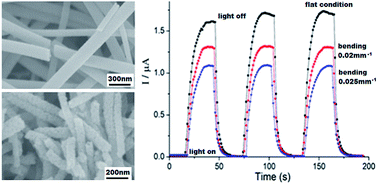
Optoelectronic properties of the nanorod device were also measured by illuminating under a xenon lamp which radiates a wavelength region from 200 to 2500 nm, the current changes could reflect the response to illumination. Under dark condition, the current showed an inconspicuous increase with the increase of voltage. However, when the electrode was exposed under the lamp with light power of 1 mW, the current became increased obviously. The band gap of as-obtained TiO2 nanorods have been calculated to 3.2 eV, so the photon of wavelength region less than 385 nm which the energy is higher than the band gap could be absorbed sufficiently to excite electrons directly from the valence band to the conduction band. As shown in the inset of Fig. 6a, with the increase of the light power, the current increased greater because larger numbers of photons with enough energy could lead to a higher carrier concentration according to Stoletov's law. When the light power reached to 10.24 mW, the photocurrent increased from initial current (background current under bias of 5.0 V) 2.04 nA to 1.74 μA and tended to be saturation with a sensitivity (defined as Imax/I0) as high as 103. From Fig. 6b, we could observe that the TiO2 nanorod devices showed a good cyclicity and reversibility after repeated exposure to illumination (light power was 10.24 mW) with a fast response and recovery speed of ∼10 s.
In the condition of bending, the photocurrent had a little decrease compared with the current in the flat condition. However, the conductivity had a big improvement towards dark condition. When σ = 0.02 mm−1, the photocurrent increased to 1.31 μA and when σ = 0.025 mm−1, the photocurrent increased to 1.09 μA. The curves showed that bending the sample would block the transport of carriers and the influence of bending deformation was weak relatively towards dark condition (Fig. 5c). When σ = 0.02 mm−1, the resistance changes (ΔR/R) reached to 33% (R is the original resistance under flat condition) and when σ = 0.025 mm−1, it reached to 60%. The results indicate that the TiO2 nanorod devices possess a potential application as a flexible photodetector and solar cells.
Compared to brookite and rutile phase, TiO2 with anatase phase always have a remarkable performance of the photoelectric conversion and photocatalytic activity. However, phase structure is not the only factor which affects its activity. It's also important to control the morphology (e.g., porosity, specific surface and size distribution), crystalline, and surface structure to make sure better device performance. There have been lots attempts to improve the photocatalytic performance of TiO2 nanomaterials under UV light and to extend the light absorption and conversion capacity into the visible light for getting higher solar-energy conversion efficiency. Such studies on flexible TiO2 nanorods via electrospinning are now in progress.
Footnote |
| † These two authors contributed to this work equally. |
| This journal is © The Royal Society of Chemistry 2014 |