
Jonathan Z. Bloh‡
a,
Andrea Folliab and
Donald E. Macphee*a
aUniversity of Aberdeen, Department of Chemistry, Meston Walk, Aberdeen AB24 3UE, UK. E-mail: d.e.macphee@abdn.ac.uk
bDanish Technological Institute, Gregersensvej 4, 2630 Taastrup, Denmark
First published on 15th September 2014
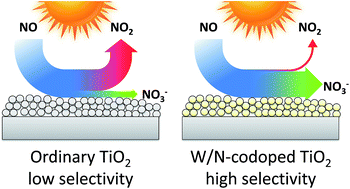
Titanium dioxide photocatalysis offers an excellent way to oxidise NOx to nitrate and thus reduce air pollution. However, unmodified titanium dioxide also releases a significant amount of the toxic intermediate nitrogen dioxide in the process, a problem that is rarely discussed in previous literature. Herein, we highlight this issue by presenting systematic data on the activity and selectivity of a number of commercial titania powders. The photocatalytic performance of a previously developed W/N-codoped titanium dioxide is also reported which, for the first time, offers a way to eliminate this problem as it exhibits an exceptionally high selectivity towards nitrate. The selectivity appears to be solely dependent on the tungsten content, a concentration of 4.8 at.% is sufficient to induce a very high selectivity. Furthermore, the high selectivity could also be replicated by a W/N-codoped sample derived from the industrial sulphate synthetic process. The increased selectivity comes at the expense of absolute activity, which is lower than in the reference titania samples. This raises the question of how to properly evaluate NOx abatement photocatalysts when there are two factors to consider, activity and selectivity. To resolve this, we propose to define a new figure of merit for the evaluation of NOx abatement photocatalysts by distilling total NOx removal and selectivity into one value, the DeNOx index. It is derived by assigning a toxicity value to both NO and NO2 and then expressing the change in total toxicity rather than the concentration change of the individual nitrogen oxides.
Apart from reducing the emissions directly by optimising the combustion process for low-NOx formation rates, several other techniques have been developed to reduce the NOx emission of combustion processes.5 Among the more widely adopted procedures are selective catalytic or non-catalytic reduction using a reducing agent such as ammonia to reduce the nitrogen oxides to molecular nitrogen. An alternative approach is to absorb and oxidise the nitrogen oxides in aqueous solutions.1,6 All of these techniques have in common that they need external reagents and maintenance and are only effective when employed directly at the emission source. There are also recent reports questioning the efficacy of the strategy to reduce ambient NOx levels solely by reducing their emissions.7,8 Semiconductor photocatalysis presents an appealing alternative capable of removing NOx and other air pollutants from the air once it has already been released and dispersed.9 Additionally, photocatalysis needs neither maintenance nor external reagents, since the only required reagents are sunlight and molecular oxygen, which are both already present in outdoor conditions.
Owing to these advantageous properties, photocatalysis has been explored as a way to functionalise building materials to give them air cleaning properties.10–18 Titanium dioxide based photocatalysts supported on cement-based construction materials for the reduction of nitrogen oxide pollution has been investigated extensively not just at the laboratory scale but also in several real-life pilot projects.19–23 This highlights that this technology is on the verge of being employed on a large scale in the environment. However, the fundamental reaction mechanism of the nitric oxide oxidation, as well as the spectrum and fate of the reaction products, are still only poorly understood.
Up to now, the selectivity of the photocatalytic reaction has only been of interest for applications in organic synthesis.24,25 In applications focused on the removal of pollutants from various sources, however, usually only the disappearance of the substrate was considered and the selectivity of the reaction and the spectrum of products largely ignored. More recently, the selectivity has attracted some attention and several authors have highlighted that one of the main aspects of the next generation of photocatalysts should be their selectivity.26–31 This is especially true in the case of photocatalytic removal of nitrogen oxides from the air as during the eventual oxidation of the nitrogen oxides to nitrate there are several toxic intermediate products, the release of which could be detrimental to the air quality. An improvement in the air quality can only be guaranteed by a selective catalyst which suppresses the formation and the release of these undesired intermediates.
Herein, we present a detailed description of the photocatalytic nitric oxide oxidation, its possible intermediate products and their individual hazards. Moreover, a new figure of merit for NOx abatement photocatalysts, the DeNOx index is introduced, which takes account of both activity and selectivity in a single value. This index attempts to depict how a photocatalyst will alter the overall air quality through the removal and formation of the various nitrogen oxides. We also present the NOx abatement performance of several commercial titania powders as well as a recently developed W/N-codoped titanium dioxide, which contrary to ordinary titanium dioxide exhibits exceptionally high selectivity.
the volumetric flow rate, p the pressure, A the irradiated area, R the gas constant, T the absolute temperature and Φ the photon flux impinging the photocatalyst surface as determined by actinometry. The photonic efficiency was determined separately for NO, NO2 and total NOx.
![]() | (1) |
The complete oxidation of nitric oxide (NO) to nitrate or nitric acid (NO3−/HONO2) in a photocatalytic process is a complex affair that involves several intermediate species and has been previously described in a number of publications.6,11,37–43 In principle, the photocatalytic oxidation of nitric oxide to nitrate proceeds in three individual one-electron transfer steps, via the intermediate species nitrous acid (HONO) and nitrogen dioxide (NO2). Each step can be realised by the direct reaction with valence band holes or mediated via reactive oxygen species such as superoxide (O2˙−), hydrogen peroxide (H2O2) or hydroxyl radicals (˙OH):
![]() | (2) |
As shown by example in Fig. 1, it sometimes takes several hours, depending on the surface area of the sample, for steady state conditions to appear. After reaching that state, however, the observed concentrations were constant for hours. Repeated experiments showed that after several cycles, steady state conditions are reached much faster but with the same final concentrations.
All of the reference powders that are based on anatase exhibit a very similar behaviour, cf. Table 1. The highest degradation rates for nitric oxide are observed with the PC105 powder, closely followed by UV100, PC500 and P25. The P90 and PC50 powders are less active by about 30 and 60%, respectively. When total NOx is considered rather than just nitric oxide, the removal rates are smaller by a factor of about 3.5 to 4, but the relative ranking remains the same. An exception is the pure rutile powder which shows the lowest activity by far of all the reference powders, only 2 and 8% of the activity of the worst anatase based catalyst PC50 for NOx and NO removal, respectively. A pure brookite powder was tested as well for a comparison and it performed comparable with the best anatase based powders in terms of NO removal but 30% better than the best anatase based photocatalyst in terms of NOx removal, consistent with other reports of brookite's superior photocatalytic activity.33 The surface area of the samples seems to have a negligible effect on the observed activity, as both the PC500 powder and the P25 powder exhibit approximately the same activity, even though their surface areas are drastically different (350 m2 g−1 for PC500 versus 50 m2 g−1 for P25). This indicates that the activity is rate-limited by the photoreaction rather than the adsorption, as predicted by Dillert et al. for the concentrations applied here.39
| Sample | Phase/% | S/% | ξDeNOx/ppm | ξNOx/ppm | ξNO/ppm | ξNO2/ppm |
|---|---|---|---|---|---|---|
| Aeroxide P25 | 75A/25R | 27.8 | −3689 | 878 | 3162 | 2284 |
| Aeroxide P90 | 90A/10R | 26.8 | −3163 | 710 | 2647 | 1937 |
| UV100 | 100A | 27.2 | −3928 | 900 | 3314 | 2414 |
| PC50 | 100A | 25.1 | −2129 | 429 | 1708 | 1279 |
| PC105 | 100A | 29.1 | −4090 | 1054 | 3627 | 2572 |
| PC500 | 100A | 28.8 | −3543 | 897 | 3117 | 2220 |
| Rutile TiO2 | 100R | 6.9 | −232 | 9 | 129 | 120 |
| Brookite TiO2 | 100B | 38.8 | −2952 | 1374 | 3537 | 2163 |
| W-0-400 | 70A/30B | 27.8 | −2273 | 541 | 1974 | 1407 |
| W-0-600 | 28A/72R | 7.5 | −1823 | 77 | 1026 | 950 |
| W-0-800 | 100R | 6.3 | −1218 | 42 | 672 | 630 |
| WN-0-400 | 100A | 29.3 | −2940 | 768 | 2622 | 1854 |
| WN-0-600 | 96A/4R | 9.4 | −3938 | 217 | 2294 | 2077 |
| WN-0.1-400 | 100A | 29.1 | −1483 | 382 | 1315 | 933 |
| WN-0.1-600 | 88A/12R | 13.6 | −1494 | 127 | 938 | 811 |
| WN-0.5-400 | 100A | 24.1 | −1598 | 302 | 1251 | 950 |
| WN-0.5-600 | 100A | 24.7 | −777 | 152 | 617 | 465 |
| WN-1.0-400 | 100A | 25.1 | −500 | 101 | 401 | 301 |
| WN-1.0-600 | 100A | 25.0 | −996 | 199 | 796 | 598 |
| WN-2.0-400 | 100A | 39.8 | −168 | 83 | 208 | 128 |
| WN-2.0-600 | 100A | 42.1 | −132 | 75 | 179 | 104 |
| WN-3.5-400 | 100A | 57.7 | −72 | 153 | 266 | 112 |
| WN-3.5-600 | 100A | 52.4 | −51 | 62 | 118 | 56 |
| WN-4.8-400 | 100A | 80.8 | 73 | 140 | 173 | 33 |
| WN-4.8-600 | 100A | 80.4 | 101 | 198 | 246 | 48 |
| WN-9.1-400 | 100A | 81.8 | 79 | 142 | 174 | 32 |
| WN-9.1-600 | 100A | 97.1 | 148 | 158 | 162 | 5 |
| W-9.1-600 | 98A/2R | 91.7 | 235 | 287 | 312 | 26 |
| WN-16.7-600 | 100A | 86.1 | 133 | 196 | 228 | 32 |
| PC7A (10% W) | 100A | 89.7 | 134 | 174 | 194 | 20 |
Similar results were obtained when our own pure titanium dioxide powders were measured (W-0 series). However, after co-doping with tungsten and nitrogen, the observed photocatalytic activity significantly decreased. The drop in activity appears to be higher for higher tungsten loadings, stabilising after addition of about 1 at.% tungsten, after which no further decrease in activity was observed, even when the tungsten loading was as high as 16.7 at.%. Interestingly, however, while the drop in nitric oxide oxidation efficiency (ξNO) was decreased by a factor of about 5 to 15, the efficiency in total nitrogen oxide removal (ξNOx) was only smaller by a factor of about 3 to 6, indicating that the spectrum of the formed products is significantly altered in the co-doped materials.
This highlights that absolute activity should not be the only factor to consider when evaluating photocatalyst performance. The photocatalytic oxidation of nitric oxide to nitrate involves several intermediate steps, most notably the formation of nitrogen dioxide before it is finally fully oxidised to nitrate. Nitrogen dioxide, however, is a strong environmental pollutant itself.
To account for this, nitrogen dioxide levels were also monitored during the photocatalytic reaction and catalyst selectivity for nitrate (S) is introduced as an additional parameter. The selectivity expresses the ratio of degraded NO that ends up as innocuous nitrate rather than toxic nitrogen dioxide and is derived according to eqn (3).
![]() | (3) |
As evident in Fig. 2, the selectivity gradually rises with increasing tungsten content. This is true for both the samples doped with tungsten and the ones codoped with tungsten and nitrogen. A significant increase in the selectivity can first be observed at a tungsten loading of 2 at.%. At tungsten loadings of 4.8 at.% or higher, no significant further improvement in the selectivity is observed, even when increasing the tungsten-doping ratio to 16.7 at.%. Instead, all of the samples with high tungsten concentration display more or less the same high selectivity of 82 to 91%.
Furthermore, the results were empirically fit with an exponential decay function (eqn (4), best fit: y0 = 1.560 × 10⁻⁴, A1 = 5.186 × 10⁻⁴, t1 = 0.0038) for the activity and an asymptotic function (eqn (5), best fit: a = 0.91803, b = 0.71592, c = 2.101 × 10⁻¹¹) for the selectivity, respectively. With these empirical functions, a good fit for the experimental data was obtained with deviations within the expected experimental errors.
| y = y0 + A1e−x/t1 | (4) |
| y = a − bcx | (5) |
These materials were produced using a lab-scale sol–gel synthetic process which is expensive and difficult to scale up. We were, however, able to obtain a W/N-codoped sample with 10 at.% W loading from Huntsman Pigments that was produced using the same sulphate synthetic process commonly used for large-scale TiO2 production. This sample, denoted PC7A, showed almost exactly the same behaviour in both activity and selectivity as the sol–gel derived samples with similar tungsten loading, proving that these materials can readily be scaled up and produced with established industrial processes.
In order to ascertain that the observed effects are not related to the photocatalyst surface being completely saturated with nitrate, the time at which such a saturation would occur was calculated. It has been shown that nitrate saturation occurs at approximately 2 molecules per square nanometre of photocatalyst surface and that nitrate can freely diffuse into layers not exposed to light so that saturation is only reached when the whole amount of photocatalyst is completely saturated at 2 nm−2.44 Under the conditions employed, this saturation would be reached at approximately 1 h g m−2 multiplied by the specific surface area of the material, assuming a complete conversion of all nitric oxide to nitrate. Considering that both, the specific surface area of the samples was at least 10 m2 g−1 and the conversion to nitrate was considerably less than 50% in all cases, it is highly unlikely that nitrate saturation did occur within the maximum of 20 h the experiments were conducted.
However, as illustrated in Fig. 2, the increased selectivity of the W/N-codoped samples is bought at the expense of activity which decreases in turn as the selectivity increases. In terms of conversion to nitrate (ξNOx), the activity at higher tungsten content drops to only about a third of its original value.
The existence of two individual parameters – activity on one side and selectivity on the other – makes an unambiguous evaluation of the catalysts exceedingly difficult, especially in this case, where their trends work in conflicting directions. As a solution to this, we propose to introduce an alternative way to rate and evaluate photocatalysts in their nitrogen oxide abatement performance, the DeNOx index (ξDeNOx). Rather than looking at the concentration changes of the individual nitrogen oxide species, this index assesses the change in total nitrogen oxide associated toxicity. However, in order to achieve this, relative toxicity values need to be assigned to the individual species.
Nitric oxide is considered a dangerous compound mainly for its tendency to form the toxic nitrogen dioxide, while it is not so harmful itself. In fact, air quality regulations such as the EU Directive 2008/50/EC usually only set limit thresholds for NO2, not for NO.4 The OSHA, ACGIH and NIOSH all place the limit value of NO at 25 ppm.58 Nitrogen dioxide, on the other hand, is a dangerous compound for several reasons. First of all, it has a much lower toxic concentration for humans and animals, both, in acute in chronic exposure. The limit value on NO2 varies from 1 to 3 ppm, making it 8 to 25 times more dangerous than NO.58 Also, as a result of its photolysis followed by reaction with molecular oxygen, it may form ozone, which is even more toxic with a limit value of 0.1 ppm.58 In fact, the photolysis of nitrogen dioxide is the major source of ozone found at ground level. Until eventually stopped by the oxidation of NO2 to nitrate, which is rather slow in comparison, this NO–NO2-cycle continues, forming ozone in the process.59 Photocatalysis offers a convenient approach to skip the NO2 intermediate and fast forward to nitrate instead, avoiding the formation of ozone altogether. However, this can only be achieved when the catalyst has a high selectivity towards nitrate. With a low selectivity and consequently high nitrogen dioxide formation level, the photocatalyst would actually even amplify the adverse effects of NOx by speeding up the first part of the reaction, the oxidation of NO to NO2. This also raises the question of why NOx abatement is commonly assessed only on the basis of NO removal rather than NO2 or total NOx removal.29
Given the relative toxicity of 8 to 25 for higher concentrations and the additional risk of ozone formation, the assumption that NO2 contributes three times as much as NO to the NOx-associated air toxicity seems a conservative estimate. The DeNOx index can then be calculated according to eqn (6) or eqn (7), where ξNO and ξNO2 represent the photonic efficiencies of NO removal and NO2 formation, respectively, and S the selectivity towards nitrate formation according to eqn (3).
| ξDeNOx = ξNO − 3ξNO2 | (6) |
![]() | (7) |
This index is dimensionless and will be positive if the catalyst lowers the overall NOx toxicity, according to the abovementioned weighing, and negative if the catalyst increases the toxicity level. The threshold for a positive index is a nitrate selectivity of at least 66.7%. It should be noted that using the index in combination with a test that uses pure NO as the pollutant gas overemphasises the possible adverse effects since in real world conditions, there is always a mixture of both NO and NO2 present, typically in roughly similar concentrations.8,60,61 This means that while an unselective photocatalyst evolves a lot of NO2 by oxidising NO, it also oxidises some of the NO2 already present, so the overall NO2 concentration might not change considerably at all or at least not as much as the present studies on pure NO might suggest. This behaviour is indicated by systematic studies on the photocatalytic abatement of different NO/NO2-mixtures using P25 as a photocatalyst.46 However, this does not change the fact that a more selective catalyst will still perform better in these conditions as it will both oxidise the already present NO2 and the NO while avoiding to release any additional NO2, resulting in an overall reduction in the NO2-level.
Many of the tested samples including all reference materials exhibit a selectivity of 30% or less, reflecting an unfavourable, negative DeNOx index. Systems characterised by very high activity but inadequate selectivity (≤50%) could potentially increase the air toxicity by predominant formation of NO2 rather than decreasing it. Only the samples with a tungsten content of 4.8 at.% or more displayed a significantly higher selectivity, in the range of 80–100%. Consequently, these materials should in general be preferred in real world applications even though their absolute activity is lower than that of the unmodified photocatalysts.
Using the empirical fit functions for activity and selectivity, eqn (4) and (5), the resulting DeNOx index can be calculated as well according to eqn (7) (see solid line in Fig. 3) and the tungsten content at which the DeNOx index turns positive estimated at 4.2 at.%. This is in accordance with the experimental results where the samples with 3.5 at.% or less tungsten have a negative DeNOx index but the ones with 4.8 at.% tungsten or higher are all positive. At high tungsten concentrations the DeNOx index is virtually constant and no further improvement is observed upon addition of more than 9.1 at.% tungsten.
![]() | ||
| Fig. 3 The DeNOx index as calculated according to eqn (6) for the W-doped and W/N-codoped titanium dioxide photocatalysts in dependence of their tungsten content. Displayed are the measured data points for the sol–gel derived samples (red dots) and the W/N-codoped TiO2 derived from the sulphate process (PC7A, green triangle) as well as the empirical fit from Fig. 2 (blue line). | ||
When the pure titanium dioxides are considered, it appears that all materials based exclusively on anatase exhibit a very reproducible selectivity of 24–29%, independent of their particle size, surface area and synthesis method. This is also the case for the co-doped materials with a tungsten content low enough to not yet induce an increased selectivity, i.e., ≤1%. Likewise, pure rutile powders show a much lower selectivity of 6–7%. These results suggest that the selectivity is a fundamental property of the material and that anatase is much more selective than rutile. When mixed phases are considered, a diverging behaviour is observed for some of the materials, as shown in Fig. 4. The Aeroxide titanium dioxide particles exhibit the same selectivity as is seen for pure anatase, even though they also contain 10–25% of rutile. However, when the co-doped powders with a low (≤1%) tungsten content are studied, those with even a very small amount of rutile show a drastically reduced selectivity, more in line with what was observed in the pure rutile powders. This may be a consequence of the different synthetic route, as the Aeroxides are produced by flame pyrolysis and the co-doped powders were obtained in a sol–gel synthesis. In fact, the atypical behaviour of the Aeroxides, mainly P25, has already been reported for several other properties, such as their unusually high photocatalytic activity.
It should also be noted that the brookite powder tested here for comparison displays a significantly higher selectivity than the other titanium dioxide phases, 38.8%. However, due to the difficulty in obtaining brookite as a pure phase and the unavailability of it as a commercial product, we were not yet able to confirm this value with different brookite powders.
The selectivity of the reaction is most likely a property of both the photocatalyst and the experimental setup used. Our results presented herein show that the selectivity of a given material, e.g., anatase or rutile, is reproducible within a very small experimental error and no dependence on the surface area, particulate size or absolute photocatalytic activity was observed. In the experimental setup, parameters such as initial concentration of the pollutant gases, gas flow rate and residence time, mass of catalyst used and the irradiance of the light source are expected to have an influence on the selectivity. However, while not showing the exact same value, the low selectivity of ordinary anatase photocatalysts was observed without exception in the variety of different experimental setups that have been reported, including that of the widely used ISO 22197-1 standard.11,27,43,45–55 Consequently, the selectivity must be a feature attributable mainly to the material used as photocatalyst.
At present, we do not yet understand the mechanism of the increased selectivity. Possible causes should be investigated in the different properties of the modified materials and will be the focus of future studies. These include an altered surface chemistry and acidity, compositional heterogeneity, including surface concentration of specific phases, conduction band position and electron transfer reactions and changes in the adsorption capabilities.
It was shown that several of the novel compositions significantly outperform conventional photocatalysts in terms of their nitrate selectivity. The selectivity appears to be solely dependent on the tungsten doping ratio and independent of nitrogen codoping or calcination temperature. A tungsten concentration of 4.8 at.% is sufficient to induce a high selectivity and is not further improved by adding even more tungsten. The high selectivity could also be replicated by a W/N-codoped sample derived from the industrial sulphate synthetic process.
The mechanistic pathway for the increased nitrate selectivity has not as yet been elucidated and will be the focus of future studies on these materials. This is considered to be the first report of selective photocatalytic oxidation of nitric oxide to nitrate using titanium dioxide based materials. Minimising the production of NO2 in the catalytic process has significant environmental and public health implications and has not been specifically addressed previously in the photocatalytic literature. This property highlights a significant differentiator between the novel W/N-doped catalysts and conventional TiO2-based catalysts.
However, this increased selectivity is accompanied by a decrease in absolute photocatalytic activity by a factor of about 3. This raises the question of how to properly evaluate NOx abatement photocatalysts when there are two figures of merit to consider, activity and selectivity.
By distilling total NOx removal and selectivity into one value, we propose to define a DeNOx index (ξDeNOx) for the evaluation of NOx abatement photocatalysts. It is derived by assigning a toxicity value to both NO and NO2 and then expressing the change in total toxicity rather than the change in the individual nitrogen species. The DeNOx index represents the relative change in nitrogen oxide associated air toxicity, defined by the weighing factors of 1 and 3 for NO and NO2, respectively, that is caused by the photocatalyst upon illumination. At this point this is an arbitrary assignment since exact toxicity data for long term chronic exposure at the low ambient concentrations are not available, but given the relative toxicity at higher concentrations this seems a conservative estimate. Not only does this new index allow for a better evaluation of the NOx removal properties of photocatalysts, it also reduces the amount of data to process, allowing for a clearer picture of the situation.
Footnotes |
| † Electronic supplementary information (ESI) available: XRD patterns of the synthesised samples. See DOI: 10.1039/c4ra07916g |
| ‡ Present address: DECHEMA Research Institute, Theodor-Heuss-Allee 25, 60486 Frankfurt am Main, Germany.; E-mail: E-mail: bloh@dechema.de |
| This journal is © The Royal Society of Chemistry 2014 |