A simple and efficient mechanochemical route for the synthesis of 2-aryl benzothiazoles and substituted benzimidazoles

Mainak Banerjee*a, Amrita Chatterjee*a, Vikash Kumara, Zigmee T. Bhutiaa, Dipratn G. Khandarea, Mahesh S. Majikb and Biswajit Gopal Royc
aDepartment of Chemistry, BITS, Pilani-K. K. Birla Goa Campus, NH 17 B Bypass Road, Zuarinagar, Goa 403726, India. E-mail: mainak@goa.bits-pilani.ac.in; amrita@goa.bits-pilani.ac.in; Fax: +91-832-2557-033; Tel: +91-832-2580-347 Tel: +91-832-2580-320
bBio-organic Chemistry Laboratory, CSIR-National Institute of Oceanography, Dona-Paula, Goa 403 004, India
cDepartment of Chemistry, Sikkim University, 6th Mile, Tadong, Gangtok, Sikkim 737102, India

Received 13th July 2014 , Accepted 20th August 2014

First published on 20th August 2014


Abstract

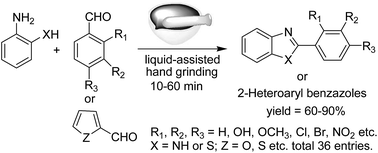
An efficient and versatile mechanochemical route to 2-aryl benzothiazoles and both 2-substituted and 1,2-disubstituted benzimidazole derivatives has been developed via a simple mortar–pestle grinding method. The mechanochemical agitation was found to be sufficient for smooth condensation between a variety of aromatic aldehydes and o-aminothiophenol/o-phenylenediamine followed by cyclization leading to the formation of the corresponding 1,3-benzazoles. The salient features of this new protocol are catalyst-free reaction, cleaner reaction profiles, absence of a work-up step, high yields, and short reaction times.

1. Introduction

The development of efficient and environmentally friendly chemical processes for the synthesis of biologically active and industrially useful molecules constitutes a major challenge for chemists in organic synthesis. A sustainable and “greener” method would focus on minimal to no use of solvents, reduction of other wastes, use of ambient conditions as well as shortening of reaction time, and developing more facile ways of product separation and purification. A mechanochemical process, which typically involves the reactions induced by the input of mechanical energy such as grinding or ball-milling, facilitates most of the above mentioned features of sustainable methods and therefore, such strategies have emerged as attractive alternative to the traditional solution based synthetic methods.1 Mechanosynthesis by “ball milling” has been used with great success for typical organic reactions2,3 such as aldol condensation,3a–d Michael additions,3e,f Knoevenagel condensation,3g,h Morita–Baylis–Hillman reactions,3i cross-coupling reactions,3k–o and click reactions.3p,q On the other hand, manual grinding with a mortar and pestle is a very useful method at laboratory scale due to simple and hazardless experimental set-up. This technique is mostly used for condensation reactions4 including Schiff's base formation,4b–e oxime formation4f with occasional exceptions.5 Recently, it is found to be equally effective for the construction of heteroaromatic compounds of biological interest.6

Benzofused heteroaromatic compounds, in particular benzimidazoles and benzothiazoles, are common structural scaffold of biologically active compounds and natural products.7 These heterocycles are of regular pharmaceutical interest as they show a range of pharmacological activities such as antibacterial, antiulcers, antihypertensives, antivirals, antifungals, anticancers, and antihistaminics.8 They are an integral part of various clinical medicines as well, for example, 2-substituted benzimidazole, esomeprazole9 is an anti-ulcerative drug, 1,2-substituted benzimidazole, astemizole is an antihistamine drug,10 whereas, a benzothiazole derivative, Riluzole (Rilutek)11 is used to treat motor neurone disease (Fig. 1). In addition, they are important intermediates in various organic reactions12 and key components of many functional materials.13 Therefore, their synthesis is a frequently encountered mission for both organic and medicinal chemists. The traditional methods for the synthesis of the benzimidazoles14b,c and benzothiazoles14d involve condensation of o-phenylenediamine/o-aminothiophenol with a carboxylic acid or its derivatives under harsh dehydrating conditions.14 Recently, various alternative routes have been developed for these heterocycles which include transition metal catalyzed cyclization of ortho-haloanilides,15 metal catalyzed direct arylation via C–H bond activation,16 solid-phase supported synthesis17 and many others.18 However, dehydrative Schiff's base formation followed by oxidative cyclization in one-pot between ortho-functionalized anilines and aldehydes emerged as the most popular method for these 1,3-benzazole derivatives.19–21 It is necessary to mention, majority of these methods use metal catalysts and/or additional reagents, and generate acidic and metallic wastes apart from use of considerable amounts of hazardous organic solvents for reaction and extraction processes. Therefore, their utility is limited, especially in industrial applications. In the last few years, several eco-friendly solution phase synthetic methods have been developed for both benzothiazoles22 and benzimidazoles22,23 by us23a,b and others. In many of these methods, the organic solvent is replaced by an environmentally benign solvent and reaction is often carried out in the presence of a catalyst such as surfactant. However, an eco-friendly synthesis can be turned more economical by avoiding use of catalysts, additional reagents and solvents. In this direction, we report, herein, development of an efficient mechanochemical route to 2-aryl benzothiazoles and both 2- and 1,2-disubstituted benzimidazoles (Scheme 1). The syntheses of benzimidazoles and benzothiazoles are achieved in high yields by simply grinding of a mixture of o-aminothiophenol/o-phenylenediamine and the corresponding aldehydes in an Agate mortar–pestle.


image file: c4ra07058e-f1.tif
Fig. 1 Chemical structures of few 1,3-benzazole derived drug candidates.

image file: c4ra07058e-s1.tif
Scheme 1 Mechanochemical route to 2-substituted benzothiazoles and both 2- and 1,2-disubstituted benzimidazoles.

We started our work with a focus on optimizing the reaction conditions. In this direction, we first examined whether grinding under neat condition is useful or liquid assisted grinding (LAG) is more effective by keeping a model reaction between equimolar mixture of o-aminothiophenol (1a) and benzaldehyde (2a). The reactants were taken in an Agate mortar and ground gently with a pestle under neat condition at ambient temperature. The reaction produced a sticky solid mass after 5 min of grinding, which is partly intermediate imine and partly unreacted starting materials in addition to trace amount of desired product, as observed by TLC. As some of the unreacted starting materials were trapped inside the solid mass further reaction became sluggish under neat condition. Addition of little amount of solvent into the same reaction mixture accelerated the rate of formation of the product to a great extent. We observed that the added solvent could dissolve major part of the solid intermediates and thereby, releases trapped starting materials to facilitate their complete conversion to the desired 2-phenylbenzothiazole (3a). It is well-documented that liquid assisted grinding often brings out better results than “dry” grinding.5b,24 Therefore, we used various common organic solvents for LAG and the percentage of isolated yields of the product (3a) was analyzed to find out the solvent of choice (Table 1). The grinding was performed up to 30 min and the progress of the reaction was monitored by TLC after each 5 min interval. In this regard, ethanol being relatively less volatile was found to be most suitable in terms of yield and rate of the reaction. The reaction goes to completion with slender amount of ethanol (0.5 mL per 1 mmol of substrate) in just 15 min (Table 1, entry 6). Whereas, only 46% of product was obtained by grinding the reaction mixture under neat condition for 30 min; rest was intermediate imine and starting materials (Table 1, entry 1). Although similar results were obtained with MeOH as solvent like EtOH (Table 1, entry 5), it was not considered for other reactions due to its higher toxicity profile. The progress of the reaction was monitored by IR spectroscopy (see ESI for details). The IR spectra of reaction mixture were recorded at regular interval and compared with the spectra of pure starting materials and product. It was observed that the characteristic stretching bands of starting materials like carbonyl of aromatic aldehyde at 1691 cm−1 and amine N–H bands at 3452 cm−1 and 3357 cm−1 almost disappeared after 5 min and a sharp peak at 3388 cm−1 (presumably, N–H stretching band of intermediate imine) appeared in the IR spectrum due to condensation of benzaldehyde and amine group of 2-aminothiophenol to form corresponding imine. The same band significantly diminished after another 10 min indicating conversion of intermediate imine to 2-phenylbenzothiazole. In continuation of our efforts towards standardizing the reaction condition, we also examined that 1[thin space (1/6-em)]:[thin space (1/6-em)]1 molar ratio of o-aminothiophenol (1a) and benzaldehyde (2a) is ideal to achieve high yield of product (3a); excess aldehyde does not impose any significant improvement in the final yield (Table 1, entries 7 and 8). From the mechanistic point of view we expected that the reaction will be initiated by spontaneous formation of a Schiff's base when an aldehyde molecule comes in contact with o-aminothiophenol with the removal of a water molecule followed by the nucleophilic attack of sulphur atom to imine carbon to convert it to corresponding 1,2-dihydrobenzothiazole derivative, which will be finally oxidized to the desired 2-phenylbenzothiazole. Therefore, we used several nonhazardous, easily available, cheap oxidizing agents to check their effect in accelerating the aromatization step. However, added oxidizing agent had hardly any effect in terms of speed of the reaction and the yield of 2-phenylbenzothiazole (Table 1, entry 9–11). This suggests that the final oxidative aromatization step is predominantly occurred by aerial oxygen23a during mechanochemical agitation (Fig. 2). Therefore, we carried out rest of the reactions in minimum volume of ethanol in the absence of any added oxidizing agent.

Table 1 Optimization of the reaction condition for 2-substituted benzothiazoles

image file: c4ra07058e-u1.tif

Entry Solvent No. of equiv. of 2a Added oxidant Time (min) Yield of 3a (%)
a Some amount starting materials and imine were also isolated.
1 Neat 1.0 30 46a
2 CH3Cl 1.0 30 68a
3 EtOAc 1.0 30 72a
4 CH3CN 1.0 30 62a
5 H2O 1.0 30 42a
6 MeOH 1.0 20 85
7 EtOH 1.0 15 88
8 EtOH 1.1 15 88
9 EtOH 1.2 15 90
10 EtOH 1.0 H2O2 10 85
11 EtOH 1.0 (NH)4S2O8 15 82
12 EtOH 1.0 Iodine 15 87


image file: c4ra07058e-f2.tif
Fig. 2 Proposed mechanistic pathway for the formation of 2-phenylbenzothiazole via mortar–pestle grinding route.

To test the generality of this method, a series of aromatic and heteroaromatic aldehydes was treated with o-aminothiophenol under optimal conditions. The mortar–pestle grinding method25 was found to be excellent in terms of yield, reaction time and cleanliness resulting in a variety of 2-substituted benzothiazoles in high yields (Table 2). The products were characterized by 1H NMR, 13C NMR and mass. The aldehydes with electron donating (Table 2, entries 11–14) as well as with electron withdrawing groups (Table 2, entries 2–10) participated in the reaction uniformly with no significant distinction with regard to the yields of the target products. The method was found equally suitable for heteroaromatic aldehydes (Table 2, entries 15–18). Even sensitive substrates like furfuraldehyde (Table 2, entries 15) produced the desired product in high yield. However, the variation in the substituents in the aryl ring did have influence on the rate of the reaction. Although most of the reactions were completed within 30 min, presences of strong electron donating groups in the aldehyde residue delayed complete conversion to some extent (Table 2, entry 12–14). On the other hand, aldehydes with strong electron withdrawing groups reacted faster (Table 2, entries 2, 9, 10, etc.), as per expectation. However, to our dismay, reaction of aliphatic aldehydes with o-aminothiophenol failed to produce expected results (Table 2, entries 20 and 21). As a token of demonstration, we carried out grinding of o-aminothiophenol with cyclohexanecarboxaldehyde and butaraldehyde. Only 10% of desired product (3s) was isolated after grinding the mixture up to 1 h, whereas, no product was isolated in pure form from the other reaction. Apparently, the imine was formed in due course of time but the cyclization step was retarded by the poor reactivity of the aliphatic imine group. Therefore, we restricted our study to aromatic aldehydes only.

Table 2 Mechanochemical synthesis of 2-aryl benzothiazoles

image file: c4ra07058e-u2.tif

Entry Ar Time (min) Product % Yield of 3a
a All yields refer to isolated product, characterized by 1H NMR 13C NMR and mass.b Corresponding imine was isolated as the major product.c No desired product was isolated and imine got decomposed during column chromatography. n.d. is not determined.
1 Ph 15 3a 88
2 4-NO2C6H4 10 3b 80
3 3-NO2C6H4 15 3c 83
4 4-ClC6H4 15 3d 78
5 3-ClC6H4 15 3e 81
6 2-ClC6H4 20 3f 79
7 4-BrC6H4 15 3g 81
8 3-BrC6H4 15 3h 85
9 4-FC6H4 10 3i 87
10 4-CNC6H4 15 3j 83
11 2-OHC6H4 60 3k 82
12 4-OHC6H4 45 3l 78
13 4-OH, 3-MeOC6H3 60 3m 78
14 4-MeOC6H4 40 3n 83
15 Furan-2-yl 20 3o 88
16 Thiophene-2-yl 20 3p 94
17 Indole-3-yl 20 3q 88
18 Pyridine-4-yl 25 3r 92
19 Cyclohexyl 60 3s 10b
20 Butaryl 60 n.d.c


In order to expand the scope of this method we treated o-phenylenediamine with various aromatic aldehydes in variable molar ratio under similar conditions, which resulted in the formation of either 2-aryl benzimidazoles or 1,2-disubstituted benzimidazoles as the major product. We observed that the selectivity of 2-substituted benzimidazole over 1,2-disubstituted benzimidazole is mostly dependent on the availability of the aromatic aldehyde. It was found that portion-wise addition of the aldehyde in the mortar containing o-phenylenediamine in ethanol with continuous grinding would lead to 2-aryl benzimidazole as the major product with 15–20% of 1,2-disubstituted benzimidazole. Whereas, addition of 1 equiv. of o-phenylenediamine and 2.2 equiv. of aromatic aldehydes mostly led to 1,2-disubstituted benzimidazoles with negligible amount of 2-substituted benzimidazoles making it a suitable method for the preparation of 1,2-disubstituted benzimidazoles. It is worthy to note that 2-substituted benzimidazoles can be easily separated from 1,2-disubstituted benzimidazoles by column chromatography and therefore, the same method is useful for the syntheses of 2-substituted benzimidazoles as well. Each reaction was repeated for three times and the yields of 2-substituted and 1,2-disubstituted benzimidazoles were found to be of negligible difference. The course of the reactions follows the same trend like formation of 2-aryl benzothiazoles. Substituent effect was found to be insignificant in terms of yields. However, aldehydes with strong electron withdrawing groups reacted little faster (Table 3, entry 2) and reactions were slow for aldehydes with strong electron donating groups (Table 2, entries 9–12). In general, it was observed that benzimidazole formation takes relatively longer time for completion as compared to the time required for benzothiazoles. The slight difference in reactivity may be attributed to the reduced nucleophilicity of –NH moiety as compared to sulphur atom. We also tried to synthesize benzoxazoles using mechanochemical grinding. However, couple of attempts of condensation of o-aminophenol with either benzaldehyde or 4-nitrobenzaldehyde followed by cyclization did not lead to desired benzoxazole derivatives. Although imine was formed, further reaction was proved to be difficult. Presumably, the oxygen atom of o-aminophenol is reluctant to attack newly formed imine bond due to its poor nucleophilicity under the mild reaction condition.

Table 3 Mechanochemical synthesis of 2-aryl and 1,2-disubstituted benzimidazoles

image file: c4ra07058e-u3.tif

Entry Ar Equiv. of ArCHO Time (min) % Yield of 2-substituted benzimidazole (5)a % Yield of 1,2-disubstituted benzimidazole (6)a
a All yields refer to isolated product, characterized by melting point 1H NMR 13C NMR and mass.
1 Ph 1 30 62 (5a) 18 (6a)
2 Ph 2.2 30 06 (5a) 84 (6a)
3 4-NO2C6H4 1 20 60 (5b) 15 (6b)
4 4-NO2C6H4 2.2 30 04 (5b) 85 (6b)
5 4-ClC6H4 1 25 58 (5c) 20 (6c)
6 4-ClC6H4 2.2 30 08 (5c) 79 (6c)
7 4-BrC6H4 1 20 61 (5d) 16 (6d)
8 4-BrC6H4 2.2 30 06 (5d) 78 (6d)
9 2-OHC6H4 1 60 63 (5e) 14 (6e)
10 2-OHC6H4 2.2 60 05 (5e) 82 (6e)
11 4-MeOC6H4 1 40 66 (5f) 14 (6f)
12 4-MeOC6H4 2.2 45 07 (5f) 76 (6f)
13 Thiophene-2-yl 1 25 60 (5g) 16 (6g)
14 Thiophene-2-yl 2.2 30 04 (5g) 86 (6g)
15 Furan-2-yl 1 30 54 (5h) 18 (6h)
16 Furan-2-yl 2.2 30 05 (5h) 84 (6h)


2. Conclusion

In conclusion, we have developed an efficient and cost effective mechanochemical route to 2-aryl benzothiazoles and both 2- and 1,2-disubstituted benzimidazoles via a simple mortar–pestle grinding method. A broad range of benzothiazoles and benzimidazoles have been synthesized starting from o-aminothiophenol or o-phenylenediamine and a variety of aromatic aldehydes using this method. The operational simplicity, catalyst free condition, cleaner reaction profiles, absence of work-up step, higher yields, and short reaction times make this protocol superior to many other existing methods.

Acknowledgements

M.B. thanks CSIR (India) (project no. 02(0075)/12/EMR-II) for financial support.

Notes and references

  1. (a) G.-W. Wang, Chem. Soc. Rev., 2013, 42, 7668 RSC; (b) S. L. James, C. J. Adams, C. Bolm, D. Braga, P. Collier, T. Friščić, F. Grepioni, K. D. M. Harris, G. Hyett, W. Jones, A. Krebs, J. Mack, L. Maini, A. G. Orpen, I. P. Parkin, W. C. Shearouse, J. W. Steed and D. C. Waddell, Chem. Soc. Rev., 2012, 41, 413 RSC; (c) G. A. Bowmaker, Chem. Commun., 2013, 49, 334 RSC.
  2. (a) B. Rodríguez, A. Bruckmann, T. Rantanen and C. Bolm, Adv. Synth. Catal., 2007, 349, 2213 CrossRef PubMed; (b) T. Szuppa, A. Stolle, S. E. S. Leonhardt and B. Ondruschka, Chem. Soc. Rev., 2011, 40, 2317 RSC.
  3. For some recent examples of organic synthesis in ball-mills, see: (a) B. Rodríguez, T. Rantanen and C. Bolm, Angew. Chem., Int. Ed., 2006, 45, 6924 CrossRef PubMed; (b) A. Bañón-Caballero, G. Guillena and C. Nájera, Green Chem., 2010, 12, 1599 RSC; (c) J. G. Hernandez and E. Juaristi, J. Org. Chem., 2011, 76, 1464 CrossRef CAS PubMed; (d) J. G. Hernández, V. García-López and E. Juaristi, Tetrahedron, 2012, 68, 92 CrossRef PubMed; (e) Y.-F. Wang, R.-X. Chen, K. Wang, B.-B. Zhang, Z.-B. Lib and D.-Q. Xu, Green Chem., 2012, 14, 893 RSC; (f) M. Jörres, S. Mersmann, G. Raabe and C. Bolm, Green Chem., 2013, 15, 612 RSC; (g) R. Trotzki, M. M. Hoffmann and B. Ondruschka, Green Chem., 2008, 10, 873 RSC; (h) R. Trotzki, M. M. Hoffmann and B. Ondruschka, Green Chem., 2008, 10, 767 RSC; (i) J. Mack and M. Shumba, Green Chem., 2007, 9, 328 RSC; (j) D. C. Waddell and J. Mack, Green Chem., 2009, 11, 79 RSC; (k) E. Tullberg, F. Schachter, D. Peters and T. Frejd, Synthesis, 2006, 1183 CAS; (l) F. Schneider, T. Szuppa, A. Stolle, B. Ondruschka and H. Hopf, Green Chem., 2009, 11, 1894 RSC; (m) F. Schneider and B. Ondruschka, ChemSusChem, 2008, 1, 622 CrossRef CAS PubMed; (n) D. A. Fulmer, W. C. Shearouse, S. T. Medonza and J. Mack, Green Chem., 2009, 11, 1821 RSC; (o) R. Thorwirth, A. Stolle and B. Ondruschka, Green Chem., 2010, 12, 985 RSC; (p) R. Thorwirth, A. Stolle, B. Ondruschka, A. Wild and U. S. Schubert, Chem. Commun., 2011, 47, 4370 RSC; (q) T. L. Cook, J. A. Walker and J. Mack, Green Chem., 2013, 15, 617 RSC; (r) V. Estévez, M. Villacampa and J. C. Menéndez, Chem. Commun., 2013, 49, 591 RSC; (s) W. Su, J. Yu, Z. Li and Z. Jiang, J. Org. Chem., 2011, 76, 9144 CrossRef CAS PubMed; (t) V. Štrukil, B. Bartolec, T. Portada, I. Đilović, I. Halasz and D. Margetić, Chem. Commun., 2012, 48, 12100 RSC; (u) J. G. Hernández and E. Juaristi, J. Org. Chem., 2010, 75, 7107 CrossRef PubMed; (v) D. Tan, V. Štrukil, C. Mottillo and T. Friščić, Chem. Commun., 2014, 50, 5248 RSC; (w) Y. Fang, N. Salamé, S. Woo, D. S. Bohle, T. Friščić and L. A. Cuccia, CrystEngComm, 2014, 16, 7180 RSC.
  4. (a) K. Tanaka and F. Toda, Chem. Rev., 2000, 100, 1025 CrossRef CAS PubMed; (b) J. Schmeyers, F. Toda, J. Boy and G. Kaupp, J. Chem. Soc., Perkin Trans. 2, 1998, 989 RSC; (c) O. Dolotko, J. W. Wiench, K. W. Dennis, V. K. Pecharsky and V. P. Balema, New J. Chem., 2010, 34, 25 RSC; (d) D. Cinčić, I. Brekalo and B. Kaitner, Chem. Commun., 2012, 48, 11683 RSC; (e) D. Cinčić, I. Brekalo and B. Kaitner, Cryst. Growth Des., 2012, 12, 44 CrossRef; (f) C. B. Aakeröy and A. S. Sinha, RSC Adv., 2013, 3, 8168 RSC; (g) G. Rothenberg, A. P. Downie, C. L. Raston and J. L. Scott, J. Am. Chem. Soc., 2001, 123, 8701 CrossRef CAS PubMed.
  5. (a) V. Štrukil, M. D. Igrc, L. Fábián, M. Eckert-Maksić, S. L. Childs, D. G. Reid, M. J. Duer, I. Halasz, C. Mottilloe and T. Friščić, Green Chem., 2012, 14, 2462 RSC; (b) V. Štrukil, M. D. Igrc, M. Eckert-Maksić and T. Friščić, Chem.–Eur. J., 2012, 18, 8464 CrossRef PubMed; (c) A. Shaabani and D. G. Lee, Tetrahedron Lett., 2001, 42, 5833 CrossRef CAS; (d) I. Huskić, I. Halasz, T. Friščić and H. Vančik, Green Chem., 2012, 14, 1597 RSC.
  6. (a) H. Shy, P. Mackin, A. S. Orvieto, D. Gharbharan, G. R. Peterson, N. Bampos and T. D. Hamilton, Faraday Discuss., 2014 10.1039/c3fd00140g; (b) G. Brahmachari and S. Das, RSC Adv., 2014, 4, 7380 RSC; (c) G. Shukla, G. K. Verma, A. Nagaraju, R. K. Verma, K. Raghuvanshi and M. S. Singh, RSC Adv., 2013, 3, 13811 RSC.
  7. (a) A. R. Katritzky, C. A. Ramsden, E. F. V. Scriven and R. J. K. Taylor, Comprehensive Heterocyclic Chemistry III, Pergamon, Oxford, New York, USA, 2008, vol. 4 Search PubMed; (b) A. R. Katritzky and A. F. Pozharskii, Handbook of Heterocyclic Chemistry, Pergamon, Oxford, UK, 2nd edn, 2000 Search PubMed.
  8. (a) D. A. Horton, G. T. Bourne and M. L. Smythe, Chem. Rev., 2003, 103, 893 CrossRef CAS PubMed; (b) M. Boiani and M. González, Mini-Rev. Med. Chem., 2005, 5, 409 CrossRef CAS; (c) A. A. Spasov, I. N. Yozhitsa, L. I. Bugaeva and V. A. Anisimova, Pharm. Chem. J., 1999, 33, 232 CrossRef CAS; (d) J. S. Kim, B. Gatto, C. Yu, A. Liu, L. F. Liu and E. J. LaVoie, J. Med. Chem., 1996, 39, 992 CrossRef CAS PubMed; (e) T. Roth, M. L. Morningstar, P. L. Boyer, S. H. Hughes, R. W. Buckheit Jr and C. J. Michejda, J. Med. Chem., 1997, 40, 4199 CrossRef CAS PubMed; (f) I. Hutchinson, T. D. Bradshaw, C. S. Matthews, M. F. Stevens and A. D. Westwell, Bioorg. Med. Chem. Lett., 2003, 13, 4 CrossRef; (g) S.-T. Huang, I.-J. Hsei and C. Chen, Bioorg. Med. Chem. Lett., 2006, 14, 6106 CrossRef CAS PubMed; (h) R. J. Alaimo, S. S. Pelosi and R. Freedman, J. Pharm. Sci., 1978, 67, 281 CrossRef CAS PubMed.
  9. L. J. Scott, C. J. Dunn, G. Mallarkey and M. Sharpe, Drugs, 2002, 62, 1503 CrossRef CAS PubMed.
  10. H. Al Muhaimeed, J. Int. Med. Res., 1997, 25, 175 CAS.
  11. P. Jimonet, F. Audiau, M. Barreau, J.-C. Blanchard, A. Boireau, Y. Bour, M.-A. Coléno, A. Doble, G. Doerflinger, C. D. Huu, M.-H. Donat, J. M. Duchesne, P. Ganil, C. Guérémy, E. Honoré, B. Just, R. Kerphirique, S. Gontier, P. Hubert, P. M. Laduron, J. L. Blevec, M. Meunier, J.-M. Miquet, C. Nemecek, M. Pasquet, O. Piot, J. Pratt, J. Rataud, M. Reibaud, J.-M. Stutzmann and S. Mignani, J. Med. Chem., 1999, 42, 2828 CrossRef CAS PubMed.
  12. (a) Y. Bai, J. Lu, Z. Shi and B. Yang, Synlett, 2001, 544 CAS; (b) E. Hasegawa, A. Yoneoka, K. Suzuki, T. Kato, T. Kitazume and K. Yanagi, Tetrahedron, 1999, 55, 12957 CrossRef CAS; (c) G. A. Molander and K. Ajayi, Org. Lett., 2012, 14, 4242 CrossRef CAS PubMed.
  13. (a) J. A. Asensio and P. Gómez-Romero, Fuel Cells, 2005, 5, 336 CrossRef CAS PubMed; (b) G. Schwartz, K. Fehse, M. Pfeiffer, K. Walzer and K. Leo, Appl. Phys. Lett., 2006, 89, 083509 CrossRef PubMed.
  14. (a) M. R. Grimmet, A. R. Katritzky and C. W. Rees, in Comprehensive Heterocyclic Chemistry, 1984, vol. 5, p. 457 Search PubMed; (b) D. Vourloumis, M. Takahashi, K. B. Simonsen, B. K. Ayida, S. Barluenga, G. C. Winters and T. Hermann, Tetrahedron Lett., 2003, 44, 2807 CrossRef CAS; (c) S.-Y. Lin, Y. Isome, E. Stewart, J.-F. Liu, D. Yohannes and L. Yu, Tetrahedron Lett., 2006, 47, 2883 CrossRef CAS PubMed; (d) Y. H. So and R. DeCaire, Synth. Commun., 1998, 28, 4123 CrossRef CAS.
  15. For few selected examples of the synthesis of benzofused azoles via transition metal catalyzed cyclization of ortho-haloanilides, see: (a) P. Saha, M. A. Ali, P. Ghosh and T. Punniyamurthy, Org. Biomol. Chem., 2010, 8, 5692 RSC; (b) P. Saha, T. Ramana, N. Purkait, M. A. Ali, R. Paul and T. Punniyamurthy, J. Org. Chem., 2009, 74, 8719 CrossRef CAS PubMed; (c) J. E. R. Sadig, R. Foster, F. Wakenhut and M. C. Willis, J. Org. Chem., 2012, 77, 9473 CAS; (d) N. Zheng and S. L. Buchwald, Org. Lett., 2007, 9, 4749 CrossRef CAS PubMed.
  16. For few selected examples of transition metal catalyzed direct arylation of benzofused azoles via C–H activation, see: (a) S. Ranjit and X. Liu, Chem.–Eur. J., 2011, 17, 1105 CrossRef CAS PubMed; (b) J. Huang, J. Chan, Y. Chen, C. J. Borths, K. D. Baucom, R. D. Larsen and M. M. Faul, J. Am. Chem. Soc., 2010, 132, 3674 CrossRef CAS PubMed; (c) F. Shibahara, E. Yamaguchi and T. Murai, Chem. Commun., 2010, 46, 2471 RSC; (d) N. S. Nandurkar, M. J. Bhanushali, M. D. Bhor and B. M. Bhanage, Tetrahedron Lett., 2008, 49, 1045 CrossRef CAS PubMed.
  17. (a) Z. Wu, P. Rea and G. Wickham, Tetrahedron Lett., 2000, 41, 9871 CrossRef CAS; (b) H. Hioki, K. Matsushita, M. Kubo, K. Harada, M. Kodama and Y. Fukuyama, Tetrahedron, 2007, 63, 11315 CrossRef CAS PubMed; (c) S. Mourtas, D. Gatos and K. Barlos, Tetrahedron Lett., 2001, 42, 2201 CrossRef CAS; (d) H. Matsushita, S.-H. Lee, M. Joung, B. Clapham and K. D. Janda, Tetrahedron Lett., 2004, 45, 313 CrossRef CAS PubMed.
  18. (a) Y.-P. Zhu, M. Lian, F.-C. Jia, M.-C. Liu, J.-J. Yuan, Q.-H. Gao and A.-X. Wu, Chem. Commun., 2012, 48, 9086 RSC; (b) M. Bala, P. K. Verma, U. Sharma, N. Kumar and B. Singh, Green Chem., 2013, 15, 1687 RSC; (c) R. G. Kalkhambkar and K. K. Laali, Tetrahedron Lett., 2012, 53, 4212 CrossRef CAS PubMed; (d) S. Liu, R. Chen, X. Guo, H. Yang, G.-J. Deng and C.-J. Li, Green Chem., 2012, 14, 1577 RSC; (e) D. S. Bose and M. Idrees, Tetrahedron Lett., 2007, 48, 669 CrossRef CAS PubMed; (f) E. A. Jaseer, D. J. C. Prasad, A. Dandapat and G. Sekar, Tetrahedron Lett., 2010, 51, 5009 CrossRef CAS PubMed; (g) C. Siddappa, V. Kambappa, M. Umashankara and K. S. Rangappa, Tetrahedron Lett., 2011, 52, 5474 CrossRef CAS PubMed; (h) G. Satish, K. H. V. Reddy, K. Ramesh, K. Karnakar and Y. V. D. Nageswar, Tetrahedron Lett., 2012, 53, 2518 CrossRef CAS PubMed; (i) D. L. Yang, D. Fokas, J. Z. Li, L. B. Yu and C. M. Baldino, Synthesis, 2005, 37, 47 CrossRef PubMed; (j) R. J. Perry and B. D. Wilson, J. Org. Chem., 1993, 58, 7016 CrossRef CAS; (k) M. Shen and T. G. Driver, Org. Lett., 2008, 15, 3367 CrossRef PubMed; (l) D. Anastasiou, E. M. Campi, H. Chaouk and W. R. Jackson, Tetrahedron, 1992, 48, 7467 CrossRef CAS.
  19. For few selected examples of synthesis of 1,3-benzazoles from o-substituted aniline and aldehydes, see: (a) T. B. Kumar, C. Sumanth, A. V. D. Rao, D. Kalita, M. S. Rao, K. B. C. Sekhar, K. S. Kumar and M. Pal, RSC Adv., 2012, 2, 11510 RSC; (b) K. Bahrami, M. M. Khodaei and F. Naali, J. Org. Chem., 2008, 73, 6835 CrossRef CAS PubMed; (c) J. M. Khurana, Sneha and K. Vij, Synth. Commun., 2012, 42, 2606 CrossRef CAS.
  20. For few selected examples of synthesis of 1,3-benzothiazoles from o-aminothiophenol and aldehydes, see: (a) S. Das, S. Samanta, S. K. Maji, P. K. Samanta, A. K. Dutta, D. N. Srivastava, B. Adhikary and P. Biswas, Tetrahedron Lett., 2013, 54, 1090 CrossRef CAS PubMed; (b) A. A. Weekes, M. C. Dix, M. C. Bagley and A. D. Westwell, Synth. Commun., 2010, 40, 3027 CrossRef CAS; (c) S. D. Gupta, H. P. Singh and N. S. H. N. Moorthy, Synth. Commun., 2007, 37, 4327 CrossRef CAS.
  21. For few selected examples of 1,3-benzimidazole synthesis from o-phenylenediamine and aldehydes, see: (a) D. Kumar, D. N. Kommi, R. Chebolu, S. K. Garg, R. Kumar and A. K. Chakraborti, RSC Adv., 2013, 3, 91 RSC , and references cited therein; ; (b) J. S. Yadav, B. V. S. Reddy, K. Premalatha and K. S. Shankar, Can. J. Chem., 2008, 86, 124 CrossRef CAS; (c) R. G. Jacob, L. G. Dutra, C. S. Radatz, S. R. Mendes, G. Perin and E. J. Lenardão, Tetrahedron Lett., 2009, 50, 1495 CrossRef CAS PubMed; (d) V. Narsaiah, A. R. Reddy and J. S. Yadav, Synth. Commun., 2011, 41, 262 CrossRef; (e) D. Saha, A. Saha and B. C. Ranu, Green Chem., 2009, 11, 733 RSC; (f) H. M. Bachhav, S. B. Bhagat and V. N. Telvekar, Tetrahedron Lett., 2011, 52, 5697 CrossRef CAS PubMed.
  22. (a) S. Liu, R. Chen, X. Guo, H. Yang, G. Deng and C.-J. Li, Green Chem., 2012, 14, 1577 RSC; (b) N. Khatun, L. Jamir, M. Ganesha and B. K. Patel, RSC Adv., 2012, 2, 11557 RSC; (c) K. U. Sadek, R. A. Mekheimer, A. M. A. Hameed, F. Elnahas and M. H. Elnagdi, Molecules, 2012, 17, 6011 CrossRef CAS PubMed.
  23. (a) V. Kumar, D. G. Khandare, A. Chatterjee and M. Banerjee, Tetrahedron Lett., 2013, 54, 5505 CrossRef CAS PubMed; (b) M. S. Majik, S. Tilvi, S. Mascarenhas, V. Kumar, A. Chatterjee and M. Banerjee, RSC Adv., 2014, 4, 28259 RSC; (c) K. Bahrami, M. M. Khodaei and A. Nejatia, Green Chem., 2010, 12, 1237 RSC; (d) P. Ghosh and A. Mandal, Catal. Commun., 2011, 12, 744 CrossRef CAS PubMed; (e) D. N. Kommi, P. S. Jadhavar, D. Kumar and A. K. Chakraborti, Green Chem., 2013, 15, 798 RSC; (f) D. N. Kommi, D. Kumar, R. Bansal, R. Chebolu and A. K. Chakraborti, Green Chem., 2012, 14, 3329 RSC; (g) S. Santra, A. Majee and A. Hajra, Tetrahedron Lett., 2012, 53, 1974 CrossRef CAS PubMed; (h) S. Paul and B. Basu, Tetrahedron Lett., 2012, 53, 4130 CrossRef CAS PubMed; (i) J.-P. Wan, S.-F. Gan, J.-M. Wu and Y. Pan, Green Chem., 2009, 11, 1633 RSC; (j) P. Gogoi and D. Konwar, Tetrahedron Lett., 2006, 47, 79 CrossRef CAS PubMed.
  24. G. A. Bowmaker, Chem. Commun., 2013, 49, 334 RSC.
  25. General procedure for the synthesis of 2-aryl benzothiazoles: both aromatic aldehyde (1 mmol) and o-aminothiophenol (1 mmol) were taken in an Agate mortar and 0.5 mL of ethanol was added and the solution was gently ground by a pestle. The reaction mixture turned to a pasty mass after 5–10 min of grinding. The grinding was continued for the time mentioned in Table 2. The progress of the reaction was monitored by TLC after each 5 min. In some cases, 0.2 mL of EtOH was added after 30 min to facilitate complete conversion. The crude reaction mixture was directly subjected to column chromatography (silica gel, 60–120 mesh) and eluted out in pure form by using variable percentage of EtOAc in petroleum ether.

Footnote

Electronic supplementary information (ESI) available: Details of synthetic procedure, spectral data, selected spectra of compounds, IR studies. See DOI: 10.1039/c4ra07058e

This journal is © The Royal Society of Chemistry 2014
Click here to see how this site uses Cookies. View our privacy policy here.