DOI:
10.1039/C4RA06795A
(Paper)
RSC Adv., 2014,
4, 45995-46001
Preparation of Zn–Al layered double hydroxide intercalated with triethylenetetramine-hexaacetic acid by coprecipitation: uptake of rare-earth metal ions from aqueous solutions
Received
8th July 2014
, Accepted 11th September 2014
First published on 11th September 2014
Abstract
A Zn–Al layered double hydroxide intercalated with triethylenetetramine-hexaacetic acid (TTHA·Zn–Al LDH) was prepared by the dropwise addition of a Zn–Al nitrate solution to a TTHA solution at a constant pH value of 10.0. The TTHA·Zn–Al LDH could uptake rare-earth metal ions such as Nd3+ ions from aqueous solutions. This can be attributed to the chelating ability of the TTHA ions in the interlayer, i.e., Nd–TTHA complexes could be formed in the interlayer. However, the TTHA·Zn–Al LDH could hardly uptake Sr2+ ions from aqueous solutions, indicating that the TTHA ions in the interlayer did not function as effective chelating agents for Sr2+ ions. Therefore, TTHA·Zn–Al LDH could uptake Nd3+ ions selectively from an aqueous mixture of Nd3+ and Sr2+ ions. This was confirmed by the fact that the uptake amount after 120 min was 0.078 and 0.007 mmol g−1 for Nd3+ and Sr2+, respectively, when TTHA·Zn–Al LDH was added to a 1![[thin space (1/6-em)]](https://www.rsc.org/images/entities/char_2009.gif) :1 mixed nitrate solution of Nd3+ and Sr2+ ions. In this case, the degree of selectivity, i.e., the Nd/Sr molar ratio, was 10.7. Furthermore, TTHA·Zn–Al LDH was superior to ethylenediaminetetraacetate (EDTA)·Zn–Al LDH for the uptake of Nd3+ ions, which can be attributed to the order of the stability of the metal–chelate complexes: Nd–TTHA complex > Nd–EDTA complex.
:1 mixed nitrate solution of Nd3+ and Sr2+ ions. In this case, the degree of selectivity, i.e., the Nd/Sr molar ratio, was 10.7. Furthermore, TTHA·Zn–Al LDH was superior to ethylenediaminetetraacetate (EDTA)·Zn–Al LDH for the uptake of Nd3+ ions, which can be attributed to the order of the stability of the metal–chelate complexes: Nd–TTHA complex > Nd–EDTA complex.
Introduction1
Layered double hydroxides (LDHs) have anion-exchange capability and are represented by the chemical formula [M2+1−xM3+x(OH)2](An−)x/n·mH2O, where M2+ = Mg2+, Ni2+, Zn2+, etc.; M3+ = Al3+, Fe3+, etc.; An− = CO32−, Cl−, etc.; and x = M3+/(M2+ + M3+) molar ratio (0.20 ≦ x ≦ 0.33).1 LDHs have been used for the preservation of aqueous environments, e.g., the uptake of C.I. Reactive Red 2, arsenate, molybdate, Cr(VI), acid green 68:1, bromate, and boron species.2–11 LDH cannot uptake cationic metals from aqueous solutions owing to its anion-exchange capability; therefore, cationic clays and chelate resins are usually used. However, organic-modified LDH can uptake cationic metals from aqueous solutions. For example, the uptake of heavy metal ions such as Cu2+, Cd2+, Pb2+, and Hg2+ ions using Mg–Al and Zn–Al LDHs intercalated with chelating agents such as mercaptocarboxylate, diethylenetriaminepentaacetate, and meso-2,3-dimercaptosuccinate, has been investigated.12–14 The Mg–Al LDHs intercalated with citrate, malate, and tartrate could also uptake heavy metal ions such as Cu2+ and Cd2+ ions from aqueous solutions.15–17 Several researchers examined ethylenediaminetetraacetate (EDTA) as the chelating agent, which was intercalated in the interlayer of LDH. Mg–Al, Zn–Al, Cu–Al, and Mg–Fe LDHs intercalated with EDTA could uptake metal ions, such as Cu2+, Cd2+, Pb2+, Ni2+, Co2+, Cs+, Sr2+, Sc3+, Y3+, and La3+ ions, in the cationic form from aqueous solutions.18–27 EDTA is one of the aminocarboxylic acids used as a chelating ligand for metal ions. Other aminocarboxylic acids are iminodiacetic acid (IDA), nitrilotriacetic acid (NTA), and triethylenetetramine-hexaacetic acid (TTHA). The stability of a metal–chelate complex is different for different combinations of metals and aminocarboxylic acids. For several metals, the stability of the metal–chelate complex formed with TTHA (Fig. 1) is known to be superior to that formed with EDTA.28–30 Therefore, the LDH intercalated with TTHA may possess enhanced ability to uptake metal ions from aqueous solutions. In this study, a Zn–Al LDH intercalated with TTHA (TTHA·Zn–Al LDH) was prepared by coprecipitation, and the uptake of Nd3+ and Sr2+ ions from aqueous solutions was investigated. The separation of rare-earth metals such as Nd3+ and Sr2+ is considered necessary during the extraction of metal from waste compact appliances such as mobile phones after their dissolution. In order to prevent the precipitation of Nd(OH)3, Zn–Al LDH and not Mg–Al LDH was used because the buffer action of Zn2+ is higher than that of Mg2+. We also compared the uptake efficiency of Nd3+ ions on using TTHA·Zn–Al LDH and EDTA·Zn–Al LDH.
 |
| | Fig. 1 Molecular formula of TTHA. | |
Experimental
All the reagents were of chemical reagent grade and used as received without further purification.
Preparation
TTHA·Zn–Al LDH was prepared by the dropwise addition of a Zn–Al nitrate solution to a TTHA (C18H30N4O12) solution at a constant pH value of 10.0. At this pH, C18H25N4O125− ion was the stable anionic species of TTHA.31 Therefore, the theoretical formulas are as follows: Zn0.67Al0.33(OH)2(C18H25N4O12)0.07, Zn0.75Al0.25(OH)2(C18H25N4O12)0.05, and Zn0.80Al0.20(OH)2(C18H25N4O12)0.04. The coprecipitation reactions are expressed by eqn (1)–(3), in which the stoichiometric coefficient for C18H25N4O125− ion was calculated using the neutralization of the excess positive charge in the Al-bearing brucite-like octahedral layers by the replacement of Zn2+ ions with Al3+ ions at a Zn/Al molar ratio of 2.0, 3.0, and 4.0 as follows:| | |
0.67Zn2+ + 0.33Al3+ + 0.07C18H25N4O125− + 2OH− → Zn0.67Al0.33(OH)2(C18H25N4O12)0.07.
| (1) |
| | |
0.75Zn2+ + 0.25Al3+ + 0.05C18H25N4O125− + 2OH− → Zn0.75Al0.25(OH)2(C18H25N4O12)0.05.
| (2) |
| | |
0.80Zn2+ + 0.20Al3+ + 0.04C18H25N4O125− + 2OH− → Zn0.80Al0.20(OH)2(C18H25N4O12)0.04.
| (3) |
The Zn–Al solutions ([Zn2+] + [Al3+] = 0.5 mol L−1) with Zn/Al molar ratios of 2.0–4.0 were prepared by dissolving the required amount of Zn(NO3)2·3H2O and Al(NO3)3·9H2O in 250 mL of deionised water. The TTHA solution was prepared by dissolving 2.0 times the stoichiometric amounts of C18H30N4O12, as defined by eqn (1)–(3) in 250 mL of deionised water. The Zn–Al solution was added dropwise to the TTHA solution at a rate of 10 mL min−1 at 30 °C under mild agitation. The resulting solution was adjusted to pH 10.0 by adding a 1.25 mol L−1 NaOH solution until the desired pH was attained. The resulting suspensions were kept at 30 °C for 1 h at a constant pH value of 10.0. The TTHA·Zn–Al LDH particles were obtained by filtering the resulting suspension, washing repeatedly with deionised water till neutral pH, and drying under reduced pressure (133 Pa) for 40 h. N2 gas was bubbled into the solution throughout the operation to minimize the effect of dissolved CO2.
Uptake of rare-earth metal ions from aqueous solutions
The obtained TTHA·Zn–Al LDH was added to 500 mL of a 1.0 mmol L−1 Nd(NO3)3 or Sr(NO3)2 solution, and the resulting suspension was kept at 30 °C for 120 min under 300 rpm stirring. N2 was bubbled into the solution throughout the operation. Samples of the suspension were extracted at different time intervals and immediately filtered through a 0.45 μm membrane filter after measuring the pH. The filtrates were analyzed for the target metal ions. The molar ratios of TTHA in TTHA·Zn–Al LDH to Nd3+ and Sr2+ ions in the nitrate solutions were set at 1, 2, 3, 4, and 5. Furthermore, the variations in the degrees of Nd3+ and Sr2+ ion uptake with time using a suspension of TTHA·Zn–Al LDH in a 1:1 mixed nitrate solution of Nd3+ and Sr2+ ions was investigated when the molar ratio of the TTHA in Zn–Al LDH to (Nd3+ + Sr2+) ions in the mixed nitrate solution was 2.5. To demonstrate the effect of the interlayer anion, NO3·Zn–Al LDH, EDTA·Zn–Al LDH, Zn(OH)2, and Al(OH)3 were also used as the reference materials.
Characterization methods
The TTHA·Zn–Al LDH, TTHA·Zn–Al LDH loaded with Nd3+ and Sr2+ ions, and CO3·Zn–Al LDH samples were analyzed by X-ray diffraction (XRD) using CuKα radiation. In this case, the CO3·Zn–Al LDH sample was used as the reference to confirm that the TTHA·Zn–Al LDH was indeed a LDH. Furthermore, the materials were dissolved in 1 mol L−1 HNO3 and analyzed for Zn2+ and Al3+ ions by inductively coupled plasma-atomic emission spectrometry (ICP-AES). The materials were also dissolved in 1 mol L−1 HNO3 and analyzed for TTHA based on the total organic carbon (TOC) content.
For the adsorption experiments, the residual concentrations of Nd3+ and Sr2+ ions in the filtrates were determined by ICP-AES. The concentrations of Zn2+ ions dissolved from the Zn–Al LDHs into the filtrates were also determined by ICP-AES.
Theoretical calculations
The molecular geometry of isolated TTHA in the ground state was calculated using the ab initio Hartree–Fock method utilizing an STO-3G basis set in Gaussian 03.32
Results and discussion
Preparation
Fig. 2 shows the XRD patterns for (a) CO3·Zn–Al and TTHA·Zn–Al LDHs prepared at the initial Zn/Al molar ratios of (b) 2.0, (c) 3.0, and (d) 4.0. The XRD peaks for CO3·Zn–Al LDH (Fig. 2a) can be attributed to zinc aluminium carbonate hydroxide hydrate (JCPDS card no. 38-486) formulated as Zn6Al2(OH)16CO3·4H2O with a LDH structure. For CO3·Zn–Al LDH, the observed basal spacing, d003, was 7.9 Å, with an LDH host layer thickness of ∼4.8 Å and an interlayer spacing of 3.1 Å. The XRD peaks for TTHA·Zn–Al LDHs (Fig. 2b–d) were broader than those for CO3·Zn–Al LDH (Fig. 2a); however, the similarity of both the XRD peaks indicates that the TTHA·Zn–Al LDHs have a LDH structure. The intercalation of TTHA ions, which are larger than CO32− ions, in the interlayer of Zn–Al LDH, probably increased the basal spacing from 7.9 Å to ∼15 Å. Fig. 2b–d show that the TTHA·Zn–Al LDHs have basal spacings of 15.0, 15.5, and 15.0 Å with interlayer spacings of 10.2, 10.7, and 10.2 Å at the initial Zn/Al molar ratios of 2.0, 3.0, and 4.0, respectively. Fig. 3a shows the molecular structure of TTHA; the length of TTHA was calculated to be 12.1 Å. This value was larger than the abovementioned interlayer spacings. Therefore, the TTHA ion was most probably inclined at ∼60° with respect to the brucite-like Zn–Al LDH layers, as shown in Fig. 3b.
 |
| | Fig. 2 XRD patterns for (a) CO3·Zn–Al LDH and TTHA·Zn–Al LDHs prepared at the initial Zn/Al molar ratios of (b) 2.0, (c) 3.0, and (d) 4.0. The amount of TTHA present in the solutions was 2.0 times the stoichiometric quantities required by that calculated using eqn (1)–(3). | |
 |
| | Fig. 3 (a) Molecular structure of TTHA. (b) Proposed molecular orientation of TTHA intercalated in the Zn–Al LDH interlayer. | |
Table 1 shows the chemical compositions of TTHA·Zn–Al LDHs prepared at various initial Zn/Al molar ratios. The Zn/Al molar ratios were close to the values calculated using eqn (1)–(3), indicating that Zn2+ and Al3+ ions in the solutions were precipitated as Zn–Al LDH. The TTHA/Al molar ratios were in the range 0.19–0.40. The theoretical TTHA/Al molar ratio based on the charge balance with the Zn–Al LDH was 0.20, as shown in eqn (1)–(3). The TTHA/Al molar ratio for the initial Zn/Al molar ratio of 2.0 was almost similar to the theoretical value, indicating that C18H25N4O125− ion was intercalated in the Zn–Al LDH interlayer. However, the TTHA/Al molar ratios for the initial Zn/Al molar ratios of 3.0 and 4.0 were larger than the theoretical value. This indicates that not only C18H25N4O125− ion, but also [Zn–C18H25N4O12]3− and [Zn2–C18H25N4O12]− complexes were intercalated in the Zn–Al LDH interlayer, because TTHA is known to form 1:1 and 2:1 Zn(II)–TTHA complexes.28,29 The positive charges in the host layers of Zn–Al LDH did not exclusively neutralized by C18H25N4O125− ions. If [Zn–C18H25N4O12]3− and [Zn2–C18H25N4O12]− complexes were intercalated in the Zn–Al LDH interlayer, the theoretical TTHA/Al molar ratios would be 0.33 and 1.0, respectively. The fact that the values in Table 1 (b and c) are between the theoretical values of 0.20 and 1.0 also indicates that [Zn–C18H25N4O12]3− and [Zn2–C18H25N4O12]− complexes in addition to C18H25N4O125− ions were most probably intercalated in the Zn–Al LDH interlayer. Although the TTHA/Al molar ratio for the initial Zn/Al molar ratio of 2.0 was almost similar to the theoretical value, 0.20, not only C18H25N4O125− ion, but also [Zn–C18H25N4O12]3− and [Zn2–C18H25N4O12]− complexes were probably intercalated in the Zn–Al LDH interlayer, because it is difficult to prevent Zn2+ ions and TTHA from forming Zn(II)–TTHA complexes in the solution.
Table 1 Chemical compositions of TTHA·Zn–Al LDHs prepared at various initial Zn/Al molar ratios. The amount of TTHA present in the solution was 2.0 times the stoichiometric quantities calculated using eqn (1)–(3)
| Initial Zn/Al molar ratio |
wt% |
Molar ratio |
| Zn |
Al |
TTHA |
Zn/Al |
TTHA/Al |
| (a) |
2.0 |
31.3 |
7.3 |
25.2 |
1.8 |
0.19 |
| (b) |
3.0 |
32.2 |
5.3 |
23.7 |
2.5 |
0.25 |
| (c) |
4.0 |
30.3 |
2.8 |
20.8 |
4.5 |
0.40 |
In sum, these coprecipitation methods for the initial Zn/Al molar ratios of 2.0–4.0 afforded the Zn–Al LDHs intercalated with C18H25N4O125−, [Zn–C18H25N4O12]3−, and [Zn2–C18H25N4O12]− species. The sample prepared at the initial Zn/Al molar ratio of 2.0 had the largest amount of TTHA among the three samples. Therefore, the sample prepared at the initial Zn/Al molar ratio of 2.0 was used to uptake rare-earth metal ions from aqueous solutions in the remainder of this study and is hereafter referred to as TTHA·Zn–Al LDH.
Uptake of rare-earth metal ions from aqueous solutions
Fig. 4 shows the variations in Nd3+ ion uptake with time using a suspension of TTHA·Zn–Al and NO3·Zn–Al LDHs in the Nd(NO3)3 solution. The TTHA/Nd3+ molar ratio indicates the molar ratio of TTHA in the added TTHA·Zn–Al LDH to the Nd3+ ions in the Nd(NO3)3 solution. The amount of NO3·Zn–Al LDH was equal to that of TTHA·Zn–Al LDH at TTHA/Nd3+ = 5. The Nd3+ ion uptake increased with time for all the TTHA·Zn–Al LDHs. The Nd3+ ion uptake increased with increasing TTHA/Nd3+ molar ratios for all the durations, reaching 91.5% at TTHA/Nd3+ = 5 at 120 min. In contrast, the Nd3+ ion uptake was 7.5% for NO3·Zn–Al LDH after 120 min. This difference in the Nd3+ ion uptake can be attributed to the functions of C18H25N4O125− ion and [Zn–C18H25N4O12]3− complex in the interlayer of the TTHA·Zn–Al LDH. For the C18H25N4O125− ion, the [Nd–C18H25N4O12]2− complex was formed in the interlayer of TTHA·Zn–Al LDH according to eqn (4).| | |
Nd3+ + C18H25N4O125− ⇄ [Nd–C18H25N4O12]2−
| (4) |
 |
| | Fig. 4 Variations in Nd3+ ion uptake with time using a suspension of TTHA·Zn–Al and NO3·Zn–Al LDHs in the Nd(NO3)3 solution. * This amount is equal to that of TTHA·Zn–Al LDH at TTHA/Nd3+ = 5. | |
For the [Zn–C18H25N4O12]3− complex, the [Nd–C18H25N4O12]2− complex was most probably formed in the interlayer of TTHA·Zn–Al LDH according to eqn (5).
| | |
Nd3+ + [Zn–C18H25N4O12]3− ⇄ [Nd–C18H25N4O12]2− + Zn2+
| (5) |
This behaviour may be caused by the difference between the stabilities of [Nd–C18H25N4O12]2− and [Zn–C18H25N4O12]3− complexes. The metal–chelate formation constants for [Nd–C18H25N4O12]2− and [Zn–C18H25N4O12]3− complexes were 22.8 and 16.7, respectively;28,29 thus, [Nd–C18H25N4O12]2− complex was more stable than [Zn–C18H25N4O12]3− complex. As mentioned above, the [Zn2–C18H25N4O12]− complex was also intercalated in the interlayer of TTHA·Zn–Al LDH. However, the [Zn2–C18H25N4O12]− complex has a high stability as shown by the metal chelate formation constant of 28.7;28,29 therefore, this complex probably did not react with Nd3+ ions.
Fig. 5 shows the variations in the Zn2+ dissolution from TTHA·Zn–Al and NO3·Zn–Al LDHs with time during their suspension in the Nd(NO3)3 solution. For NO3·Zn–Al LDH, Zn2+ ions did not dissolve. However, for TTHA·Zn–Al LDHs, the Zn2+ ions solubilised increased rapidly with time and remained constant below 4%. This indicates the release of Zn2+ ions with the formation of the [Nd–C18H25N4O12]2− complex according to eqn (5). This was caused not by C18H25N4O125− but by the [Zn–C18H25N4O12]3− complex present in the interlayer of TTHA·Zn–Al LDH.
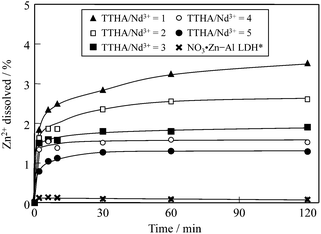 |
| | Fig. 5 Variations in the Zn2+ ion dissolution from TTHA·Zn–Al and NO3·Zn–Al LDHs with time during their suspension in the Nd(NO3)3 solution. * This amount is equal to that of TTHA·Zn–Al LDH at TTHA/Nd3+ = 5. | |
Fig. 4 also shows that the Nd3+ ion uptake for NO3·Zn–Al LDH was 7.5% after 120 min, probably due to the precipitation of Nd3+ ions as Nd(OH)3 caused by the increase in pH due to the addition of the LDH. In fact, the pHs for all the Zn–Al LDHs increased rapidly from 5.5 to >7 in a short time, but remained below 8 during the suspensions. This can be attributed to the buffer action of the Zn2+ ions dissolved from Zn–Al LDHs. The prevention of a larger pH increase caused by the buffer action resulted in the less precipitation of Nd3+ ions as Nd(OH)3. Notably, TTHA·Zn–Al LDH could uptake almost all the Nd3+ ions from solutions in cationic form.
Fig. 6a shows the variations in the Sr2+ ion uptake with time using TTHA·Zn–Al and NO3·Zn–Al LDH suspensions in the Sr(NO3)2 solution. The TTHA/Sr2+ value indicates the molar ratio of TTHA in the added TTHA·Zn–Al LDH to the Sr2+ ions in the Sr(NO3)2 solution. The amount of NO3·Zn–Al LDH was equal to that of TTHA·Zn–Al LDH at TTHA/Sr2+ = 5. For all the Zn–Al LDHs, the Sr2+ ion uptake increased less with time, and reached to <10% after 120 min. All the Zn–Al LDHs could hardly uptake the Sr2+ ions from the solutions, and the uptake behaviour of TTHA·Zn–Al LDH was similar to that of NO3·Zn–Al LDH. This indicates that the C18H25N4O125− ion and [Zn–C18H25N4O12]3− complex in the interlayer of the TTHA·Zn–Al LDH did not function as chelating agents. If they react with Sr2+ ions, the [Sr–C18H25N4O12]3− complex would be formed in the interlayer of the TTHA·Zn–Al LDH. The metal chelate formation constant for [Sr–C18H25N4O12]3− was 9.3;28,29 thus, [Sr–C18H25N4O12]3− complex was less stable than [Zn–C18H25N4O12]3− complex. Because of the low stability of [Sr–C18H25N4O12]3− complex, TTHA·Zn–Al LDH could not form the metal–chelate complex in the interlayer. In particular, Sr2+ ions could not exchange with the Zn2+ ions in [Zn–C18H25N4O12]3− complex. As shown in Fig. 7, the dissolution of Zn2+ ions from TTHA·Zn–Al LDHs was low, ∼1%, confirming the low release of Zn2+ ions during the uptake of Sr2+ ions. Fig. 6b shows the variations in the Sr2+ ion uptake with time using a suspension of Zn(OH)2 and Al(OH)3 in the Sr(NO3)2 solution. Although Zn(OH)2 could not uptake Sr2+ ions from an aqueous solution, Al(OH)3 could uptake the same amount of Sr2+ ions as TTHA·Zn–Al and NO3·Zn–Al LDHs. The uptake of Sr2+ ions by Al(OH)3 can be attributed to the coprecipitation of Al hydrolysate (i.e., Al(OH)2+ and Al(OH)2+) and Sr2+ ions. Therefore, the Sr2+ ion uptake by TTHA·Zn–Al LDHs and NO3·Zn–Al LDH, as shown in Fig. 6a, can be attributed to the coprecipitation of Sr2+ ions and Al hydrolysate derived from LDH.
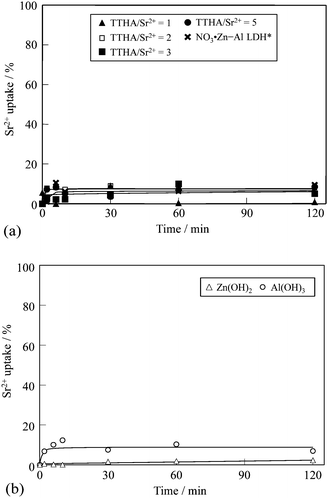 |
| | Fig. 6 (a) Variations in the Sr2+ ion uptake with time using a suspension of TTHA·Zn–Al and NO3·Zn–Al LDHs in the Sr(NO3)2 solution. (b) Variations in the Sr2+ ion uptake with time using a suspension of Zn(OH)2 and Al(OH)3 in the Sr(NO3)2 solution. The amounts are equal to that of TTHA·Zn–Al LDH at TTHA/Sr2+ = 5. * This amount is equal to that of TTHA·Zn–Al LDH at TTHA/Sr2+ = 5. | |
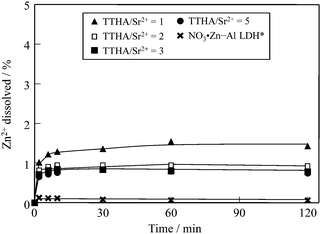 |
| | Fig. 7 Variations in the Zn2+ dissolution from TTHA·Zn–Al and NO3·Zn–Al LDHs with time during their suspension in the Sr(NO3)2 solution. * This amount is equal to that of TTHA·Zn–Al LDH at TTHA/Nd3+ = 5. | |
Fig. 8 shows the XRD patterns for the products obtained from TTHA·Zn–Al LDH suspensions in the (a) Nd(NO3)3 and (b) Sr(NO3)2 solutions. Compared to the XRD patterns for the original TTHA·Zn–Al LDH (Fig. 2b), few detectable shifts of the diffraction peaks were observed at an angle corresponding to the basal spacing. This indicates that the uptake of Nd3+ ions did not disrupt the interlayer spacing, indicating that the [Nd–C18H25N4O12]2− complex was smoothly formed in the interlayer of TTHA·Zn–Al LDH. Because Sr2+ ions were not taken up by the metal–chelate formation, the basal spacing did not change.
 |
| | Fig. 8 XRD patterns for the products obtained from the TTHA·Zn–Al LDH suspension in the (a) Nd(NO3)3 and (b) Sr(NO3)2 solutions at TTHA/M = 5 in 120 min. | |
Fig. 9 shows the variations in the Nd3+ and Sr2+ ion uptake with time using a suspension of TTHA·Zn–Al LDH in a 1:1 mixed nitrate solution of Nd3+ and Sr2+ ions. The degree of Nd3+ ion uptake increased rapidly with time; however, that of Sr2+ ion uptake increased slightly with time. The degree of uptake decreased in the order, Nd3+ > Sr2+, for all the time periods, and the degrees of Nd3+ and Sr2+ ion uptake were 80.6% and 7.6%, respectively, in 120 min. In this case, the degree of selectivity, i.e., the Nd3+/Sr2+ molar ratio, was 10.7. The uptake amount was 0.078 and 0.007 mmol g−1 for Nd3+ and Sr2+, respectively. TTHA·Zn–Al LDH was found to uptake Nd3+ ions more preferentially than the Sr2+ ions from solutions. This can be attributed to the difference among the stabilities of [Nd–C18H25N4O12]2−, [Zn–C18H25N4O12]3−, and [Sr–C18H25N4O12]3− complexes. The metal–chelate formation constants for [Nd–C18H25N4O12]2−, [Zn–C18H25N4O12]3−, and [Sr–C18H25N4O12]3− complexes have been reported to be 22.8, 16.7, and 9.3, respectively;28,29 i.e., the stability of the metal–chelate complex decreased in the order, [Nd–C18H25N4O12]2− > [Zn–C18H25N4O12]3− > [Sr–C18H25N4O12]3−. Nd3+ ions easily form [Nd–C18H25N4O12]2− complex with the C18H25N4O125− ions in the interlayer of TTHA·Zn–Al LDH and easily exchange with the Zn2+ ions in [Zn–C18H25N4O12]3− complex in the interlayer. In contrast, [Sr–C18H25N4O12]3− complexes were difficult to form from Sr2+ and C18H25N4O125− ions in the interlayer of TTHA·Zn–Al LDH, and the Zn2+ ions in [Zn–C18H25N4O12]3− complex were difficult to be exchanged with Sr2+ ions in the interlayer.
 |
| | Fig. 9 Variations in Nd3+ and Sr2+ ion uptake with time using a suspension of TTHA·Zn–Al LDH in a 1:1 mixed nitrate solution of Nd3+ and Sr2+ ions. * TTHA/(Nd3+ + Sr2+) = 2.5. | |
Fig. 10 shows the variations in the Nd3+ ion uptake with time using TTHA·Zn–Al and EDTA·Zn–Al LDH suspensions in the Nd(NO3)3 solution at both the TTHA/Nd3+ and EDTA/Nd3+ ratios of 5. In both the cases, the Nd3+ ion uptake increased with time. The degree of Nd3+ ion uptake decreased in the order, TTHA·Zn–Al LDH > EDTA·Zn–Al LDH for all the time periods, and the degrees of Nd3+ ion uptake by TTHA·Zn–Al and EDTA·Zn–Al LDHs were 91.5% and 38.8%, respectively, in 120 min. TTHA·Zn–Al LDH was superior to EDTA·Zn–Al LDH for the uptake of Nd3+ ions. This can be attributed to the difference between the stabilities of Nd–TTHA and Nd–EDTA complexes. Similar to the case of TTHA·Zn–Al LDH, EDTA·Zn–Al LDH could uptake Nd3+ ions because of the formation of Nd–EDTA complex in the interlayer.18,19 The metal–chelate formation constant for Nd–EDTA complex has been reported to be 16.6;30 i.e., the stability of the metal–chelate complex decreased in the order Nd–TTHA complex > Nd–EDTA complex. The degree of Nd3+ ion uptake was changed by the stability of the metal–chelate complex. These results show the possibility that the degree of rare-earth metal uptake can be controlled by choosing suitable chelating agents based on the stability of the metal–chelate complex.
 |
| | Fig. 10 Variations in the Nd3+ ion uptake with time using TTHA·Zn–Al and EDTA·Zn–Al LDH suspensions in the Nd(NO3)3 solution at both the TTHA/Nd3+ and EDTA/Nd3+ ratios of 5. | |
Conclusions
TTHA·Zn–Al LDH was prepared by the dropwise addition of a Zn–Al nitrate solution to a TTHA solution at a constant pH value of 10.0. The as-synthesized TTHA·Zn–Al LDH contained C18H25N4O125−, [Zn–C18H25N4O12]3−, and [Zn2–C18H25N4O12]− species in its interlayer. The TTHA·Zn–Al LDH was found to uptake Nd3+ ions from aqueous solutions. This can be attributed to the metal–chelating functions of C18H25N4O125− and [Zn–C18H25N4O12]3− species in the interlayer of the TTHA·Zn–Al LDH, i.e., [Nd–C18H25N4O12]2− complex could be formed in the interlayer. However, the TTHA·Zn–Al LDH could hardly uptake Sr2+ ions from aqueous solutions. The C18H25N4O125− and [Zn–C18H25N4O12]3− species in the interlayer of the TTHA·Zn–Al LDH did not function as the chelating agents for Sr2+ ions. This can be attributed to the low stability of [Sr–C18H25N4O12]3− complex. TTHA·Zn–Al LDH was found to uptake Nd3+ ions more preferentially than the Sr2+ ions from aqueous solutions, which can be attributed to the order of the stabilities of the metal–chelate complexes, [Nd–C18H25N4O12]2− > [Zn–C18H25N4O12]3− > [Sr–C18H25N4O12]3−. Furthermore, TTHA·Zn–Al LDH was superior to EDTA·Zn–Al LDH for the uptake of Nd3+, which can be attributed to the order of the stabilities of metal–chelate complex, Nd–TTHA complex > Nd–EDTA complex. Thus, the degree of rare-earth metal uptake can be controlled by selecting suitable metal–chelating agents based on the stability of the metal–chelate complex.
Notes and references
- F. Cavani, F. Trifiro and A. Vaccari, Catal. Today, 1991, 11, 173 CrossRef CAS.
- L. Zhang, Appl. Mech. Mater., 2012, 148–149, 1276 CAS.
- Y. Guo, Z. Zhu, Y. Qiu and J. Zhao, J. Hazard. Mater., 2012, 239–240, 279 CrossRef CAS PubMed.
- C. Ardau, F. Frau, E. Dore and P. Lattanzi, Appl. Clay Sci., 2012, 65–66, 128 CrossRef CAS PubMed.
- Y. Chen and Y.-F. Song, Ind. Eng. Chem. Res., 2013, 52, 4436 CrossRef CAS.
- P. Koilraj and K. Srinivasan, Ind. Eng. Chem. Res., 2013, 52, 7373 CrossRef CAS.
- C. Ardau, F. Frau and P. Lattanzi, Appl. Clay Sci., 2013, 80–81, 1 CrossRef CAS PubMed.
- R. M. M. Santos, R. G. L. Goncalves, V. R. L. Constantino, L. M. Costa, L. H. M. Silva, J. Tronto and F. G. Pinto, Appl. Clay Sci., 2013, 80–81, 189 CrossRef PubMed.
- X. Wu, X. Tan, S. Yang, T. Wen, H. Guo, X. Wang and A. Xu, Water Res., 2013, 47, 4159 CrossRef CAS PubMed.
- Y. Zhong, Q. Yang, K. Luo, X. Wu, X. Li, Y. Liu, W. Tang, G. Zeng and B. Peng, J. Hazard. Mater., 2013, 250–251, 345 CrossRef CAS PubMed.
- F. L. Theiss, G. A. Ayoko and R. L. Frost, J. Colloid Interface Sci., 2013, 402, 114 CrossRef CAS PubMed.
- H. Nakayama, S. Hirami and M. Tsuhako, J. Colloid Interface Sci., 2007, 315, 177 CrossRef CAS PubMed.
- I. Pavlovic, M. R. Perez, C. Barriga and M. A. Ulibarri, Appl. Clay Sci., 2009, 43, 125 CrossRef CAS PubMed.
- X. Liang, W. Hou, Y. Xu, G. Sun, L. Wang, Y. Sun and X. Qin, Colloids Surf. A: Physicochem. Eng. Aspects, 2010, 366, 50 CrossRef CAS PubMed.
- T. Kameda, H. Takeuchi and T. Yoshioka, Sep. Purif. Technol., 2008, 62, 330 CrossRef CAS PubMed.
- T. Kameda, H. Takeuchi and T. Yoshioka, Mater. Res. Bull., 2009, 44, 840 CrossRef CAS PubMed.
- T. Kameda, H. Takeuchi and T. Yoshioka, Colloids Surf., A, 2010, 355, 172 CrossRef CAS PubMed.
- T. Kameda, S. Saito and Y. Umetsu, Sep. Purif. Technol., 2005, 47, 20 CrossRef CAS PubMed.
- M. R. Perez, I. Pavlovic, C. Barriga, J. Cornejo, M. C. Hermosin and M. A. Ulibarri, Appl. Clay Sci., 2006, 32, 245 CrossRef CAS PubMed.
- R. Rojas, M. R. Perez, E. M. Erro, P. I. Ortiz, M. A. Ulibarri and C. E. Giacomelli, J. Colloid Interface Sci., 2009, 331, 425 CrossRef CAS PubMed.
- S. A. Kulyukhin, E. P. Krasavina, I. V. Gredina, I. A. Rumer and L. V. Mizina, Radiochemistry, 2008, 50, 493 CrossRef CAS.
- S. R. J. Oliver, Chem. Soc. Rev., 2009, 38, 1868 RSC.
- V. V. Goncharuk, L. N. Puzyrnaya, G. N. Pshinko, A. A. Kosorukov and V. Y. Demchenko, J. Water Chem. Technol., 2011, 33, 288 CrossRef.
- S. A. Kulyukhin, E. P. Krasavina, I. A. Rumer, L. V. Mizina, N. A. Konovalova and I. V. Gredina, Radiochemistry, 2011, 53, 504 CrossRef CAS.
- T. Kameda, K. Hoshi and T. Yoshioka, Solid State Sci., 2011, 13, 366 CrossRef CAS PubMed.
- T. Kameda, K. Hoshi and T. Yoshioka, Mater. Res. Bull., 2012, 47, 4216 CrossRef CAS PubMed.
- T. Kameda, K. Hoshi and T. Yoshioka, Solid State Sci., 2013, 17, 28 CrossRef CAS PubMed.
- L. Harju and A. Ringbom, Anal. Chim. Acta, 1970, 49, 221 CrossRef CAS.
- L. Harju, Anal. Chim. Acta, 1970, 50, 475 CrossRef CAS.
- R. M. Smith and A. E. Martell, Critical Stability Constants, Plenum Press, New York, 1989 Search PubMed.
- P. Letkeman and A. E. Martell, Inorg. Chem., 1979, 18, 1284 CrossRef CAS.
- M. J. Frisch, G. W. Trucks, H. B. Schlegel, G. E. Scuseria, M. A. Robb, J. R. Cheeseman, J. A. Montgomery Jr, T. Vreven, K. N. Kudin, J. C. Burant, J. M. Millam, S. S. Iyengar, J. Tomasi, V. Barone, B. Mennucci, M. Cossi, G. Scalmani, N. Rega, G. A. Petersson, H. Nakatsuji, M. Hada, M. Ehara, K. Toyota, R. Fukuda, J. Hasegawa, M. Ishida, T. Nakajima, Y. Honda, O. Kitao, H. Nakai, M. Klene, X. Li, J. E. Knox, H. P. Hratchian, J. B. Cross, V. Bakken, C. Adamo, J. Jaramillo, R. Gomperts, R. E. Stratmann, O. Yazyev, A. J. Austin, R. Cammi, C. Pomelli, J. W. Ochterski, P. Y. Ayala, K. Morokuma, G. A. Voth, P. Salvador, J. J. Dannenberg, V. G. Zakrzewski, S. Dapprich, A. D. Daniels, M. C. Strain, O. Farkas, D. K. Malick, A. D. Rabuck, K. Raghavachari, J. B. Foresman, J. V. Ortiz, Q. Cui, A. G. Baboul, S. Clifford, J. Cioslowski, B. B. Stefanov, G. Liu, A. Liashenko, P. Piskorz, I. Komaromi, R. L. Martin, D. J. Fox, T. Keith, M. A. Al-Laham, C. Y. Peng, A. Nanayakkara, M. Challacombe, P. M. W. Gill, B. Johnson, W. Chen, M. W. Wong, C. Gonzalez and J. A Pople, Gaussian 03, Revision 3.09, Gaussian, Inc., Wallingford, CT, 2004 Search PubMed.
|
| This journal is © The Royal Society of Chemistry 2014 |
Click here to see how this site uses Cookies. View our privacy policy here. 


