Anand Lodhaa,
Alok Pandyab,
Pinkesh G. Sutariyac and
Shobhana K. Menon*ad
aDepartment of Forensic Science, School of Sciences, Gujarat University, Ahmedabad, Gujarat-380009, India. E-mail: forensicwithanand@gmail.com
bInstitute of Life Sciences, Ahmedabad University, Ahmedabad, Gujarat-380009, India
cBhavans Shree I. L.Pandya Arts, Science College, Dakor 388225, Gujarat, India
dDepartment of Chemistry, School of Sciences, Gujarat University, Ahmedabad, Gujarat-380009, India. E-mail: shobhanamenon07@gmail.com; Tel: +91-079-26300435
First published on 11th September 2014
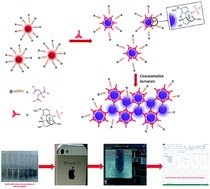
Driven by the need to detect narcotics, we designed a “smart” system for the rapid detection and quantification of codeine sulphate levels using a smartphone, which allows simple, portable, on-spot, rapid and ultrasensitive nanoaggregation colorimetric detection (a lower detection limit of 0.9 μM) using the unique properties of citrate-stabilized gold nanoparticles (AuNPs) as a probe.
Currently, many different techniques exist for the detection of the drugs and their metabolites from various types of samples. The most common techniques that are routinely in use are high-performance liquid chromatography,3 absorption spectroscopy,4 IR spectroscopy,5 thin-layer chromatography,6 mass spectrometry (MS) and gas chromatography (GC).7 However, these methods require sophisticated equipment, which are quite inconvenient for outdoor detection or for on-spot analysis. Hence, it is necessary to develop simple, cost-effective, highly sensitive and smart techniques for the detection of drugs of forensic interest.
In recent years, gold nanoparticles (AuNPs) have attracted considerable attention, owing to their excellent biocompatibility, unique optical and electrochemical properties8 and their applications for the sensing of various analytes. These include proteins, DNA, amino acids and metal ions with a sensing mechanism, based on analyte-induced changes in their absorption and fluorescence, which are widely researched.9 Recently, these unique optical properties are smartly utilized in quantitative analysis using digital imaging and smartphone cameras. The measurement of shades of colorimetric product in digital imaging facilitates a quantitative analysis using the color space and imaging devices.10 Recently, we reported a novel nanoaggregation detection technique of TNT using nanocurcumin as a probe,11 potassium ion recognition by benzo-15-crown-5-gold nanoparticles,12 selective amino acid recognition of lysine, arginine and histidine by functionalized calix [4] arene thiol AuNPs,13 “on-spot” colorimetric recognition of clonazepam by melamine-modified AuNP14 and a rapid colorimetric detection of sulfides using calix [4] arene-modified AuNPs as a probe.15 The sensitivity and selectivity of these sensors inspired us to design and develop sensors on the same line for codeine sulphate.
The surface adsorption of electron-rich ligands on AuNPs has been well recognized in the literature.16 Hydroxyl groups with electron-rich oxygen atoms are more likely to be bound onto the surface of metal nanoparticles through coordinating interactions with the electron-deficient surfaces of metal nanoparticles.17 In particular, oxygen containing rings of hybrid aromatics exhibit considerably stronger binding to AuNPs; therefore, the furan like compounds are often used as transfer agents of AuNPs from one phase to another or as a mediator of aggregating states of metal nanoparticles. Accordingly, codeine sulphate with multiple binding sites containing sulphate groups and an oxygen hybrid ring may strongly coordinate to AuNPs by the ligand exchange with weak surface-bound citrate ions, and finally cross-linked AuNPs. The colloidal stability is significantly reduced to result in the prompt occurrence of particle aggregation, as revealed in Fig. 1A. The molecular linker-based aggregation offers a new approach to a simple and rapid colorimetric assay for the detection of codeine sulphate in bone, bone marrow and soil, which does not require any extra aid such as specific acceptors.
The AuNP synthesis procedure was essentially the same as that developed by Menon et al.15 (ESI†). 1 mL of codeine sulphate was added into 2 mL of the AuNPs (0.07 mM) suspension in a phosphate buffer (pH 7.5). The shift in the surface plasmon resonance (SPR) absorption maxima of the AuNPs on adding predetermined quantities of codeine sulphate standard was recorded using a UV-visible absorption spectrophotometer, and the same resultant color product was imaged with an iPhone 5S in a safety cabinet for smart analysis. The aggregating kinetics of AuNPs with 1 μM to 1 mM codeine sulphate was obtained by measuring the absorbance and intensity of the red, green, blue lights and total RGB at an interval of 2 min and these were further optimized. The calibration curves were plotted with the wavelength against the absorbance (Fig. 2B) and the concentration against the intensity of the red, blue, green and total RGB (Fig. 3).
The light intensity of the color product was measured in safety cabinet with a white interior to obtain same environment and lighting condition for photography. The color product of AuNPs and codeine sulphate obtained was transferred into micro centrifuge tubes and was photographed in this system with the built-in digital camera of the iPhone 5S, which was set to “flash-off” mode. The iPhone 5S's backside illumination (BSI) CMOS image sensor was used, which facilitated more incident light to reach the light-sensing silicon. These properties allow the light to strike the photocathode layer without passing through the wiring layer in the BSI CMOS sensor providing better sensitivity to detect small differences in photon emission from darker products as compared to any DSLR camera.10a Each photographed image was saved as a JPEG (24 bit) on the iPhone's memory. Subsequently, images were transferred to a computer and opened in Adobe Photoshop CS6. The fixed size box of 100 × 100 pixels was placed at fixed points on each micro centrifuge tube image with the help of the Rectangular Marquee tool. The mean intensity of the red, green and blue colors of the selected parts was obtained by using the Histogram tool. This entire procedure was repeated five times, and the average of intensity of each was recorded in an Excel (version 2013) spreadsheet for data analysis (Fig. 1A).
The UV-visible spectrum of the citrate-capped AuNPs solution showed maximum absorption at 520 nm, which remained same even after several months of storage. This indicates that microwave-synthesized nanoparticles are stable. Citrate-capped AuNPs are miscible with water, and the clear solution appears red. In our study, a molecular-linker-based aggregation mechanism between AuNPs and codeine sulphate was monitored by a UV-vis spectrophotometer. During the study, various concentrations of drug solutions, from 1 μM to 50 μM, were treated with 0.07 mM AuNPs. Upon direct exposure of 0.1 mM codeine sulphate to citrate-stabilized AuNPs, the solution immediately turned to purple color from wine red (Fig. 2). This significant change in color indicates that citrate capped AuNPs recognize codeine sulphate. As shown in Fig. S1 (ESI†) the absorption ratio (A582/A520) remained unchanged after 2 min, indicating that the interaction was almost completed under this condition. Therefore, all of the absorption measurements were performed within 2 min. The surface plasmon absorption of citrate capped AuNPs solution were subjected to instantaneous exposure of increasing amounts of codeine sulphate from 7 μM to 1 μM as schemed in Fig. 2A. With the addition of 0.1 mM codeine sulphate, the absorbance at 520 nm decreases dramatically and a new band upturns at 582 nm, which confirms the binding of codeine sulphate with AuNPs. Fig. 2A shows that the intensity of the new band rises with the increasing concentration of codeine sulphate. This indicates that an increasing number of AuNPs were consumed to form an increasing number of aggregates.
From the series of experiments, it was concluded that as the aggregation increases, the sizes of the particles also increase, which results in the color change. These changes in the intensity were noticed as a shift in UV-visible spectrogram. It is directly noticeable that there is a significant change in absorbance intensity from 520 nm to 582 nm upon increasing the concentration of the codeine sulphate (Fig. 1B). However, there is a decrease in color intensity after three days due to sedimentation. The linear range for codeine sulphate, using 0.07 mM citrate-capped AuNPs is found to be 1 μM–20 μM (R2 = 0.998) (Fig. 2B). The lower detection limit was found to be 0.9 μM (3σ) and shows fast response behaviour (<60 s) after the addition of codeine sulphate into citrate-stabilized AuNPs. The appearance of a new peak is due to the aggregation of AuNPs, which is caused by the replacement of citrate ions by codeine sulphate, leading to the formation of AuNPs–cod complex (Fig. 1B). This can be attributed to the greater electrostatic attraction of active groups of codeine sulphate with AuNPs rather than citrate groups, which is responsible for the additional band at a longer wavelength. It has been shown theoretically and experimentally that AuNP aggregation leads to another plasmon absorption at a longer wavelength when the individual nanoparticles are electronically coupled to each other. The oscillating electrons in one particle feel the electric field due to the oscillation of the free electrons in a second particle, which can lead to a collective plasmonic oscillation of the aggregated system. This ligand-exchange reaction, or cross-linking interaction, provides an important means for the chemical functionalization of the nanoparticles and greatly extends the versatility of these systems. The relative absorbance change of AuNPs at 520 nm in the presence of 0.1 mM codeine sulphate and other drugs such as morphine, phenylephrine, phenobarbital, diazepam, lorazepam and clonazepam were measured to evaluate the selectivity of probe, where no such interference was observed in the case of other drugs (Fig. S2, ESI†). The high selectivity of the codeine sulphate towards the nanoprobe may be due to the presence of three oxygen-containing groups on one end binding to the citrate-modified AuNPs and sulphate group (SO32−) on the opposite end binding with the another citrate-modified AuNP, resulting in the aggregation.
The quantitative study of proposed nanoprobe with codeine sulphate was performed by smartphone. As previously discussed, the collected images were opened in Adobe Photoshop CS6 software, automatically recognizing the color space of the picture. The R(ed), G(reen), and B(lue) intensities are representing the total photons in each region of the spectrum.15 This phenomenon was used for quantification in this study, and the results were found to be prominent (Table S1, ESI†). The range for codeine sulphate from 1 μM to 10 μM was analyzed and found to be linear. The graph shows that color intensities of the green and total RGB were more significant and give good results (Fig. 3). It was observed that the blue and red lights and codeine sulphate concentration were similar as both reflected by the color products. The color intensity showed a good relationship between their intensity and codeine sulphate concentration (Fig. 3).
Molecular linker-based aggregation of codeine sulphate-conjugated AuNPs has been evaluated by dynamic light scattering (DLS) measurements, which illustrated that the 0.07 mM AuNPs has an average hydrodynamic diameter of ∼44 nm that maintain their size and stability (Fig. 4A). Similarly, the addition of a codeine sulphate solution (0.1 mM) to citrate-stabilized AuNPs (0.07 mM), immediately resulted in aggregation, and the size of nanoparticles increases to ∼663 nm. The DLS histogram (Fig. 4B) clearly confirms the cross linking between the codeine sulphate and citrate-stabilized AuNPs. Upon the addition of various codeine sulphate concentrations (1 μM, 10 μM), AuNPs agglomerated and the size increased to (286 nm, 413 nm, respectively) (Fig. S3, ESI†). Thus, AuNP-based DLS assay was able to show a response at a lower concentration of codeine sulphate with only smaller aggregate formation and at higher concentrations, codeine sulphate shows larger aggregates. The cross-linking-based aggregation between codeine sulphate and citrate-stabilized AuNPs is further confirmed by TEM. As shown in Fig. 4C, the TEM images of mono dispersed 0.07 mM AuNPs showed uniform particles with an average size of 44 nm in diameter in the absence of codeine sulphate. However, after the interaction with codeine sulphate, irregular AuNP nanoaggregates were observed (Fig. 4D). As previously mentioned, this significantly indicates that citrate-capped AuNPs will bind with codeine sulphate to form AuNPs–codeine sulphate nanoaggregates via cross-linking interaction.
A ligand exchange reaction-based AuNPs–cod complex is investigated by FT-IR spectroscopy. The FT-IR spectra of AuNPs and cod complex ranged between 4000–600 cm−1 with broad stretching vibrations of all characteristic functional moieties of ligands revealing their direct interaction with codeine sulphate. Vibrational spectra of codeine sulphate (Fig. S4A, ESI†) shows a broad band at 3415 cm−1 (–OH), 2923 cm−1, 2831 cm−1 (asymmetric and symmetric –C–H stretching), and (C–N) 1143 cm−1, (–S
O) 2599 cm−1 (SO3−) 1041 cm−1, and (O
S
O–stretching in SO3H) 1378 cm−1. The vibrational spectrum of AuNPs–cod complex is quite different as compared to codeine sulphate due to disappearance of peak at (–S
O) 2599 cm−1 and shifting of peak at (C–N) 1196 cm−1, (SO3−) 1081 cm−1, (O
S
O–stretching in SO3H) 1438 cm−1 (Fig. S4B, ESI†). As there was a very strong interlinked complex, it can be said that the peak difference is due to the ligand exchange reaction or electrostatic interaction.
The ligand exchange-based complex formation between codeine sulphate and AuNPs are further confirmed by ESI-MS spectra. Fig. S5 (ESI†) shows the ESI-MS spectra of the mixtures of codeine sulphate with AuNPs in an aqueous solution, when the codeine sulphate was mixed with AuNPs in an aqueous solution, in which the molecular ion peak at m/z = 893 was clearly detected. This undoubtedly suggests the formation of AuNPs–cod complex in the mixture.
The pH of the medium is another critical factor affecting codeine sulphate detection. For the gold nanoprobe, the drug recognition became less efficient with pH elevation, thus it was optimized at pH 6–9 and entire reactions were carried out at pH 7.5. The pH dependence of detection potently proves the aforementioned AuNPs–codeine ligand exchange or electrostatic interaction. Therefore, it is reasonable that the ligand exchange will be impeded greatly at higher pH conditions (6.0–9.0) (Fig. S6, ESI†) as a result of the increase in the electrostatic interaction between codeine sulphate and citrate-capped AuNPs. We also assessed the stability of a citrate-capped AuNP assembly at various pH conditions (Table S2, ESI†). It was perceived that AuNPs exhibited lower stability in a solution of low pH ranging from 2 to 4 and were aggregated in a few hours in the pH range of 7–10. The solution remained stable for weeks to months with no sign of further aggregation.
In order to evaluate the applicability and selectivity of the present assay, the determination of total drug content in bone, bone marrow and soil were performed using UV-vis spectrophotometry (ESI†). Extracted drug samples (Scheme 1) from bone, bone marrow and soil samples were initially diluted with deionised water as per the requirement, to fall into the linear range (1–50 μM), of our method and to obtain quantitative recovery of the treated samples. The total codeine sulphate content in bone, bone marrow and soil samples was also determined by the standard addition method. The control non-treated real samples were also examined and compared. The recovery results ranged from 98% to 102.4%, indicating that no significant interference occurs in the determination of the drug from bone, bone marrow and soil samples after an appropriate dilution of the samples (Table S3, ESI†). The aforementioned results demonstrate that the drug-mediated aggregation of AuNPs possesses great potential for detecting abused drugs in post-mortem skeletal remains samples in forensic investigations.
![]() | ||
| Scheme 1 Flow chart of extraction and sample preparation of bone, bone marrow and soil for codeine sulphate. | ||
Footnote |
| † Electronic supplementary information (ESI) available. See DOI: 10.1039/c4ra06269h |
| This journal is © The Royal Society of Chemistry 2014 |