
Han-Wen Hsu and
Cheng-Liang Liu*
Department of Chemical and Materials Engineering, National Central University, Taoyuan 32001, Taiwan. E-mail: clliu@ncu.edu.tw
First published on 26th June 2014
We herein present the results from our study of spray-coated poly[(9,9-dioctylfluorenyl-2,7-diyl)-co-bithiophene] (F8T2) semiconducting polymer films for organic thin film transistor (OTFT) applications. Optimized spray-coating parameters were performed for deposition of F8T2 layer on Si/SiO2 substrate treated with self-assembled monolayers (SAMs) of organosilane compounds. OTFTs fabricated from general spin-coating on the same substrate were also tested to evaluate the quality of active F8T2 layer. Comparable OTFT electrical performances can be obtained for both cases even through the spray-coated devices have high surface roughness and low overall homogeneity. The spray-coated F8T2 OTFTs on the SAMs-modified substrate exhibit a maximum hole mobility of ∼7.8 × 10⁻³ cm2 V−1 s−1 and ON/OFF ratios of over 105. These results confirm that the spray-coating method is a powerful tool in production of reliable and reproducible OTFTs, displaying a great potential for other solution-processable organic (opto-)electronics devices.
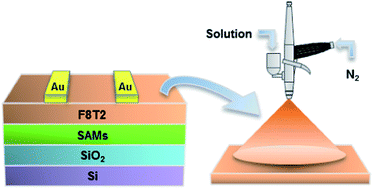
Among these, spray-coating is the subject of our interest since it has come up with advantages of being able to coat the organic/polymer thin film for a large number of potential applications ranging from transistors, photovoltaic cells, electrochemical devices and chemical/biological sensors to biomedical applications.14–25 Spray-coating in general compromises N2- or air-pressurized atomization of a solution mixture through the nozzle, tiny droplet coalesce and flight in the vertical direction, solvent evaporation, droplet spreading and drying, and adhesion of solid parts attached on the substrates to form the thin film layer. Spray-coating needs the related processing parameters to be manipulated such as solution concentration, solvent used, spraying distance between nozzle and substrate, carrier gas pressure and substrate types and annealing temperature, etc. Since the spray-deposited OTFTs are not fully understood and the results are now still inconclusive, the aim of this work is to gain more significant insight into the properties of spray-on semiconducting layer. All these issues can be taken into consideration for optimizing the OTFTs characteristics.
Chan et al. have investigated poly(3-hexylthiophene) (P3HT)-based OTFTs fabricated by airbrush deposition technique. Here, we report a detailed study of optimization of spraying parameters on the quality of the resulting conjugated polymer semiconductors coating. The spraying process was performed under the ambient conditions since commercially available poly[(9,9-dioctylfluorenyl-2,7-diyl)-co-bithiophene] (F8T2) semiconducting polymer is formulated for good performance as well as high stability against environmental conditions. The use of self-assembled monolayers (SAMs) of organosilanes was introduced between spray-coated F8T2/SiO2 interface to control the interfacial properties. The structural effects were determined using polarizing optical microscope and UV-Vis absorption spectroscopy. Statistical analysis on the OTFTs characteristics is performed as guideline for influencing processing parameters. Semiconducting F8T2 films using spray-coating process exhibited a maximum hole mobility of ∼7.8 × 10⁻³ cm2 V−1 s−1 and ON/OFF ratios of over 105 comparable to spin-coated device and can be used in the large scale fabrication of solution-processable OTFTs.
000 g mol−1) solution with approximately 4 mg ml−1 in dichlorobenzene (stirred overnight and filtered through PTFE syringe filter before use) was loaded into the commercially available pistol-type airbrush with a nozzle size of 0.3 mm and sprayed onto the substrate using a N2 pressure of 15 psi. The nozzle-to-substrate surface distance and deposited time were varied to control the quality and thickness of F8T2 layer. After spraying, the F8T2 film was heat treated at ∼80 °C for 30 min. 50 nm thick source and drain Au electrodes were deposited by thermal evaporation on the F8T2 semiconducting layer through the shallow mask.
![]() | ||
| Fig. 2 Polarizing microscope image of the F8T2 spray-coated thin film prepared on (a) bare SiO2 and (b) OTS- and (c) PTS-modified substrate. | ||
The UV-Vis absorption spectra of spray-coated and spin-coated F8T2 thin films on SAMs/quartz substrates were measured and are shown in Fig. 3. Both F8T2 thin films exhibit a broad absorption range from 350 to 550 nm and similar position in absorption spectra with the maximum at 460 nm and vibronic band at 485 nm. Slightly blue-shifted absorption edge and decease in relative intensity for higher wavelength peak based on the spray-coated F8T2 film may be due to a reduced molecular interaction and disordered chain alignment. Note that the spray-coated film still have strong electronic perturbation due to the π–π stacking of F8T2 chain.26
Top-contact bottom-gate (TCBG) OTFTs were fabricated in which source and drain electrode was vacuum-deposited on top of semiconducting layer, as shown in Fig. 1. The electrical characteristics of the F8T2 OTFTs were examined by output (Id–Vd) and transfer (Id–Vg) measurement. The organic buffer layer on the SiO2 surface can play a critical role on the OTFTs performance. Fig. 4(a) and (b) depict the transfer and output characteristics of spray-coated F8T2 OTFTs based on OTS- and PTS-functionalized substrates, respectively (for the case of bare SiO2/Si substrates, see Fig. S1 of ESI†). The output characteristics are measured with a gate bias that varies from 0 to −60 V in steps of −10 V and exhibit well-defined linear and saturated regimes with a typical p-channel operation mode. The transfer curves in Fig. 4 also show that the spray-coated F8T2 devices have low gate OFF currents to be below 10−11 A. The hole mobility (μh) can be deduced to be based on respective transfer curves swept in the Vg range of 0 V to −60 V at a Vd of −60 V. The Vth is determined from a linear extrapolation of Id1/2 versus Vg. Table 1 summarizes the OTFTs performance data (including μh, ON/OFF current ratio (ION/IOFF) and Vth) of the devices prepared on the non- or OTS- or PTS-modified SiO2/Si substrates. The charge modulation of the F8T2 current channel is influenced by the attached interactions between F8T2 droplet and underlying layers and is reflected on the μh. Notably, OTFTs on SAMs-modified surface exhibit a steep parabolic slope in transfer characteristics and well-defined saturated region in output characteristics. Among these, the OTFTs prepared on OTS substrates have a highest μh (as high as ∼7.8 × 10⁻³ cm2 V−1 s−1), and SAMs-modified substrates provide one order of magnitude higher μh compared with the bare SiO2/Si substrate while ION/IOFF is also improved substantially after SAMs treatment and has a similar increasing trend with the μh results. This is mainly due to the reduced charge trapping defect at the spray-coated F8T2 semiconductor/SAMs-modified dielectric interface. Passivation of SiO2 surface by SAMs and the long alkane chain ends in OTS/phenyl rings in PTS allowed to interact with stacking of aromatic rings in F8T2 can effectively enhance the charge mobility. When comparing the μh in different SAMs surfaces, it can be observed that the OTFTs characteristics fabricated by spray-coating on PTS-modified substrate are consistently superior to those deposited by other conditions. Specifically, the collected μh prepared from OTS-modified substrate varies in a relatively broad range as compared to PTS-modified substrate mainly attributed to the incomplete coverage and inhomogeneity of F8T2 layer caused by the spraying process (see Fig. 2(b) & (c)). Presumably good wettability and spreading of F8T2 droplet on the PTS-modified surface increase the contact area between the F8T2 and substrate, favoring the continuous attachment. Surface treatment with PTS results in more tightly distributed μh value of F8T2-based OTFTs. However, the morphologies of spray-coated F8T2 thin film under different SAMs surfaces were also investigated by AFM topographies (Fig. S2 of ESI†). In a microscopic level, small aggregated domains appear in the F8T2 thin film layer prepared from PTS-modified substrate, suggesting the reduced interchain charge transport properties. Probably good F8T2 chain connection within the droplet causes that the average mobility of F8T2 device from OTS-modified surface is slightly higher than from PTS-modified surface. Besides, all Vth data exhibit no significant change perhaps originated from the large charge injection barrier from the work function of Au source/drain electrodes into the HOMO level of F8T2 semiconducting layer or rough top-contact interface of Au/F8T2 rather than from F8T2/dielectric interface trapping. Therefore, the results suggest that the spray-coating method indeed can be used to fabricate the high degree device-to-device performance uniformity.
![]() | ||
| Fig. 4 Transfer curves (upper) and output curves (lower), measured for the spray-coated F8T2 OTFTs on (a) OTS- and (b) PTS-modified substrate. | ||
In parallel with the spray-deposited OTFTs, spin-coated F8T2 OTFTs were also tested for comparison (Fig. S3 of ESI†). It is noted that the Id of spray-coated OTFTs has almost similar order of magnitude with spin-coated ones and comparable μh results (>10−3 cm2 V−1 s−1) can also be obtained for both cases.26,27 Therefore, suitable drying time by controlling the nozzle-to-substrate surface distance may introduce the F8T2 droplets reorganization although the presence of the surface boundary and microscale film roughness during the spray-coating process may limit the current transport channel. While the film uniformity and roughness are subject to more variability, the resulting devices prepared from spray-coating still show remarkable tolerance to these differences. The spray-coating technique can not only be used to deposit the polymer semiconducting layer in the solid substrates, it can also be used to obtain all layers in OTFTs (electrode and dielectric layer) patterned in terms of the flexible substrates. An automatic spray-coating system can be implanted for further controlling the processing parameters. This subject is now under investigation and will be reported elsewhere.
Footnote |
| † Electronic supplementary information (ESI) available. See DOI: 10.1039/c4ra03726j |
| This journal is © The Royal Society of Chemistry 2014 |