DOI:
10.1039/C4RA03502J
(Paper)
RSC Adv., 2014,
4, 28056-28061
Reduced dielectric loss in Ba0.95Sr0.05(Fe0.5Nb0.5)O3 thin film grown by pulsed laser deposition
Received
17th April 2014
, Accepted 5th June 2014
First published on 5th June 2014
Abstract
Thin films of Ba0.95Sr0.05(Fe0.5Nb0.5)O3 ceramic on ITO-coated glass substrate were prepared by pulsed laser deposition technique. Deposited films were annealed at 500 °C for 1 h in vacuum. Structural, dielectric and optical properties were studied at different substrate temperature. Thin films were analyzed using low angle X-ray diffraction. All thin films have a single-phase perovskite structure. AFM analysis showed the uniform and nanosize grains in all samples. At room temperature, high dielectric constant (∼4037) with low dielectric loss (0.04) was obtained at 1 kHz frequency. The optical band gap was found to be 2.60 eV for 550 °C deposited film.
1. Introduction
Complex perovskite BaFe0.5Nb0.5O3 has drawn much attention in the fields of material science for its interesting dielectric relaxation and high dielectric constant behaviour.1,2 This material is, potentially, very useful for practical applications owing to its environmental friendly, lead-free nature and high dielectric material. However, the dielectric loss of BaFe0.5Nb0.5O3 is relatively high, and for practical applications, it is important to have low dielectric loss in addition to a high dielectric constant.
The dielectric loss is related with the mechanism of the dielectric response. Researchers proposed that the barrier layer mechanism is responsible for the dielectric behaviour in BaFe0.5Nb0.5O3 ceramics.3–6 Chung et al.,3 Intatha et al.6 and Liao et al.4 confirmed this idea by the impedance spectroscopy measurements which showed that BaFe0.5Nb0.5O3 ceramics are electrically heterogeneous, consisting of semiconducting grains with insulating grain boundaries. Recently, Wang et al.7 and Huang et al.8 suggested that the dielectric relaxation in BaFe0.5Nb0.5O3 ceramics is an oxygen vacancies related phenomena. On the whole, the grain boundary barrier layer capacitor model is widely accepted for the dielectric behaviour in BaFe0.5Nb0.5O3 ceramics.4,5 The barrier layers are formed due to the creation of oxygen vacancies during sintering at high temperature (≥1000 °C) in ceramics.4,5 Electrons released in this process, may be captured by Fe3+ leading to the formation of Fe2+. This leads to the hopping of electrons between the Fe2+ and Fe3+ ions, and increases the conductivity, which is responsible for the dielectric loss.9 A thin-film technology may provide a way to decrease the dielectric loss of BaFe0.5Nb0.5O3 as the synthesis/annealing temperature of the thin film is low as compared to the sintering temperature of bulk for the formation of materials.10
A pulsed laser deposition (PLD) technique has been developed into a well-established method for growing thin films of multicomponent oxides.11,12 To get better physical properties and high quality thin films for investigation, it is important to study the impact of key deposition conditions on the growth and surface morphology of thin films.10,13,14 In view of the technological importance, a great deal of basic research and development has been carried out on the electrical and optical properties of indium oxide-based materials.15 The ITO-coated glass substrate is found to be a suitable conducting substrate due to its good conductivity and good lattice constant matching.16,17
For the first time, we report Ba(1−x)Srx(Fe0.5Nb0.5)O3; x = 0, 0.05, 0.10 and 0.20 and have found a very high value of dielectric constant for x = 0.05.18 In addition, we also report for the first time, the thin film of Ba0.95Sr0.05(Fe0.5Nb0.5)O3 (BSFN) and have studied its dielectric and optical properties.
2. Experimental method
To prepare highly dense target for PLD, single-phase BSFN ceramic was synthesized by sol–gel method.18 A PLD system with a wavelength of 355 nm was used to grow BSFN thin films on ITO substrate. Thin films deposited with a fixed energy fluence of 1.5 J cm−2 at 500 °C, 550 °C and 600 °C in fixed oxygen pressure at 10 Pa. Deposited films were annealed at 500 °C for 1 h in vacuum. The thickness of thin films was estimated and found to be about 1 μm in all the samples. Ag electrodes of 1 mm in diameter were deposited on the top of the films by vacuum evaporation. The room temperature X-ray diffraction (XRD) patterns of the compounds were recorded by X-ray powder diffractometer (Brueker D8 Advance). The surface topography was examined by atomic force microscopy (AFM). The dielectric constant and dielectric loss of the samples were measured at room temperature using a HIOKI 3532-50 Hi Tester LCR meter. The UV-vis spectra were recorded by JASCO Model V-650 spectrophotometer in the wavelength range of 200–800 nm. The thickness of the thin films was determined by this spectrophotometer using interference fringes pattern of transmission spectra.
3. Results and discussion
3.1 X-ray diffraction
X-ray diffraction patterns of BSFN ceramic target and thin films were deposited at various substrate temperatures, which are shown in Fig. 1. The XRD pattern of BSFN target exhibits single phase monoclinic structure.18 The monoclinic structure agrees well with the results reported by Sinha et al.19 and Chung et al.3,5 However, the XRD analysis by Intatha et al.,1 Wang et al.,7 Tawichai et al.20 and Ke et al.21 indicated BaFe0.5Nb0.5O3 with a cubic structure. The XRD peaks of thin film samples are broader as compared to the ceramic target, so it is difficult to identify the structure of BSFN thin film. It can be seen that the BSFN films synthesized up to 550 °C were good polycrystalline with well-defined X-ray reflections. However, the X-ray reflection of (101) and (111) peaks was decreased for the 600 °C deposited film, which indicates the decrement in the polycrystalline nature.
 |
| | Fig. 1 (a) XRD pattern of BSFN ceramic target and low angle XRD pattern of BSFN thin film deposited at different substrate temperature (b) 500 °C, (c) 550 °C and (d) 600 °C. Star (*) represents the ITO peak. | |
In order to distinguish the effect of crystallite-size-induced broadening and strain-induced broadening, the Williamson–Hall plot22,23 was performed and is shown in Fig. 2. The Williamson–Hall equation is described by the following relation (1)
| |
 | (1) |
where
β1/2 is the diffraction peak width at half intensity (FWHM),
d is the crystallite size,
K is the Scherrer constant (0.89) and

is the lattice strain. Hence, by plotting
β1/2![[thin space (1/6-em)]](https://www.rsc.org/images/entities/char_2009.gif)
cos
θB versus sin
θB, the crystallite size can be determined from the intercept of the line at sin
θB = 0 and slope of the line gives the lattice strain. The crystallite size was found to be about 9 nm, 11 nm and 15 nm for 500 °C, 550 °C and 600 °C deposited films, respectively. Moreover, the lattice strain was found to be 0.005, 0.009 and 0.003 for 500 °C, 550 °C and 600 °C deposited films, respectively. However, the strain values are very small in all the samples so their effect on broadening is negligible.
23
 |
| | Fig. 2 Williamson–Hall plot of BSFN thin film deposited at different substrate temperature. | |
3.2 AFM analysis
Fig. 3 shows the 2-D AFM images (a–c) with their respective 3-D film surfaces (e–f) of BSFN thin films deposited at 500 °C, 550 °C and 600 °C, respectively. The circular grains with well-defined grain boundaries are observed. The average grain size was found to be about 27 nm, 38 nm and 45 nm for the 500 °C, 550 °C and 600 °C deposited films, respectively. The average grain size increases with increasing substrate temperature. At higher substrate temperature (600 °C), clusters of grains were observed. Similar results were also found by He et al.,24 Wei et al.25 and Mancilla et al.26 It is to be noted that grain size determined by AFM are higher than the crystallite size. It means that the grains observed in the AFM images are not single crystals but are made-up of few crystallites.
 |
| | Fig. 3 2D AFM images (a–c) with their respective 3D film surfaces (d–f) of BSFN thin films. | |
3.3 Dielectric and complex impedance study
Fig. 4 shows the influence of substrate temperature on the dielectric properties of BSFN thin films. Dielectric constant decreases with increasing frequency for a normal ferroelectric/dielectric material. We found high dielectric constant at lower frequencies, which may be due to the presence of all different type of polarizations (space charge, dipolar, ionic, electronic contribution) in the material. In BSFN thin films, oxygen vacancies and other charge carriers (electrons and holes) can also be generated at various stages of calcination and sintering at high temperatures during the target preparation, and in particular during the film deposition process.27 This may be the reason for the high value of dielectric constant at low frequencies. At high frequencies, some of the above-mentioned polarizations do not contribute, resulting in low dielectric constant. The room temperature values of dielectric constant is about 2176, 4037 and 789 and dielectric loss is about 0.09, 0.04 and 0.13 for samples grown at 500 °C, 550 °C and 600 °C, respectively, and at 1 kHz frequency. The value of dielectric constant increases with increasing substrate temperature (up to 550 °C) due to the increasing grain size and denser morphology.24–26 At higher substrate temperature (600 °C), dielectric constant decreases, which may be due to the cluster formation [Fig. 3(c)], which creates porosity in the system.23 It is noteworthy that the dielectric loss in thin film is lower than the bulk ceramic because ceramic has more defects than thin film.18,28 At room temperature, high dielectric constant (∼4037) with low dielectric loss (∼0.04) was found for 550 °C deposited film at 1 kHz frequency, which is found to be better than that previously reported.25
 |
| | Fig. 4 Variation of dielectric constant with frequency along with dielectric loss in the inset at room temperature. | |
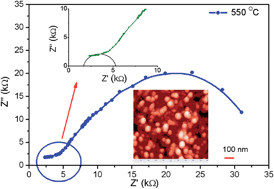
In order to see the effect of barrier layer in BSFN thin film, we did complex impedance (Z* = Z′ + iZ′′) measurement (Cole–Cole plot) for 550 °C deposited film at room temperature, as shown in Fig. 5. It is the variation of imaginary part of impedance (Z′′) as a function of real part (Z′).4,5 This plot shows two semicircular arcs with their centres lying below the real axis. The semicircular arcs and the extent of their intercept on the real axis give information about the electrical behaviour of the compound. The arc at lower frequency corresponds to grain boundary, while the arc at higher frequency corresponds to grain. The intercepts of semicircles on the Z′ axis yield the grain resistance (Rg) in the high frequency range (shown in the inset of Fig. 5) and grain boundary resistance (Rgb) in the low frequency range. The value of Rg and Rgb is about 5250 Ω and 33760 Ω, respectively, at room temperature in thin film. In case of bulk BSFN ceramic, the value of Rg and Rgb is about 2444 Ω and 33750 Ω, respectively, at room temperature.18 The high value of Rg in thin film confirms that the thin films have less defects as compared to the bulk ceramics.28,29 The impedance spectroscopy analysis demonstrates that the BSFN thin films are composed of semiconducting grains separated by insulating grain boundaries. The origin of semiconductivity in the grains may arise from a small but measurable oxygen loss during the synthesis process. Thus, the high dielectric constant behaviour is attributed to the grain-boundary mechanism, as found in internal barrier layer capacitors.30
 |
| | Fig. 5 Cole–Cole plot of BSFN thin film deposited at 550 °C and magnified view of the high frequency data close to origin are shown in inset along with the fitting curve of the experimental data. | |
Fig. 6 shows the plot of imaginary part (ε′′) versus the real part (ε′) of the complex dielectric constant (ε* = ε′ − iε′′) i.e. Cole–Cole plot6,19 for 550 °C deposited film at room temperature along with the fitting curve. The complex dielectric constant is described by the empirical relation (2)
| |
 | (2) |
where
εs and
ε∞ are the low and high frequency values of
ε′, respectively,
τ is the mean relaxation time and
α represents the distribution of relaxation time (0 ≤
α ≤ 1). The parameter
α, as determined from the angle subtended by the radius of the circle with the
ε′ axis passing through the origin of the
ε′′ axis. When
α goes to zero,
eqn (2) reduces to Debye's formalism.
6,19,27 From this plot, it can be seen that the relaxation process of the BSFN thin film is quite different from that of monodispersive Debye-type (
α = 0)
i.e. the parameter
α is larger than zero. Therefore, the non-zero value of parameter
α confirms the polydispersive nature of dielectric relaxation in BSFN thin film, which agrees with the conclusion drawn from the Cole–Cole plots of
Z′′
versus Z′.
 |
| | Fig. 6 Cole–Cole plot of BSFN thin film deposited at 550 °C. | |
3.4 Optical properties
Fig. 7 shows the transmittance curve for the BSFN thin films. All the transmission spectra show fringes, which originate due to interference at the air and substrate film interfaces. This revealed the excellent surface quality and homogeneity of the films. This occurs when the film surface reflects without much scattering/absorption loss in the film.31,32 The sharp fall in transmission and disappearance of fringes at shorter wavelength are due to the fundamental absorption of the films.31
 |
| | Fig. 7 Transmittance curves of BSFN thin films deposited at different substrate temperature. | |
Fig. 8 shows the UV-vis absorption spectra of BSFN thin films. The optical band gap was estimated using the reflectance and transmission data. The optical absorption coefficient (α) can be calculated from the absorbance using the formula (eqn (3))
| |
 | (3) |
where
A is the absorbance and
t is the thickness of the sample.
32 Optical band gap energy was calculated by Wood and Tauc method.
33 In this method, the optical band gap is related with absorbance and photon energy by the following
eqn (4)where
h is Planck's constant,
ν is frequency,
Eg is the optical band gap and
n is constant associated with the various type of electronic transitions (
n = 0.5, 1.5, 2 and 3 for direct allowed, direct forbidden, indirect allowed and indirect forbidden transitions, respectively).
34–36 The value of
n can be obtained from the slope of the straight line plot of ln(
αhν)
versus ln(
hν −
Eg).
35,36 In this work, UV-vis absorption spectra indicated a direct allowed transition. Hence, we have chosen the value
n = 0.5 in the above
eqn (4). Thus, the energy band gap of BSFN thin films was calculated by extrapolating the linear portion of the curve or tail. The band gap energy was found to be nearly similar (∼2.60 eV) for 500 °C and 550 °C deposited sample. However, the energy band gap (2.68 eV) increased for 600 °C deposited sample, which may be attributed to the poor crystallinity of film, as shown in
Fig. 1(d).
23
 |
| | Fig. 8 UV-vis absorption spectra of BSFN thin films. | |
4. Conclusions
We studied the effect of various substrate temperatures on the structure, surface morphology, dielectric and optical properties of BSFN thin films. The XRD analysis reveals the single phase perovskite structure in all thin film samples. The AFM image confirmed the well-crystallized BSFN thin film for 550 °C deposited film, which exhibits high dielectric constant (∼4037) with very low dielectric loss (∼0.04) at room temperature and at 1 kHz frequency. The optical band gap was found to be 2.60 eV for 550 °C deposited film.
Acknowledgements
We thank Council of Scientific and Industrial Research, New Delhi, India, for financial support under the Project Grant number 03 (1172)/13/EMR II dated 12-04-2013. One of the authors Piyush Kumar Patel would like to acknowledge MHRD for providing fellowship.
References
- U. Intatha, S. Eitssayeam, K. Pengpat, K. J. D. Mackenzie and T. Tunkasiri, Mater. Lett., 2007, 61, 196–200 CrossRef CAS PubMed.
- N. Charoenthai, R. Traiphol and G. Rujijanagul, Mater. Lett., 2008, 62, 4446–4448 CrossRef CAS PubMed.
- C. Y. Chung, Y. H. Chang and G. J. Chen, J. Appl. Phys., 2004, 96, 6624–6628 CrossRef CAS PubMed.
- K. F. Liao, Y. S. Chang, Y. L. Chai, Y. Y. Tsai and H. L. Chen, J. Mater. Sci. Eng. B, 2010, 172, 300–304 CrossRef CAS PubMed.
- C. Y. Chung, Y. S. Chang, G. J. Chen, C. C. Chung and T. W. Huang, Solid State Commun., 2008, 145, 212–217 CrossRef CAS PubMed.
- U. Intatha, S. Eitssayeam, J. Wang and T. Tunkasiri, Curr. Appl. Phys., 2010, 10, 21–25 CrossRef PubMed.
- Z. Wang, X. M. Chen, L. Ni and X. Q. Liu, Appl. Phys. Lett., 2007, 90, 022904 CrossRef PubMed.
- S. Ke and H. Huang, J. Appl. Phys., 2010, 108, 064104 CrossRef PubMed.
- S. Eitssayeam, U. Intatha, K. Pengpat and T. Tunkasiri, Curr. Appl. Phys., 2006, 6, 316–318 CrossRef PubMed.
- W. Zhang, L. Li and X. M. Chen, J. Appl. Phys., 2009, 106, 104108 CrossRef PubMed.
- M. Mitsugi, S. Asanuma, Y. Uesu, M. Fukunaga, W. Kobayashi and I. Terasaki, Appl. Phys. Lett., 2007, 90, 242904 CrossRef PubMed.
- A. Ahlawat, V. G. Sathe, V. Ganesan, D. M. Phase and S. Satapathy, J. Appl. Phys., 2012, 111, 074302 CrossRef PubMed.
- B. E. Jun, Y. S. Kim, H. J. Park, S. B. Kim, H. K. Yang, J. H. Park, B. C. Choi and J. H. Jeong, Thin Solid Films, 2008, 516, 5266–5271 CrossRef CAS PubMed.
- W. Zhang, L. Lei and X. M. Chen, J. Appl. Phys., 2010, 108, 044104 CrossRef PubMed.
- M. D. Benoy, E. M. Mohammed, M. Suresh Babu, P. J. Binu and B. Pradeep, Braz. J. Phys., 2009, 39, 629–632 CrossRef CAS PubMed.
- M. H. Habibi and N. Talebian, Acta Chim. Slov., 2005, 52, 53–59 CAS.
- D. D. Shah, P. K. Mehta, M. S. Desai and C. J. Panchal, J. Nano- Electron. Phys., 2011, 3, 330–340 Search PubMed.
- P. K. Patel and K. L. Yadav, Sci. Adv. Mater., 2013, 5, 891–895 CrossRef CAS PubMed.
- S. Saha and T. P. Sinha, Phys. Rev. B: Condens. Matter Mater. Phys., 2002, 65, 134103 CrossRef.
- N. Tawichai, W. Sittiyot, S. Eitssayeam, K. Pengpat, T. Tunkasiri and G. Rujijanagul, Ceram. Int., 2012, 38S, S121–S124 CrossRef PubMed.
- S. Ke, H. Huang, H. Fan, H. L. W. Chan and L. M. Zhou, Ceram. Int., 2008, 34, 1059–1062 CrossRef CAS PubMed.
- S. Bhagat and K. Prasad, Phys. Status Solidi A, 2010, 207, 1232–1239 CrossRef CAS.
- S. T. Tan, B. J. Chen, X. W. Sun, W. J. Fan, H. S. Kwok, X. H. Zhang and S. J. Chua, J. Appl. Phys., 2005, 98, 013505 CrossRef PubMed.
- S. He, Y. Li, X. Liu, B. Tao, D. Li and Q. Lu, Thin Solid Films, 2005, 478, 261–264 CrossRef CAS PubMed.
- Z. Wei, W. S. Ya and C. X. Ming, Chin. Sci. Bull., 2013, 58, 3398–3402 CrossRef.
- J. E. Mancilla, J. N. Rivera, C. A. Hernandez and M. G. Zapata, J. Aust. Ceram. Soc., 2012, 48, 223–226 CAS.
- Q. Ke, X. Lou, Y. Wang and J. Wang, Phys. Rev. B: Condens. Matter Mater. Phys., 2010, 82, 024102 CrossRef.
- W. Si, E. M. Cruz, P. D. Johnson, P. W. Barnes, P. Woodward and A. P. Ramirez, Appl. Phys. Lett., 2002, 81, 2056 CrossRef CAS PubMed.
- M. A. Ramireza, A. Z. Simões, A. A. Felix, R. Tararam, E. Longo and J. A. Varela, J. Alloys Compd., 2011, 509, 9930–9933 CrossRef PubMed.
- L. Fang, M. Shen and W. Cao, J. Appl. Phys., 2004, 95, 6483–6485 CrossRef CAS PubMed.
- D. Pamu, P. D. Raju and A. K. Bhatnagar, Solid State Commun., 2009, 149, 1932–1935 CrossRef CAS PubMed.
- M. Caglar, Y. Caglar and S. Ilican, J. Optoelectron. Adv. Mater., 2006, 8, 1410–1413 CAS.
- S. K. Rout, L. S. Cavalcante, J. C. Sczancoski, T. Badapanda, S. Panigrahi, M. S. Li and E. Longo, Phys. B, 2009, 404, 3341–3347 CrossRef CAS PubMed.
- J. C. Sczancoski, L. S. Cavalcante, T. Badapanda, S. K. Rout, S. Panigrahi, V. R. Mastelaro, J. A. Varela, M. S. Li and E. Longo, Solid State Sci., 2010, 12, 1160–1167 CrossRef CAS PubMed.
- J. Rani, K. L. Yadav and S. Prakash, Appl. Phys. A DOI:10.1007/s00339-014-8482-4.
- D. Bhattacharyya, S. Chaudhuri and A. K. Pal, Vacuum, 1992, 43, 313–316 CrossRef CAS.
|
| This journal is © The Royal Society of Chemistry 2014 |
Click here to see how this site uses Cookies. View our privacy policy here.