Jyotsana Pathaka,
Kamla Rawat*b and
H. B. Bohidar*ab
aPolymer and Biophysics Laboratory, School of Physical Sciences, Jawaharlal Nehru University, New Delhi 110067, India. E-mail: bohi0700@mail.jnu.ac.in
bSpecial Center for Nanosciences, Jawaharlal Nehru University, New Delhi 110067, India. E-mail: kamla.jnu@gmail.com; Fax: +91 11 2674 1837; Tel: +91 11 2670 4699
First published on 16th May 2014
Surface selective patch binding (SPB) interaction occurring between two protein molecules, bovine serum albumin (BSA) and gelatin B (GB), both having same isoelectric pH (pI ≈ 5) and identical pH-zeta potential profile, was systematically examined. BSA
:
GB mixing ratio r was varied in the range 0.16–2.00 and ionic strength was varied in the range 0–10 mM, which yielded optimum binding ratio r = 1. The binding profiles produced asymmetric bell-like curves with clearly identifiable pairs of transition pHs: onset of intermolecular interaction, formation of soluble complexes and coalescence of the soluble complexes occurring at pHc1,2, pHφ1,2 and pHm respectively. Since pHm could be approached from either lower or higher side of pI, these profiles yielded pairs of pHc and pHφ values. In fact, we found (pHc2 − pI) > (pHc1 − pI), which clearly indicated that initiation of intermolecular associative interaction was not symmetric about pI (pI = pHm for r ≤ 1, an observation not reported hitherto. Secondly, (pHφ2 − pI) ≈ (pHφ1 − pI) implied that the pH at which soluble complexes formed (pHφ) was always located symmetrically about pHm, irrespective of the binding ratio. Higher binding affinity determined from higher value of pHc2 was confirmed from size measurement results. The change in the turbidity maximum Δτ could be correlated as Δτ ∼ I1/2 implying electrostatic screening of SPB with increase in ionic strength (I). This interaction was modelled using a linear combination of attractive and repulsive electrostatic forces which revealed considerable screening of the interaction potential U, consistent with aforesaid experimental data; ΔU ∼ I1/2. Further, it is concluded that intermolecular binding in protein–polyampholyte systems is qualitatively different from that in protein–polyelectrolyte class.
The effect of ionic strength, polyion persistence length and charge density on SPB binding mechanism has been reported.19–21 However, little is known about the symmetry of this binding mechanism near the isoelectric or any other reference pH, which we seek to answer in this work. For completeness, the surface selective binding process has been explained through potential energy calculations following a simple model where the interaction potential is assumed to be a linear combination of an attractive and a repulsive Coulombic force. In this article, the terms complexes and aggregates are used interchangeably. Considering the fact that protein–protein interactions have the potential to generate novel biomaterials, the importance of their studies can hardly be stressed enough. In addition, such studies provide basic understanding of specific and non-specific interactions between complementary polyelectrolytes.1–7
Gelatin B aqueous solution at a concentration of 0.75% was prepared by dissolving known amount of the protein powder in double distilled deionized water at 40 °C using a magnetic stirrer for almost 1 to 1.5 hours. BSA aqueous solution at a concentration of 0.75% was prepared by dissolving known amount of the protein powder in double distilled deionized water at 25 °C using a magnetic stirrer for almost 1 hour. These stock solutions appeared optically transparent to the eye. Further, these stock solutions were left for 12 hours at 25 °C to equilibrate. Reacting samples for the experiments were prepared by mixing equal volume of stock solutions, and appropriate amount of NaCl was used to set the ionic strength. The salt concentration was varied from 0 to 20 mM. All procedures were performed at room temperature (25 °C) and relative humidity in the laboratory was less than 50%. Solutions used for different experiments described below were obtained by mixing the GB and BSA stock solutions at appropriate proportions to obtain different protein
:
polyampholyte mixing ratio r (BSA
:
GB).
The experimental binding ratios were chosen based on the optimum binding stoichiometry ascertained through an independent experiment. The UV absorbance (UV-vis spectrophotometer, Model CE-7300, Cecil Instruments, UK) of the solutions was measured at λ ≈ 290 nm (maximum BSA absorption wavelength), which yielded a binding curve shown in Fig. 1 that clearly established the optimum binding ratio as r = BSA
:
GB = 1
:
1. The mixing ratio of other samples was chosen so as to span a broad range of r. Thus, samples with r = 1
:
6, 1
:
3, 1
:
1, 4
:
3, 5
:
3 and 6
:
3 were prepared for further studies.
![]() | ||
Fig. 1 Binding plot of BSA and gelatin B measured at 25 °C, clearly showing the optimum binding condition pertained to r = BSA : GB = 1 : 1. | ||
The extent of binding (resulting from intermolecular associative interaction) was inferred from quantitative measurement of solution turbidity, light scattering and electrophoresis data. The change in transmittance (%T) was monitored systematically using a colorimeter (Brinkmann-910, Brinkmann Instruments, U.S.) operating at 450 nm.
Zeta potential measurement was performed on an electrophoresis instrument (model: ZC-2000, Microtec, Japan). In order to minimize the influence of electrolysis on the measurements, molybdenum (+) and platinum (−) were used for electrodes. Also, during the measurements, the cell chamber tap on the molybdenum electrode was kept open to release the air bubbles, for the purpose of reducing their effects on the particle movements. If one uses the zeta potential (ζ) as an approximation of the surface potential φ of a uniformly charged sphere, the theory gives ζ ≅ φ = 4π (σ0/εκ), where σ0 is the surface charge density of the particle, and ε and κ are the dielectric constant and Debye–Huckel parameter of the solution, respectively. The relationship between mobility (μ0) and zeta potential (ζ) is ζ = 4π(μ0η/ε). Then, μ can be written as μ0 = σ0/ηκ where η is the viscosity of the solution.21
Dynamic light scattering (DLS) experiments were performed at a scattering angle of θ = 90° and laser wavelength of λ = 632.8 nm on a 256 channel digital correlator (Photocor Instruments, USA) that was operated in the multi-τ mode (logarithmically spaced channels). The goniometer was placed on a Newport (USA) vibration isolation table. The time scale spanned 8-decades, i.e. from 0.5 μs to 10 s. This instrument used a 35 mW linearly polarized He:Ne laser. In all the experiments, the difference between the measured and calculated base line was not allowed to go beyond ±0.1%. The measured intensity auto-correlation functions were analyzed by the CONTIN regression software to check the relaxation time distribution function. The diffusion coefficient D is related to corresponding hydrodynamic radius Rh through the Stoke–Einstein relation given as D = kBT/(6πη0Rh), where solvent viscosity is η0, kB is Boltzmann constant, and T is absolute temperature. Robustness of the fitting results was decided based on two criteria: sample to sample accuracy, and data reproducibility within the same sample.
This data could be analyzed about the ΔpH = (pH − pI) = 0 line as shown in this figure. Region I is the region where the proteins reside in their protonated state whereas in Region II proteins are present in their deprotonated state. One clear observation can be made from this data: the zeta potential versus pH plot for both the proteins is nearly symmetric about their common pI and their profiles are overlapping. Thus, at a given pH both protein molecules will be endowed with same magnitude and similar polarity of charge. This set the background for further experiments. It was pertinent to examine if the two molecules would bind through any form of electrostatic interaction at all, which we have dealt with in detail and discussed in the following sections. Since we are concerned with the issue of symmetry about pI of the proteins, we shall be using (pH − pI) = ΔpH as the independent variable in further discussions.
The pH titration profile yielded a clear picture of intermolecular complex formation through change in the solution turbidity τ (= 100 − %T). Turbidity is a function of molecular size, weight and shape of the scattering moiety present in the sample. Thus, rise in turbidity indicates presence of large aggregates in the dispersion medium. This data is presented in Fig. 3 along with the data for BSA and GB samples. The protein samples exhibit expected pH dependent behaviour: low turbidity away from pI (mostly monomeric dispersion) and high turbidity near pI (dispersion contains aggregates).27 The turbidity of BSA–GB solution was much pronounced with the maximum turbidity reaching a value twice that of individual protein sample. Note that the turbidity maximum observed at pHm could be approached from either +ΔpH or −ΔpH direction. Thus, there are two pHc values pHc1 and pHc2, and two pHφ values given by pHφ1 and pHφ2. We shall discuss the significance of these later.
Note that the turbidity profiles are symmetric about pI for the two constituents whereas the turbidity profile for BSA–GB complex is highly asymmetric, exhibiting preferential binding between the two in their anionic state. This inference is corroborated by the data shown in Fig. 4 where size of the intermolecular complex is shown as function of solution pH. Region I pertaining to the protonated state of the proteins depicts formation of smaller complexes as compared to Region II (deprotonated state) where much larger complexes were formed implying preferential binding in that region. Further, the slope of the binding curve, dRH/dΔpH, was 35 below pI, whereas above pI, it was 55, an increase of close to 60%, which implied that SPB binding was preferred in Region II. Note that the slope dRH/dΔpH is a quantitative estimation of binding affinity. In the same figure, the turbidity profile of the pH titration data is shown for comparison, and as before, it is possible to estimate the binding affinity from this data by looking at the (dτ/dΔpH) value. Again below pI (ΔpH < 0), the slope (dτ/dΔpH) = 32 and above pI (ΔpH > 0) it was 40, an increase of close to 25%. Thus, the data presented in Fig. 3 and 4 categorically indicated binding propensity in Region II. It is worthwhile to note that close to pI, the measured hydrodynamic radii were minimum because, in our special treatment of the DLS data, the maximum particle size was restricted to wavelength of incident light (634 nm) in order to meet the Rayleigh criterion. This analysis filtered out large size particles from being included in the particle size distribution. Further, the turbidity registers a decrease in Region II due to selective sedimentation of larger complexes.
![]() | ||
| Fig. 4 Variation of solution turbidity and size of BSA–GB (r = 1) complexes as a function of solution ΔpH (= pH − pI). The dotted line defines pI, which is coincident with pHm. | ||
![]() | ||
| Fig. 6 Variation of change in turbidity Δτ and interaction potential ΔU shown as a function of square root of solution ionic strength. | ||
As has been stated earlier, turbidity offers a quantitative measure of the size of the scattering entity and a larger size is caused due to stronger interactions. Thus, to a first approximation, turbidity can be assumed to be directly related to intermolecular interaction. It is rather well known that electrostatic interactions are screened in the presence of mobile ions28 considerably and the Debye screening length is given by κ−1 ≈ 0.33/I1/2 (eqn (3)). Thus, at high ionic strength the electric double layer formed by the mobile ions reduces the Debye screening length. Therefore, electrostatic interactions were weak. On the other hand, at low enough ionic strengths, EDL assumed a finite thickness and electrostatic interactions were facilitated. In the light of this, the experimental observation of Δτ ∼ I1/2 implied that the BSA–GB interactions were governed by screened Coulomb interactions. Though the strength of the associative interaction decreased with ionic strength, the onset of these interactions did not (see Fig. 5). This will be discussed further when modelling of interaction potential will be dealt with in detail.
:
GB binding ratio. A series of pH titrations were carried out on solutions having proteins present in differing binding ratios, which is depicted in Fig. S2 (ESI).† The characteristic transition pH values are plotted in Fig. 7. As before, one found no symmetry in either pHc or pHφ profiles about pI; however, with respect to pHm, the pHφ profiles are located symmetrically (pI and pHm were same for ≤1, but deviations towards higher pH was noticed when r ≥ 1. Here again the pHc1 profile was found to be located closer to pHm compared to pHc2. Thus, the general behaviour of various pH profiles was similar to the one shown in Fig. 5. This observation further reinforced the fact that in their deprotonated state these protein molecules were capable to exhibiting profound SPB interaction even when the net charge carried by them was significantly large. Thus, the obtained data lead to the conclusion, without an iota of ambiguity, that SPB was more favoured in the deprotonated state of proteins.
![]() | ||
| Fig. 7 Behaviour of various transition pHs as function of binding ratio. The vertical dotted line defines the pI of the proteins whereas the horizontal dotted line defines the optimum binding ratio. | ||
Let us consider the protein chain GB as a dipole with the positive and negative charge separated by a distance r (end-to-end length of the chain). The typical radius of gyration Rg of a gelatin B chain is ≈ 34 ± 3 nm, which assigns an effective end-to-end length to the chain √6Rg ∼ 83 nm, whereas BSA is treated as a small dipole of charge q+ and q−, having radius of gyration Rg ≈ 3.1 ± 0.5 nm. The size of BSA (6 nm) is very small in comparison to that of gelatin B (83 nm). It is presumed that whole of GB surface is available for interaction with BSA regardless of the fact that some portion of it may be found in a frozen state. BSA can be assumed as a point charge particle having charge qP. Let R− and R′− be the distances between the negative charge of gelatin B and the negative and positive charges of BSA, respectively, and R′+ and R+ be the distances the positive charge of gelatin B and the negative and positive charges of BSA, respectively, and d is the mean intermolecular distance between the two proteins, as shown in Fig. 8. The protein molecules are essentially amphoteric containing both positive and negatively charged residues. Therefore, simultaneously electrostatic attraction and repulsion between the two protein molecules exist. According to the general model of electrostatic interaction of a protein with a polyelectrolyte,29,30 the electrostatic attraction and electrostatic repulsion may be related to the average distance between the BSA and GB molecules, and is given by
U = (qp−/2ε)[[{(Q− exp(−kR+))/R+}exp(−kR+) − {(Q+ exp(−kR−))/R−}exp(−kR−)]
| (1) |
R′+ ≈ R+ ≈ d + (r/2)cos Φ and R′− ≈ R− ≈ d − (r/2)cos Φ
| (2) |
| k−1 = √(1000εkBT/(8NAe2I)) | (3) |
![]() | ||
| Fig. 8 Representative diagram showing the gelatin B and BSA interaction. The curvy line depicts the gelatin B chain that has an end-to-end length = r. | ||
The average intermolecular distance can be found from concentration and molecular weight as
| d = [1/(NBSA + NGB)](1/3) | (4) |
| NBSA = (NA/100) × (CBSA/MBSA) and NGB = (NA/100) × (CGB/MGB) | (5) |
The van der Waals and electrostatic interactions of the protein and the polyelectrolyte at various average distances between BSA and GB are shown in Fig. 9, which shows that there is very small contribution of van der Waals interaction, so herein we focus only on the changes occurring due to the electrostatic interaction.
![]() | ||
| Fig. 9 Plot of electrostatic and van der Waal interaction potentials as function of average intermolecular separation with Debye screening parameter κ = 0.001. | ||
The intermolecular distance d was estimated to be ∼20 nm. The total positive and negative charge on the protein was sum of the contributions arising from all the protonated and deprotonated amino acid residues at a given pH. Angle Ø was varied between 0 and π, but for a range of angles 60° < Ø < 90°, typically the interaction potential increased sharply making the system unstable. For optimum binding condition Ø assumed a value close to 60 °C. The intermolecular separation and charge on BSA and GB chains are known (from their zeta potential data), which makes it possible to obtain potential energy of interaction U operating between these two biopolymers. Since qP, Q+, Q−, R+, and R− are independent of salt concentration, the presence of salt leads to Coulombic screening through k. This is shown in Fig. 9 for various salt concentrations.
A deeper minimum was observed in low ionic strength solutions, and relative change in the minima of the potential ΔU with ionic strength was plotted as function of I1/2 in Fig. 5. Remarkably, this data could be least squares fitted to a straight line alike the turbidity versus I1/2 data. The close ionic strength dependence similarity observed between turbidity and interaction potential could be explained as follows: two molecules exhibiting strong associative interactions will lead to the formation of intermolecular aggregates which will have high solution turbidity. This makes the interaction potential and turbidity directly proportional to each other to a large extent, and hence, Fig. 5 data provides a clear manifestation of this correlation.
Further, the interaction potential revealed two characteristic features: (i) it has a minima invariant of salt concentration located at 16 nm which happens to be the average intermolecular separation and (ii) the potential gets screened with increase in ionic strength of the solution, while in the low salt regime (NaCl < 7.5 mM) it exhibits a weak dependence. The minima vanish for solutions with NaCl > 10 mM. Beyond 20 mM NaCl, no binding transition was noticed in our experiments. Thus, we find close resemblance between the predictions made by the simple model and experimental data.
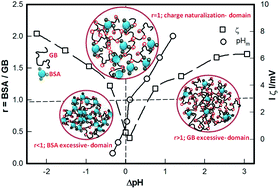
The data in hand clearly indicated differential binding behaviour between the two proteins which is schematically represented in Fig. 11. For r < 1 and ΔpH < 0, the binding was weak; as ΔpH increased to approach 0, optimum binding between the two proteins was observed, which led to the formation of BSA–GB complexes that had low zeta potential values. And for r > 1 and ΔpH > 0, disproportionate binding occurred as a result of which large complexes having sizable zeta potential values were formed in the system. It is to be noted that though ΔpH and r are treated as independent variables, any change in ΔpH has a corresponding impact on r (through the extent of binding). This has been depicted in Fig. 10.
![]() | ||
| Fig. 10 Plot of interaction potential as function of average intermolecular separation. Note the screening of the potential with increase in solution ionic strength. | ||
Let us turn our attention to the pHφ values which were found to be symmetrically placed about pHm. We found that formation of soluble complexes was facilitated through SPB interaction regardless of the protein net charge which implied that pHφ was invariant of protein net charge. Neither could we find any correlation between pHc and pHφ values. This raised the pertinent question: what caused the sharp rise in turbidity at pHφ? The data in hand allows us to propose the following. The propensity of hot spots (complementary charge patches) on BSA surface increases with pH in a disproportionate manner. For pH < pI, this is low whereas for pH > pI it is very high. But the observed fact that (pHm − pHφ1) ≈ (pHm − pHφ2) established that only a few hot spots on BSA surface need to be bound to GB chain to produce soluble complexes, and charge neutralization may not necessarily be achieved in this process. In our experiments, this was achieved when (pHm − pHφ1) ≈ (pHm − pHφ2) < 1 pH unit. The typical zeta potential of the complex at pHφ1,2 was ≈ ±7 mV, which clearly indicated that these complexes were not fully charge neutral. At this pH, the individual proteins had zeta potential value ≈ ± 10 mV. The aforesaid characteristics clearly differentiated the binding between the two systems: protein–polyampholyte and protein–polyelectrolyte.34–36
:
1. The associative interactions observed through the monitoring of the solution turbidity generated a bell shaped turbidity–pH profile with maximum turbidity occurring at pHm (close to pI for r = 1) in both salt-free and salty solutions. For r > 1, pHm shifted towards higher pH (pHm > pI) values. Thus, pHm could be approached from either side of pI regardless of the r-value. This feature established the presence of two uniquely identified transition pHs: (i) pHc where the initiation of associative intermolecular interactions ensued and (ii) pHφ where soluble complexes were formed. Needless to say the titration profile yielded a pair of values for pHc and a pair of values for pHφ. The pHφ1 and pHφ2 values were found to be placed symmetrically about pHm, whereas no such behaviour was exhibited by pHc1 and pHc2 values. In fact, we found (pHc2 − pI) > (pHc1 − pI), which clearly indicated that SPB driven initiation of intermolecular associative interaction was not symmetric about pI. Secondly, (pHφ2 − pI) ≈ (pHφ1 − pI) implied that the transition pH where soluble complexes formed (i.e. pHφ) was always located symmetrically about pHm. Further, it was observed that complete charge neutralization was not achieved at pHφ1,2, and pHφ and pHc were uncorrelated.
It is highly possible that self-interaction occurs, leading to GB–GB and BSA–BSA (smaller aggregates) aggregate formation along with the existence of bigger GB–BSA complexes. Then the system comprises a set of three complexes present in varying ratios depending on the ionic strength, concentration, aging etc. at any point of time. Binding in Region I and Region II are quantitatively different. BSA–GB binding in Region I is driven by SPB that causes charge neutralization and formation of smaller complexes. In their deprotonated state (Region II), this binding proceeds beyond the charge neutralization boundary to cause disproportionate binding. Realize that even at the charge neutralization point there exist residual favorable binding sites that provide further binding, and this has been observed in DNA–protein binding earlier.20 For example, DNA and Gelatin A exhibited disproportionate binding and formed a variety of complex coacervates.37 The complex formed comprises GB–GB and BSA–BSA aggregates (self-interaction) and aggregate BSA–GB aggregates. It is well known that SPB interaction between a pair of polyions can cause coacervation due to associative interaction. Thus, the presence of coacervates is a good indicator of polyion–polyion interaction. We successfully collected the coacervate corresponding to ΔpH = −1, 0 and +2. This clearly implied that the complex formed comprised both protein molecules. Neither BSA–BSA nor GB–GB aggregation will lead to the phenomena of coacervation. We can see that the coacervation yield is more in Region II which is an indicator of intensity of coacervation. This has been clearly depicted in Fig. S3 (ESI).† This is a significant observation considering that in protein–polyelectrolyte systems, at pHφ, charge neutralization was invariably seen. Thus, intermolecular binding in protein–protein systems are qualitatively different from that in protein–polyelectrolyte systems. The abovementioned conclusions can be summarized as follows: proteins can interact with other protein molecules via an array of secondary interactions. Clear definition of these intermolecular interactions requires a molecular level understanding. However, for native state aggregation, self-association of proteins in their secondary structure conformation is primarily mediated by electrostatic effects. The depletion of Coulombic forces at pI is relevant because charge anisotropy can drive “isoelectric precipitation”, as demonstrated by turbidity maxima commonly observed near the pI. The present study is important for the better understanding of the aforesaid mechanisms. These results can have considerable bearing on the stabilization, separation, and hence protein purification processes.
Footnote |
| † Electronic supplementary information (ESI) available: The pH titration profiles showing turbidity and coacervation yield as a function of solution pH for BSA–GB solutions at various ionic strengths and mixing ratios examined in this study are included. See DOI: 10.1039/c4ra02372b |
| This journal is © The Royal Society of Chemistry 2014 |