High catalytic performance and sustainability of the Ni/La2O3 catalyst for daily pre-reforming of liquefied petroleum gas under a low steam/carbon molar ratio

Zhen Huang, Xueguang Wang*, Zhiying Wang, Xiujing Zou, Weizhong Ding and Xionggang Lu*
Shanghai Key Laboratory of Modern Metallurgy and Material Processing, Shanghai University, Yanchang Road No. 149, Shanghai 200072, China. E-mail: wxg228@shu.edu.cn; Fax: +86-21-56338244

Received 24th February 2014 , Accepted 17th March 2014

First published on 18th March 2014


Abstract

The Ni/La2O3 catalyst first shows not only high catalytic activity and long-term stability but also excellent sustainability in the daily start-up and shut-down operation for the pre-reforming of LPG at a low S/C molar ratio of 1.0 due to new synergistic active sites consisting of metal Ni nanoparticles and La2O2CO3 species.

Hydrogen production via fuel processing has been one of the key issues for the development of hydrogen-powered fuel cell devices and thus has become an important area of catalysis research.1,2 Liquid hydrocarbons such as liquefied petroleum gas (LPG) are considered as preferred potential feedstock for distributed hydrogen production for on-site and on-board fuel cell applications due to their higher energy density than natural gas, easy storage and transportation, and well-established distribution infrastructures.3–5 However, the higher hydrocarbons are generally required to first perform catalytic steam reforming at low temperatures, also referred to as pre-reforming, followed by the catalytic reforming of the reformate in a main reformer into hydrogen and carbon oxides at temperatures above 700 °C with minimal risk of carbon formation.6,7 The pre-reforming of higher hydrocarbons is usually carried out at 400–550 °C and high steam/carbon (S/C) molar ratios (>3) to suppress coke deposition on the catalyst.6,8 In order to achieve high energy efficiency and reduce the size and weight of fuel processor, it is quite necessary to employ the catalyst with sufficiently high activity and stability for pre-reforming of higher hydrocarbons and to operate the reaction with a low S/C molar ratio. In addition, the steam reforming of the reformate with lower S/C molar ratios is feasible to combine with catalytic partial oxidation reforming in the main reformer to fulfill autothermal steam reforming, which seems to be more hopeful for the future polymer electrolyte fuel cells because the exothermic oxidation can supply the heat for endothermic steam reforming.9,10 However, up to now only very few examples of noble metal Ru- and Pt-based catalysts have been reported to possess high catalytic stability in the pre-reforming of higher hydrocarbons under low S/C ratios (≤1.0).8,11

Ni-based catalysts have widely been considered as promising candidates for the steam reforming of hydrocarbons because of their high activity and low cost. However, these catalysts are required to employ excess amounts of steam to prevent coke formation on the catalyst surface in the steam reforming of hydrocarbons.12 On the other hand, for distributed hydrogen production for on-site and on-board fuel cell applications, daily start-up and shut-down (DSS) operations are frequently performed. Between shut-down and start-up in the DSS operation, the catalyst bed in the reformer is purged by steam for ensuring safety. Thus, the catalyst must be able to tolerate multiple cycles under such unusual transient conditions without deterioration.13 Unfortunately, active metal Ni species can be oxidized into Ni oxides under either steam or gaseous oxygen atmospheres, resulting in complete deactivation of the catalyst. Therefore, there is a great challenge for developing a novel and economic Ni-based catalysts not only with high activity and stability under low S/C molar ratios but also with excellent sustainability in the DSS operations for the pre-reforming of higher hydrocarbons for on-site and on-board fuel cell applications.

Lanthanum oxide supported Ni catalysts derived from LaNiO3 perovskite are reported to be active in several reactions of methane with oxygen, water and carbon dioxide, and show remarkable stability and inimitable resistance to coke deposition due to high resistance of the nickel particles to be oxidized and distinct interaction between lanthanum oxide and metal Ni.14,15 The properties of active metal Ni particles formed and their catalytic performance are significantly affected by both preparation routes and reaction atmospheres.16–20 In this communication, we demonstrate for the first time that Ni catalyst supported on lanthanum oxide originating from LaNiO3 perovskite synthesized via a precipitation–combustion method shows substantially high activity and long-term stability, and are successfully performed for multiple cycle reactions without deterioration in the DSS-like operation mode for the pre-reforming of LPG at a low S/C molar ratio of 1.0.

LaNiO3 perovskite (specific surface area: 12.6 m2 g−1) was prepared by a precipitation–combustion method proposed by us. The as-prepared solid was dried at 120 °C and calcined in air at 400 °C and 600 °C, respectively (synthesis details in ESI). XRD pattern of the dried material showed two-group diffraction lines, corresponding to NH4NO3 crystal (JCPDS 43-1431) and Ni2CO3(OH)2·H2O crystal (JCPDS 29-0868), respectively (Fig. S1). This implies that La species existed in the amorphous form. After calcination at 600 °C, the LaNiO3 perovskite with a rhombohedral symmetry (JCPDS 33-0710) is formed as illustrated in Fig. 1a. In addition, weak and broad diffraction peaks associated with cubic NiO phase (JCPDS 47-1049) are also observed in the sample. Upon being reduced with hydrogen at 600 °C, the LaNiO3 perovskite structure is completely destroyed, and concomitantly lanthanum oxide supported metal Ni catalyst, Ni/La2O3, is formed, where metal Ni shows a cubic structure (JCPDS 04-0850) and La2O3 a hexagonal phase (JCPDS 05-0602) (Fig. 1b). The metal Ni crystallite size is estimated to be 8.1 nm by applying Scherrer's equation using the Ni (111) reflection. The TEM image of the sample reduced in Fig. 2a shows that Ni nanoparticles are homogeneously dispersed in the matrix with an average diameter of 7.6 nm, which is in good agreement with the XRD result.


image file: c4ra01627k-f1.tif
Fig. 1 XRD patterns of the prepared LaNiO3 samples. (a) Calcined at 600 °C, (b) reduced at 600 °C, (c) reacted for the pre-reforming of LPG for 380 h, and (d) after the 4th cycle reaction for the pre-reforming of LPG in the DSS mode, followed by treatment with steam purging at 450 °C for 2 h.

image file: c4ra01627k-f2.tif
Fig. 2 TEM images of the prepared LaNiO3 samples. (a) Reduced at 600 °C, (b) reacted for 380 h, (c) after 4th cycle reaction, followed by treatment with steam at 450 °C for 2 h, and (d) HR-TEM image for representative Ni nanoparticle.

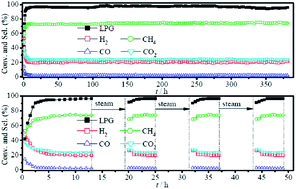
The pre-reforming reaction of LPG was carried out over the prepared LaNiO3 perovskite calcined at 600 °C, which showed the optimum catalytic performance in the screening experiments. The obtained Ni/La2O3 catalyst was highly active and was able to completely convert LPG to CH4, CO, CO2 and H2 for the steam reforming of LPG at S/C = 1.0 in the temperature range of 400–550 °C, at which no visible coke deposition and thermal cracking of hydrocarbons took place. The maxima of gas hourly space velocities (GHSVs) of inlet gas with 100% conversion of LPG were almost linearly increased from ca. 4100 mL gcat−1 h−1 at 425 °C to 16[thin space (1/6-em)]500 mL gcat−1 h−1 at 550 °C and the product selectivities were very close to the corresponding equilibrium values on the basis of chemical thermodynamics, indicating that the methanation of carbon oxides with H2 and water gas shift reaction in the reforming system reached the chemical equilibrium (Fig. S2). Fig. 3 displays the conversion of LPG and product selectivities as a function of time on stream over the Ni/La2O3 catalyst at GHSV = 11[thin space (1/6-em)]000 mL gcat−1 h−1 and S/C = 1.0. The catalytic activity increases with time on stream during the initial reaction time of ∼5 h, and then the LPG conversion being ∼95%, where the reforming of LPG is governed by chemical kinetics, is kept essentially invariable with time on stream during the tested 380 h reaction, indicating an excellent catalytic stability. For comparison, the Ni/La2O3-imp catalyst by conventional impregnation method is also examined in Fig. 3, showing lower activity and poorer stability. To the best of our knowledge, such a high stability of Ni-based catalyst for the steam reforming of hydrocarbons at a low S/C molar ratio of less than 1.0 has never been reported in the previous literature. Throughout the steam reforming of LPG, the product selectivities coincide well with the thermodynamic equilibrium values estimated according to the total small gas molecules (CH4, CO, CO2, H2, and H2O) except LPG in the exit gas. This result implies that the reforming of LPG is the rate-determining step over the Ni/La2O3 catalyst. The increase in the initial activity with the time on steam demonstrates that more active catalytic sites for the steam reforming of LPG might be formed on the Ni/La2O3 catalyst surface, following exposure of the catalyst to the reaction mixture.


image file: c4ra01627k-f3.tif
Fig. 3 The activity and product selectivities as a function of time on stream for the steam reforming of LPG over the Ni/La2O3 (solid line) and Ni/La2O3-imp (dash line) catalysts at the reaction conditions: catalyst, 100 mg; 450 °C; GHSV = 11[thin space (1/6-em)]000 mL gcat−1 h−1; S/C = 1.0. (■) LPG; (□) H2; (○) CH4; (△) CO; and (△) CO2.

It is suggested that in the case of Ni/La2O3 catalyst, high catalytic performance for CO2 reforming of methane is related with the formation of hexagonal La2O2CO3 phase by CO2 adsorbed on the La2O3 support or the LaOx species, which decorate a portion of the surface of Ni crystallites to form a new type of surface compound or synergistic catalytic sites at the interfacial area.16,17 The oxygen species from La2O2CO3 participate in the reactions with the surface carbon species (CHx) on the neighbouring Ni sites to form CO.16 The XRD patterns of the samples during different initial reaction periods for the steam reforming of LPG reveal that lanthanum oxide or hydroxide species gradually disappear, and are completely transformed into hexagonal La2O2CO3 carbonate phase after 5 h time on stream (Fig. S3), which is in good agreement with the variation in the catalyst activity. Therefore, it can be reasonably proposed that in the steam reforming of LPG over the Ni/La2O3 catalyst, the synergistic active sites, which consist of metal Ni and La2O2CO3 species, are fabricated through the interaction of La2O3 support with CO2 generated from the steam reforming of hydrocarbons and water gas shift. The carbon species formed on the Ni sites are favourably removed by the oxygen species originating from La2O2CO3, offering the active and stable catalytic performance at low S/C molar ratio. On the other hand, for the Ni/La2O3 catalyst from the reduction of LaNiO3 perovskite, homogeneously distributed Ni nanoparticles are buried partially or even totally in the support,14b inhibiting the agglomeration of particles during the reaction. It should be noted that this partial/total covering of metal particles does not always decrease the activity of the active phase, but in many cases it produces a significant improvement on it.14b The XRD pattern in Fig. 1c indicates that the diffraction peaks of the Ni/La2O3 catalyst after the 380 h reaction time for the pre-reforming of LPG are almost identical to that after the 5 h reaction (Fig. S3), which are responsible for only metal Ni and La2O2CO3 phase. The TEM image of the catalyst in Fig. 2b shows that the metallic Ni nanoparticles after the 380 h reaction for the pre-reforming of LPG are still homogeneously distributed in the matrix with a mean particle size of ∼7.8 nm, which is almost unchanged compared with that before the reaction (Fig. 2a), and no obvious coke deposition is formed on the catalyst surface. These results demonstrate that the Ni/La2O3 catalyst by our method possesses high stability and excellent resistance to coke formation for the steam reforming of LPG at low S/C molar ratio.

In the DSS-like pre-reforming of LPG, the first cycle reaction was performed over the Ni/La2O3 catalyst at 450 °C for 13 h so that the reaction system could be completely stable. The 2nd cycle reaction was conducted for ca. 5.5 h and the following cycle reactions proceeded in the same operation mode. Fig. 4 shows the activity and the product selectivities over the Ni/La2O3 catalyst for the pre-reforming of LPG in the DSS operation. After each steam purging, the catalyst always presents a high initial activity of more than 90% and rapidly increases to ∼95% within a short reaction time of 1.5 h, reaching the same stable reaction state as displayed in the 1st cycle reaction. Correspondingly, the selectivities of the products (CH4, CO, CO2 and H2) also remain unchanged in the DSS cycle reactions. These results suggest that synergistic active sites of the catalyst might be retained after the steam purging, which are significantly different from the other Ni catalysts in the previous studies.10,13 The XRD pattern and TEM images of the Ni/La2O3 catalyst after the 4th cycle reaction, followed by treatment with steam purging at 450 °C for 2 h, are illustrated in Fig. 1d and 2c and d, which demonstrate that the steam purging has little influence on the catalyst structure composed of metal Ni particles and La2O2CO3 phase. The particle size of metal Ni nanoparticles dispersed in the matrix has no clear change, compared with that before the reaction (Fig. 2a). These results indicate that not only metal Ni is not oxidized but also the La2O2CO3 phase is maintained under the steam purging in the DSS operation for the pre-reforming of hydrocarbons. This phenomenon is likely due to the decoration of La2O2CO3 species on the surface of metal particles, inhibiting the interaction between H2O and metal Ni.


image file: c4ra01627k-f4.tif
Fig. 4 The activity and product selectivities for DDS-like steam reforming of LPG over the Ni/La2O3 catalyst at the reaction conditions: catalyst, 100 mg; 450 °C; GHSV = 11[thin space (1/6-em)]000 mL gcat−1 h−1; S/C = 1.0.

In summary, we have successfully demonstrated that Ni/La2O3 catalyst derived from LaNiO3 perovskite synthesized via the precipitation–combustion method shows excellent catalytic performance for the pre-reforming of LPG in the temperature range of 400–550 °C and at a low S/C molar ratio of 1.0. La2O3 phase is transformed into La2O2CO3 to form new synergistic active sites, resulting in substantially high catalytic activity and long-term stability without deterioration during the 380 h reaction period. Furthermore, the excellent sustainability under the DSS operation conditions is demonstrated, with no detectable change in the catalyst activity after the multiple cycle reactions for the pre-reforming of LPG, likely due to the covering of La2O2CO3 on the surface of metal particles, inhibiting the oxidation of metal Ni under steam purging. These results will be helpful to develop highly effective Ni-based catalysts for low temperature steam reforming of higher hydrocarbons for on-site and on-board fuel cell applications.

Notes and references

  1. J. J. Strohm, J. Zheng and C. S. Song, J. Catal., 2006, 238, 309–320 CrossRef CAS.
  2. H. Jeong and M. Kang, Appl. Catal., B, 2010, 95, 446–455 CrossRef CAS.
  3. P. Corbo and F. Migliardini, Int. J. Hydrogen Energy, 2007, 32, 55–66 CrossRef CAS.
  4. (a) S. Takenaka, K. Kawashima, H. Matsune and M. Kishida, Appl. Catal., A, 2007, 321, 165–174 CrossRef CAS; (b) S. Takenaka, Y. Orita, H. Umebayashi, H. Matsune and M. Kishida, Appl. Catal., A, 2008, 351, 189–194 CrossRef CAS.
  5. (a) K. Shen, X. G. Wang, X. J. Zou, X. X. Wang, X. G. Lu and W. Z. Ding, Int. J. Hydrogen Energy, 2011, 36, 4908–4916 CrossRef CAS; (b) X. J. Zou, X. G. Wang, L. Li, K. Shen, X. G. Lu and W. Z. Ding, Int. J. Hydrogen Energy, 2010, 35, 12191–12200 CrossRef CAS.
  6. T. S. Christensen, Appl. Catal., A, 1996, 138, 285–309 CrossRef CAS.
  7. C. S. Song, Catal. Today, 2002, 77, 17–49 CrossRef CAS.
  8. T. Suzuki, H. I. Iwanami, O. Iwamoto and T. Kitahara, Int. J. Hydrogen Energy, 2001, 26, 935–940 CrossRef CAS.
  9. B. J. Dreye, I. C. Lee, J. J. Krummenacher and L. D. Schmidt, Appl. Catal., A, 2006, 307, 184–194 CrossRef.
  10. D. L. Li, K. Nishida, Y. Y. Zhan, T. Shishido and Y. Oumi, Appl. Catal., A, 2008, 350, 225–236 CrossRef CAS.
  11. F. Z. Chen, S. W. Zha, J. Dong and M. L. Liu, Solid State Ionics, 2004, 166, 269–273 CrossRef CAS.
  12. J. G. Seo, M. H. Youn, H. I. Lee, J. J. Kim and E. Yang, Chem. Eng. J., 2008, 141, 298–304 CrossRef CAS.
  13. (a) D. L. Li, I. Atake, T. Shishido, Y. Oumi, T. Sano and K. Takehira, J. Catal., 2007, 250, 299–312 CrossRef CAS; (b) D. L. Li, T. Shishido, Y. Oumi, T. Sano and K. Takehira, Appl. Catal., A, 2007, 332, 98–109 CrossRef CAS.
  14. (a) R. Pereniguez, V. M. Gonzalez-Delacruz, A. Caballero and J. Holgado, Appl. Catal., B, 2012, 123, 324–332 CrossRef; (b) R. Pereniguez, V. M. Gonzalez-Delacruz, J. Holgado and A. Caballero, Appl. Catal., B, 2010, 93, 346–353 CrossRef CAS.
  15. T. Maneerung, K. Kidajar and S. Kawi, Catal. Today, 2011, 171, 24–35 CrossRef CAS.
  16. (a) V. A. Tsipouriari and X. E. Verykios, J. Catal., 1999, 187, 85–94 CrossRef CAS; (b) V. A. Tsipouriari, Z. Zhang and X. E. Verykios, J. Catal., 1998, 179, 283–291 CrossRef CAS; (c) A. Slagtern, Y. Schuurman, C. Leclercq, X. E. Verykios and C. Mirodatos, J. Catal., 1997, 172, 118–126 CrossRef CAS; (d) Z. Zhang and X. E. Verykios, Appl. Catal., A, 1996, 138, 109–133 CrossRef CAS; (e) Z. Zhang, X. E. Verykios, S. M. MacDouald and S. Affrossman, J. Phys. Chem., 1996, 100, 744–754 CrossRef CAS.
  17. G. S. Gallego, C. Batiot-Dupeyrat, J. Barrault and F. Moudragon, Ind. Eng. Chem. Res., 2008, 47, 9272–9278 CrossRef.
  18. V. R. Choudhary, B. S. Uphade and A. A. Belhekar, J. Catal., 1996, 163, 312–318 CrossRef CAS.
  19. K. H. Lin, C. B. Wang and S. H. Chien, Int. J. Hydrogen Energy, 2013, 38, 3226–3232 CrossRef CAS.
  20. H. Q. Chen, H. Yu, F. G. Peng, X. Yang, H. J. Wang, J. Yang and Y. Tang, Chem. Eng. J., 2010, 160, 333–339 CrossRef CAS.

Footnote

Electronic supplementary information (ESI) available: Materials and detailed preparation procedures of LaNiO3 perovskite, catalyst characterization, catalytic reaction, and analysis of products. See DOI: 10.1039/c4ra01627k

This journal is © The Royal Society of Chemistry 2014
Click here to see how this site uses Cookies. View our privacy policy here.