Facile synthesis of 2-amino-3-bromoquinolines by palladium-catalyzed isocyanide insertion and cyclization of gem-dibromovinylanilines

Baishan Jiang*, Langxi Hu and Weijun Gui
Institute of Chemical Biology, Guangzhou Institutes of Biomedicine and Health, Chinese Academy of Sciences, 190 Kaiyuan Avenue, Guangzhou 510530, China. E-mail: jiang_baishan@gibh.ac.cn; Fax: +86-20-3201-5209; Tel: +86-20-3201-5209

Received 28th January 2014 , Accepted 5th March 2014

First published on 7th March 2014


Abstract

A novel and efficient synthesis of 2-amino-3-bromoquinolines through palladium-catalyzed isocyanide insertion followed by intramolecular cyclization of gem-dibromovinylanilines was developed. The reactions were carried out in 1,4-dioxane at 100 °C for 2–3 h and the corresponding products were obtained in good isolated yields.

The quinoline scaffold occurs in a large number of natural products and synthetic drugs with different biological activities.1 Particularly 2-aminoquinoline derivatives have been frequently studied during the past decades because of their pharmacological potential covering a range of possible applications, including anti-cancer,2 anti-hypertensive3 and anti-Alzheimer's4 activities. In the past decades, while numerous synthetic approaches have been developed for quinoline synthesis,5 only a few examples are available for the synthesis of 2-aminoqunolines.6 Nevertheless, the existing methods generally suffer from limited availability of substrates, complicated multistep procedures and low regioselectivity in most cases. Meanwhile, aromatic halides are a very important class of compounds not only widely used in drug and natural product synthesis, but also providing good opportunities for further formation of C–C and/or C–heteroatom bonds by metal-catalyzed coupling reactions.7 Therefore, simple and efficient new protocols for the preparation of halo-2-aminoquinolines are still desirable.

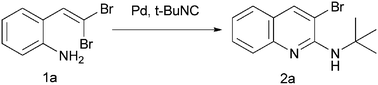
Gem-dihaloolefins as highly versatile reagents have attracted considerable attentions in transition metal-catalyzed cross-coupling chemistry due to their high reactivity and ready availability from inexpensive aldehydes.8 Recently, a number of novel and elegant methods for the preparation of various substituted indoles from 2-(gem-dibromovinyl)anilines were developed via Pd and/or Cu-catalyzed tandem cross-coupling strategies, such as C–N/C–C,9,10 C–N/C–N,11 C–N/C–P,10 C–N/C–H,12 C–N/carbonylation,13 and C–N/carbonylation/C–C reactions.14 However, to the best of our knowledge, there is no example of constructing quinoline scaffold from gem-dihalovinylanilines. In our continuous studies of 1,1-dibromoolefins,15 we report herein the preparation of 2-amino-3-bromoquinoline derivatives through tandem palladium-catalyzed isocyanide insertion and intramolecular cyclization of gem-dibromovinylanilines. The reaction involves t-butyl isocyanide and 2-(gem-dibromovinyl)anilines using palladium catalysis (Scheme 1).


image file: c4ra00821a-s1.tif
Scheme 1 Strategic approach to the synthesis of 2-amino-3-bromoquinolines.

Our investigation started with the treatment of 2-(gem-dibromovinyl)aniline (1a) and t-BuNC in the presence of Pd(OAc)2 (5 mol%) and PPh3(10 mol%) using K2CO3 (2 equiv.) as the base in THF at 100 °C. To our delight, the quinoline product 2a was obtained in 70% yield after 3 h (Table 1, entry 1). To improve the yield, screening of the reaction conditions was then carried out. Firstly, by using Pd(OAc)2 as catalyst, the effect of different solvents including DMSO, DMF, toluene, 1,4-dioxane and CH3CN was studied (Table 1, entry 2–6). Among them, 1,4-dioxane gave 2a in the highest yield (Table 1, entry 5). Lautens16 reported a convenient synthesis of 2-bromoindoles using PtBu3. When PtBu3 was used in our studies, 2a was obtained in 34% yield while 2-bromoindole in 29% yield. When t-BuNC (0.6 eq.) was used, 2a was obtained in 17% yield, and 2-bromoindole in 33% yield (Table 1, entry 7 and 8). After screening a series of palladium catalysts, Pd(dppf)Cl2 turned out to be the best choice (Table 1, entry 6–12). We were delighted to find that the reaction went well without additional ligand PPh3 (Table 1, entry 13). Other experiments with different bases showed that Cs2CO3 was the most efficient one (Table 1, entry 13–16). In addition, elevating or lowering reaction temperature resulted in decreased yields of 2a (Table 1, entry 17 and 18). On the basis of these findings, a wide variety of 2-amino-3-bromoquinolines were prepared in good yields from 2-(gem-dibromovinyl)anilines under the optimized conditions: Pd(dppf)Cl2 as the catalyst, Cs2CO3 as the base and 1,4-dioxane as the solvent at 100 °C. The results are shown in Table 2.

Table 1 Optimization of the reaction conditionsa

image file: c4ra00821a-u1.tif

Entry Catalyst Ligand Solvent Base Yieldb (%)
a Reaction conditions: 1a (0.2 mmol), t-BuNC (0.3 mmol), base (0.4 mmol), catalyst (0.01 mmol), ligand (0.04 mmol), solvent (2.0 mL), sealed tube, 100 °C, 3 h.b Isolated yields.c t-BuNC (0.12 mmol).d 120 °C.e 80 °C.
1 Pd(OAc)2 PPh3 THF K2CO3 70
2 Pd(OAc)2 PPh3 DMSO K2CO3 43
3 Pd(OAc)2 PPh3 DMF K2CO3 46
4 Pd(OAc)2 PPh3 Toluene K2CO3 51
5 Pd(OAc)2 PPh3 Dioxane K2CO3 77
6 Pd(OAc)2 PPh3 CH3CN K2CO3 72
7 Pd(OAc)2 PtBu3 Dioxane K2CO3 34
8 Pd(OAc)2 PtBu3 Dioxane K2CO3 17c
9 PdCl2 PPh3 Dioxane K2CO3 68
10 Pd(PPh3)4 Dioxane K2CO3 61
11 Pd(dppf)Cl2 PPh3 Dioxane K2CO3 80
12 Pd(PPh3)Cl2 PPh3 Dioxane K2CO3 79
13 Pd(PPh3)Cl2 Dioxane K2CO3 81
14 Pd(dppf)Cl2 Dioxane Cs2CO3 86
15 Pd(dppf)Cl2 Dioxane Na2CO3 82
16 Pd(dppf)Cl2 Dioxane K3PO4 65
17 Pd(dppf)Cl2 Dioxane Cs2CO3 71d
18 Pd(dppf)Cl2 Dioxane Cs2CO3 58e


Table 2 Synthesis of 2-amino-3-bromoquinolines 2b–2la

image file: c4ra00821a-u2.tif

Entry Substrate Product Yieldb (%)
a Reaction conditions: 1 (0.2 mmol), t-BuNC (0.3 mmol), Cs2CO3 (0.4 mmol), Pd(dppf)Cl2 (0.01 mmol), 1,4-dioxane (2.0 mL), sealed tube, 100 °C, 3 h.b Isolated yields.
1 image file: c4ra00821a-u3.tif image file: c4ra00821a-u4.tif 82
2 image file: c4ra00821a-u5.tif image file: c4ra00821a-u6.tif 87
3 image file: c4ra00821a-u7.tif image file: c4ra00821a-u8.tif 85
4 image file: c4ra00821a-u9.tif image file: c4ra00821a-u10.tif 81
5 image file: c4ra00821a-u11.tif image file: c4ra00821a-u12.tif 84
6 image file: c4ra00821a-u13.tif image file: c4ra00821a-u14.tif 86
7 image file: c4ra00821a-u15.tif image file: c4ra00821a-u16.tif 80
8 image file: c4ra00821a-u17.tif image file: c4ra00821a-u18.tif 82
9 image file: c4ra00821a-u19.tif image file: c4ra00821a-u20.tif 83
10 image file: c4ra00821a-u21.tif image file: c4ra00821a-u22.tif 84
11 image file: c4ra00821a-u23.tif image file: c4ra00821a-u24.tif 85


Gratifyingly, gem-dibromovinylanilines bearing both electron-withdrawing and electron-donating moieties on the aromatic ring afforded the quinoline products in good yields (Table 2, entry 1–6). It is obvious that the electronic effects of substituted groups on the benzene rings in 2-(gem-dibromovinyl)anilines had little impact on the yields of the products. Halogen substitutes on the aromatic ring were well tolerated, giving polyhalogenated 2-amino-3-bromoquinolines (Table 2, entry 7–10), which provides attractive intermediates for their further transformation via transition-metal catalyzed C–C or C–heteroatom formation reactions.

Having successfully established the general method for the synthesis of 2-amino-3-bromoquinolines, we envisioned that 2-amino-3-bromoquinolines could easily undergo an intramolecular cross-coupling reaction to afford various 3-substituted-2-aminoquinolines, even through a one-pot two-step process. As expected, we found 3-substituted-2-aminoquinolines (6/7/8) could be conveniently prepared in 66%/51%/43% yields through palladium-catalyzed isocyanide insertion and typical Suzuki/Sonogashira/Heck reaction, respectively (Scheme 2).


image file: c4ra00821a-s2.tif
Scheme 2 One-pot two-step cross-coupling reaction of 2a. Reaction conditions: step (1) 1a (0.2 mmol), t-BuNC (0.3 mmol), Cs2CO3 (0.4 mmol), Pd(dppf)Cl2 (0.01 mmol), 1,4-dioxane (2.0 mL), sealed tube, 100 °C, 3 h; step (2) 3/4/5 (0.3 mmol), K3PO4 (0.4 mmol), Pd(dppf)Cl2 (0.01 mmol), toluene (2.0 mL), sealed tube, 120 °C, N2, 12 h.

Since ortho effect exists in many metal-catalyzed reactions,6a,15,17 a plausible mechanism for the formation of 2-amino-3-bromoquinoline is proposed in Scheme 3. Initial oxidative addition of cis-bromovinyl of 1a to Pd(0) species formed vinylpalladium complex A. Subsequent migratory insertion of t-butyl isocyanide to A gave intermediate B, followed by intramolecular nucleophilic attack of the aniline to provide intermediate C and hydrogen bromide. Reductive elimination of C afforded final product 2a, generating the Pd(0) catalyst. Further studies into the mechanism of this transformation and synthetic applications are still ongoing.


image file: c4ra00821a-s3.tif
Scheme 3 Proposed mechanism.

Conclusions

In summary, we have developed a novel and efficient method for the construction of 2-amino-3-bromoquinolines via palladium-catalyzed isocyanide insertion followed by intramolecular cyclization of gem-dibromovinylanilines. The palladium-catalyzed reactions proceeded in 1,4-dioxane at 100 °C for 3 h and the corresponding products were obtained in good isolated yields. More importantly, this method can be extended to the synthesis of various 3-substituted-2-aminoquinolines via palladium-catalyzed Suzuki/Sonogashira/Heck reactions starting from easily accessible gem-dibromovinylanilines in a one-pot two-step way.

This work was financially supported by Foundation of the Leading Talents of Guangdong Province (no. 1187000044).

Notes and references

  1. (a) K. Andries, P. Verhasselt, J. Guillemont, H. W. H. Göhlmann, J.-M. Neefs, H. Winkler, J. V. Gestel, P. Timmerman, M. Zhu, E. Lee, P. Williams, D. D. Chaffoy, E. Huitric, S. Hoffner, E. Cambau, C. Truffot-Pernot, N. Lounis and V. Jarlier, Science, 2005, 307, 223 CrossRef CAS PubMed; (b) B. D. Bax, P. F. Chan, D. S. Eggleston, A. Fosberry, D. R. Gentry, F. Gorrec, I. Giordano, M. M. Hann, A. Hennessy, M. Hibbs, J. Huang, E. Jones, J. Jones, K. K. Brown, C. J. Lewis, E. W. May, M. R. Saunders, O. Singh, C. E. Spitzfaden, C. Shen, A. Shillings, A. J. Theobald, A. Wohlkonig, N. D. Pearson and M. N. Gwynn, Nature, 2010, 466, 935 CrossRef PubMed.
  2. S. R. Inglis, R. K. Jones, G. W. Booker and S. M. Pyke, Bioorg. Med. Chem. Lett., 2006, 16, 387 CrossRef CAS PubMed.
  3. S. F. Campbell, J. D. Hardstone and M. J. Palmer, J. Med. Chem., 1988, 31, 1031 CrossRef CAS; R. L. Knight, D. R. Allen, H. L. Birch, G. A. Chapman, F. C. Galvin, L. A. Jopling, C. J. Lock, J. W. G. Meissner, D. A. Owen, G. Raphy, R. J. Watson and S. C. Williams, Bioorg. Med. Chem. Lett., 2008, 18, 629 CrossRef PubMed.
  4. Y. Cheng, T. C. Judd, M. D. Bartberger, J. Brown, K. Chen, J. Robert, T. Fremeau, D. Hickman, S. A. Hitchcock, B. Jordan, V. Li, P. Lopez, S. W. Louie, Y. Luo, K. Michelsen, T. Nixey, T. S. Powers, C. Rattan, E. A. Sickmier, D. J. St. Jean Jr, R. C. Wahl, P. H. Wen and S. Wood, J. Med. Chem., 2011, 54, 5836 CrossRef CAS PubMed.
  5. For typical methods on quinoline synthesis, see: (a) J. Marco-Contelles, E. Pérez-Mayoral, A. Samadi, M. A. D. C. Carreiras and E. Soriano, Chem. Rev., 2009, 109, 2652 CrossRef CAS PubMed; (b) S. Khong and O. Kwon, J. Org. Chem., 2012, 77, 8257 CrossRef CAS PubMed; Y. Laras, V. Hugues, Y. Chandrasekaran, M. Blanchard-Desce, F. C. Acher and N. Pietrancosta, J. Org. Chem., 2012, 77, 8294 Search PubMed; (c) Y. C. Wu, L. Liu, H. J. Li, D. Wang and Y. J. Chen, J. Org. Chem., 2006, 71, 6592 CrossRef CAS PubMed; (d) R. Yan, X. Liu, C. Pan, X. Zhou, X. Li, X. Kang and G. Huang, Org. Lett., 2013, 15, 4876 CrossRef CAS PubMed; (e) Y. Zhang, M. Wang, P. Li and L. Wang, Org. Lett., 2012, 14, 2206 CrossRef CAS PubMed.
  6. (a) B. Liu, H. Gao, Y. Yu, W. Wu and H. Jiang, J. Org. Chem., 2013, 78, 10319 CrossRef CAS PubMed; (b) T. Tomioka, Y. Takahashi and T. Maejim, Org. Biomol. Chem., 2012, 10, 5113 RSC; J. Yin, B. Xiang, M. A. Huffman, C. E. Raab and I. W. Davies, J. Org. Chem., 2007, 72, 4554 Search PubMed.
  7. J. T. Payne, M. C. Andorfer and J. C. Lewis, Angew. Chem., Int. Ed., 2013, 52, 5271 CrossRef CAS PubMed; X. Sun, G. Shan, Y. Sun and Y. Rao, Angew. Chem., Int. Ed., 2013, 52, 4440 CrossRef PubMed; X. Wan, Z. Ma, B. Li, K. Zhang, S. Cao, S. Zhang and Z. Shi, J. Am. Chem. Soc., 2006, 128, 7416 CrossRef PubMed; S. Andrews, S. J. Burgess, D. Skaalrud, J. X. Kelly and D. H. Peyton, J. Med. Chem., 2010, 53, 916 CrossRef PubMed.
  8. For selected reviews, see: (a) G. Chelucci, Chem. Rev., 2012, 112, 1344 CrossRef CAS PubMed; (b) S. Cacchi, G. Fabrizi and A. Goggiamani, Org. Biomol. Chem., 2011, 9, 641 RSC.
  9. (a) Y. Q. Fang, R. Karisch and M. Lautens, J. Org. Chem., 2007, 72, 1341 CrossRef CAS PubMed; (b) Y. Q. Fang, J. Yuen and M. Lautens, J. Org. Chem., 2007, 72, 5152 CrossRef CAS PubMed; (c) M. Nagamochi, Y. Q. Fang and M. Lautens, Org. Lett., 2007, 9, 2955 CrossRef CAS PubMed; (d) A. Fayol, Y. Q. Fang and M. Lautens, Org. Lett., 2006, 8, 4203 CrossRef CAS PubMed; (e) Y. Q. Fang and M. Lautens, Org. Lett., 2005, 7, 3549 CrossRef CAS PubMed; (f) Y. Q. Fang and M. Lautens, J. Org. Chem., 2008, 73, 538 CrossRef CAS PubMed.
  10. S. Thielges, E. Meddah, P. Bisseret and J. Eustache, Tetrahedron Lett., 2004, 45, 907 CrossRef CAS PubMed.
  11. J. Yuen, Y. Q. Fang and M. Lautens, Org. Lett., 2006, 8, 653 CrossRef CAS PubMed.
  12. (a) W. Chen, M. Wang, P. Li and L. Wang, Tetrahedron Lett., 2011, 67, 5913 CrossRef CAS PubMed; (b) X. R. Qin, X. F. Cong, D. B. Zhao, J. S. You and J. B. Lan, Chem. Commun., 2011, 47, 5611 RSC; (c) Z. J. Wang, F. Yang, X. Lv and W. Bao, J. Org. Chem., 2011, 76, 967 CrossRef CAS PubMed; (d) Z. J. Wang, J. G. Yang, F. Yang and W. Bao, Org. Lett., 2010, 12, 3034 CrossRef CAS PubMed; (e) C. S. Bryan and M. Lautens, Org. Lett., 2008, 10, 4633 CrossRef CAS PubMed.
  13. T. O. Vieira, L. A. Meaney, Y. L. Shi and H. Alper, Org. Lett., 2008, 10, 4899 CrossRef CAS PubMed.
  14. M. Arthuis, R. Pontikis and J. C. Florent, Org. Lett., 2009, 11, 4608 CrossRef CAS PubMed.
  15. B. Jiang, K. Tao, W. Shen and J. Zhang, Tetrahedron Lett., 2010, 51, 6342 CrossRef CAS PubMed.
  16. S. G. Newman and M. Lautens, J. Am. Chem. Soc., 2010, 132, 11416 CrossRef CAS PubMed.
  17. For selected publications, see: (a) Y. Li, J. Zhao, H. Chen, B. Liu and H. Jiang, Chem. Commun., 2012, 48, 3545 RSC; (b) G. Baelen, S. Kuijer, S. Sergeyev, E. Janssen and R. Orru, Chem. – Eur. J., 2011, 17, 15039 CrossRef PubMed; (c) G. Maestri, E. Motti, M. Malacria, E. Derat and M. Catellani, J. Am. Chem. Soc., 2011, 133, 8574 CrossRef CAS PubMed.

Footnote

Electronic supplementary information (ESI) available. See DOI: 10.1039/c4ra00821a

This journal is © The Royal Society of Chemistry 2014
Click here to see how this site uses Cookies. View our privacy policy here.