DOI:
10.1039/C4RA00512K
(Paper)
RSC Adv., 2014,
4, 19370-19374
Spectral properties of 4-(4-hydroxy-1-naphthylazo)benzenesulfonic acid and its application for colorimetric determination of trace Fe3+
Received
24th January 2014
, Accepted 6th March 2014
First published on 7th March 2014
Abstract
A multifunctional dye, 4-(4-hydroxy-1-naphthylazo)benzenesulfonic acid (HNABA) was identified and synthesized. The dye, combining hydroxyl, azo and carboxyl groups, possessed excellent optical absorption properties changing with pH, solvent and coexisting metal ions. In particular, its spectral properties remained extremely stable under acid or neutral conditions and it was effectively applied for colorimetric determination of Fe3+ from brick-red to light red in aqueous solution under physiological pH conditions (pH 7.0). Under the optimum conditions, the detection possessed a linear range of 9.5–400 × 10−8 mol L−1 with a correlation coefficient (R) of 0.9938 and a limit detection (3σ, n = 20) of 4.2 × 10⁻⁹ mol L−1. The relative standard deviation (R.S.D.) was lower than 3.5% (n = 5). The proposed method was successfully used to determine trace Fe3+ in three real environmental water samples. The mechanism of action between HNABA and Fe3+ ion is discussed in detail.
1. Introduction
Detection of metal ions has continued to attract tremendous attention in recent years due to its importance in environmental, biology and chemistry domains. Iron, the third most abundant element in the earth's crust, is not only a very important macro-element in the environment, but also an essential mineral nutrient for human health.1,2 People who lack iron will suffer from iron deficiency anemia and other serious effects on human health, while excess iron would cause an increased risk of cancer, heart disease and other illnesses such as haemochromatosis.3–8 Therefore, there is an urgent need to develop chemical sensors that are capable of detecting and monitoring iron levels in environmental samples. Considerable efforts have been made to develop various detection methods, such as fluorescent spectrometry,9–14 electro-chromic techniques15,16 flow injection spectro-photometry,17,18 chromatography,19,20 mass spectrometry,21 nuclear magnetic resonance,22 and inductively coupled plasma mass spectrometry.23 However, these instrumentally intensive methods often require utilizing sophisticated instrumentation or complicated pretreatment procedures, and are not suitable for on-line or in-field monitoring. By virtue of its simplicity, rapidity, non-destructive characteristics and especially the fact that the naked eye, rather than complex instruments,24–29 can be used to observe change, colorimetric sensors for Fe3+ have attracted considerable attention in recent years.30–33 Typically, Yun et al.31 presented an easy naked-eye detection method for Fe3+ with a detection limit of 0.024 μg mL−1, based on 1-nitroso-2-naphthol, an excellent color-forming chelating agent. Adebayo et al.34 found a novel 8-hydroxyquinoline-based colorimetric sensor for the simple and rapid determination of Fe3+ using the reaction of Fe3+ with the sensor to form a metaloxine complex in chloroform solution. Wallace et al.30 developed a system that was able to detect low levels of Fe3+ using a squaraine dye to model on siderophores. All these confirm that organic colorimetric sensors are a promising, easy and practical strategy for detecting Fe3+. However, the sensitivity of common colorimetric sensors is still lower than that of the instrumentally intensive methods mentioned above. To develop novel and efficient colorimetric sensing materials will remain a big challenge for a long time in the future.
Herein, to improve the sensitivity and selectivity of Fe3+ detection in aqueous systems, a multifunctional dye, 4-(4-hydroxy-1-naphthylazo)benzenesulfonic acid (HNABA), was identified and applied for Fe3+ detection after its optical properties were studied in detail. The multifunctional dye was expected to possess high selectivity and sensitivity to Fe3+ using both a hydroxyquinoline group31 and an –N
N– group35,36 as chelating groups and to further increase the solubility in aqueous solution combining –SO3H, –OH and –N
N– groups. The action mechanism between HNABSC and Fe3+ was discussed by means of Job's plots and theoretical calculation.
2. Experiments
2.1 Reagents and apparatus
All the chemicals in the experiment were of AR grade and used as received from Sinopharm Chemical Reagent Co. Ltd. Water used throughout was doubly deionized.
A 1.0 mmol L−1 Fe3+ standard solution for testing was prepared in doubly deionized water at room temperature and diluted to the appropriate concentration daily. HNABA was synthesized according to our previous work37,38 and a 5.0 × 10⁻³ mol L−1 HNABA stock solution was prepared in doubly deionized water at room temperature and stored at 4 °C. Phosphate buffers (PB) were prepared by mixing a 0.01 mol L−1 H3PO4 solution, a 0.01 mol L−1 K2HPO4 solution, a 0.01 mol L−1 KH2PO4 solution or a 0.01 mol L−1 KOH solution in the proper ratio to achieve the desired pH (pH = 3.0, 4.0, 5.0, 6.0, 7.0, 7.5, 8.0, 9.0, 10.0).
FTIR spectra of HNABA using a KBr disc were acquired using a Nicolet NEXUS 870 FTIR spectrophotometer at room temperature from 4000–500 cm−1. 1H NMR spectra were recorded using a Bruker AMX-500 spectrometer operating at 400 MHz, with tetramethyl-silane (TMS) used as the reference and D2O as solvent. Elemental analysis was conducted using an Elemental Vario EL-III apparatus. UV-vis spectra were recorded on a Lambda 35 UV/vis spectrometer using a 1 cm square quartz cell. pH was measured by a PHS-25 pH meter.
2.2 Preparations of HNABA
According to the literature,37,38 p-amino benzenesulfonic acid (0.87 g, 5 mmol) was dissolved in an ice–water solution of 15% sodium nitrite (0.38 g, 5.5 mmol). After cooling to 0 °C, the solution was added to concentrated hydrochloric acid (1.2 mL) and stirred for 30 min. The excess nitrous acid was destroyed with about 5 mg urea. The mixture was then added dropwise to 10 mL buffered aqueous solution (KH2PO4/Na2HPO4, pH = 6) containing naphthol (0.73 g, 5 mmol) and stirred for another 2 h at 0–5 °C. The resultant precipitate was filtered and purified by recrystallizing three times from ethanol to provide dark red crystals of HNABA in a yield of 92.1%.
IR (KBr), ν (cm−1): 3433–2500 (OH, SO3H), 1594, 1518 (Ar), 1376 (Ar–N (R1R)), 1169 (S–O). 1H-NMR (D2O, 400 Hz) δ (ppm): 8.74 (d, J = 8.5 Hz, 1H, Ar–H), 8.61 (d, J = 8.4 Hz, 1H, Ar–H), 8.40 (d, J = 8.4 Hz, 1H, Ar–H), 8.12 (d, J = 7.8 Hz, 1H, Ar–H), 8.06 (d, J = 7.8 Hz, 1H, Ar–H), 7.48 (t, J = 6.4 Hz, 1H, Ar–H), 7.51 (t, J = 6.7 Hz, 1H, Ar–H), 7.15 (t, J = 6.5 Hz, 1H, Ar–H), 5.15 (s, 1H, –OH). Anal. calcd for C16H12N2SO4: H, 3.68; C, 58.53; N, 8.51; S, 9.77%. Found: H, 3.73; C, 58.49; N, 8.50; S, 9.79%.
2.3 Fe3+ detection procedure
For the Fe3+ determination, 1.0 mL PB (pH 7.0), 1.0 mL 5.0 × 10⁻⁴ mol L−1 of HNABA and 1.0 mL of the appropriate Fe3+ solution or sample were transferred into a 10 mL volumetric flask. The mixture was stirred thoroughly and finally diluted to 10 mL with doubly deionized water. After 20 min, the absorption spectra were measured from 200 nm to 600 nm and the band-slit was set as 2.0 nm. The absorption intensity difference at 478 nm was used for quantitative analysis. The decreased absorption intensity of HNABA was represented as ΔA = A0 − A, where A0 and A were the absorption intensities of the systems in the absence and presence of Fe3+, respectively.
3. Results and discussion
3.1 The UV-vis absorption spectrum of HNABA
It is well known that HNABA is a strong polar compound, whose solubility is quite low in nonpolar solvents. To illustrate the effect of solvents on the absorption spectrum of HNABA, the UV-vis spectra in different polar solvents, i.e., N,N-dimethyl formamide (DMF), tetrahydrofuran (THF), acetone, ethanol and water were recorded as shown in Fig. 1.
 |
| | Fig. 1 The UV-vis spectra of HNABA in polar solvents, DMF, THF, acetone, water and ethanol. | |
In Fig. 1, we can find that HNABA has a strong and sharp absorption peak at ca. 478 nm in polar protic water and ethanol, attributed to the whole molecular π-conjugated system, with molar absorptivity (ε) of 2.54 × 10⁴ L mol−1 cm−1 and 1.95 × 10⁴ L mol−1 cm−1, respectively, meaning that HNABA exists in the form of a monomolecule, i.e., polar protic water and ethanol are both good solvents for HNABA. However in polar aprotic acetone, THF and DMF, the absorption intensity at ca. 478 nm decreases and a new blue-shifted absorption peak emerges at ca. 420 nm. The widening and blue-shift of the absorption might be attributed to the H-aggregation of HNABA in poor solvents such as acetone, THF and DMF.39,40 The conclusion could be further confirmed by the fact that the absorptions at ca. 240, 266, 290, 330 nm appear clearly in polar protic water and ethanol while they decrease or disappear almost in polar aprotic acetone, THF and DMF, attributed to the π→π*, n→π* transitions of the C
C, N
N and O
C bonds in the non-conjugated benzenesulfonic acid and naphthol moieties.
For an acidic HNABA molecule, the pH of the system will have a more significant influence on the form in which it exists and so will make its absorption spectrum change. Here the effect of pH on the absorption spectrum was investigated in polar protic water with a pH range of 3.0–10.0. As shown in Fig. 2, it is interesting to find that the absorption at 478 nm keeps quite stable as long as the pH is less than 7.0. When pH is more than 8.0, the absorption intensity at 478 nm decreases gradually and red shifts. The reason may be that the SO3H and OH groups in HNABA molecules are all ionized to SO3− and O− ions under basic conditions, which would enlarge the whole molecular π-conjugated system, but decrease the molecular dipole moment. The same phenomenon is also found in the absorbance at ca. 240, 266, 290, 330 nm as shown in Fig. 2, meaning that HNABA could possess good optical absorption properties under a wide pH range, i.e., physiological conditions (pH ca. 7.0) will be selected in the next experiments.
 |
| | Fig. 2 Effect of pH on the UV-vis spectra of HNABA (From up to down: 3.0, 4.0, 5.0, 6.0, 7.0, 7.5, 8.0, 9.0, 10.0). | |
3.2 Special response to Fe3+
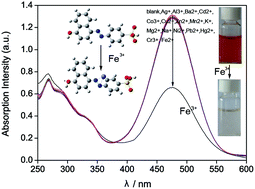
To demonstrate the selectivity of HNABA sensing for Fe3+, we investigated its colorimetric response to some other environmentally relevant metal ions, i.e., Ag+, Al3+, Ba2+, Cd2+, Co3+, Cu2+, Zn2+, Mn2+, K+, Mg2+, Na+, Ni2+, Pb2+, Hg2+, Cr3+ and Fe2+ at high concentrations in aqueous solutions at pH 7.0. After the addition of 100 equiv. (4.0 × 10⁻⁴ mol L−1) of the different metal ions above and Fe3+ (4.0 × 10⁻⁶ mol L−1), the relative changes in absorption intensities of the sensing system were recorded as shown in Fig. 3, respectively. It can be seen from Fig. 3 that the absorption intensities of the HNABA sensing system in the presence of Ag+, Al3+, Ba2+, Cd2+, Co3+, Cu2+, Zn2+, Mn2+, K+, Mg2+, Na+, Ni2+, Pb2+, Hg2+, Cr3+ and Fe2+ show negligible change even with 100-fold higher concentrations than that of Fe3+ and the alterations in ΔA are all less than 5% (detection error). The results indicate that HNABA possesses excellent selectivity for Fe3+ even in the presence of other coexisting metal ions under very high concentrations.
 |
| | Fig. 3 Effect of different metal ions on the UV-vis spectra of HNABA. | |
To illustrate the response speed of HNABA to Fe3+ and the stability of the proposed system, the effect of incubation time on the absorption intensity was also investigated. The results show that a maximum and constant ΔA is reached after all reagents are added and incubated for ca. 20 min at room temperature. ΔA remains constant for more than 1 h, implying that the HNABA sensor for Fe3+ is stable and reliable.
The influence of ionic strength on ΔA of the system at 478 nm was also investigated by varying NaCl concentration from 1.0 × 10⁻² mol L−1 to 1.0 × 10⁻⁶ mol L−1. It is worth noting that all the ion strengths tested have no obvious effect on ΔA, hinting that the target sensing system is quite stable and may be applied in various kinds of surroundings.
3.3 Analytical parameters and samples detection
Fig. 4 shows the colour change and the absorption spectra of HNABA at different concentrations of Fe3+ between 9.5–400 × 10−8 mol L−1. From Fig. 4a, it is easy to find that the colour of the sensing system changes from brick-red to light red, which can be detected by the naked eye. Also, the calibration graph, the detection limit and precision for Fe3+ detection are obtained under the optimal conditions from Fig. 4b and c. A linear relationship between ΔA and Fe3+ concentration is exhibited in the range of 9.5–400 × 10−8 mol L−1 with a correlation coefficient of 0.9938. The regression equation is A = −0.04834 × 10⁻⁴ + 1.37 × 10⁻³c. Based on the definition of detection limit, three times the average deviation of UV absorption at 478 nm in 20 blank samples without Fe3+ divided by the slope absolute value of the standard curve in Fig. 4c here, the limit of detection (LOD) for Fe3+ is up to 4.2 × 10⁻⁹ mol L−1.
 |
| | Fig. 4 The colour change (4a) and the absorption spectra (4b) of HNABA in different Fe3+ concentrations (from up to down: 0, 9.5, 20, 60, 100, 150, 200, 250, 300, 350, 400 × 10−8 mol L−1); and the linear relationship between the ΔA of HNABA at 478 nm and cFe3+ (4c). | |
To confirm its feasibility, the proposed method was applied to determine Fe3+ in three environmental water samples from the Pi River, underground water and tap water on campus, respectively (Table 1). All the samples were obtained by filtering several times and concentrated by a factor of 100 before testing. For recovery studies, some known concentrations of Fe3+ were added to the environmental water samples and the total Fe3+ concentrations were determined following the method proposed above. The recoveries of different known amounts of Fe3+ spiked solution were obtained from 97.8% to 102.2% with a satisfying analytical precision (R.S.D. ≤3.5%).
Table 1 Determination results for environmental water samples (n = 5)a
| Samplesb |
CFe3+ in sampleb (nM) |
Spiked (nM) |
Found (nM) |
Recovery (%) |
R.S.D. (%) |
| PB, pH 7.0. The environmental water Fe3+ concentration determined using HNABA with the proposed method. The real values are the table values × 10−2 nmol L−1 for the detected water samples were concentrated 100 times. |
| 1 (The Pi river) |
788.5 |
500.0 |
1277.7 |
97.8 |
2.2 |
| 2 (Underground) |
985.2 |
500.0 |
1496.0 |
102.2 |
3.5 |
| 3 (Pure water) |
0.00 |
500.0 |
492.8 |
98.6 |
1.3 |
3.4 Action mechanism between HNABA and Fe3+
To investigate the nature of the bonding between HNABA and Fe3+, the binding stoichiometry of HNABA with Fe3+ was determined by using a Job plot. For the Job plot analyses, a series of solutions with varying mole fractions of Fe3+ were prepared by maintaining the total HNABA and Fe3+ concentration constant (6.0 × 10⁻⁵ mol L−1). The absorption intensity at 478 nm was measured for each solution. As shown in Fig. 5a 1
:
1 stoichiometry for the complex between HNABA and Fe3+ can be drawn from the Job plots,41 which confirms that Fe3+ might coordinate with the nitrogen atoms in the –N
N bonds or with oxygen atoms on the naphthol rings.
 |
| | Fig. 5 Job plot of HNABA–Fe3+ system. [HNABA] + [Fe3+] = 8.0 × 10⁻⁵ mol L−1 in aqueous at pH 7.0. | |
Theoretical calculations have been carried out to further understand the nature of the bonding between HNABA and Fe3+. The structures of HNABA before and after coordinating with Fe3+ are shown in Fig. 6, and were optimized using the B3LYP/6-31G level of theory and method implemented in the Gaussian 03 suite of programs.42 From the results, we can find easily that the terminal phenyl rings were greatly distorted, because of the binding of Fe3+ with the nitrogen atoms in the –N
N bonds in HNABA, which resulted in the original conjugated system being destroyed and so the absorbance at 478 nm was reduced and even quenched.
 |
| | Fig. 6 Optimized geometries of HNABA before and after reaction with Fe3+ ion. O, N, C, H, S and Fe atom are represented as red, blue, gray, white-gray, yellow and blue-purple, respectively. | |
4. Conclusions
In conclusion, a multifunctional dye, 4-(4-hydroxy-1-naphthylazo)benzenesulfonic acid (HNABA) possessed a strong absorption (ε = 2.54 × 10⁴ L mol−1 cm−1) at ca. 478 nm in polar protic water and remained tremendously stable under acid or neutral conditions. Based on the results, the dye was successfully developed for trace Fe3+ detection with high selectivity and sensitivity under physiological pH conditions (pH 7.0). The optimal test conditions were obtained (after 20 min incubation time at room temperature under pH = 7.0, cHNABA 5.0 × 10⁻⁵ mol L−1 in water) by investigating the influences of solvent, pH, ion intensity and incubation time on detection sensitivity. The linear range for detection of Fe3+ in aqueous environments was 9.5–400 × 10−8 mol L−1 with a detection limit of 4.2 × 10⁻⁹ mol L−1 and a correlation coefficient of 0.9938. The mechanism of action of HNABA and Fe3+ ion was confirmed by means of Job plots, as well as experimental and theoretical deduction.
Acknowledgements
The authors gratefully acknowledge financial support from the National Natural Science Fund of China (no. 21277103) and Anhui Provincial Natural Science Fund (no. 1308085ME57).
Notes and references
- R. K. Shervedani, A. Hatefi-Mehrjardi and A. Asadi-Farsani, Anal. Chim. Acta, 2007, 601, 164–171 CrossRef CAS PubMed.
- M. Shamsipur, M. Sadeghi, A. Garau and V. Lippolis, Anal. Chim. Acta, 2013, 761, 169–177 CrossRef CAS PubMed.
- J. Mao, Q. He and W. S. Liu, Talanta, 2010, 80, 2093–2098 CrossRef CAS PubMed.
- P. Blatny, F. Kvasnicka and E. Kenndler, J. Chromatogr. A, 1997, 757, 297–302 CrossRef CAS.
- M. J. C. Marenco, C. Fowley, B. W. Hyland, D. Galindo-Riano, S. K. Sahoo and J. F. Callan, J. Fluoresc., 2012, 22, 795–798 CrossRef CAS PubMed.
- T. A. Ali, G. G. Mohamed, M. M. I. El-Dessouky, S. M. Abou El Ella and R. T. F. Mohamed, Int. J. Electrochem. Sci., 2013, 8, 1469–1486 CAS.
- N. R. Chereddy, S. Thennarasu and A. B. Mandal, Dalton Trans., 2012, 41, 11753–11759 RSC.
- B. D. Wang, J. Hai, Z. C. Liu, Q. Wang, Z. Y. Yang and S. H. Sun, Angew. Chem., Int. Ed., 2010, 49, 4576–4579 CrossRef CAS PubMed.
- Y. Y. Du, M. Chen, Y. X. Zhang, F. Luo, C. Y. He, M. J. Li and X. Chen, Talanta, 2013, 106, 261–265 CrossRef CAS PubMed.
- C. H. Ma, L. P. Lin, Y. Y. Du, L. B. Chen, F. Luo and X. Chen, Anal. Methods, 2013, 5, 1843–1847 RSC.
- K. G. Qu, J. S. Wang, J. S. Ren and X. G. Qu, Chem.–Eur. J., 2013, 19, 7243–7249 CrossRef CAS PubMed.
- S. H. Wang, L. Y. Du, A. M. Zhang and B. Li, Anal. Lett., 1997, 30, 2099–2107 CrossRef CAS.
- X. F. Wu, B. W. Xu, H. Tong and L. X. Wang, Macromolecules, 2010, 43, 8917–8923 CrossRef CAS.
- X. S. Zhu and R. R. Jiang, J. Fluoresc., 2011, 21, 385–391 CrossRef CAS PubMed.
- M. Becuwe, P. Rouge, C. Gervais, M. Courty, A. Dassonville-Klimpt, P. Sonnet and E. Baudrin, J. Colloid Interface Sci., 2012, 388, 130–136 CrossRef CAS PubMed.
- M. M. Zareh, I. F. A. Ismail and M. H. Abd El-Aziz, Electroanalysis, 2010, 22, 1369–1375 CrossRef CAS.
- B. Haghighi and A. Safavi, Anal. Chim. Acta, 1997, 354, 43–50 CrossRef CAS.
- W. Ruengsitagoon, Talanta, 2008, 74, 1236–1241 CrossRef CAS PubMed.
- M. Sugiyama, Y. Naraki and T. Hori, J. Liq. Chromatogr. Relat. Technol., 2009, 32, 788–800 CrossRef CAS.
- H. Matsumiya, N. Iki and S. Miyano, Talanta, 2004, 62, 337–342 CrossRef CAS PubMed.
- I. A. Korobeinikova, G. B. Pronchev and A. N. Ermakov, J. Anal. Chem., 2011, 66, 740–744 CrossRef CAS.
- H. Fujii, J. Am. Chem. Soc., 2002, 124, 5936–5937 CrossRef CAS PubMed.
- S. B. Khan, M. M. Rahman, H. M. Marwani, A. M. Asiri, K. A. Alamry and M. A. Rub, Appl. Surf. Sci., 2013, 282, 46–51 CrossRef CAS PubMed.
- L. Hu, Z. Q. Yan and H. Y. Xu, RSC Adv., 2013, 3, 7667–7676 RSC.
- L. Hu, Y. F. Zhang, L. Nie, C. G. Xie and Z. Q. Yan, Spectrochim. Acta, Part A, 2013, 104, 87–91 CrossRef CAS PubMed.
- Z. Q. Yan, S. Y. Guang, H. Y. Xu and X. Y. Liu, Analyst, 2011, 136, 1916–1921 RSC.
- Z. Q. Yan, L. Hu, L. Nie and H. Lv, Spectrochim. Acta, Part A, 2011, 79, 661–665 CrossRef CAS PubMed.
- E. W. Baumann, Analyst, 1992, 117, 913–916 RSC.
- M. A. Kabil and S. E. Ghazy, Anal. Sci., 1995, 11, 817–822 CrossRef CAS.
- K. J. Wallace, M. Gray, Z. L. Zhong, V. M. Lynch and E. V. Anslyn, Dalton Trans., 2005, 2436–2441 RSC.
- J. Yun and H. Choi, Talanta, 2000, 52, 893–902 CrossRef CAS.
- S. Kawakubo, K. Shimada, Y. Suzuki and K. Hattori, Anal. Sci., 2011, 27, 341–344 CrossRef CAS.
- S. P. Wu, Y. P. Chen and Y. M. Sung, Analyst, 2011, 136, 1887–1891 RSC.
- B. K. Adebayo, S. Ayejuyo, H. K. Okoro and B. J. Ximba, Afr. J. Biotechnol., 2011, 10, 16051–16057 CAS.
- S. Zareba and H. Hopkala, J. Pharm. Biomed. Anal., 1996, 14, 1351–1354 CrossRef CAS.
- A. K. Sharma and I. Singh, Food Anal. Methods, 2009, 2, 221–225 CrossRef.
- Z. Q. Yan, Y. F. Chen, S. Y. Guang, H. Y. Xu and L. F. Li, Polym. Sci., Ser. B, 2011, 53, 535–539 CrossRef CAS.
- Z. Q. Yan, S. Y. Guang, H. Y. Xu and X. Y. Liu, Dyes Pigm., 2013, 99, 720–726 CrossRef CAS PubMed.
- Z. Q. Yan, H. Y. Xu, S. Y. Guang, X. Zhao, W. L. Fan and X. Y. Liu, Adv. Funct. Mater., 2012, 22, 345–352 CrossRef CAS.
- Z. Q. Yan, S. Y. Guang, H. Y. Xu, X. Y. Su, X. L. Ji and X. Y. Liu, RSC Adv., 2013, 3, 8021–8027 RSC.
- H. J. Kim, J. E. Park, M. G. Choi, S. Ahn and S. K. Chang, Dyes Pigm., 2010, 84, 54–58 CrossRef CAS PubMed.
- M. J. T. Frisch, G. W. Trucks, H. B. Schlegel, G. E. Scuseria, M. A. Robb, J. R. Cheeseman, J. A. Montgomery, Jr, T. Vreven, K. N. Kudin and J. C. Burant, Gaussian 03, revision A.1, Gaussian, Inc., Pittsburgh, PA, 2004 Search PubMed.
|
| This journal is © The Royal Society of Chemistry 2014 |
Click here to see how this site uses Cookies. View our privacy policy here.