Photocatalytic hydrogen generation from water using a hybrid of graphene nanoplatelets and self doped TiO2–Pd

Farheen N. Sayeda, R. Sasikala*a, O. D. Jayakumar*a, R. Raob, C. A. Bettya, Anand Chokkalingamc, R. M. Kadamd, Jagannathe, S. R. Bharadwaja, Ajayan Vinuc and A. K. Tyagia
aChemistry Division, Bhabha Atomic Research Centre, Trombay, Mumbai 400085, India. E-mail: sasikala@barc.gov.in; ddjaya@barc.gov.in
bSolid State Physics Division, Bhabha Atomic Research Centre, Trombay, Mumbai 400085, India
cAustralian Institute for Bioengineering and Nanotechnology (AIBN), The University of Queensland, Brisbane, QLD 4072, Australia
dRadio Chemistry Division, Bhabha Atomic Research Centre, Trombay, Mumbai 400085, India
eTechnical Physics Division, Bhabha Atomic Research Centre, Trombay, Mumbai 400085, India

Received 26th December 2013 , Accepted 4th March 2014

First published on 4th March 2014


Abstract

Nanohybrids of self doped (Ti3+ doped or reduced TiO2–TiO2R) TiO2–graphene nanoplatelets (TiO2R–G) of different compositions are synthesized by a facile soft chemical method. A decrease of bandgap and improved visible light absorption is exhibited by TiO2R–G. Based on current–voltage (IV) measurements, it is concluded that the hybrid material possesses improved electron transport properties compared to TiO2R and pure TiO2. A detailed characterization of the composites indicated that TiO2R exists as a dispersed phase on graphene nanoplatelets (graphene). Among different compositions of the composites, the catalyst containing 3 weight% of graphene (TiO2R–3G) shows enhanced photocatalytic activity for hydrogen generation from water compared to both TiO2 and TiO2R. When Pd is used as co-catalyst in this composite, a large increase in the activity is observed. The increased efficiency of the nanocomposite is attributed to factors like: (i) improved visible light absorption promoted by G and Ti3+ dopant (ii) increased lifetime of the charge carriers assisted by the enhanced electron transporting properties of G (iii) increased number of active sites for hydrogen evolution provided by the Pd co-catalyst. This work highlights the role of TiO2 based hybrid materials as efficient photocatalysts for solar energy utilization.

Introduction

Hydrogen is a clean fuel and its application for future energy needs is attractive as it does not generate any greenhouse gas when burnt. Photocatalytic water splitting using solar radiation is one of the methods studied for hydrogen generation as both water and solar energy are renewable. For carrying out this reaction, development of a suitable photocatalyst is needed, which can absorb visible light. Besides, the photogenerated charge carriers should have sufficient lifetime so that the reaction can take place at an appreciable rate. TiO2 is a widely studied photocatalyst as it is very stable and can be easily synthesized. A number of modifications of TiO2 are reported like doping with cations,1–4 anions5–8 or both to make it visible light active.9–13 Most of these doped catalysts show enhanced photocatalytic activity because the dopants modify the band structure of TiO2 and improve the optical absorption property. Another method employed is to sensitize TiO2 with dyes, which can absorb visible light and transfer the photo generated electrons to the conduction band of TiO2. These electrons in the conduction band of TiO2 can initiate the reduction of water.14,15

Another strategy used to improve the photocatalytic activity of TiO2 is to make a composite with other semiconductors (SC) having suitable conduction band (CB) and valence band (VB) potentials. The photo generated electrons/holes from one SC can get transferred to the other, if band potentials are favorable, which can increase the lifetime of the charge carriers. Thus, different composites of TiO2 like TiO2–SnO2,16,17 TiO2–CdS,18 TiO2–ZrO2,19 TiO2–SrTiO3 (ref. 20) etc. have been studied and reported to have improved photocatalytic activity.

Currently, researches are going on to investigate the role of graphene, a monolayer of graphite, in enhancing the photocatalytic activity of semiconductors. As graphene has certain unique properties like high surface area and high electrical conductivity, photoactive phases are embedded on it to increase the active surface area and to enhance the separation of photo generated charge carriers. Reports are available on graphene containing composites such as CdS–graphene,21 Ag3VO4/TiO2/graphene,22 CdS–TiO2–graphene,23 TiO2–graphene,24 ZnFe2O4–ZnO–graphene25 etc., either for the photocatalytic hydrogen generation from water or for the photocatalytic degradation of organic pollutants present in water. Majority of these studies reported an enhanced photocatalytic activity due to the increased surface area and enhanced separation of charge carriers due to the presence of graphene in them. However, most of these studies have been on composites synthesized using reduced graphene oxide prepared by chemically reducing graphene oxide. Studies on composites utilizing pristine graphene/graphene nanoplatelets (G) are in scarce.

In the present work, we have synthesized a novel self-doped (Ti3+ doped) TiO2–G nanocomposite by a facile new synthesis route and studied its photocatalytic activity for hydrogen generation from water in the presence of methanol as sacrificial reagent. The aim of the work is three fold: (i) to increase the surface area of self-doped TiO2 by making a composite (ii) to modify the bandgap of TiO2 by self-doping so that it can absorb visible light (iii) to enhance the separation of charge carriers by making a composite with graphene nanopaltelets. Detailed characterization of the composite was done and the observed activity is correlated with its physico-chemical properties.

Results and discussion

Powder XRD patterns of graphene nanoplatelets (G), TiO2R and TiO2R–G composites are shown in Fig. 1. Pure G shows a peak at 2θ = 26.5°, which can be assigned to the reflection from (002) plane of graphene.26 The XRD pattern of TiO2R is similar to that of TiO2 and exists as anatase phase of TiO2. All compositions of the composite samples show peaks corresponding to both TiO2 and G indicating that they exist as separate phases. The BET surface area of graphene nanoplatelets, TiO2R and TiO2R–3G are 700, 75 and 190 m2 g−1 respectively.
image file: c3ra47974a-f1.tif
Fig. 1 Powder XRD patterns of graphene, TiO2, TiO2R and TiO2R–G.

SEM and TEM images of TiO2R–3G are shown in Fig. 2. SEM images of pure graphene nanoplatelets (Fig. 2a) show graphene of size ∼5–10 μm. The TEM images of TiO2R–3G (Fig. 2b–d) show a dispersed phase of TiO2 on graphene clearly. The particle size of the dispersed TiO2R on graphene is found to be ∼20–30 nm. HRTEM image (Fig. 2e) and SAED pattern (Fig. 2f) confirmed that TiO2 is in anatase phase. TEM and SAED pattern of TiO2R are shown in Fig. S1 of (ESI). The particles appear to be of irregular shaped having a size of ∼25 nm. The SAED pattern indicates that the sample has good crystallinity and it is polycrystalline in nature. The pattern could be indexed as anatase phase of TiO2. This observation is in conformity with the XRD results of this sample.


image file: c3ra47974a-f2.tif
Fig. 2 SEM (a), TEM (b–d), HRTEM (e) images and SAED pattern (f) of TiO2R–3G.

Raman spectra of graphene nanoplatelets and TiO2R–G composites are shown Fig. 3. Raman bands at 151, 395, 514 and 638 cm−1 corresponding to Eg(1), B1g(1), A1g + B1g (2) and Eg(3) vibrational modes of anatase TiO2 are seen for all TiO2R–G composites (Fig. 3A).27,28 Pure graphene nanoplatelets shows (Fig. 3B) an intense Raman band at 1583 cm−1 corresponding to the G band, which arises due to the in plane vibration of sp2 bonded C atoms (E2g mode).29–31 A small peak seen at 1364 cm−1 (D band) suggests that some small amount of defects or sp3 carbon atoms are present in this graphene.29–31 The positions of D and G bands, their full width at half maximum (FWHM) and the intensity ratio of D and G bands (ID/IG) of graphene and TiO2R–G composites are given in Table 1 (S2) of ESI. The spectra of the composites are clearly different from that of pure graphene nanoplatelets and a peak broadening as well as a shift in the peak positions are observed for all composites. There is a marked increase in the ratio of relative intensity ID/IG from 0.3 in graphene to 1.4 in 3 G. This significant change in the peak positions, shape and intensity of the G and D peaks suggests that there is a strong interaction between graphene and TiO2R.


image file: c3ra47974a-f3.tif
Fig. 3 Raman spectra of graphene and TiO2R–G.

Chemical state of C, Ti and O in these composites was investigated by XPS. Fig. 4A and B show the Ti 2p, O 1s and C 1s XPS of TiO2R and TiO2R–3G respectively. The Ti 2p3/2 and Ti 2p1/2 peaks of TiO2R are seen at BE values of 457.9 and 463.5 eV, respectively. The corresponding values for TiO2R–3G samples are at 457.7 and 463.4 eV. Spectra of unreduced TiO2 along with TiO2R and TiO2R–3G are shown in Fig. S3 of ESI to check whether there is any significant shift in the peak position of reduced samples with respect to unreduced TiO2. Unreduced TiO2 showed the Ti 2p3/2 peak at a BE of 458.1 eV, which is comparable to the value reported for Ti4+ in TiO2 (458.7 eV).32,33 Thus, it is seen that there is no considerable change in the Ti 2p3/2 peak positions of unreduced and reduced samples. O 1s spectra of TiO2R and the composite were fitted into two peaks. The lower BE peak is attributed to the Ti4+–O bonding of TiO2.34 The second peak seen around 531 eV can be assigned to adsorbed water on the surface or due to Ti3+–O bond.34,35 C1s spectra of all samples showed an intense peak around 284.5 eV corresponding to the C–C bonding of graphitic carbon.27 This confirms that graphene is in a reduced form and no graphene oxide is present in the composite samples. A very low intense peak is seen around 288 eV, which can be attributed to carbonate species adsorbed on the surface.27 The reduced TiO2 also showed the presence of carbon as it was synthesized from organic precursors. As we have used hydrazine for the reduction of TiO2, the possibility of N getting doped on the surface was explored. The N 1s spectra of all samples are shown in Fig. S4 of ESI. The absence of peak in the region 390–410 eV confirms that the surface of these samples do not contain any bonded N or nitrogen containing species.27


image file: c3ra47974a-f4.tif
Fig. 4 Ti 2p, O 1s and C 1s X-ray photoelectron spectra of (A) TiO2R and (B) TiO2R–3G.

As XP spectra did not give any conclusive evidence for the presence of Ti3+, EPR spectra of the reduced as well as unreduced samples were recorded. The presence of Ti3+ and other paramagnetic species like O2 in TiO2R, TiO2R–3G and TiO2R–5G were examined by recording electron paramagnetic resonance at room temperature and at 100 K. It may be noted that the EPR is insensitive to Ti4+, and hence no EPR signal is observed in unreduced samples (Fig. 5a). EPR spectrum of TiO2R sample (Fig. 5b) showed a signal at g = 1.985 which was attributed to presence of Ti3+ center in a distorted octahedral symmetry of oxygen in this sample.36 The concentration of Ti3+ is measured by comparing the integrated areas of EPR signal due to Ti3+ in reduced TiO2 (TiO2R) and CuSO4·5H2O sample and is estimated to be around 0.09% (by weight) in TiO2R. It is believed that surface Ti3+ would adsorb atmospheric oxygen which would be reduced to O2 (g1 = 2.025, g2 = 2.009 and g3 = 2.003). However, in the present case, no signal was observed at these g values. Whereas, room temperature EPR spectra of TiO2R–G composites (TiO2R–3G and TiO2R–5G) showed a relatively narrow peak at g ca. 1.99 having line width of ΔHpp ≈ 50 G which was attributed to Ti3+ and this signal is superimposed on an intense broad peak (ΔHpp ≈ 1500 G) which can be attributed to the presence of graphene. The electronic structure and magnetic properties for layered graphene synthesized by chemical vapor deposition has been investigated previously by EPR.37 The broad signal in their measurements was dependent strongly on annealing temperature and was attributed to presence of localized spins in graphene nanoribbons.


image file: c3ra47974a-f5.tif
Fig. 5 EPR spectra of (a) unreduced TiO2 (b) TiO2R, (c) TiO2R–3G and (d) TiO2R–5G.

UV-visible absorption spectra of TiO2, reduced TiO2 and composites are shown in Fig. 6A. Increased visible light absorption is seen for all composite samples and for TiO2R as compared to pure TiO2. A red shift of the absorption edge is seen for all samples compared to pure TiO2 and it is the highest for TiO2R–3G. Plots of transformed Kubelka–Munk function against energy to calculate the bandgap of different samples are shown in Fig. 6B. It is seen that the bandgap of TiO2R has decreased (3.04 eV) as a result of incorporation of Ti3+ in TiO2. The presence of Ti3+ creates anion vacancies in the lattice and generates defect levels within the bandgap of TiO2. This vacancy induced band can overlap with the CB of anatase phase TiO2 and decrease the band gap.4,38 The bandgap of all composites were less than that of pure TiO2 and the values are 3.22, 3.04, 2.66 and 3.09 eV for TiO2, TiO2R, TiO2R–3G and TiO2R–5G, respectively.


image file: c3ra47974a-f6.tif
Fig. 6 (A) UV-visible DRS of TiO2, TiO2R and TiO2R–G; (B) modified KM function plotted against for TiO2, TiO2R and TiO2R–G; the numbers given in brackets is the bandgap values.

Electrical properties of TiO2/modified TiO2 have been studied by conducting IV measurements and the characteristics are shown in Fig. 7. Inset shows the schematic of the pellet and the silver contacts used for IV measurements. While the IV characteristics for TiO2 showed ohmic behavior, modified TiO2 (both TiO2R and TiO2R–3G) showed non-ohmic behaviour. The non-ohmic behavior of IV characteristics indicates that, there is a difference in the electron affinity of TiO2, TiO2R and TiO2R–3G. It may be seen from the figure that both TiO2R and TiO2R–3G show a significantly increased current compared to undoped TiO2. The increased current and the non-ohmic behavior shown by the reduced TiO2 in the IV experiment can be attributed to the increased number of anion vacancies, which results in shallow levels below the conduction band. The shallow levels allow the charge separation before e–h recombination. The Shcottky barrier between TiO2R and graphene can cause the non-ohmic behaviour shown by TiO2R–G. It is known that Schottky barrier gets formed between graphene and ZnO nanowires39,40 The significant current enhancement observed for TiO2R–G compared to TiO2R can be attributed to the efficient electron transfer from the conduction band of TiO2R to the graphene. TEM images (Fig. 2b–d) clearly show that TiO2R is densely surrounded by 2D-graphene indicating large area contact surface. The large contact surface and the excellent conducting property of G promote efficient electron transfer from TiO2R to the graphene improving the charge seperation and thus the lifetime of carriers.


image file: c3ra47974a-f7.tif
Fig. 7 IV plots of TiO2, TiO2R and TiO2R–3G.

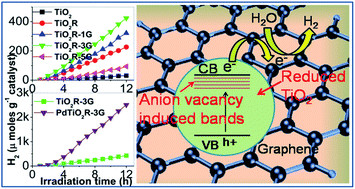
Photocatalytic activity of TiO2, TiO2R and the composites are shown in Fig. 8A. It can be seen that the photocatalytic activity of TiO2R is more than that of pristine TiO2. Addition of graphene nanoplatelets (graphene) increases the photocatalytic activity of TiO2R and the optimum concentration of graphene is found to be 3 wt%. Further increase in the concentration of graphene does not increase the activity of TiO2R. There exists an optimum concentration of graphene, which can enhance the photocatalytic activity of a semiconductor.41 When the concentration is low, the contact established between the photoactive material and graphene is not sufficient. The decreased activity with increased concentration of graphene is attributed to a ‘shielding effect’, which results in the masking of TiO2 from the incident light and decreases the light absorption. Effect of Pd co-catalyst on the activity of TiO2R–3G, which showed the highest activity among the composite sample, was studied and the result is shown in Fig. 8B. A significant increase in the amount of hydrogen generated is observed in the presence of Pd and a hydrogen evolution rate of 288 μmol g−1 h−1 is obtained using this catalyst.The sample is used repeatedly for photocatalysis experiment and found that the activity is almost same during repeated cycles indicating that the sample is stable. Photocatalytic activity for the TiO2R–3G sample for repeated cycle is shown in Fig. S5 of ESI.


image file: c3ra47974a-f8.tif
Fig. 8 Photocatalytic activity for hydrogen generation as a function of irradiation time (A) TiO2, TiO2R and TiO2R–G composites, (B) TiO2R–3G and Pd–TiO2R–3G. Reaction conditions: 50 mg catalyst suspended in 25 cm3 of water and methanol mixture in 4[thin space (1/6-em)]:[thin space (1/6-em)]1 ratio by volume; light source: ordinary day light fluorescent lamp (total 36 × 8 = 288 watts).

A direct comparison of the hydrogen generation rate of the present work with that of reported values is inappropriate as the experimental conditions such as the source of light, irradiated area etc. are different in each experiment. However, some reported results are presented here, which can give an idea about how good our photocatalyst is when compared with the reported ones. It is reported42 that N doped TiO2–graphene composite under visible light irradiation produced hydrogen at a rate of 112 μmol g−1 h−1. A composite of TiO2-reduced graphene oxide43 showed an activity of 740 μmol g−1 h−1 under UV-visible light of xenon arc lamp whereas a composite of TiO2–MoS2–graphene44 generated hydrogen at the rate of 2066 μmol g−1 h−1 under UV irradiation. A TiO2 (P25)–graphene system45 showed a hydrogen generation rate of 108 μmol g−1 h−1 under UV-visible light of Xenon arc lamp and a TiO2–RGO composite46 produced hydrogen at a rate of 500 μmol g−1 h−1 under UV irradiation. It may be noted that in all cases except the N-doped TiO2,42 UV or UV-visible light was used for the experiment. When compared with the N doped TiO2–graphene composite, which used visible light, our catalyst showed improved activity.

The enhanced photocatalytic activity of Pd–TiO2R–3G can be attributed to a synergistic effect of Ti3+ dopant, graphene and Pd in increasing the charge separation in the composite system. The presence of Ti3+ creates anion vacancies in TiO2 which can enhance the charge separation in the doped system.47,48 Graphene is well known for its excellent electron accepting and transporting properties.49 Hence, the photogenerated electron from TiO2R, which is having an intimate contact with graphene as seen from the TEM and Raman studies, can be immediately conducted away from TiO2R minimizing the recombination of electrons and holes. A schematic illustration of the charge separation process occurring in the composite is shown in Fig. 9. The H+ generated can combine with the electrons in graphene liberating hydrogen gas as the reduction potential of graphene/graphene is more negative than the reduction potential of H+/H2.49 The significantly high increase in the photocatalytic activity in the presence of Pd co-catalyst is due to the interfacial transfer of electrons from the composite to the Pd metal. The noble metal co-catalyst acts as an electron sink, enhances the charge separation and increases the availability of electrons for H+ reduction.50


image file: c3ra47974a-f9.tif
Fig. 9 Schematic illustration of the charge separation process in TiO2R–G composites.

Another reason for the increased photocatalytic activity of the composite is due to the increased visible light absorption as compared to pure TiO2. Both Ti3+ and graphene play roles in enhancing the visible light absorption of TiO2R–3G composite. Introduction of graphene can modify the band structure of TiO2 due to a chemical interaction of TiO2R and graphene forming Ti–O–C bonding, which increases the light absorption to extended visible region.51 It may be recalled that a strong interaction between TiO2R and graphene has been indicated by the Raman spectra of these samples.

Experimental

To synthesize TiO2, 3 ml of Ti-isopropoxide (Sigma Aldrich, 99.9%) was added drop wise to 20 ml of isopropyl alcohol (Sigma Aldrich, 99.9%), followed by addition of 1 ml of distilled water. The white precipitate obtained was constantly stirred for 1 h at 50 °C. The mixture was then evaporated to dryness. The powder thus obtained was heated at 450 °C for 2 h in air. The sample was then washed with distilled water and dried at room temperature. The dried product was again heated at 450 °C for 2 h in air.

For the preparation of composites with different ratios of graphene nanoplatelets (research grade, grade 4, <5 nm thick, <4 layers, obtained from commercial sources in Singapore) (1.0, 3.0, and 5.0 weight% of graphene with TiO2), calculated amount of graphene nanoplatelets was added in 20 ml of isopropyl alcohol which was sonicated followed by stirring at 50 °C for 30 min. To this, 3 ml Ti-isopropoxide was added drop wise followed by the same procedure used for the pristine sample.

To synthesize TiO2R and TiO2R–G composites (TiO2R–xG, where x = 1.0, 3.0 and 5.0), all the samples were reduced in ethylene glycol medium, using hydrazine hydrate. The reduction was done at 180 °C for 2 h. Hydrazine is a well known reducing agent. The NH2 group can react with the oxygen of TiO2 forming water, N2 and reduced TiO2 as shown below.

TiO2 + H2N–NH2 → Ti4+(3+) O2−x + xH2O + N2

The product was separated and dried followed by heating in argon atmosphere at 450 °C for 2 h. Palladium as co-catalyst was loaded on TiO2R–3G (PdTiO2R–3G) by a wet impregnation method. Required amount of palladium chloride (0.5% by weight of the catalyst) was dissolved in distilled water and the powder was dispersed in it. The mixture was evaporated to dryness under constant stirring. The powder was photo reduced by suspending in water–methanol mixture (4[thin space (1/6-em)]:[thin space (1/6-em)]1 ratio) and exposing to UV-visible light of Xenon arc lamp (300 watts, Hamamatsu) for 4 h. The sample was removed from the solution, washed with acetone and dried under ambient conditions.

Characterization

Powder X-ray diffraction (XRD) patterns of these samples were recorded using a Philips PW1820 X-ray diffractometer coupled with a PW 1729 generator, which was operated at 30 kV and 20 mA. Graphite crystal monochromator was used for generating monochromatic CuKα radiation. Surface area of the samples was measured using Brunauer, Emmett and Teller (BET) method employing nitrogen as the adsorbing gas. Transmission electron microscopy (TEM), high resolution TEM (HRTEM), selected area electron diffraction (SAED) and energy dispersive X-ray spectroscopy (EDXS) analyses were carried out using a JEOL JSM 2100 instrument operating at an accelerating voltage of 200 kV. The sample preparation for HRTEM imaging involved sonication in ethanol for 5 minutes followed by deposition on a copper grid. Raman spectra were recorded using 532 nm line from a diode-pumped Nd-YAG laser (power 15 mW) focused to a spot size of about 20 μm. The scattered light was analyzed using a home-built 0.9 m single monochromator coupled with super notch filter and detected by a cooled charge couple device (CCD, Andor technology). The entrance slit was kept at 50 μm, which gave a resolution limited line width of 3 cm−1. UV-visible diffused reflectance spectra (UV-Visible DRS) of all samples were recorded using a Jasco (model V-670) spectrophotometer equipped with an integrating sphere accessory. Barium sulfate was used as reference for recording the reflectance spectra. XPS studies were carried out in a VG Microtech electron spectrometer using Mg-Kα X-rays ( = 1253.6 eV) as the primary source of radiation. Chamber pressure was maintained at 1 × 10⁻⁹ torr. Appropriate correction for charging effect was made with the help of C 1s signal appearing at 284.5 eV. The peaks were fitted using nonlinear square method by convolution of Lorentzian and Gaussian functions. EPR spectra were recorded by using EMX 1843 system operated at X band frequency (9.5 GHz). DPPH was used for calibration of g values. Approximately 50 mg of sample was placed in quartz tube and spectra were recorded under identical spectrometer settings. For the current–voltage (IV) measurements the Potentiostat Parstat 273, was used. For the electrical contacts, silver dots (1 mm dia.) were deposited on sample pellets on one side using silver ink (obtained from Electrulobe, UK).

Photocatalytic activity was studied in a tubular glass (pyrex) reactor using day-light fluorescent lamps as source of radiation. Details of the reactor and irradiation chamber are given in the ESI (S6) and in our earlier publications.52,53 The emission profile of the fluorescent lamp is given in Fig. S7 (ESI). Fifty milligram of sample was kept in contact with water (20 ml) containing methanol (5 ml) as sacrificial reagent under constant stirring. The reactor was flushed with argon gas before irradiation. After every one hour, the gas mixture in the reactor was analyzed using a gas chromatograph (Chromatography and Instruments company, GC 2011) equipped with molecular sieve 5A column and thermal conductivity detector. The intensity of the light source was measured using a calibrated precision light meter (model cal-Light 400) and was found to be 69[thin space (1/6-em)]000 lux.

Conclusions

Self doped TiO2–G composites show enhanced photocatalytic activity for hydrogen generation from water. The composite samples show improved visible light absorption due to the modification of the band structure of TiO2 by Ti3+ and graphene. TiO2R–G sample exhibits excellent electron transport properties compared to pure TiO2. The improved photocatalytic activity of the composite is attributed to enhanced visible light absorption, large surface area and increased charge separation occurring in this system. Both graphene and Pd act as co-catalysts, which increase the photocatalytic activity of Ti3+ doped TiO2 further by facilitating the interfacial transfer of electrons from the photocatalyst to graphene and Pd resulting in the availability of large number of electrons for H+ reduction.

References

  1. C. Wang, C. Bottcher, D. W. Bahemann and J. K. Dohrmann, J. Mater. Chem., 2003, 13, 2322 RSC.
  2. R. Sasikala, V. Sudarsan, C. Sudakar, R. Naik, T. Sakuntala and S. R. Bharadwaj, Int. J. Hydrogen Energy, 2008, 33, 4966 CrossRef CAS PubMed.
  3. S. Murcia-Lopez, M. C. Hidalgo and J. A. Navio, Appl. Catal., A, 2011, 404, 59 CAS.
  4. R. Sasikala, V. Sudarsan, C. Sudakar, R. Naik, L. Panicker and S. R. Bharadwaj, Int. J. Hydrogen Energy, 2009, 34, 6105 CrossRef CAS PubMed.
  5. O. D. Jaykumar, R. Sasikala, C. A. Betty, A. K. Tyagi, S. R. Bharadwaj, U. K. Gautam, P. Srinivasu and A. Vinu, J. Nanosci. Nanotechnol., 2009, 9, 4663 CrossRef PubMed.
  6. K. Lv, H. Zuo, J. Sun, K. Deng, S. Liu, X. Li and D. Wang, J. Hazard. Mater., 2009, 161, 396 CrossRef CAS PubMed.
  7. S. Yin, K. Ihara, Y. Aita, M. Komatsu and T. Sato, J. Photochem. Photobiol., A, 2006, 179, 105 CrossRef CAS PubMed.
  8. K. A. Michalow, D. Loginowich, A. Weidenkaff, M. Amberg, G. Fortunato, A. Heel, T. Graule and M. Rekas, Catal. Today, 2009, 144, 7 CrossRef CAS PubMed.
  9. F. N. Sayed, O. D. Jayakumar, R. Sasikala, R. M. Kadam, S. R. Bhradwaj, L. Kienle, U. Schürmann, S. Kaps, R. Adelung, J. P. Mittal and A. K. Tyagi, J. Phys. Chem. C, 2012, 116, 12462 CAS.
  10. T. Ohno, Z. Miyamoto, K. Nishijima, H. Kanemitsu and F. Xueyuan, Appl. Catal., A, 2006, 302, 62 CrossRef CAS PubMed.
  11. C. Liu, X. Tanga, C. Mo and Z. Qiang, J. Solid State Chem., 2008, 181, 913 CrossRef CAS PubMed.
  12. R. Sasikala, A. R. Shirole, V. Sudarsan, Jagannath, C. Sudakar, R. Naik, R. Rao and S. R. Bharadwaj, Appl. Catal., A, 2010, 377, 47 CrossRef CAS PubMed.
  13. A. Charanpahari, S. S. Umare, S. P. Gokhale, V. Sudarsan, B. Sreedhar and R. Sasikala, Appl. Catal., A, 2012, 443–444, 96 CrossRef CAS PubMed.
  14. Z. Jin, X. Zhang, Y. Li, S. Li and G. Lu, Catal. Commun., 2007, 8, 1267 CrossRef CAS PubMed.
  15. W. Kim, T. Tachikawa, T. Majima and W. Choi, J. Phys. Chem. C, 2009, 113, 10603 CAS.
  16. R. Sasikala, A. Shirole, V. Sudarsan, T. Sakuntala, C. Sudakar, R. Naik and S. R. Bharadwaj, Int. J. Hydrogen Energy, 2009, 34, 3621 CrossRef CAS PubMed.
  17. M. Maeda and K. Hirota, Appl. Catal., A, 2006, 302, 305 CrossRef CAS PubMed.
  18. V. M. Daskalaki, M. Antoniadou, G. L. Puma, D. I. Kondarides and P. Lianos, Environ. Sci. Technol., 2010, 44, 7200 CrossRef CAS PubMed.
  19. R. Sasikala, A. R. Shirole, V. Sudarsan, V. S. Kamble, C. Sudakar, R. Naik, R. Rao and S. R. Bharadwaj, Appl. Catal., A, 2010, 390, 245 CrossRef CAS PubMed.
  20. J. Ng, S. Xu, X. Zhang, H. Y. Yang and D. D. Sun, Adv. Funct. Mater., 2010, 20, 4287 CrossRef CAS.
  21. N. Zhang, M. Q. Yang, Z. R. Tang and Y. J. Xu, J. Catal., 2013, 303, 60 CrossRef CAS PubMed.
  22. J. Wang, P. Wang, Y. Cao, J. Chen, W. Li, Y. Shao, Y. Zheng and D. Li, Appl. Catal., B, 2013, 136–137, 94 CrossRef CAS PubMed.
  23. T. Lv, L. Pan, X. Liu, T. Lu, G. Zhu, Z. Suna and C. Q. Sun, Catal. Sci. Technol., 2012, 2, 754 CAS.
  24. Y. Wang, R. Shi, J. Lin and Y. Zhu, Appl. Catal., B, 2010, 100, 179 CrossRef CAS PubMed.
  25. L. Sun, R. Shao, L. Tang and Z. Chen, J. Alloys Compd., 2013, 564, 55 CrossRef CAS PubMed.
  26. G. Wang, J. Yang, J. Park, X. Gou, B. Wang, H. Liu and J. Yao, J. Phys. Chem. C, 2008, 112, 8192 CAS.
  27. X. Yang, C. Cao, L. Erickson, K. Hohn, R. Maghirang and K. Klabunde, J. Catal., 2008, 260, 128 CrossRef CAS PubMed.
  28. M. Gotic, M. Ivanta, S. Popovic, S. Music, A. Turkovic and K. Furic, J. Raman Spectrosc., 1997, 28, 555 CrossRef CAS.
  29. A. C. Ferrari, J. C. Meyer, V. Scardaci, C. Casiraghi, M. Lazzeri, F. Mauri, S. Piscanec, D. Jiang, K. S. Novoselov, S. Roth and A. K. Geim, Phys. Rev. Lett., 2006, 97, 187401 CrossRef CAS.
  30. S. Song, W. Gao, X. Wang, X. Li, D. Liu, Y. Xing and H. Zhang, Dalton Trans., 2012, 41, 10472 RSC.
  31. Z. Sun, Z. Yan, J. Yao, E. Beitler, Y. Zhu and J. M. Tour, Nature, 2010, 468, 549 CrossRef CAS PubMed.
  32. K. A. Michalow, D. Logvinovich, A. Weidenkaff, M. Amberg, G. Fortunato, A. Heel, T. Graule and M. Rekas, Catal. Today, 2009, 144, 7 CrossRef CAS PubMed.
  33. Y. Huo, Y. Jin, J. Zhu and H. Li, Appl. Catal., B, 2009, 89, 543 CrossRef CAS PubMed.
  34. Y. Wang, M. Zhong, F. Chen and J. Yang, Appl. Catal., B, 2009, 90, 249 CrossRef CAS PubMed.
  35. M. Grodzicki, R. Wasielewski, P. Mazur, S. Zuber and A. Ciszewski, Opt. Appl., 2013, XLIII, 99 Search PubMed.
  36. F. Zuo, L. Wang, T. Wu, Z. Zhang, D. Borchardt and P. Feng, J. Am. Chem. Soc., 2010, 132, 11856 CrossRef CAS PubMed.
  37. V. L. Joseph Joly, M. Kiguchi, S.-J. Hao, K. Takai, T. Enoki, R. Sumii, K. Amemiya, H. Muramatsu, T. Hayashi, Y. A. Kim, M. Endo, J. C. Delgado, F. López-Urías, A. B. Méndez, H. Terrones, M. Terrones and M. S. Dresselhaus, Phys. Rev. B: Condens. Matter Mater. Phys., 2010, 81, 245428 CrossRef.
  38. I. Justicia, P. Ordejon, G. Canto, J. L. Mozos, J. Fraxedes and G. A. Battiston, Adv. Mater., 2002, 14, 1399 CrossRef CAS.
  39. Y. Ye, L. Gan, L. Dai, H. Meng, F. Wei, Y. Dai, Z. J. Shi, B. Yu, X. F. Guo and G. G. Qin, J. Mater. Chem., 2011, 21, 11760 RSC.
  40. S. S. Lin, B. G. Chen, W. Xiong, Y. Yang, H. P. He and J. Luo, Opt. Express, 2012, A706, 20(S5) Search PubMed.
  41. Q. Li, B. Guo, J. Yu, J. Ran, B. Zhang, H. Yan and J. R. Gong, J. Am. Chem. Soc., 2011, 133, 10878 CrossRef CAS PubMed.
  42. F. Pei, Y. Liu, S. Xu, J. Lu, C. Wang and S. Cao, Int. J. Hydrogen Energy, 2013, 38, 2670 CrossRef CAS PubMed.
  43. W. Fan, Q. Lai, Q. Zhang and Y. Wang, J. Phys. Chem. C, 2011, 115, 10694 CAS.
  44. Q. Xiang, J. Yu and M. Jaroniec, J. Am. Chem. Soc., 2012, 134, 6575 CrossRef CAS PubMed.
  45. X. Zhang, Y. Sun, X. Cui and Z. Jiang, Int. J. Hydrogen Energy, 2012, 37, 811 CrossRef CAS PubMed.
  46. J. Shen, Y. Long, T. Li, M. Shi, N. Li and M. Ye, Mater. Chem. Phys., 2012, 133, 480 CrossRef CAS PubMed.
  47. L. Liu, F. Gao, H. Zhao and Y. Li, Appl. Catal., B, 2013, 134–135, 349 CrossRef CAS PubMed.
  48. H. H. Lo, N. O. Gopal and S. C. Ke, Appl. Phys. Lett., 2009, 95, 083126 CrossRef PubMed.
  49. G. Xie, K. Zhang, B. Guo, Q. Liu, L. Fang and J. R. Gong, Adv. Mater., 2013, 25, 3820 CrossRef CAS PubMed.
  50. P. V. Kamat, J. Phys. Chem. C, 2007, 111, 2834 CAS.
  51. H. Zhang, X. Lv, Y. Li, Y. Wang and J. Li, ACS Nano, 2010, 4, 380 CrossRef CAS PubMed.
  52. R. Sasikala, A. R. Shirole, V. Sudarsan, K. G. Girija, R. Rao, C. Sudakar and S. R. Bharadwaj, J. Mater. Chem., 2011, 21, 16566 RSC.
  53. R. Sasikala, A. R. Shirole and S. R. Bharadwaj, J. Colloid Interface Sci., 2013, 409, 135 CrossRef CAS PubMed.

Footnote

Electronic supplementary information (ESI) available. See DOI: 10.1039/c3ra47974a

This journal is © The Royal Society of Chemistry 2014
Click here to see how this site uses Cookies. View our privacy policy here.