
Investigation and modelling of surface tension of power-law fluids

K. Muthamizhi, P. Kalaichelvi*, Shubhangi Tukaram Powar and R. Jaishree
Department of Chemical Engineering, National Institute of Technology, Tiruchirappalli – 620015, Tamil Nadu, India. E-mail: kalai@nitt.edu; Fax: +91-431-2500133; Tel: +91-431-2503110

Received 10th November 2013 , Accepted 21st January 2014

First published on 23rd January 2014


Abstract

Thermo-physical properties of power-law fluids are both required for engineering and product design applications in food, drugs, cosmetics and agriculture. Surface tension not only determines the quality of many of the products resulting from different industries as noted before, but also affects some important steps in the production process: catalysis, adsorption, distillation and extraction, etc. This study involved the measurement of surface tension of power-law fluids (xanthan gum, carboxymethyl cellulose and sodium alginate) using the drop weight method for the concentration range of 0.1–0.6% w/w and temperature range of 293.15–333.15 K. The experimental measurements are often unavailable, expensive and time consuming; hence a model has been developed for predicting the surface tension of power-law fluids. Central composite rotatable design-response surface methodology (CCRD-RSM) has been used for model prediction.

Introduction

Fluid from food, pharmaceutical, chemical and biochemical media generally has shear thinning or power-law characteristics.1 Power-law fluids find wide application in food, drugs, cosmetics and agriculture due to their high viscosity in low concentration. Literature is available on viscosity of power-law fluid, but surface tension received less attention from researchers. The surface tension phenomenon is caused by cohesive forces among liquid molecules.2–4 Surface tension is measured in N m−1 depending on how it is demarcated. Each molecule is dragged equally in every direction by adjacent liquid molecules in the bulk of the liquid, resulting in zero net force. The molecules at the surface are pulled inwards because those molecules do not have other molecules on all sides of them. This produces some internal pressure and forces liquid surfaces to compact to minimal area. The shape of liquid droplets is owing to surface tension. Even if it is easily misshapen, the cohesive force of the surface layer is reasonable for spherical shape of the water droplets pulled.4

Surface tension is used to test the quality and performance of numerous industrial products such as paints, ink jet products, detergents, cosmetics, pharmaceuticals, lubricants, pesticides and food products. Surface tension shows some significant effect in industrial processes such as adsorption, distillation and extraction.5,6

The production, development, and performance of pharmaceutical products, food, biomaterial and other products are swayed by surface tension. Surface tension plays vital role in surface chemistry compaction with chemical processes at the interface between two phases. In order to meet challenges and develop new and improved products, knowledge of surface tension is of ultimate importance and these values are not readily available.7 Surface tension can be expressed using the empirical formula.

It states that the surface tension of a liquid can be given as a function of the liquid- and vapor-phase densities as in equilibrium with its own vapor:

 
σ = K(ρlρV)4 (1)
where K is a constant and it is characteristic of the liquid below deliberation which is independent of temperature.8 Surface tension can be used to calculate the thickness of layer of surface for simple liquids using the Kirkwood theory, assuming smooth variation of density between liquid and vapor.9

New expressions have been proposed for surface tension which contains a temperature correction term resulting from statistical mechanics and for corresponding-states to calculate the parameter Po as a function of molar refraction and normal boiling point temperature.10 The study of surface tension for liquid mixtures have been carried out and concluded that the expressions proposed are applicable to multi component mixture.11 Surface excess energy and entropy per unit area from the temperature dependency of surface and interfacial tensions have been found. The consequences for model interpretations of surface tension also has been discussed.12

Dynamic surface tension has been explained with a new combined diffusion evaporation model, for up to first 1000s of the experiments with tetrachloroethylene (PCE) dissolved in water and diffuse portion of the new model was only a short time approximation and not applicable for later stages of the experiment.13

New drop weight analysis has been studied for the grit of surface tension of liquids and developed an LCP coefficient method to remove the effect of liquid properties of the drop weight method. The proposed simple semi-empirical equation for liquid surface tension is given by:

 
σ = 171.2C2 (2)
where C2 is the second coefficient of a quadratic rapport between the drop weight and tip radius.14 Surface tension of liquid ternary Cu–Fe–Sb systems have been measured using sessile drop method, also effect of temperature, iron and antimony on the surface tension of Cu–Fe–Sb has been studied and observed that surface tension decreases linearly with the increase of temperature.15

To the best of our knowledge, surface tension values of power-law fluids have not yet been sufficiently addressed in the open literature. Hence the aim of the present work was to experimentally determine the surface tension of selected power-law fluids at several concentrations (0.1–0.6% w/w) and temperature (293.15–333.15 K) by drop weight method. The other objective was also to propose a suitable model for the prediction of surface tension values of any power-law fluids at given concentration and temperature. Advanced central composite rotatable design response surface methodology (CCRD-RSM) was used for model prediction. General equation has been found to predict the surface tension of all power-law fluids with minimum error.

Materials and methods

Materials

Xanthan gum, pure (food grade), CMC & Sodium Alignate were obtained from LOBA Chemie, Merck & Himedia.

Solution preparation

To measure the surface tension values of selected power-law fluids, concentration range of 0.1–0.6% by weight and temperature range of 293.15–333.15 K were selected in accordance with conventional values used in industry.

The samples were prepared in a 250 ml conical flask with distilled water by mixing power-law fluids in a specific ratio by weight to obtain different concentrations ranging from 0.1–0.6% w/w. The samples were stirred continuously until the solute gets completely dissolved.

The mixture of known amount was transferred into burette and the surface tension values were measured.

Methods and procedure

Various methods have been developed to measure the surface tension of liquids such as the capillary rise method, drop weight method, du Nouy ring method, Wilhelmy plate method, spinning drop method, pendant drop method and sessile drop method. The choice of the method depends on the nature and stability of the liquid being measured, the measurement conditions, precision, reliability and instrumentation cost. Among these methods, drop weight method could be considered as antique and still widely used due to its higher accuracy than other methods. This method is popular because it is inexpensive and the set-up (Fig. 1) is simple.16–18
image file: c3ra46555a-f1.tif
Fig. 1 A schematic diagram of a surface tension measurement apparatus.

The principle of the drop weight method was based on Tate's law which approximates the balance between gravitational force pulling drop down and surface tension force holding the drop pendant to the tip at the instant of droplet detachment. In this method, liquid is allowed to drip slowly from a dripping tip of known radius and weight of the collected liquid droplets was measured.19

The drop of a mass m gets released when the load (G = mg) is equal or greater than the surface force at the tip of the burette.

 
mg = 2π (3)

The radius of burette bottom tip r in eqn (3) was calculated from mass m and surface tension of water. The ratio of the mass and surface tension is constant for all the liquids.

The surface tension values of water were taken from literature (0.0719, 0.0712, 0.07041, 0.0696, 0.0687 and 0.06794 N m−1 at 298.15, 303.15 and 308.15, 313.15, 318.15 and 323.15 K respectively)20 to calculate the surface tension of the selected power-law fluids using eqn (4):

 
image file: c3ra46555a-t1.tif(4)

Mass of 20 drops have been measured in order to increase the precision of the calculation using eqn (4).

The burette has been rinsed with acetone and dried for a few minutes on the vertical stand, then it was first filled with distilled water. Weight of 20 drops of water were collected by removing the tip of the burette and measured using a two decimal electronic balance (Cyborial Corporation, USA). The above procedure was repeated for all power-law fluids of different concentrations after cleaning the burette every time as mentioned above. Then, using eqn (4), the surface tension values of all three selected power-law fluids were calculated. The temperature of the water and power-law fluid samples was measured using a digital thermometer.

Response surface methodology

Response Surface Methodology (RSM), a collection of mathematical and statistical techniques used to model the surface tension of power-law fluids which is swayed by concentration and temperature was used in this study. A two factor, five level central composite rotatable designs (CCRD) were employed due to the benefits of uniform prediction error and extension of the design region. Design-Expert 9 software was used to model equation for surface tension of power-law fluids. The independent variables, i.e. temperature and concentration were coded at five levels between −2 and +2, where the temperature (T) in the range of 293.15–333.15 K and concentration in the range of 0.1–0.6% w/w respectively as shown in Table 1. The generated runs of the CCRD investigated in this work consist of 13 experimental runs with two factors. To evaluate the pure error, eight experiments were carried out with five replications at the design center in randomized order.
Table 1 Physical and coded values of independent process variables
Factors Levels and range
Lowest Low Center High Highest
Temperature (K) 284.86 293.15 313.15 333.15 341.43
Concentration (%) 0 0.1 0.35 0.6 0.7


The experimental data were fitted to the following second-order polynomial model and the regression coefficients (β's) are obtained:

 
image file: c3ra46555a-t2.tif(5)
where Y is the predicated surface tension and X1, X2, X3, X4, and X5, are the independent variables affecting the surface tension; β0 is a constant, βj, βjj, and βji, are the coefficients of linear, quadratic and interacting terms and εi is the error. The quality of fit of the quadratic model was expressed by the value of the correlation coefficients (R2) and the significance was checked using F-test in this program. The prime motive is to determine the second order polynomial equation for the surface tension of power-law fluids.

Results and discussion

Surface tension is a fundamental property of liquids which vary with temperature and concentration. The experimental surface tension of xanthan gum, CMC and sodium alginate solution was analyzed and the results are presented as follows.

Influence of temperature and concentration

Temperature and concentration influence on the surface tension of xanthan gum, CMC, and sodium alginate solution have been plotted in Fig. 2–4 respectively. It can be inferred from Fig. 2–4 that the surface tension of all three power-law fluids under consideration decrease when the temperature is increased for 0.2, 0.4 and 0.6% w/w concentration of the respective solution. When temperature of power-law fluid increases kinetic energy of its molecules also increases. Hence there will be a weak cohesive force between the molecules of the solution. Thus, for all the solutions under consideration, surface tension decreases with temperature increase for a particular fixed concentration. The same was observed for 0.1, 0.3 and 0.5% w/w for all three power-law fluids. The minimum and maximum values of surface tension observed from the graphs are presented in Table 2.
image file: c3ra46555a-f2.tif
Fig. 2 Concentration and temperature influence on surface tension of xanthan gum solution.

image file: c3ra46555a-f3.tif
Fig. 3 Concentration and temperature influence on surface tension of CMC solution.

image file: c3ra46555a-f4.tif
Fig. 4 Concentration and temperature influence on surface tension of sodium alginate solution.
Table 2 Power-law fluids experimental range, minimum and maximum values of surface tension analysed
Power-law fluids Temperature range (K) Concentration range (% w/w) Surface tension range (N m−1)
Xanthan gum 293.15–333.15 0.1–0.6 0.068–0.078
CMC 0.068–0.074
Sodium alginate 0.068–0.073


Fig. 2–4 show that surface tension of power-law fluids increases when the concentration increases from 0.2, 0.4 and 0.6% w/w at 293.15–333.15 K. Power-law fluids do not show the surface activities for low concentration21 and also low concentration of power-law fluids did not affect the water surface tension. This is the reason that increases in concentration of power-law fluids increases the surface tension. The same was observed in 0.1, 0.3 and 0.5% w/w for all three power-law fluids.

Experimental design

The experimental results obtained were used to determine the model equation for the surface tension of power-law fluids using central composite rotatable design under response surface methodology, which was influenced by independent variables, i.e., temperature and concentration.

The final quadratic model regression equations (6), (7) and (8) in terms of actual factors as obtained by response surface methodology are given below:

For xanthan gum solution,

 
σx = 0.860052 − 0.00473Tx − 0.03529Cx + 0.00015TxCx + 0.00000705Tx2 − 0.00345Cx2 (6)

For CMC solution,

 
σc = 0.331914 − 0.0016Tc + 0.049082Cc − 0.00013TcCc + 0.00000242Tc2 − 0.0021Cc2 (7)

For sodium alginate solution,

 
σsa = 0.311495 − 0.00147Tsa + 0.045433Csa − 0.00013TsaCsa − 0.00000222Tsa2 + 0.0018Csa2 (8)

ANOVA table is a collection of statistical model used to determine the significant effects of operating variables. F-Test was used to analyze the statistical significance of a model equation. F and p-values were used to determine the significance of each coefficient. Any factor or interacting factors with p < 0.05 indicates a high significance for the regression model. The validity of predicted model was confirmed by comparison with the experimental values and it was observed that the values lie close to the diagonal line. R2, adjusted-R2 and adequate precision expresses the quality of fit of the quadratic model regression equation. Absolute average deviation analysis (AAD) is a direct method for describing the deviation between predicted and experimental values. The quadratic regression model of surface tension of power-law fluids showed the coefficient of determination R2, adjusted coefficient of determination and AAD as 0.9770, 0.9605 and 0.0108 for xanthan gum, 0.9980, 0.9967 and 0.000156 for CMC and 0.9847, 0.9738 and 0.0017 for sodium alginate respectively.

Combined effect of concentration and temperature on surface tension of power-law fluids

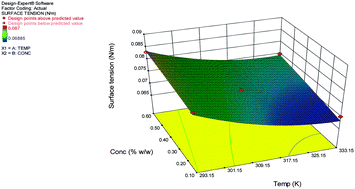
The response surface curves for surface tension of power-law fluids were plotted using developed eqn (6)–(8) to study the combined effect of temperature and concentration (Fig. 5–7). It is observed that the nature of response surface shows good agreement with experimental results.
image file: c3ra46555a-f5.tif
Fig. 5 Response surface plots showing the effect on surface tension of xanthan gum solution.

image file: c3ra46555a-f6.tif
Fig. 6 Response surface plots showing the effect on surface tension of CMC solution.

image file: c3ra46555a-f7.tif
Fig. 7 Response surface plots showing the effect on surface tension of the sodium alginate solution.

The surface tension of xanthan gum was higher compared to surface tension of CMC and sodium alginate. Xanthan gum is a thickener by nature and has a viscosity higher than other solutions involved in the analysis. This could perhaps be the reason for its high surface tension compared to other solutions being considered.

Development of general model equation for all power-law fluids at any given temperatures and concentration

There are number of power-law fluids having wide applications, but no information is available on surface tension. It is not possible to generate surface tension data experimentally for each power-law fluid. Hence, based on present experimental studies and quadratic equation of surface tension of xanthan gum, CMC and sodium alginate, general quadratic model eqn (9) which can be used to calculate the surface tension of any shear thinning fluid was developed.
 
σ = 0.501154 − 0.0026T + 0.019742C − 0.000037TC + 0.0000039T2 − 0.00125C2 (9)

AAD was calculated for 108 experimental data points using eqn (6)–(9) and shown in Fig. 8, to find the best fit for surface tension calculation of any power-law fluid. From Fig. 8, eqn (9) with ADD of 1.05 can be used to estimate the surface tension of any power-law fluid without carrying out experimental work with minimum error.


image file: c3ra46555a-f8.tif
Fig. 8 Absolute average deviation of surface tension of power-law fluids following various eqn (6)–(9).

Conclusion

The surface tension of three power-law fluids (xanthan gum, CMC and sodium alginate) was measured at different temperature and concentration using drop weight method. The surface tension of power-law fluids found to increase with concentration and with decrease in temperature, where concentration is having greatest effect than temperature. The predictions of surface tension values by second order polynomial equation (eqn (9)) are consistent with the experimental data for studied power-law fluids with absolute average deviation of 1.05. Since no correlation exists for surface tension of power-law fluids, it can be calculated using the proposed generalized model (eqn (9)) with reasonable error.

Acknowledgements

The authors are thankful to the CSIR (Council of Scientific and industrial research) for the financial support (Ref. no. 22/514/10-EMR-II).

Notes and references

  1. R. M. Manglick and J. Ding, Laminar flow heat transfer to viscous power-law fluids in double sine ducts, Int. J. Heat Mass Transfer, 1997, 40(6), 1379–1390 Search PubMed.
  2. H. Y. Erbil, in Handbook of Surface and Colloid Chemistry, ed. K. S. Birdi, CRC Press, LCC, New York, ch. 9, 1997 Search PubMed.
  3. H. Butt, K. Graf and M. Kappl, Physics and Chemistry of Interfaces, Wiley-VCHVerlag, 2004 Search PubMed.
  4. J. Hamuyuni, Surface Tension in Base Metal Sulfide Mattes by an Improved Sessile Drop Method, Stellenbosch University December StellenboschUniversity, 2012, http://scholar.sun.ac.za Search PubMed.
  5. A. Anwar-UL-Haq, B. Salma and S. Siddiqi, Concentration and temperature dependence of surface parameters of some aqueous salt solutions, Colloids Surf., A, 2006, 272, 105–110 CrossRef PubMed.
  6. A. J. Queimada, I. M. Marrucho, E. H. Stenby and J. A. P. Coutinho, Generalized relation between surface tension and viscosity: a study on pure and mixed n-alkanes, Fluid Phase Equilib., 2004, 222–223, 161–168 CrossRef CAS PubMed.
  7. A. Fathi-Azarbayjani, A. Jouyban and S. Y. Chan, Impact of Surface Tension in Pharmaceutical Sciences, J. Pharm. Pharm. Sci., 2009, 12(2), 218–228 CAS , http://www.cspsCanada.org.
  8. D. B. Macleod, Relation Between Surface Tension and Density, Trans. Faraday Soc., 1923, 19, 38 RSC.
  9. M. Berry, R. F. Durrans and R. Evans, The calculation of surface tension for simple liquids, J. Phys. A: Gen. Phys., 1972, 5, 166 CAS.
  10. J. Escobedo and G. Ali Mansoori, Surface Tension Prediction for Pure Fluids, AIChE J., 1996, 42(5), 1425–1433 CAS.
  11. J. Escobedo and G. Ali Mansoori, Surface Tension Prediction for Liquid Mixtures, AIChE J., 1998, 44(10), 2324–2332 CrossRef CAS.
  12. J. Lyklema, Thermodynamic components and corresponding states, Colloids Surf., A, 1999, 156, 413–421 CAS.
  13. P. Chen, Understanding the dynamic surface tension of solutions containing volatile organic compounds (VOCs), Colloids Surf., A, 2001, 192, 195–204 CAS.
  14. B.-B. Lee, P. Ravindra and E.-S. Chan, New drop weight analysis for surface tension determination of liquids, Colloids Surf., A, 2009, 332, 112–120 CAS.
  15. J. Willner, G. Siwiec and J. Botor, The surface tension of liquid Cu–Fe–Sb alloys, Appl. Surf. Sci., 2010, 256, 2939–2943 CAS.
  16. M. C. Wilkinson, Extended use of, and comments on, the drop-weight (drop volume) technique for the determination of surface and interfacial tensions, J. Colloid Interface Sci., 1972, 40, 14–26 CAS.
  17. P. J. Doyle and B. J. Carroll, An improved and semi-automated version of the drop volume technique for interfacial Tension measurement, J. Phys. E: Sci. Instrum., 1989, 22, 431–433 CAS.
  18. J. C. Earnshaw, E. G. Johnson, B. J. Carroll and P. J. Doyle, The drop volume method for interfacial tension determination: an error analysis, J. Colloid Interface Sci., 1996, 177, 150–155 CAS.
  19. W. D. Harkins and E. C. Humphery, The drop weight method for the determination of surface tension (surface tension 1), J. Am. Chem. Soc., 1916, 38, 242–246 CrossRef CAS.
  20. N. B. Vargaftik, B. N. Volkov and L. D. Voljak, International tables of surface tension of water, J. Phys. Chem. Ref. Data, 1983, 12(3), 817–820 CAS.
  21. K. R. Prud'homme and E. R. Long, Surface tension of concentrated xanthan and polyacrylamide solutions with added surfactants, J. Colloid Interface Sci., 1983, 93, 274–276 Search PubMed.

This journal is © The Royal Society of Chemistry 2014
Click here to see how this site uses Cookies. View our privacy policy here.