Substituent effect on fluorophores instead of ionophores: its implication in highly selective fluorescent probes for Zn2+ over Cd2+

Yongqian Xu*a, Liangliang Xiaoa, Yunfei Zhanga, Shiguo Sun*a and Yi Pangb
aCollege of Science, Northwest A&F University, Yangling, Shaanxi, P.R. China 712100. E-mail: xuyq@nwsuaf.edu.cn; sunsg@nwsuaf.edu.cn
bDepartment of Chemistry & Maurice Morton Institute of Polymer Science, The University of Akron, Akron, OH 44325, USA

Received 7th November 2013 , Accepted 10th December 2013

First published on 10th December 2013


Abstract

Three fluorescent molecules with different substituent modification on 5-position showing different extents of fluorescent response to Zn2+ and distinct discriminating effect of RZn/RCd have been readily synthesized. The addition of a dithiol group induces the discriminating effect of RZn/RCd to be obviously improved from twice to 32 times.
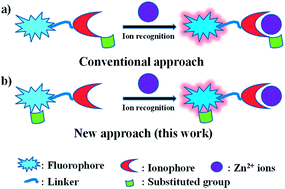

As the second most abundant transition metal ion in the human body, Zn2+ plays an important role in biological processes including gene transcription, regulation of metalloenzymes, DNA synthesis, neural signal transmission and apoptosis, as well as catalysis of proteins.1 The disorder of Zn2+ has been associated with a number of pathological processes, such as Alzheimer's disease, epilepsy, Parkinson's disease, ischemic stroke and infantile diarrhea.2 The accurate measurement of Zn2+ in physiological media has been considered as an essential factor and addressed target in these diseases. Among the methods developed for Zn2+ sensing, fluorescent probes have attracted considerable attention due to their simple operation, high sensitivity and real time detection.3 At present, most of fluorescent probes for Zn2+ utilize di-2-picolylamine (DPA) as recognition component with photo-induced electron transfer (PET) sensing mechanism.4 The quenched fluorophores by PET effect would recover after Zn2+ coordinating with DPA. The selectivity of these probes mainly relies on the binding capability of ionophores (DPA) to Zn2+ ions.5 Due to the similar binding characters of Cd2+ to DPA, most of them suffered from poor selectivity to Zn2+. To resolve this issue, more efforts have been devoted into the exploration of DPA derivatives (Scheme 1).6 Lippard's group made great efforts to alter the Zn2+-binding group by replacing one of the pyridines to specifically detect Zn2+.7 Peng et al. for the first time reported the ethylene substituted DPA which is linked to BODIPY to discriminate Zn2+ from Cd2+.8 Recently, Jiang and Yoon's groups developed a method of introducing additional binding unit (an amide group) to a DPA-type receptor for distinguishing Zn2+ and Cd2+.9 Up to now, all of Zn2+ probes are focused on the optimization of ionophore to sufficiently enlarge the difference of coordination affinity for Zn2+ and Cd2+. However, this strategy encountered difficulty in labor-intense synthetic process for recognition unit and the guide of probe design for other ions. In addition, introduction of more binding sites usually trend to strongly bind more kinds of metal ions, reducing the sensing selectivity.10 Alternatively, as a concept-of-principle method, alternation of substitution on fluorophores instead of ionophores for endowing simple sensing subunit the different binding affinity to differentiate Zn2+ from Cd2+ would be hopeful. At present, most of reported Zn2+ fluorescent probes are mainly based on PET or intramolecular charge transfer (ICT) mechanisms which are disadvantageous in the design of highly selective and versatile probes through substituent effect on fluorophores because of the susceptibility of electron transfer to substitution. In contrast, fluorescent probes based on excited-state intramolecular proton transfer (ESIPT) mechanism can address this problem.11 ESIPT has recently received considerable attention due to its unique photophysical properties.12 Different from other organic chromophores, ESIPT molecules exhibit dual emissions from both the excited enol and keto tautomers. Fluorescent sensing of metal ions could realize by prohibiting ESIPT through the coordination of metal ion with ESIPT centers, resulting in detectable spectral change. 2-(2′-Hydroxyphenyl)benzoxazole (HBO), a typical ESIPT molecule, has been reported for cations and anions sensing.12 Although the effect of substituent on the fluorescent properties of enol and keto tautomers has been investigated,13 none of them showed that the alternation of substituent on fluorophores is feasible to increase the selectivity for metal ions sensing. In addition, it is desirable for Zn2+ fluorescent probes to provide near infrared (NIR) fluorescent signal (700–900 nm) to avoid photodamage, scattering light and strong interference derived from short wavelength emission in biological media.3 For ESIPT molecules, large Stokes shift (ca. 150–200 nm) enables their fluorescent wavelength to reach in NIR region.14 Thus, they are ideal candidates for NIR fluorescent probes. Herein, we present a simple fluorescent ESIPT molecule (H-3) for Zn2+ sensing with high sensitivity and selectivity (Scheme 2). Moreover, the Zn2+ distinguishing capability from Cd2+ can be readily tuned through simply substituent modification on 5-position of ESIPT molecules instead of sensing unit (Scheme 3). To the best of our knowledge, this is the first demonstration that introduction of substituent to fluorescent signal moiety rather than direct sensing unit enhances sensitivity and selectivity, which sets up a promising strategy for the rational design of fluorescent probes.
image file: c3ra46468g-s1.tif
Scheme 1 Modification on sensing unit of Zn2+ fluorescent probes based on ESIPT mechanism, where the red circles show Zn2+ binding and recognition sites.

image file: c3ra46468g-s2.tif
Scheme 2 Modification on fluorophores of Zn2+ fluorescent probes based on ESIPT mechanism.

image file: c3ra46468g-s3.tif
Scheme 3 Tactics for Zn2+ fluorescent sensors with distinguishing capability to Cd2+.

The detailed synthetic procedure was described in the ESI. Briefly, H-2 was first readily synthesized by condensation reaction between 2,4-diformylphenol and 2-aminophenol. Subsequently, H-3 could be prepared from the reaction of H-2 with 1,3-ethanedithiol in the presence of I2. H-1 as referenced compound was synthesized according to the literature procedure.15 All these compounds were fully characterized by 1H NMR, 13C NMR and HRMS.

For comparison, spectra of these compounds and their response to metal ions have been studied in identical conditions (aqueous ethanol solution (1[thin space (1/6-em)]:[thin space (1/6-em)]1, v/v, pH 7.2)). The wavelength of maximal emission intensity is at 480 nm in the absence of Zn2+, which is assigned to keto emission of ESIPT. After adding of Zn2+, ESIPT was inhibited as a consequence of the Zn2+ coordination with OH groups. Accordingly, the wavelength of maximal emission intensity shift to 420 nm (enol emission).12 Upon addition of Zn2+, the fluorescence intensity of these compounds showed large enhancement to different extents (λex = 380 nm). When 80 equivalents of Zn2+ were added to the solution of these compounds, about 88-, 31- and 376-fold fluorescence enhancement at 420 nm was observed for H-1, H-2 and H-3 respectively (Fig. 1). More interestingly, a new peak in near infrared region (ca. 850 nm) appeared along with fluorescence intensity gradual increasing (Fig. S4, S10 and S18). The excited spectra of emission at 420 and 850 nm are identical (Fig. S25), suggesting that the output at 420 and 850 nm come from the same species (H-3 + Zn2+). Accordingly, about 169-, 43- and 219-fold fluorescence enhancement at 850 nm was also observed with more than 450 nm Stokes shift. To the best of our knowledge, this is the first sample that Zn2+ ions trigger simple molecules to emit near infrared fluorescence with such large Stokes shift. Compared to H-1 and H-2, dithiol group substituted H-3 induces greater intensity increasing (F420/F0 and F850/F0, where F420 and F850 stand for the intensity intensities at 420 and 850 nm in the presence of different amount of Zn2+, and F0 stand for the intensity intensities at corresponding wavelength in the absence of Zn2+) in the presence of identical amounts of Zn2+, suggesting that H-3 shows higher sensitivity to Zn2+ at two given wavelengths. The quantum yield of H-3 and the Zn + H-3 complexes are 0.030 and 0.164, respectively. In order to further study the discriminating capacity to competitive ions, the fluorescence responses of these compounds to Cd2+ were also investigated. As shown in Fig. S1 and S2, H-1 and H-2 showed gradual fluorescence intensity enhancement at short and long wavelength with increasing of Cd2+ amounts. The discriminating effect of RZn/RCd (R = F420/F0 or R = F850/F0) is small (2–6 times) for H-1 and H-2, implying that H-1 and H-2 showed nearly same fluorescent response to Zn2+ and Cd2+ and they can hardly discriminate Zn2+ from Cd2+. In sharp contrast, H-3 shows no obvious fluorescence intensity change upon addition of Cd2+, and the discriminating effect of RZn/RCd reached 32 and 12 times at 420 and 850 nm respectively (Fig. 2), indicating that H-3 can effectively discriminate Zn2+ from Cd2+. Moreover, the fluorescence spectra of H-3 with increasing concentration of Zn2+ in the presence of 10 equivalents of Cd2+ still shows obvious fluorescence enhancement, indicating that H-3 can selectively detect Zn2+ without the interference of Cd2+. H-3 also shows same response of fluorescence enhancement to Zn2+ in EtOH–HEPES buffer (pH 7.4, 1[thin space (1/6-em)]:[thin space (1/6-em)]1, v/v) (Fig. S26). Compared to the reported method of modification on binding subunit, facile substituent change on fluorophore segment can greatly improve the discriminating effect between Zn2+ and Cd2+.


image file: c3ra46468g-f1.tif
Fig. 1 The relative fluorescence intensity changes at 420 (a) and 850 nm (b) of these three compounds (10 μM) in aqueous solution upon addition of Zn2+ (λex = 350 nm).

image file: c3ra46468g-f2.tif
Fig. 2 The relative fluorescence intensity changes at 420 (a) and 850 nm (b) of H-3 (10 μM) in aqueous solution upon addition of Zn2+ and Cd2+ (λex = 350 nm).

To further exclude the possible assistant binding of dithiol group on H-3 to Zn2+, NMR titration experiments of H-3 to Zn2+ and Cd2+ ions in identical conditions were performed. H-3 showed almost identical NMR spectra change upon addition of Zn2+ or Cd2+ (Fig. S22 and S23). This result confirms that the great discriminating effect of H-3 to Zn2+ and Cd2+ is ascribed to intrinsic characteristic but not additional binding sites.

The fluorescent intensities of H-3 solution at 437 and 850 nm were linearly proportional to the amounts of Zn2+, demonstrating that H-3 is applicable to dual-output fluorescent detection of Zn2+ (Fig. S13). To check the selectivity, the response of H-3 to other cations was investigated. It can be seen that only Zn2+ promotes significant fluorescence intensity enhancement, whereas other metal ions cause no detectable spectra change except that Cu2+ induces fluorescence quenching under the identical conditions (Fig. 3). To explore the possible utility of H-3 as fluorescent sensor for Zn2+, competitive experiments were carried out in the presence of 30 equivalents of Zn2+ and 30 equivalents of various other cations. Although a number of transition metals exert a clear quenching effect on the probe, these free cations would have little influence in vivo since they exist at very low concentrations.16 The fluorescence intensity of H-3 at 437 and 850 nm were not influenced in the presence of other competing cations, indicating that H-3 has specific selectivity for Zn2+.


image file: c3ra46468g-f3.tif
Fig. 3 Emission intensity of H-3 (5 μM) at 420 (a) and 850 nm (b) in EtOH–H2O (1[thin space (1/6-em)]:[thin space (1/6-em)]1, v/v) in the presence of different metal ions (150 μM) with the excitation at 350 nm (blank bar). Black bars represent the intensity with subsequent addition of Zn2+ ions (150 μM).

To further gain the insight into the recognition mechanism and the merits of H-3, scanning electron microscope (SEM) images of H-3 before and after addition of Zn2+ or Cd2+ were investigated by solution drop-casting. As shown in Fig. 4, different morphological characters were obtained. H-3 formed needle crystal with length of 3 micron. The absorption spectra of H-3 with increasing concentration showed the reduced ratio of A296/A323 (A296 and A323 stand for the absorption intensity at 296 and 323 nm respectively), indicating that H-3 easily trends to form aggregation due to intermolecular hydrogen bonds (Fig. S27). Upon addition of Zn2+, morphology transforms to dendritic structure. In contrast, upon addition of Cd2+ rod-like crystals with size of 1 × 4 micron were clearly formed. The different morphological structures triggered by Zn2+ and Cd2+ are presumed to the high selectivity and sensitivity.17 Stoichiometry of 1[thin space (1/6-em)]:[thin space (1/6-em)]1 with Zn2+ or Cd2+ from Job's plot can be readily achieved (Fig. S15). Associate constant between H-3 and Zn2+ was estimated as 5.85 × 10⁴ M−1 with detecting limit of 6.11 × 10⁻⁸ M. As shown in Fig. S16, the fluorescent intensities at 437 and 850 nm in the absence and presence of Zn2+ are pH independent in the range of 6–8, demonstrating that H-3 can detect Zn2+ in biological system.


image file: c3ra46468g-f4.tif
Fig. 4 SEM images of H-3 in the presence of Zn2+ or Cd2+, where (A) and (B) without addition of metal ions, (C) and (D) after addition of Zn2+, (E) and (F) after addition of Cd2+.

It should be noted that K+ triggers 2-fold signal enhancement for Zn2+ detection, which is presumed to the synergistic effect because K+ cannot induce any signal change of H-3 in the absence of Zn2+. This may be due to the building blocks of H-3 + Zn2+ fitting well for the accommodation of K+. On the other hand, K+ can still interact with another lone pair of electrons on the oxygen atom of OH groups after it has coordinated with one lone pair of electrons to Zn2+, which can increase molecular rigidity to reduce the nonradiative decay of the excited state and lead to the fluorescence enhancement.18 It is well known that K+ with suitable atomic size can stabilize the G-quadruplexes derived from G-rich DNA sequences through coordination with eight oxygen atoms of carbonyl groups which exist on two planes of tetrad.19 Based on these, a plausible binding mode between Zn2+ and H-3 was presented (Scheme 4), where the driving force for layer stacking is supposed to π–π interaction or coordination by K+. The stacking mode is consistent with the observed photographs of SEM.


image file: c3ra46468g-s4.tif
Scheme 4 The plausible binding mode between Zn2+ and H-3 in the presence of K+.

In summary, facile HBO-based fluorescent molecules through different substituent modification on 5-position showing different extents of fluorescent response to Zn2+ and distinct discriminating effect of RZn/RCd have been readily synthesized. The addition of a dithiol group results in that the discriminating effect of RZn/RCd was obviously improved from twice to 32 times. Instead of sophisticated tuning of recognition units, simple substitution varied on fluorophore subunit provides a new strategy for design of Zn2+ fluorescent sensors. Although some drawbacks for Zn2+ sensing, for example, too be short excited wavelength and low binding constant to apply for confocal microscopy analysis in vivo, need to be further optimized, as a concept-of-principle method, variation of substitution on fluorophores instead of ionophores to differentiate similar interferents would be hopeful. Endeavors to further increase the sensitivity of sensing and expand the analytes based on this strategy are in process in our laboratory.

This work was supported by the National Natural Science Foundation of China (Grant no. 21206137) and the Scientific Research Foundation of Northwest A&F University (Z111021103 and Z111021107).

Notes and references

  1. C. J. Frederickson, J. Y. Koh and A. I. Bush, Nat. Rev. Neurosci., 2005, 6, 449 CrossRef CAS PubMed.
  2. A. I. Bush, Curr. Opin. Chem. Biol., 2000, 4, 184 CrossRef CAS.
  3. R. Y. Tsien, in Fluorescent and Photochemical Probes of Dynamic Biochemical Signals Inside Living Cells, ed. A. W. Czarnik, American Chemical Society, Washington, DC, 1993, pp. 130–146 Search PubMed.
  4. Z. Xu, J. Yoon and D. R. Spring, Chem. Soc. Rev., 2010, 39, 1996 RSC.
  5. (a) X. Zhang, K. S. Lovejoy, A. Jasanoff and S. J. Lippard, Proc. Natl. Acad. Sci. U. S. A., 2007, 104, 10780 CrossRef CAS PubMed; (b) B. A. Wong, S. Friedle and S. J. Lippard, J. Am. Chem. Soc., 2009, 131, 7142 CrossRef CAS PubMed; (c) X. Zhang, D. Hayes, S. J. Smith, S. Friedle and S. J. Lippard, J. Am. Chem. Soc., 2008, 130, 15788 CrossRef CAS PubMed; (d) E. Tomat, E. M. Nolan, J. Jaworski and S. J. Lippard, J. Am. Chem. Soc., 2008, 130, 15776 CrossRef CAS PubMed; (e) J. E. Kwon, S. Lee, Y. You, K.-H. Baek, K. Ohkubo, J. Cho, S. Fukuzumi, I. Shin, S. Y. Park and W. Nam, Inorg. Chem., 2012, 51, 8760 CrossRef CAS PubMed; (f) Y. You, S. Lee, T. Kim, K. Ohkubo, W.-S. Chae, S. Fukuzumi, G.-J. Jhon, W. Nam and S. J. Lippard, J. Am. Chem. Soc., 2011, 133, 18328 CrossRef CAS PubMed; (g) Y. Wu, X. Peng, B. Guo, J. Fan, Z. Zhang, J. Wang, A. Cui and Y. Gao, Org. Biomol. Chem., 2005, 3, 1387 RSC.
  6. (a) M. M. Henary, Y. Wu and C. J. Fahrni, Chem.–Eur. J., 2004, 10, 3015 CrossRef CAS PubMed; (b) A. Helal and H.-S. Kim, Tetrahedron Lett., 2009, 50, 5510 CrossRef CAS PubMed; (c) Y. Xu and Y. Pang, Chem. Commun., 2010, 46, 4070 RSC; (d) Y. Xu and Y. Pang, Dalton Trans., 2011, 40, 1503 RSC.
  7. (a) D. Buccella, J. A. Horowitz and S. J. Lippard, J. Am. Chem. Soc., 2011, 133, 4101 CrossRef CAS PubMed; (b) E. Tomat and S. J. Lippard, Inorg. Chem., 2010, 49, 9113 CrossRef CAS PubMed; (c) B. A. Wong, S. Friedle and S. J. Lippard, Inorg. Chem., 2009, 48, 7009 CrossRef CAS PubMed.
  8. X. Peng, J. Du, J. Fan, J. Wang, Y. Wu, J. Zhao, S. Sun and T. Xu, J. Am. Chem. Soc., 2007, 129, 1500 CrossRef CAS PubMed.
  9. (a) Z. Xu, K.-H. Baek, H. N. Kim, J. Cui, X. Qian, D. R. Spring, I. Shin and J. Yoon, J. Am. Chem. Soc., 2010, 132, 601 CrossRef CAS PubMed; (b) L. Xue, Q. Liu and H. Jiang, Org. Lett., 2009, 11, 3454 CrossRef CAS PubMed; (c) L. Xue, C. Liu and H. Jiang, Org. Lett., 2009, 11, 1655 CrossRef CAS PubMed.
  10. E. M. Nolan and S. J. Lippard, Acc. Chem. Res., 2009, 42, 193 CrossRef CAS PubMed.
  11. Y.-P. Li, Q. Zhao, H.-R. Yang, S.-J. Liu, X.-M. Liu, Y.-H. Zhang, T.-L. Hu, J.-T. Chen, Z. Chang and X.-H. Bu, Analyst, 2013, 138, 5486 RSC.
  12. J. Wu, W. Liu, J. Ge, H. Zhang and P. Wang, Chem. Soc. Rev., 2011, 40, 3483 RSC.
  13. (a) T. Mutai, H. Sawatani, T. Shida, H. Shono and K. Araki, J. Org. Chem., 2013, 78, 2482 CrossRef CAS PubMed; (b) J. Seo, S. Kim and S. Y. Park, J. Am. Chem. Soc., 2004, 126, 11154 CrossRef CAS PubMed.
  14. W. Chen, B. D. Wright and Y. Pang, Chem. Commun., 2012, 48, 3824 RSC.
  15. F. M. Moghaddam, G. R. Bardajee, H. Ismaili and S. M. D. Taimoory, Synth. Commun., 2006, 36, 2543 CrossRef CAS.
  16. K. Komatsu, Y. Urano, H. Kojima and T. Nagano, J. Am. Chem. Soc., 2007, 129, 13447 CrossRef CAS PubMed.
  17. Q. Chu, D. A. Medvetz, M. J. Panzner and Y. Pang, Dalton Trans., 2010, 39, 5254 RSC.
  18. Y. Dong, J. Li, X. Jiang, F. Song, Y. Cheng and C. Zhu, Org. Lett., 2011, 13, 2252 CrossRef CAS PubMed.
  19. N. Smargiasso, F. Rosu, W. Hsia, P. Colson, E. S. Baker, M. T. Bowers, E. D. Pauw and V. Gabelica, J. Am. Chem. Soc., 2008, 130, 10208 CrossRef CAS PubMed.

Footnote

Electronic supplementary information (ESI) available: Details of experimental operation, images and additional spectra. See DOI: 10.1039/c3ra46468g

This journal is © The Royal Society of Chemistry 2014
Click here to see how this site uses Cookies. View our privacy policy here.