
DOI:
10.1039/C3RA45178J
(Review Article)
RSC Adv., 2014,
4, 1062-1066
Transformations of X (C, O, N)–CN bonds: cases of selective X (C, O, N)–C activation
Received
17th September 2013
, Accepted 7th November 2013
First published on
7th November 2013
Abstract
Activation of C–C, C–N, and C–O bonds has in recent decades been recognized as a valuable strategic objective. While considerable progress has been achieved, many of the more challenging issues, e.g., regioselective activation of specific C–X (C, O, N) bonds, chemoselective cleavage of C(sp3)–X bonds, enantioselective activation and even the successful application of solid catalysts in such transformations remain elusive. The research disclosed herein summarize recent advances in C–X bond cleavages, including regioselective processes, although the carbon is activated in the form of a cyano group. Activation and even the successful application of solid catalysts in such transformations remain elusive. The research disclosed herein summarize recent advances in C–X bond cleavages, including regioselective processes, although the carbon is activated in the form of a cyano group.
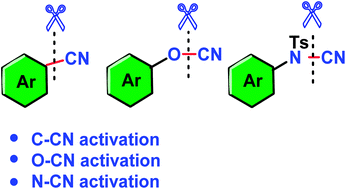
Starting as early as the 1960s, C–H activation has been a vibrant topic.1 In contrast, comparable C–C bond activation, while thermodynamically permitted, has been largely elusive.2 The higher bond energy and elevated kinetic barriers compared to C–H activation renders this pathway substantially refractory towards transition metal complexes.2a Meanwhile, C–CN bond activation3 has been realized using several transition metal complexes which can overcome the relatively high bond dissociation energy due to the unique nature of the cyano group (e.g., electron-withdrawing, polarized bond, high affinity for some metals).4 Traditionally, C–CN bonds were cleaved using metals such as Fe and Rh in tactical combination with organic silicon reagents or metal–Lewis acid bifunctional catalysts.5 Most recently, Ni(0) and Pd(0) mediated C–CN bonds cleavage were reported. Related O–CN bond activations6 have been realized in only a few cases while N–CN bond activation7 is even rarer. Considering the paramount role of the elements such as nitrogen, oxygen and carbon in organic chemistry, moreover, the broad existence of cyano groups in natural (e.g., cyanocycline A, dnacin A1, halimedin, lahadinines A, et al.) and/or medical molecules (e.g., PPARgamma-active triterpenoid, 2-cyano-3,12-dioxooleana-1,9-dien-28-oic acid), along with the versatile application of cyano group towards spectacular precursor to vast functionalized groups, viz., (i) amine; (ii) amide; (iii) acid; (iv) aldehyde; (v) ester; (vi) ketone; (vii) thioamide; (viii) hydroxyimidamide et al., reactions involved with such transformation can be of high importance. Additionally, cyano also can serve as a directing group, firstly introduce a functionalized group on the ortho-position, subsequently was converted into other group, all these aspects contribute to the ceaselessly investigation of cyano-containing reaction in organic synthesis. Thus, reactions via C–CN, O–CN and N–CN bonds activation whether single process and/or domino reaction make it remarkable, nevertheless the interesting structure of those products (e.g., dihydrobenzofuran) obtained in such transformations.
Actually, the related bonds dissociation energies are summarized in Table 1, which intuitively showed the strength of bonds between different atoms such as C–H, C–C, C–O and C–N et al. The facts directly indicate the inert nature of these transformations in the reaction.
Table 1 Bonds dissociation energies of selective bonds
| Bond |
Bond dissociation energies (kJ mol−1) |
Csp2 in arene group.
Estimated value between C–O and C O bonds, see ref. 6a.
Essential information see: Y.-R. Luo, Comprehensive Handbook of Chemical Bond Energies, CRC, Press, Boca Raton, FL, 2007.
|
| H–Ca |
413 |
| C–C |
607 |
| N–C |
305 |
| O–C |
360 |
| O–CNb |
ca. 358–799 |
| N–CNc |
ca. 497 |
| C–CNc |
ca. 555 |
In a recent publication, Chatani and co-workers reported a rhodium catalyzed C–CN bond cleavage and subsequently new C–B bond generation.8 The extraordinary synthetic versatility of C–B bonds9 put a spotlight on this challenging transformation.
In 1971, the first example of oxidative addition to a C–CN bond was observed.4l In 2002, Brookhart and co-workers disclosed Rh(III) can activate C–CN bonds.3x,y The first example of carbocyanation via cleavage of a C–CN bond was realized by Hiyama et al. a few years later.3v Subsequently, Chatani,3e,f,g,m,n,r Hiyama3h,j,l,o,p,s,t,v and Jacobsen3ket al. reported several key results for the generation of C–Si, C–H, C–C bonds, respectively, via C–CN activation based on the preceding results from Hiyama. Finally, C–CN bond cleavage resulting in the formation of C–B bond was realized (Scheme 1).8
 |
| | Scheme 1 Rhodium catalyzed C(sp2)–CN to C(sp2)–B replacement. | |
The mild reaction conditions allow broad substrate application (Scheme 2). Notably, electron-rich aryl, -deficient aryl and heteroaryl nitriles as well as alkenyl and benzyl nitriles efficiently proceed along the desired pathway utilizing di-boron reagents to afford the corresponding boron compounds. Impressively, Chatani and co-workers also reported several complex substrates possessing relatively sensitive functional groups such as chiral α-methyl esters and even an aryl chloride. These observations should expand the usage of this methodology in organic synthesis and provide a new strategy for the construction of complex boronic acid derivatives wherein a cyano group can be utilized as a boronic ester equivalent. To date, the transformation can be of high importance. With vast functionalized group tolerance, chemists may change their synthetic strategies, e.g., serving as the directing group, cyano group firstly introduce ortho position functionalization, subsequently cyano group was transferred to other one (e.g., CF3) via boronic intermediate. Future application of such one will definitely spectacular among synthesis community.
 |
| | Scheme 2 Scope of rhodium catalyzed C–CN bond transformation. | |
The first systematic study of the cleavage of the C–CN bond was initiated in the 60s by Bergman and co-workers who described the C(carbonyl)–CN bond disconnection reaction.10 Mechanistic studies of such metal-catalyzed C–CN bond cleavage reactions indicated that nitriles coordinate to metals either in an η1- or η2-fashion (Scheme 3).3o,5 In one possible pathway, the transition metal oxidatively inserts into the C–CN bond affording a R (alkyl or aryl)–metal–cyano reactive species (Scheme 3, pathway A). An alternative (Scheme 3, pathway B) relies upon the assistance of a silicon reagent; the newly generated metal-silyl species mediates the C–CN bond cleavage with release of silyl cyanide. Generally, Pd(0) and Ni(0) and related metals together with a Lewis acid (e.g., BPh3, Et2AlCl) catalyse cyano activation reactions via pathway A, while most of other metal catalyzed C–CN cleavage reactions proceeded through the later pathway B.11
 |
| | Scheme 3 Pathways of metal catalyzed oxidative addition to R–CN. | |
These authors8 invoke a similar provisional mechanistic hypothesis as shown in pathway B (Scheme 4) for the borylation of aryl cyanides. The in situ generated rhodium complex 4 reacts with aryl cyanide 5 to generate intermediate 6 by the insertion into the Rh–B bond, subsequent release of boronyl cyanide 7 resulting in the aryl–Rh complex 8. The latter complex reacts again with di-boron reagent 2 yielding aryl boronic ester 9 along with the intermediate 4 thus propagating the catalytic cycle.
 |
| | Scheme 4 A possible mechanistic pathway. | |
All the cases presented above are C–CN bond activation reactions. Although other element–cyano bond cleavages, such as silyl–cyano,12 germyl–cyano,13 stannyl–cyano,14 boryl–cyano,15 sulfur–cyano,16 and bromo–cyano17 have been achieved, a useful synthetic transformation of oxy–cyano has not been reported yet.6 In 2012, Nakao and co-workers disclosed palladium and triphenylborane catalyzed the intramolecular oxycyanation of alkenes via the cleavage of O–CN bonds and the subsequent insertion of double bonds.6a This reaction illustrates the cyanofuctionalization of a double bond through cleavage of an oxygen–cyano bond, which is rare till now. Moreover, this transformation allowed intramolecular oxycyantion of alkenes, to provide substituted dihydrobenzofurans having both a tetra-substituted carbon and cyano functionality for the first time (Scheme 5).18 Preliminary mechanistic studies supported a process similar to pathway B wherein a LA (BPh3) mimics the silicon reagent. The Lewis acid catalyst is crucial for the oxidative addition to O–CN bonds whereas it has also been shown to promote C(sp3)–CN bond-forming reductive elimination from palladium(II) through coordination of a cyano group to the Lewis acid. As benzofuran derivatives broadly existing in natural and medical chemistry and the versatile manipulation of cyano group (precursor to amine, amide, acid, et al.), the methodology disclosed herein can construct benzofuran derivatives and functionalized cyano group in one pot. Considering the demand of atom-economy in modern chemistry, this will attract great interest in the future.
 |
| | Scheme 5 Pd(0) catalyzed BPh3mediated O–CN bond activation. | |
As for N–CN bond activation, this transformation is even rarer.7 In 2011, Beller et al. presented an interesting example of a N–CN cleavage reaction as showed in Scheme 6.7d Rhodium complexes catalyzed activated N–CN bond cleavage, followed by transformation of an aryl boronic acid to aryl cyanide. It should be appreciated that N-cyano-N-phenyl-p-toluenesulfonamides are unique cyanation reagents, i.e., the N–CN bond is activated both by Ts and phenyl groups. The authors postulated a similar mechanism as pathway B, viz., (i) aryl boronic acid transmetallation by the rhodium(I) complex, (ii) coordination with the N–CN, (iii) aryl migration from rhodium to carbon, and finally (iv) reductive elimination connecting the cyano to the aryl. This is the first example of a rhodium-catalyzed cyanation of aryl and alkenyl boronic acids via N–CN bond activation. Notably, considering the importance of cyano group in organic chemistry, this pioneering cyanation methodology presented herein will be synthesis useful, not only because the non-toxic property of cyanation reagent 13, but also the rapid introduction of cyano group to aryl and styrenyl molecules (e.g., malloapeltine, ricinidine).
 |
| | Scheme 6 Aryl or styrenyl cyanate formation via N–CN cleavage. | |
In 2011, Wang and co-worker observed that metals such as Pd(0) or Rh(I) can activate a N–CN bond in an intramolecular process to provide a series of 3-arylacrylonitriles from styrenes.7a Substitution on the arenes and α-position of the styrenes was well tolerated. This was the first example of an intramolecular cyanation of a C(sp2) through N–CN bond cleavage. While mechanistic studies are still under the way, established precedent suggests this transformation follows a course similar to pathway A in Scheme 3; specifically, (i) oxidative addition of the rhodium complex into the N–CN bond, (ii) double bond insertion into the newly generated N–Rh bond, and (iii) β-elimination to regenerate the reactive Rh(I) allowing the catalytic cycle to continue. This case indicated that intra-molecular cyanation of styrene can be realized through the rarely reported N–CN bond cleavage strategy under related mild reaction condition. This will add one new type of N–C bond activation and will inspire future discovery of bond–bond activation. Moreover, the stereo-specific 3-arylacrylonitriles products obtained in this transformation are also useful intermediates, which will expand the application scope of such transformation (Scheme 7).
 |
| | Scheme 7 Intramolecular cyanation via N–CN bond activation. | |
Most recently, Liu and Fu reported an interesting and potentially highly useful intermolecular cyanation reaction7e using the previously reported Beller cyanation reagent, N-cyano-N-phenyl-p-toluenesulfonamide (NCTS). This reaction allows intramolecular cyanation of arenes via C–H bond activation mediated by rhodium catalyzed N–CN bond cleavage. A wide variety of aryl substituents and even heterocycles are tolerated and the regioselectivity can be controlled by many common directing groups. A kinetic isotope (KIE) experiment revealed the transformation is typical of Rh catalyzed C–H activation processes, followed sequentially by coordination with the N–CN moiety and elimination to provide the cyanated products. Thus these authors have developed an unprecedented and practical Rh catalyzed C–H cyanation reaction that uses less toxic and the readily available NCTS as the cyanation reagent. Although the cyanation reagent (13, NCTS) was firstly introduced by Beller and co-workers, Liu and Fu's work disclosed herein made it more practicable and useful. That is, synthesis was not only restricted to manipulation of boronic derivatives, but also was applied in the transformation of C–H activation with the assistance of DGs. In the future, chemists may introduce a cyano group to any molecules with the assisting of directing groups at the late stage. As cyano group broadly exist in natural (e.g., cyanopuupehenone, benthocyanin C, ambiguine G nitrile, et al.) and/or medical moleculars and is readily transferred into other functionalized groups, this will definitely be a powerful tool in organic synthesis (Scheme 8).
 |
| | Scheme 8 Aryl cyanation using intermolecular N–CN activation. | |
In classical organic chemistry, the emphasis was on bond formation, especially C–C and to a lesser extent C–N and C–O. Conversely, activation of C–C, C–N, and C–O bonds has in recent decades been recognized as a valuable strategic objective. While considerable progress has been achieved, many of the more challenging issues, e.g., regioselective activation of specific C–X (C, O, N) bonds, chemoselective cleavage of C(sp3)–X bonds, enantioselective activation and even the successful application of solid catalysts in such transformations remain elusive. The research disclosed herein summarize recent advances in C–X bond cleavages, including regioselective processes, although the carbon is activated in the form of a cyano group. We believe the results disclosed herein will attract vast interest and lead to new synthetic applications in the future.
Acknowledgements
We thank the NIH (GM31278) and the Robert A. Welch Foundation (GL625910) for financial support.
References
- Selected reviews on carbon–hydrogen bond functionalization:
(a) L. Ackermann, Acc. Chem. Res., 2013, 46 DOI:10.1021/ar3002798;
(b) S. R. Neufeldt and M. S. Sanford, Acc. Chem. Res., 2012, 45, 936–946 CrossRef CAS PubMed;
(c) K. M. Engle, T.-S. Mei, M. Wasa and J.-Q. Yu, Acc. Chem. Res., 2012, 45, 788–802 CrossRef CAS PubMed;
(d) C. Zhu, R. Wang and J. R. Falck, Chem.–Asian J., 2012, 7, 1502–1514 CrossRef CAS PubMed;
(e) C.-L. Sun, B.-J. Li and Z.-J. Shi, Chem. Commun., 2010, 46, 677–685 RSC , and references therein.
- Representative reviews of C–C bond activation:
(a) M. Murakami and T. Matsuda, Chem. Commun., 2011, 47, 1100–1105 RSC;
(b) Y.-J. Park, J.-W. Park and C.-H. Jun, Acc. Chem. Res., 2008, 41, 222–234 CrossRef CAS PubMed;
(c) T. Satoh and M. Miura, Top. Organomet. Chem., 2005, 14, 1–20 CAS;
(d) C.-H. Jun, Chem. Soc. Rev., 2004, 33, 610–618 RSC;
(e) M. E. van der Boom and D. Milstein, Chem. Rev., 2003, 103, 1759–1792 CrossRef CAS PubMed.
- Selected references related to carbon–cyano bond activation:
(a) Y. Nakao, Bull. Chem. Soc. Jpn., 2012, 85, 731–745 CrossRef CAS;
(b) K. Nakai, T. Kurahashi and S. Matsubara, J. Am. Chem. Soc., 2011, 133, 11066–11068 CrossRef CAS PubMed;
(c) N. R. Rondla, S. M. Levi, J. M. Ryss, R. A. Vanden Berg and C. J. Douglas, Org. Lett., 2011, 13, 1940–1943 CrossRef CAS PubMed;
(d) M. Sun, H.-Y. Zhang, Q. Han, K. Yang and S.-D. Yang, Chem.–Eur. J., 2011, 17, 9566–9570 CrossRef CAS PubMed;
(e) M. Tobisu, R. Nakamura, Y. Kita and N. Chatani, Bull. Korean Chem. Soc., 2010, 31, 582–587 CrossRef CAS;
(f) Y. Kita, M. Tobisu and N. Chatani, Org. Lett., 2010, 12, 1864–1867 CrossRef CAS PubMed;
(g) M. Tobisu, R. Nakamura, Y. Kita and N. Chatani, J. Am. Chem. Soc., 2009, 131, 3174–3175 CrossRef CAS PubMed;
(h) Y. Hirata, T. Yukawa, N. Kashihara, Y. Nakao and T. Hiyama, J. Am. Chem. Soc., 2009, 131, 10964–10973 CrossRef CAS PubMed;
(i) D.-G. Yu, M. Yu, B.-T. Guan, B.-J. Li, Y. Zhang, Z.-H. Wu and Z.-J. Shi, Org. Lett., 2009, 11, 3374–3377 CrossRef CAS PubMed;
(j) Y. Nakao, Y. Hirata, M. Tanaka and T. Hiyama, Angew. Chem., Int. Ed., 2008, 47, 385–387 CrossRef CAS PubMed;
(k) M. P. Watson and E. N. Jacobsen, J. Am. Chem. Soc., 2008, 130, 12594–12595 CrossRef CAS PubMed;
(l) Y. Nakao, S. Ebata, A. Yada, T. Hiyama, M. Ikawa and S. Ogoshi, J. Am. Chem. Soc., 2008, 130, 12874–12875 CrossRef CAS PubMed;
(m) M. Tobisu and N. Chatani, Chem. Soc. Rev., 2008, 37, 300–307 RSC;
(n) M. Tobisu, Y. Kita, Y. Ano and N. Chatani, J. Am. Chem. Soc., 2008, 130, 15982–15989 CrossRef CAS PubMed;
(o) Y. Nakao and T. Hiyama, Pure Appl. Chem., 2008, 80, 1097–1107 CrossRef CAS;
(p) Y. Nakao, A. Yada, S. Ebata and T. Hiyama, J. Am. Chem. Soc., 2007, 129, 2428–2429 CrossRef CAS PubMed;
(q) H. Nakazawa, M. Itazaki, K. Kamata and K. Ueda, Chem.–Asian J., 2007, 2, 882–888 CrossRef CAS PubMed;
(r) M. Tobisu, Y. Kita and N. Chatani, J. Am. Chem. Soc., 2006, 128, 8152–8153 CrossRef CAS PubMed;
(s) Y. Nakao, S. Oda, A. Yada and T. Hiyama, Tetrahedron, 2006, 62, 7567–7576 CrossRef CAS PubMed;
(t) Y. Nakao, A. Yada, J. Satoh, S. Ebata, S. Oda and T. Hiyama, Chem. Lett., 2006, 35, 790–791 CrossRef CAS;
(u) H. Nakazawa, K. Kamata and M. Itazaki, Chem. Commun., 2005, 4004–4006 RSC;
(v) Y. Nakao, S. Oda and T. Hiyama, J. Am. Chem. Soc., 2004, 126, 13904–13905 CrossRef CAS PubMed;
(w) H. Nakazawa, T. Kawasaki, K. Miyoshi, C. H. Suresh and N. Koga, Organometallics, 2004, 23, 117–126 CrossRef CAS;
(x) F. T. Taw, A. H. Mueller, R. G. Bergman and M. Brookhart, J. Am. Chem. Soc., 2003, 125, 9808–9813 CrossRef CAS PubMed;
(y) F. T. Taw, P. S. White, R. G. Bergman and M. Brookhart, J. Am. Chem. Soc., 2002, 124, 4192–4193 CrossRef CAS PubMed.
-
(a) T.-B. Lu, X.-M. Zhang, Y.-W. Li and S. Chen, J. Am. Chem. Soc., 2004, 126, 4760–4761 CrossRef CAS PubMed;
(b) Q.-X. Liu, F.-B. Xu, Q.-S. Li, H.-B. Song and Z.-Z. Zhang, Organometallics, 2004, 23, 610–614 CrossRef CAS;
(c) J. J. Garcia, N. M. Brunkan and W. D. Jones, J. Am. Chem. Soc., 2002, 124, 9547–9555 CrossRef CAS PubMed;
(d) D. S. Marlin, M. M. Olmstead and P. K. Mascharak, Angew. Chem., Int. Ed., 2001, 40, 4752–4753 CrossRef CAS;
(e) J. J. Garcia and W. D. Jones, Organometallics, 2000, 19, 5544–5545 CrossRef CAS;
(f) M. Abla and T. Yamamoto, J. Organomet. Chem., 1997, 532, 267–270 CrossRef CAS;
(g) R. Adam, C. Villiers, M. Ephritikhine, M. Lance, M. Nierlich and J. Vigner, J. Organomet. Chem., 1993, 445, 99–106 CrossRef CAS;
(h) G. Favero, A. Morvillo and A. Turco, J. Organomet. Chem., 1983, 241, 251–257 CrossRef CAS;
(i) F. Ozawa, K. Iri and A. Yamamoto, Chem. Lett., 1982, 1707–1710 CrossRef CAS;
(j) A. Morvillo and A. Turco, J. Organomet. Chem., 1981, 208, 103–113 CrossRef CAS;
(k) E. L. Muetterties, D. H. Gerlach, A. R. Kane, G. W. Parshall and J. P. Jesson, J. Am. Chem. Soc., 1971, 93, 3543–3544 CrossRef CAS;
(l) J. L. Burmeister and L. M. Edwards, J. Chem. Soc. A, 1971, 1663–1666 RSC.
- B. N. Storhoff and H. C. Lewis, Coord. Chem. Rev., 1977, 23, 1–29 CrossRef CAS.
-
(a) D. C. Koester, M. Kobayashi, D. B. Werz and Y. Nakao, J. Am. Chem. Soc., 2012, 134, 6544–6547 CrossRef CAS PubMed;
(b) K. Fukumoto, A. A. Dahy, T. Oya, K. Hayasaka, M. Itazaki, N. Koga and H. Nakazawa, Organometallics, 2012, 31, 787–790 CrossRef CAS;
(c) A. A. Dahy, N. Koga and H. Nakazawa, Organometallics, 2012, 31, 3995–4005 CrossRef CAS.
- We recently disclosed a rhodium-catalyzed N–CN bond activation reaction, see:
(a) R. Wang and J. Falck, Chem. Commun., 2013, 49, 6516–6518 RSC , also see: ;
(b) K. Fukumoto, T. Oya, M. Itazaki and H. Nakazawa, J. Am. Chem. Soc., 2009, 131, 38–39 CrossRef CAS PubMed;
(c) A. A. Dahy, N. Koga and H. Nakazawa, Organometallics, 2013, 32, 2725–2735 CrossRef CAS , recent rhodium-catalyzed electrophilic cyanation of aryl/alkenyl boron acids see: ;
(d) P. Anbarasan, H. Neumann and M. Beller, Angew. Chem., Int. Ed., 2011, 50, 519–522 CrossRef CAS PubMed , and most recently, ;
(e) T.-J. Gong, B. Xiao, W.-M. Cheng, W. Su, J. Xu, Z.-J. Liu, L. Lei and Y. Fu, J. Am. Chem. Soc., 2013, 135, 10630–10633 CrossRef CAS PubMed.
- M. Tobisu, H. Kinuta, Y. Kita, E. Rémond and N. Chatani, J. Am. Chem. Soc., 2012, 134, 115–118 CrossRef CAS PubMed.
-
A. Suzuki, in Metal-Catalyzed Cross-Coupling Reactions, ed. F. Diederich and P. J. Stang, Wiley-VCH, New York, 1998, ch. 2 Search PubMed.
- J. Blum, E. Oppenheimer and E. D. Bergmann, J. Am. Chem. Soc., 1967, 89, 2338–2341 CrossRef CAS.
- Catalytic carbon–cyano bond activations via path A:
(a) See ref. 10;
(b) S. Murahashi, T. Naota and N. Nakajima, J. Org. Chem., 1986, 51, 898–901 CrossRef CAS;
(c) K. Nozaki, N. Sato and H. Takaya, J. Org. Chem., 1994, 59, 2679–2681 CrossRef CAS;
(d) K. Nozaki, N. Sato and H. Takaya, Bull. Chem. Soc. Jpn., 1996, 69, 1629–1637 CrossRef CAS;
(e) J. A. Miller, Tetrahedron Lett., 2001, 42, 6991–6993 CrossRef CAS;
(f) J. A. Miller and J. W. Dankwardt, Tetrahedron Lett., 2003, 44, 1907–1910 CrossRef CAS;
(g) J. A. Miller, J. W. Dankwardt and J. M. Penney, Synthesis, 2003, 1643–1648 CrossRef CAS PubMed;
(h) J. M. Penney and J. A. Miller, Tetrahedron Lett., 2004, 45, 4989–4992 CrossRef CAS PubMed;
(i) Y. Nishihara, Y. Inoue, M. Itazaki and K. Takagi, Org. Lett., 2005, 7, 2639–2641 CrossRef CAS PubMed;
(j) Y. Nishihara, Y. Inoue, S. Izawa, M. Miyasaka, K. Tanemura, K. Nakajima and K. Takagi, Tetrahedron, 2006, 62, 9872–9882 CrossRef CAS PubMed;
(k) Y. Kobayashi, H. Kamisaki, R. Yanada and Y. Takemoto, Org. Lett., 2006, 8, 2711–2713 CrossRef CAS PubMed;
(l) Y. Kobayashi, H. Kamisaki, H. Takeda, Y. Yasui, R. Yanada and Y. Takemoto, Tetrahedron, 2007, 63, 2978–2989 CrossRef CAS PubMed ; catalytic reactions via path B: ;
(m) See ref. 3u;
(n) See ref. 3r;
(o) See ref. 3q.
-
(a) N. Chatani and T. Hanafusa, J. Chem. Soc., Chem. Commun., 1985, 838–839 RSC;
(b) N. Chatani, T. Takeyasu, N. Horiuchi and T. Hanafusa, J. Org. Chem., 1988, 53, 3539–3548 CrossRef CAS;
(c) M. Suginome, H. Kinugasa and Y. Ito, Tetrahedron Lett., 1994, 35, 8635–8638 CrossRef CAS;
(d) S. Arai, T. Sato, Y. Koike, M. Hayashi and A. Nishida, Angew. Chem., Int. Ed., 2009, 48, 4528–4531 CrossRef CAS PubMed.
- N. Chatani, N. Horiuchi and T. Hanafusa, J. Org. Chem., 1990, 55, 3393–3395 CrossRef CAS.
- Y. Obora, A. S. Baleta, M. Tokunaga and Y. Tsuji, J. Organomet. Chem., 2002, 660, 173–177 CrossRef CAS.
-
(a) M. Suginome, A. Yamamoto and M. Murahami, J. Am. Chem. Soc., 2003, 125, 6358–6359 CrossRef CAS PubMed;
(b) M. Suginome, A. Yamamoto and M. Murahami, Angew. Chem., Int. Ed., 2005, 44, 2380–2382 CrossRef CAS PubMed;
(c) A. Yamamoto, Y. Ikeda and M. Suginome, Tetrahedron Lett., 2009, 50, 3168–3170 CrossRef CAS PubMed.
-
(a) I. Kamiya, J. Kawakami, S. Yano, A. Nomoto and A. Ogawa, Organometallics, 2006, 25, 3562–3564 CrossRef CAS;
(b) Y.-T. Lee, S.-Y. Choi and Y.-K. Chung, Tetrahedron Lett., 2007, 48, 5673–5677 CrossRef CAS PubMed.
- M. Murai, R. Hatano, S. Kitabata and K. Ohe, Chem. Commun., 2011, 47, 2375–2377 RSC.
-
(a) D. E. Nichols, A. J. Hoffman, R. A. Oberlender and R. M. Riggs, J. Med. Chem., 1986, 29, 302–304 CrossRef CAS;
(b) K. Kataoka, T. Shiota, T. Takeyasu, T. Minoshima, K. Watanabe, H. Tanaka, T. Mochizuki, K. Taneda, M. Ota, H. Tanabe and H. Yamaguchi, J. Med. Chem., 1996, 39, 1262–1270 CrossRef CAS PubMed;
(c) G. Q. Shi, J. F. Dropinski, Y. Zhang, C. Santini, S. P. Sahoo, J. P. Berger, K. L. MacNaul, G. C. Zhou, A. Agrawal, R. Alvaro, T. Q. Cai, M. Hernandez, S. D. Wright, D. E. Moller, J. V. Heck and P. T. Meinke, J. Med. Chem., 2005, 48, 5589–5599 CrossRef CAS PubMed.
|
| This journal is © The Royal Society of Chemistry 2014 |
Click here to see how this site uses Cookies. View our privacy policy here.