Yi Zhangab,
Ping Nieb,
Laifa Shenb,
Guiyin Xub,
Haifu Dengb,
Haifeng Luob and
Xiaogang Zhang*b
aCollege of Chemistry & Chemical Engineering, Xinjiang University, Urumqi 830046, P. R. China
bCollege of Material Science and Engineering and Key Laboratory for Intelligent Nano Materials and Devices of Ministry of Education, Nanjing University of Aeronautics and Astronautics, Nanjing, China. E-mail: azhangxg@163.com; Fax: +86 025 52112626; Tel: +86 025 52112918
First published on 27th November 2013
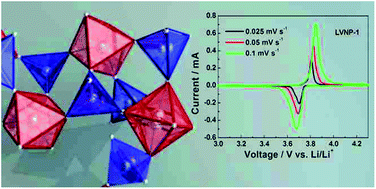
A single rhombohedral NASICON-structured cathode material Li2NaV2(PO4)3 has been synthesized through a facile sol–gel route for the first time. The results suggest that the Na+ sources, i.e. anionic surfactants including sodium dodecyl benzene sulfonate (SDBS), sodium dodecyl sulfonate (SDS) and sodium oleate (NaOL) can induce the Na+ ions to occupy all of the A1 sites in formula unit [V2(PO4)3]3−. Almost all the monoclinic phase of Li3V2(PO4)3 can be transformed into the rhombohedral phase of Li2NaV2(PO4)3 with Li+ partially substituted by Na+ ions offered by SDBS, SDS or NaOL. In the absence of monoclinic Li3V2(PO4)3, the rhombohedral Li2NaV2(PO4)3 exhibits only one voltage plateau around 3.76 V versus lithium metal during the charge–discharge process, which is consistent with the single couple V4+/V3+ redox peaks in the cyclic voltammetry (CV) curves. Furthermore, the Li2NaV2(PO4)3 obtained using SDBS as a Na+ source displays remarkably high-rate capability (80 mA h g−1 at 5 C and 68 mA h g−1 at 10 C) and excellent cyclability, 500 cycles at 2 C (about 93% of the initial capacity is retained) due to no fundamental change occurring in the host three-dimensional framework and the porous nanosheets structure with carbon coating.
The NASICON-structured Li3V2(PO4)3 has two different crystallographic forms depending on the site distribution of the [V2(PO4)3]3− units:21,22 the monoclinic form with space group P21/n and the rhombohedral form with space group R
c. As a cathode material, monoclinic LVP usually has a high operating voltage and a larger theoretical specific capacity, 197 mA h g−1, than rhombohedral LVP,23 but it exhibits four voltage plateaux with three lithium ions extraction/insertion in charge–discharge curves when tested in the range from 3.0 to 4.8 V. On the contrary, rhombohedral LVP has a theoretical specific capacity of 133 mA h g−1 and shows only one voltage plateau around 3.76 V with two lithium ions extraction/insertion in the charge–discharge process between 3.0 and 4.3 V.24 Usually, an electronic device can run normally only with a single supply voltage since a single plateau can give a stable output power. Therefore, rhombohedral LVP material with a single V4+/V3+ voltage plateau is more suitable for the application of portable electronic devices and electric vehicles. However, the rhombohedral LVP could not be obtained directly since monoclinic LVP is more stable than rhombohedral LVP.25,26 Lithium ion-exchange of the corresponding rhombohedral Na3V2(PO4)3 (NVP) is a feasible method to obtain rhombohedral LVP at present and this method is also employed for the preparation of rhombohedral Li2NaV2(PO4)3 (LNVP).27 The rhombohedral LNVP is homeotypic to rhombohedral LVP with a single voltage plateau around 3.76 V when two lithium ions extraction/insertion in the charge–discharge process between 3.0 and 4.3 V. Though rhombohedral LVP or LNVP with a single plateau is more attractive than monoclinic LVP as a cathode material, the synthetic method (ion-exchange) is extremely complex and NVP would be dissolved partially in LiNO3 even below 40 °C during the preparation procedures. In addition, the Na+ guests in NVP can stabilize the rhombohedral structure of the [V2(PO4)3]3− framework while the smaller Li+ ions could not support the larger interstitial free space, so, compared with the monoclinic LVP obtained by the sintering process (usually no obvious decay after 100 cycles at 5 C in the range from 3.0 to 4.3 V),16,17 the cycling stability of the rhombohedral LVP or LNVP obtained by lithium ion-exchange is usually poor (obvious decay at high rate).28
Recently, a hybrid phase composite Li2NaV2(PO4)3 (rhombohedral LVP, rhombohedral NVP and monoclinic LVP coexistent with a ratio of 59
:
31
:
10) was synthesized by a solid state reaction method.29 This study proved that rhombohedral LVP could be formed directly when Li+ ions are partially substituted by Na+ ions. However, multiple voltage plateaux could still be observed in the charge–discharge curves because the monoclinic LVP was generated simultaneously during the solid state reaction.
In this paper, single rhombohedral phase Li2NaV2(PO4)3 has been synthesized through a simple sol–gel route for the first time and the hybrid phase Li2NaV2(PO4)3 is also synthesized using the same method for comparison. Anionic surfactant SDBS and sodium acetate (NaAc) are employed as two different types of Na+ source to prepare LNVP precursors via a facile sol–gel route. After calcining the precursors under the same condition, rhombohedral phase Li2NaV2(PO4)3 (denoted as LNVP-1) and hybrid phase Li2NaV2(PO4)3 (denoted as LNVP-2) are obtained, respectively. We speculate that an anionic surfactant can induce Na+ ions to occupy all of the A1 sites in the formula unit of [V2(PO4)3]3− and hence the monoclinic phase of Li3V2(PO4)3 can be transformed into the rhombohedral phase of Li2NaV2(PO4)3 while NaAc or NaF29 can not introduce this change. To verify this result, we also use other anionic surfactant SDS and NaOL as Na+ source to synthesize Li2NaV2(PO4)3 (denoted as LNVP-3 and LNVP-4) under the same preparation route and both of the final products are proved to be single rhombohedral phase. The as prepared rhombohedral Li2NaV2(PO4)3 materials exhibit superior high rate performance as well as excellent cyclability, indicating their promising application as a superior cathode material for rechargeable lithium-ion batteries.
:
3:
2:
3) were dissolved in 20 mL deionized water under magnetic stirring to form a clear blue solution. Afterwards, this blue solution was added dropwise to the SDBS solution. The final mixture solution was heated gently with continuous stirring to remove the excess water and ethanol at 75 °C and blue LNVP precursor was obtained. The precursor was first sintered at 350 °C for 4 h under N2, followed by milling and then heating at 750 °C for 8 h under N2. Finally, a grey powder of rhombohedral LNVP was obtained. Hybrid phase LNVP was prepared by using 0.5 mmol NaAc and 0.5 mmol CTAB instead of SDBS as the Na+ and carbon sources via the same preparation route. In addition, another type of ionic surfactant SDS and NaOL were employed to replace SDBS to prepare rhombohedral phase LNVP under the same conditions. The final products were denoted as LNVP-1, LNVP-2, LNVP-3 and LNVP-4, respectively.
:
1 v/v). The electrochemical performance was tested at various current densities in the voltage range of 3.0–4.3 V. Cyclic voltammetry (CV) studies were carried out on an electrochemical workstation (CHI660C) between 3.0 and 4.3 V at scans rate of 0.025 mV s−1, 0.05 mV s−1 and 0.1 mV s−1, respectively.
The rhombohedral LNVP has a three-dimensional framework structure and alkali metal ions can easily diffuse through the well-defined ion channels. As illustrates in Fig. 2, each VO6 octahedron is linked with three PO4 tetrahedrons through common corners, forming the framework anion [V2(PO4)3]3− unit.
With the [V2(PO4)3]3− units aligned along the c axis and interconnected by a PO4 tetrahedral along the a axis, an open 3D framework with facile ions migration is formed. Each formula unit of LNVP contains one A1 site and two A2 sites. The one A1 site is occupied by Na+ ion so the rhombohedral structure of [V2(PO4)3]3− framework could be maintained because the radius of the Na+ ion is suitable at this site. The two A2 sites, which are occupied by Li+ ions, allow easily accomodate and transport the Li+ ions.27 However, if Li+ ions take the A1 position, the rhombohedral structure would transform into a monoclinic structure at high temperature since the radius of Li+ ion is too small to support the A1 site, so rhombohedral LVP can not be formed directly. Furthermore, during the charge–discharge process, only the two Li+ ions in the A2 site can be extracted/inserted from the NASICON framework to achieve the V4+/V3+ redox couple while the one Na+ ion in A1 site is immobilized.
An amorphous carbon layer on the surface of a single particle can be observed clearly in the HRTEM image of sample LNVP-1 (Fig. 4a). The selected area electron diffraction (SAED) pattern (Fig. 4b) demonstrates the single crystalline nature of the nanoparticles, which is a typical diffraction pattern of the rhombohedral phase.21 This SAED pattern provides evidence that the substitution of Li+ for Na+ offered by SDBS can transform almost all the monoclinic phase into rhombohedral phase.
Unlike the LNVP-1 with a one voltage plateau (Fig. 5c), four voltage plateaux could be observed in the charge–discharge curves of LNVP-2 (Fig. 5d). The short plateaux around 3.6 V, 3.68 V and 4.10 V correspond to the reversible reaction of the first and second Li+ ion in the monoclinic phase, and the long plateau near 3.76 V is caused by Li+ insertion/extraction in the rhombohedral phase. These four voltage plateaux indicate that the monoclinic and rhombohedral phases are coexistent in LNVP-2 samples. In addition, from the charge–discharge curves of LNVP-3 and LNVP-4 (Fig. S3†), we notice that there is only one observed voltage plateau around 3.76 V. This feature confirms the absence of a monoclinic phase in LNVP-3 and LNVP-4.
To evaluate the rate capability, the LNVP-1 and LNVP-2 electrodes are cycled at various current densities from 0.1C to 10C over a voltage window of 3.0–4.3 V (Fig. 5e). At the lower rate, LNVP-1 and LNVP-2 electrodes show no obvious difference in specific capacity. However, the LNVP-1 electrode shows better rate capability at high rates and deliver discharge capacities of 80 mA h g−1 and 68 mA h g−1 at 5 C and 10 C rates, respectively, much higher than that of the LNVP-2 electrode. To test the cycling performance, LNVP-1 and LNVP-2 electrodes are charged–discharged at 2 C for 500 cycles. As shown in Fig. 5f, the capacity of LNVP-1 has no obvious fading after 500 cycles (nearly 93% of the initial discharge capacity is retained) while the LNVP-2 has a rapid capacity decay. The excellent rate capacity and cycling ability of the LNVP-1 can be attributed to the small crystal size and porous nanosheets structure, which possess short distances for Li+ ions diffusion and a large electrode-electrolyte contact area for high Li+ ions flux across the interface. Furthermore, the carbon shell is closely attached onto the small LNVP particles, which would also effectively enhance the conductivity of the resultant materials.
Footnote |
| † Electronic supplementary information (ESI) available. See DOI: 10.1039/c3ra44951c |
| This journal is © The Royal Society of Chemistry 2014 |