


 PLATFORM UPDATE:


Rational design of click-assembled chiral dendrimers: anticancer activity and molecular dynamics study
 *a
and
*a
and
Abstract
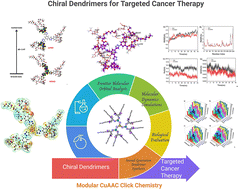
This study details the rational design, synthesis, and biological evaluation of a range of chiral dendritic compounds created using modular copper(I)-catalyzed azide–alkyne cycloaddition (CuAAC) click chemistry. We developed first-generation dendrimers (6–9) with systematically different degrees of chirality, comprising fully chiral, achiral, and mixed-chirality systems, as well as a multivalent second-generation dendrimer (12). The biological screening against human cancer cell lines (HCT-116, HepG-2, and MCF-7) revealed that the fully chiral first-generation dendrimer (9) was the most effective. Significantly, dendrimer (9) presented improved selectivity, as evidenced by a favorable therapeutic window with considerably reduced toxicity to normal WI-38 fibroblasts (IC50 = 46.79 ± 2.8 µM) relative to the reference drugs doxorubicin and sorafenib. On the other hand, the second-generation dendrimer (12) revealed slight cytotoxic effects, which can be attributed to limited cellular absorption related to its larger molecular size. Molecular dynamics (MD) simulations conducted on the ERα receptor have verified that dendrimer (9) establishes a stable complex with a total binding free energy (ΔGbind) of −65.07 ± 0.20 kcal mol−1, which is mainly influenced by robust van der Waals interactions and hydrophobic packing. Moreover, frontier molecular orbital (FMO) analysis has characterized dendrimer (9) as a kinetically stable entity with a HOMO–LUMO energy gap of 2.74 eV. These observations emphasize the important role of chirality and dendritic generation in anticancer potency, positioning these click-assembled chiral frameworks as promising lead structures for further development in targeted cancer therapy.
 Please wait while we load your content...


