


 PLATFORM UPDATE:


Interfacial ion diffusion and rapid charge transfer kinetics of the hydrothermally synthesized heterostructured Bi2WO6/Bi2O3/MXene composite for next-generation pseudocapacitors

Abstract
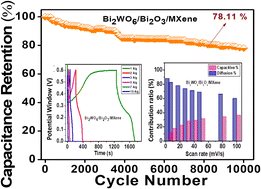
MXenes are potential electrode materials for supercapacitors because of their significant conductivity, large surface area, layered structure and chemical stability. Nonetheless, their strong interlayer interactions result in the restacking of MXene sheets, thereby hindering electrolyte diffusion as well as charge accumulation. Metal oxide nanostructures can improve interlayer spacing as well as electrolyte diffusion. In this work, a heterostructured Bi2WO6/Bi2O3/MXene composite electrode was successfully prepared through a hydrothermal method to hinder the restacking of MXene, facilitate ionic diffusion, and increase specific capacitance. The formation of the composite, the coexistence of the crystal phases in Bi2WO6, and the robust interactions between Bi2WO6 and MXene (Ti3C2Tx) were verified through structural and compositional characterization techniques, such as X-ray diffraction (XRD) and X-ray photoelectron spectroscopy (XPS). Morphological characterization demonstrated the effective anchoring of Bi2WO6/Bi2O3 nanostructures on MXene surfaces, leading to increased ion-channel pathways without the agglomeration of MXene layers. The Bi2WO6/Bi2O3/MXene electrode showed markedly enhanced charge storage performance, including higher specific capacitance, improved rate capability, and reduced internal resistance compared to pristine Bi2WO6/Bi2O3. This improvement originated from the synergistic interaction between redox-active Bi2WO6/Bi2O3 and the conductive MXene network, enabling efficient ion–electron transport and excellent cycling stability, thereby making the electrode a promising electrode for high-performance supercapacitors.
 Please wait while we load your content...


