Issue 15, 2026, Issue in Progress

MOF-derived MoO2/C composites as high-performance electrodes for electrochemical uranium(vi) removal

Abstract

In this study, an octahedral MoO2/C composite was synthesized by calcining a molybdenum-based metal–organic framework (MOF) precursor. This unique octahedral architecture significantly enhances the electro-adsorption performance while ensuring excellent structural stability. The optimized material exhibited a high U(VI) adsorption capacity of 806.79 mg g−1 from a 300 mg L−1 initial solution under an applied potential of 1.2 V for 5 h. Moreover, it demonstrated excellent cycling stability, maintaining a U(VI) removal rate above 65% even after ten consecutive adsorption–desorption cycles using 0.1 mol L−1 Na2CO3 as the eluent. This work provides a novel design strategy for developing high-capacity, stable electrode materials for efficient uranium electrosorption.
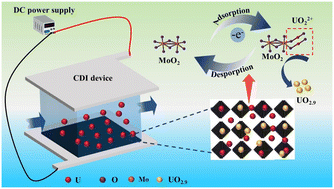
Graphical abstract: MOF-derived MoO2/C composites as high-performance electrodes for electrochemical uranium(vi) removal

Supplementary files

Article information

Article type
Paper
Submitted
24 Jan 2026
Accepted
03 Mar 2026
First published
09 Mar 2026
This article is Open Access
Creative Commons BY-NC license

RSC Adv., 2026,16, 13103-13113

MOF-derived MoO2/C composites as high-performance electrodes for electrochemical uranium(VI) removal

H. Zhou, R. Jiao, X. Ma, S. Zeng and Y. Mi, RSC Adv., 2026, 16, 13103 DOI: 10.1039/D6RA00643D

This article is licensed under a Creative Commons Attribution-NonCommercial 3.0 Unported Licence. You can use material from this article in other publications, without requesting further permission from the RSC, provided that the correct acknowledgement is given and it is not used for commercial purposes.

To request permission to reproduce material from this article in a commercial publication, please go to the Copyright Clearance Center request page.

If you are an author contributing to an RSC publication, you do not need to request permission provided correct acknowledgement is given.

If you are the author of this article, you do not need to request permission to reproduce figures and diagrams provided correct acknowledgement is given. If you want to reproduce the whole article in a third-party commercial publication (excluding your thesis/dissertation for which permission is not required) please go to the Copyright Clearance Center request page.

Read more about how to correctly acknowledge RSC content.

Social activity

Spotlight

Advertisements