


 PLATFORM UPDATE:


Interplay of defects and dopants in l-Dopa -aided UiO-66 for superprotonic conductivity

Abstract
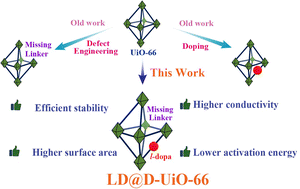
The growing demand for renewable energy sources has promoted PEMFC technology, where MOFs have emerged as an inexpensive, stable, and eco-friendly alternative to the state-of-the-art Nafion. Separate classes of functionalized and doped MOFs are explored with high conductivity in humid conditions that are per-excellent to Nafion. This work combines, for the first time, two separate approaches of (i) defect engineering and (ii) biomolecule doping. A modulator-induced defect, accompanied by doping of l-Dopa, a dopamine precursor, has been achieved in the D-UiO-66 backbone (LD@D-UiO-66). This dual strategy imparts superior proton conductivity (2.1 × 10⁻² S cm−1 at 90 °C) under non-ambient conditions, surpassing that of most MOFs. Moreover, LD@D-UiO-66 exhibits a lower activation energy (0.40 eV) than D-UiO-66 (0.56 eV), showing preference towards the Grotthuss pathway through functional polar-protic sites originating from defects as well as l-Dopa, paving the way for MOF-based solid conductors.
 Please wait while we load your content...


