


 PLATFORM UPDATE:


Green synthesis of a manganese (oxyhydr) oxide nanocomposite, utilizing Eriobotrya japonica leaf extract for adsorbing methyl blue dye from water
 *a
and
Raghad Yousif
Mohammed
a
*a
and
Raghad Yousif
Mohammed
a
Abstract
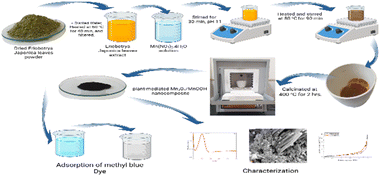
Manganese (oxyhydr) oxides (γ-Mn3O4 and α-MnOOH) were successfully synthesized using Eriobotrya japonica leaf extract via a green-synthesis technique. The synthesized nanomaterials exhibited a characteristic absorption peak at 302 nm with an optical bandgap of 3.71 eV. XRD analysis confirmed the formation of γ-Mn3O4 and α-MnOOH with an average crystallite size of 30.83 nm, while SEM images revealed a mixed morphology of nanoparticles and nanorods with an average particle size of 37.72 nm. EDS and elemental mapping verified the predominant presence of Mn and O. BET analysis showed a specific surface area of 2.58 m2 g−1 with mesoporous characteristics. The green-synthesized manganese (oxyhydr) oxide nanocomposite demonstrated high adsorption efficiency toward methyl blue dye, achieving a maximum removal of 91.95% at an initial dye concentration of 133.33 mg L−1. Adsorption equilibrium followed the Langmuir isotherm (R2 = 0.9846, qmax = 1138.2 mg g−1), while kinetic data were best described by the pseudo-second-order model (R2 > 0.99), confirming a chemisorption mechanism. Thermodynamic analysis indicated that the adsorption process is exothermic, spontaneous, and favorable. In addition, the adsorbent exhibited moderate reusability performance over multiple cycles, highlighting its stability and potential for sustainable wastewater treatment applications.
 Please wait while we load your content...


