Issue 24, 2026, Issue in Progress

Design, synthesis and bioactivity of indobufen derivatives

Abstract

Osteoporosis is characterized by excessive osteoclast-mediated bone resorption, a process that can be amplified by inflammatory cues within the bone microenvironment. Targeting the inflammation–osteoclast axis has therefore emerged as a promising strategy for preventing pathological bone loss. Here, a series of indobufen-modified derivatives were rationally designed and synthesized, and their biological activities were evaluated through a stepwise in vitro screening workflow. Early inflammatory profiling in fibroblast-like synoviocytes (FLS) identified compound A1 as a lead candidate with pronounced suppression of pro-inflammatory mediators and matrix-degrading enzymes. In a RANKL-induced RAW264.7 osteoclastogenesis model, A1 inhibited osteoclast maturation at non-cytotoxic concentrations, markedly reducing the expression of osteoclast functional proteins (MMP9 and cathepsin K) and disrupting F-actin ring formation and multinucleation. Collectively, these findings demonstrate that indobufen scaffold modification can yield small molecules with dual anti-inflammatory and anti-osteoclastogenic activities and highlight A1 as a promising lead compound for the development of therapeutics targeting osteoporosis and inflammation-associated bone loss.
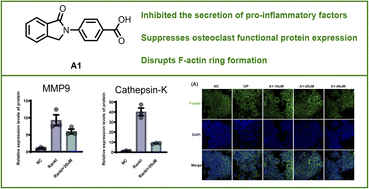
Graphical abstract: Design, synthesis and bioactivity of indobufen derivatives

Supplementary files

Transparent peer review

To support increased transparency, we offer authors the option to publish the peer review history alongside their article.

View this article’s peer review history

Article information

Article type
Paper
Submitted
08 Mar 2026
Accepted
13 Apr 2026
First published
24 Apr 2026
This article is Open Access
Creative Commons BY-NC license

RSC Adv., 2026,16, 21510-21518

Design, synthesis and bioactivity of indobufen derivatives

D. Yuan, L. Chen, X. Huang, J. Zhang and Z. Meng, RSC Adv., 2026, 16, 21510 DOI: 10.1039/D6RA01985D

This article is licensed under a Creative Commons Attribution-NonCommercial 3.0 Unported Licence. You can use material from this article in other publications, without requesting further permission from the RSC, provided that the correct acknowledgement is given and it is not used for commercial purposes.

To request permission to reproduce material from this article in a commercial publication, please go to the Copyright Clearance Center request page.

If you are an author contributing to an RSC publication, you do not need to request permission provided correct acknowledgement is given.

If you are the author of this article, you do not need to request permission to reproduce figures and diagrams provided correct acknowledgement is given. If you want to reproduce the whole article in a third-party commercial publication (excluding your thesis/dissertation for which permission is not required) please go to the Copyright Clearance Center request page.

Read more about how to correctly acknowledge RSC content.

Social activity

Spotlight

Advertisements