


 PLATFORM UPDATE:


Anaerobic pyrolysis of textile garment waste for the production of multifunctional biochar: fuel performance and Pb(ii) and Cr(vi) adsorption with machine learning prediction
 b
and
Thi Minh
Phuong Nguyen
*cd
b
and
Thi Minh
Phuong Nguyen
*cd
Abstract
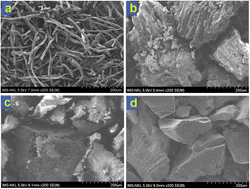
The rapid growth of the textile and garment industry generates large quantities of solid waste and heavy-metal-contaminated wastewater, creating coupled environmental challenges that require integrated solutions. In this study, post-industrial garment waste was valorized into a multifunctional carbon material via anaerobic pyrolysis and evaluated for dual applications as a solid fuel and as an adsorbent for simultaneous Pb(II) and Cr(VI) removal from aqueous solutions. Carbonized garment waste biochars (CGW) were produced at 400–900 °C and characterized by SEM, EDX, XRD, FTIR and BET analyses. Carbonization temperature strongly influenced surface chemistry, pore structure, and functionality. CGW600 exhibited the highest surface area (56.85 m2 g−1) and pore volume (0.046 cm3 g−1), whereas CGW800–900 showed superior fuel properties with high carbon content (>76 wt%), low ash (<1.4 wt%), and high calorific values (6906–7069 kcal kg−1). CGW600 achieved maximum adsorption capacities of 23.18 mg g−1 for Pb(II) and 19.68 mg g−1 for Cr(VI), with effective simultaneous removal at pH 7 (9.43 ± 0.26 and 8.78 ± 0.18 mg g−1, respectively). Spectroscopic evidence and modeling indicate adsorption dominated by surface complexation and ion exchange, with additional redox-assisted interactions for Cr(VI). Machine learning analysis (R2 = 0.99 for Pb; 0.987 for Cr) identified pH, adsorbent dosage and initial concentration as key controlling factors. The present results outline a temperature-dependent methodology for upcycling textile waste into advanced carbon materials with dual applicability in energy generation and aqueous pollutant removal. Such an integrated framework advances sustainable material development and contributes to effective strategies for environmental cleanup and reduced waste burden.
 Please wait while we load your content...


