


 PLATFORM UPDATE:


Comprehensive evaluation of synthesized dual-headed Gemini ionic liquids as protective inhibitors for carbon steel in aerated 3.0 M HCl: electrochemical and theoretical approaches

Abstract
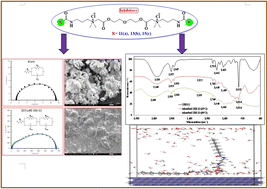
Carbon steel readily corrodes in acidic environments, particularly in HCl, where corrosion severity depends on acid concentration, exposure time, and temperature. In this study, three novel ionic liquid-based Gemini cationic surfactants were synthesized and structurally characterized using various spectroscopic techniques. Their effectiveness as corrosion inhibitors for carbon steel in aerated 3.0 M HCl was evaluated via weight-loss measurements across multiple temperatures, potentiodynamic polarization (PDP), and electrochemical impedance spectroscopy (EIS). The surfactants exhibited excellent inhibition performance, with GSE-12 achieving up to 98.00% efficiency. EIS results in the presence of GSE revealed a two-time constant (RS-2RC) response, indicating protective film formation on the steel surface. Adsorption followed the Langmuir isotherm and increased the activation energy (Ea), enthalpy (ΔH*), and entropy (ΔS*) of the corrosion process. Inhibition efficiency improved with temperature up to 50 °C, reflecting the thermal stability of the inhibitors. The Gibbs free energy of adsorption for GSE-12 was −59.49 kJ mol−1, suggesting a mixed physisorption–chemisorption mechanism. All compounds acted as mixed-type inhibitors with cathodic dominance and showed resistance against time. Computational studies using density functional theory (DFT) and Monte Carlo simulations (MCS) supported the experimental findings, showing that GSE-12 has superior electronic properties and stronger adsorption on the Fe(110) surface compared to GSE-14 and GSE-16, aligning with its enhanced inhibition performance.
 Please wait while we load your content...


